Student-athlete time management starts from a different place than ordinary study planning. Training, competition and travel are fixed by someone else, so study has to fit into the hours that are left, and travel can mean missed classes.
The planning steps are the ones other students use. What differs is how early you plan and how much you tell your teachers. Below are the hours student-athletes report in large surveys, labelled by country, and then the steps that university support offices for athletes describe.
Quick answer: In the first week of term, put the competition and travel schedule on the same calendar as your deadlines, tell each teacher which classes you will miss, and finish the work that needs a desk before each trip. In a 2025 US survey, college athletes reported a median of 66.5 hours a week on sport and academics combined in season.
What surveys report about student-athletes' time
United States: the NCAA GOALS study
The largest survey cited here comes from the United States. The National Collegiate Athletic Association (NCAA), a US college sports body whose member schools compete in Divisions I, II and III, has run a survey called GOALS five times since 2006. Its 2025 findings on time commitments, published in March 2026, are based on 20,877 student-athletes at 493 schools.
Athletes estimated their hours on a typical in-season weekday and weekend day, and the researchers calculated weekly figures from those answers.
| NCAA division | Athletics, median hours a week in season | Academics, median hours a week in season |
|---|---|---|
| Division I | 34 | 33.5 |
| Division II | 32 | 33.5 |
| Division III | 29 | 36.5 |
Athletics here includes practice, training, competing, time in the athletic training room, meetings with coaches, team functions and film study. Academics includes classes and labs, studying and other academic work outside class. Other findings from the same report:
- Across all divisions, the median for athletics and academics together was 66.5 hours a week in season.
- The typical athlete reported being away from campus about 1.5 days a week for in-season competition.
- Classes missed for any reason averaged between 1.2 and 1.9 a week, depending on the division and on whether the sport was a men's or a women's sport.
- In Division I, 74% of athletes in men's sports and 56% in women's sports said they spend as much or more time on athletics in the off-season as in season.
- Athletes reported sleeping an average of 6 hours 48 minutes on a typical in-season weeknight.
The report itself calls survey self-report "an imperfect method for assessing time demands". The figures are athletes' own estimates, and they describe NCAA sport only.
Outside the US: a survey at the 2017 Universiade
Condello and colleagues (2019) surveyed 426 student-athletes who competed at the 2017 Summer Universiade in Taipei, a multi-sport event for university athletes from many countries. Of the respondents, 62% were from Europe. They reported about 21 hours a week for sport and 22 for university on average, and 42% reported more than 20 hours of sport a week.
Asked what made combining the two difficult, 57% named long absences from classes, 50% limited leisure time and 37% feeling overloaded. The respondents were 5.8% of the athletes at the event, and the authors say the uneven mix of continents, sports and fields of study might limit how far the results can be generalized.
For Europe more broadly, a scoping review by De Maio and colleagues (2025) covered 25 studies published between 2014 and 2024, 88.5% of them in European settings. Its abstract names a lack of flexible educational programs and insufficient financial aid among the recurring barriers.
Grades in season and out of season
One paper compared athletes' results in and out of season. Scott and colleagues (2008) ran three studies, one for each NCAA division, using grade point average (the average of course grades) and credits earned. According to the abstract, academic performance was generally better outside the competitive season than during it. The in-season drop was larger in sports with heavy in-season time demands, such as Division I football, baseball and softball, and for athletes who arrived at college less academically prepared.
That is US data. It suggests the in-season weeks are the ones to plan first.
Student-athlete time management in five steps
These steps come from university offices that support athletes academically, in the United States and the United Kingdom. Rules about absences, extensions and make-up exams differ between institutions, so treat the details as examples and follow your own school's policy.
1. Merge the two calendars in the first week
Put every competition, trip and training camp on the same calendar as your exams and due dates. California State University, Fullerton's athletics academic office tells athletes to review each course outline right away to see which classes, assignments, quizzes and exams they will miss. The University of Glasgow's guide for dual-career athletes adds a useful sort: mark which sporting commitments are essential and which are optional.
The general method for a term calendar, with deadlines worked backward to start dates, is in these time management tips for students.
2. Tell each teacher early, then remind them
The offices agree on timing. Fullerton has athletes hand each instructor a letter listing the missed class dates in the first week of the term in which their sport is in season. Loyola University Maryland asks athletes to meet each professor after the first class, and to remind them one week before every absence, because remembering the schedule is not the professor's job.
In the UK, City St George's, University of London expects student-athletes to share competition and training-camp dates with their personal tutor and module leaders as soon as the dates are known.
Watch out: Notice is not the same as permission. Fullerton's page says only that instructors, given prior notice, are encouraged to let students make up missed work. Ask what each teacher will accept before you plan around it.
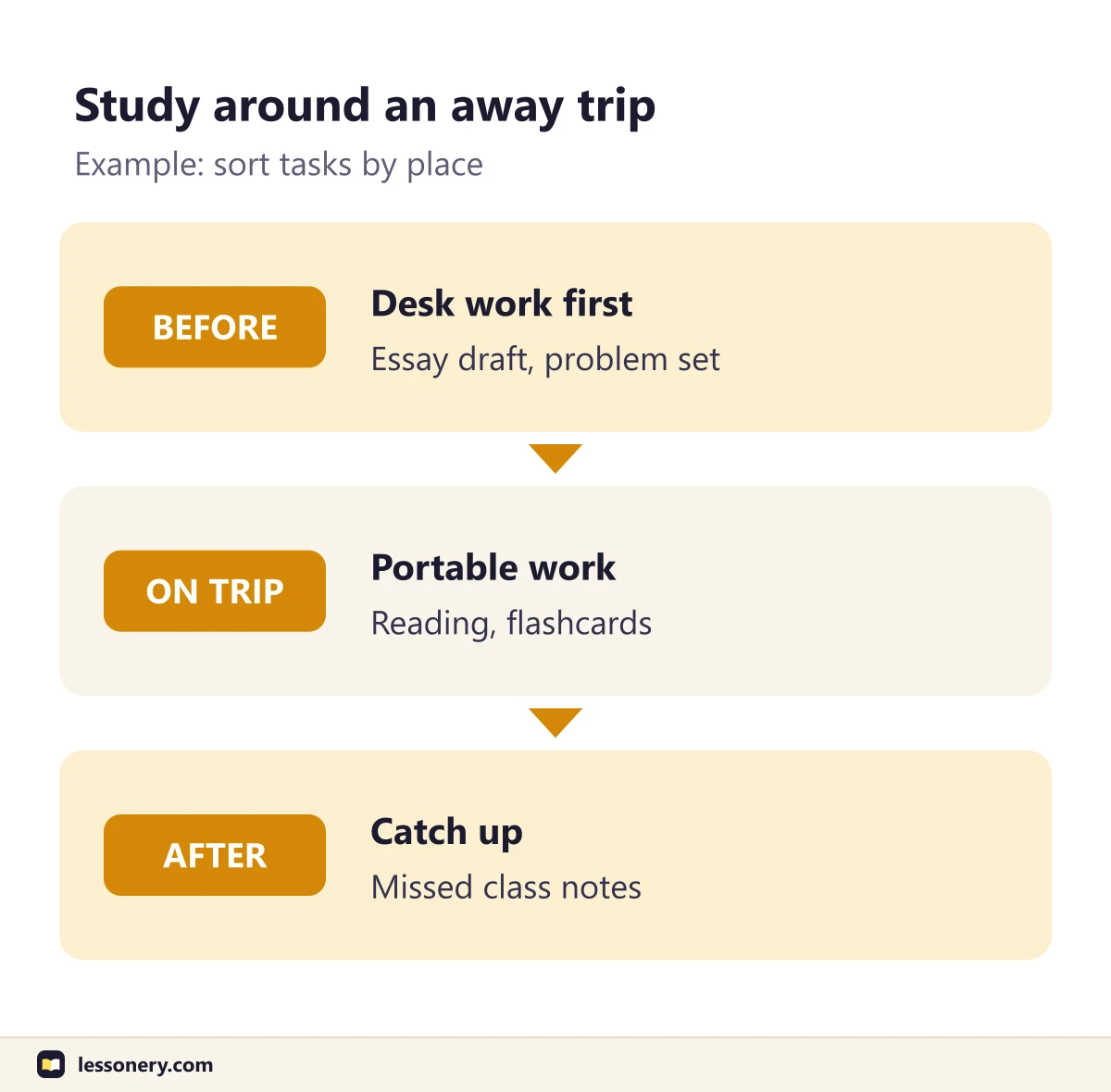
3. Sort tasks by where they can be done
Before a trip, decide which kinds of assignment you can realistically do in transit. Princeton University's McGraw Center, in a handout written with student-athlete learning consultants, calls this perhaps the most important decision for working on road trips. Everything else goes into the days before and after.
One consultant's example in the handout: a paper needs time and space, so it gets done before the trip even though it is due later, and a coding assignment that fits in a bus seat is saved for the road.
4. Plan the trip in blocks
The McGraw handout warns against counting every travel hour as a study hour. Two 12-hour bus rides and 6 hours in a hotel will not produce 30 hours of work. Its suggestions:
- Set concrete goals you can reach before you return.
- Divide a long ride into blocks. A 6-hour train ride could hold five 1-hour activities with 20-minute breaks between them.
- Keep a short reading for a day that has only 30 free minutes.
- Download or print everything in advance, charge your devices, and don't count on Wi-Fi or power.
5. Settle exams and deadlines before you leave
A clash with an exam is yours to raise. The University of North Carolina's published academic processes for student-athletes state that the athlete is responsible for telling the instructor an exam will be missed and for working out the arrangement, and that the preferred option is a make-up on campus before or after the trip. Glasgow's guide says alternative arrangements for a missed exam should be taken before departure or as soon as possible after return.
A filled-in example: a week with a weekend away trip
This week was written for this article to show the order of work. The student, tasks and times are invented, and the hours are not a recommendation.
The student trains Monday to Thursday from 4:00 to 6:30 p.m., leaves for an away competition on Friday at 8:00 a.m. and returns on Sunday at 6:00 p.m. Two Friday classes are missed. The week's work: an essay draft, a problem set due Monday, 40 pages of reading and a quiz on Tuesday.
| Day | Fixed commitments | Study plan | Study hours |
|---|---|---|---|
| Monday | Classes; training 4:00–6:30 p.m. | Essay draft, 1:00–3:00 p.m. | 2 |
| Tuesday | Classes; training 4:00–6:30 p.m. | Essay draft, 2:00–3:30 p.m.; remind Friday's two teachers | 1.5 |
| Wednesday | Classes; training 4:00–6:30 p.m. | Problem set, 1:00–3:00 p.m. | 2 |
| Thursday | Classes; training 4:00–6:30 p.m. | Finish and submit problem set, 2:00–3:30 p.m.; download reading, charge laptop | 1.5 |
| Friday | Bus 8:00 a.m.–1:00 p.m.; team meeting | Reading on the bus: two 1-hour blocks with a 20-minute break | 2 |
| Saturday | Competition | Nothing planned | 0 |
| Sunday | Bus 1:00–6:00 p.m. | Quiz flashcards on the bus: two 1-hour blocks; collect Friday's notes in the evening | 2 |
| Total | 11 |
The desk work (essay, problem set) sits on Monday to Thursday. The portable work (reading, flashcards) travels. Saturday is left empty on purpose, since the McGraw handout tells students not to feel they must work nonstop while away.
A repeating in-season timetable, with training entered as a fixed commitment, can be built with the steps for a weekly study schedule.
When the plan is not enough
| Problem | What the guidance suggests | Source |
|---|---|---|
| You can't read on a bus | Download audiobooks, or talk through the material with a friend in the same class | Princeton McGraw Center |
| The trip lasts several days | Create a routine, such as the same study slot between two training sessions each day | Princeton McGraw Center |
| A long absence covers much of a term | Meet your advisor and program leader to discuss options such as part-time study or suspending your studies | University of Glasgow |
| An absence comes up at short notice | Tell the university as early as possible | University of Glasgow |
| The week cannot hold everything | Review your commitments and reprioritize | UNSW Sydney |
The last row comes from UNSW Sydney's academic skills page, which lists sport among the commitments to review when study time runs out.
Good student-athlete time management does not create hours. If the load is affecting your health, sleep or mood, speak to your coach, an academic advisor, a doctor or your institution's student support service.
Frequently asked questions
How many hours a week do student-athletes spend on their sport?
In the NCAA's 2025 GOALS survey of US college athletes, the median in season was 34 hours a week in Division I, 32 in Division II and 29 in Division III. In the international Universiade survey by Condello and colleagues, the average was about 21 hours. Both are self-reported.
Do athletes get lower grades during the season?
In the three NCAA studies reported by Scott and colleagues (2008), academic performance was generally better outside the season than in it. That finding is from US college sport and may not match other systems.
What if my school has no support office for athletes?
The steps still apply, with you doing the coordinating. Glasgow's guide sends athletes first to their Advisor of Studies, and City St George's to a personal tutor. Any teacher or tutor responsible for your course is the person to tell.
Is student-athlete time management different at school age?
The sources here are about university students. For younger students, a US Department of Education booklet for parents, Helping Your Child with Homework, says outside activities such as sports may call for a flexible schedule, with study after school on some days and after dinner on others. The guide to homework time management covers that age group.