A weekly study schedule is a timetable that repeats: the same study blocks, for the same courses, in the same slots each week of term. You build it once around the things that can't move, such as classes, work, meals and sleep, then adjust it as the term shows you what each course really takes.
This guide covers how many hours to plan, five steps for laying out the week, and an example week whose hours add up. The hour ratios come from university guidance, and the article says which parts have research behind them.
Quick answer: Block your fixed commitments first, estimate study hours for each course (Cornell's Learning Strategies Center suggests 2 to 3 hours outside class per class hour), then place named study blocks of up to 2 hours in the free slots. Add one weekly review per course and 15 to 30 minutes to plan the next week.
What a weekly study schedule is for
A weekly timetable handles the routine work of a term: reviewing lectures, reading, problem sets and steady progress on assignments. It answers "when do I study statistics?" so you don't have to decide each day.
It is not an exam plan. A plan for an exam period counts back from exam dates and gives more time to weaker topics, and it changes every week. That is covered in the guide on how to create a study schedule for exams. The weekly version stays the same from week to week, which is the point.
It also sits in the middle of a larger system. The term calendar above it holds deadlines, and the daily list below it holds today's tasks. Those levels are explained in the time management tips for students.
How many study hours to plan
Start from your class hours and your institution's own guidance. Two published rules of thumb from US universities:
| Source | Rule of thumb | What it means for 12 class hours a week |
|---|---|---|
| Stanford's advising office | One unit is about three hours of work a week: one in class, two outside | About 24 study hours |
| Cornell's Learning Strategies Center | 2 to 3 hours outside class for every hour in class | 24 to 36 study hours |
The right-hand column is this article's arithmetic, not a figure from either university. Stanford's page adds that real hours vary by class and by student, and Cornell advises adjusting your estimates once the term is under way. Credit systems differ between countries, so check your course handbook for the hours your own program expects.
How to build a weekly study schedule in five steps
Use a blank week with one row per hour, on paper or in a calendar app.
1. Block the fixed commitments
Write in everything that can't move. Cornell's list of fixed commitments is sleeping, eating, classes, work and religious or spiritual practices. Study, recreation, relaxation and socializing are the flexible ones.
The University of North Carolina's Learning Center calls the result an unschedule: a weekly calendar of all the ways your time is already taken, including meals, exercise, errands and socializing. It suggests putting fun on the calendar too, so that you don't end up procrastinating to get time to relax.
2. Count the free hours that are left
Add up the empty slots. UNSW Sydney's academic skills page tells students to be realistic here and work out the study hours they really have after sleep, meals and other needs. If the free hours are fewer than the study hours from the table above, the week is overcommitted. UNSW's advice for that case is in the problems table further down.
3. Estimate hours for each course
Split the study hours between courses. Cornell's advice is to set aside time for every class from the beginning and to adjust the estimates once the term has started. The example below starts with equal shares, which is the simplest first guess.
4. Place named study blocks
Fill the free slots until each course has its hours. Cornell's guidelines for this step:
- Name the subject. Write "statistics problems", not "study", and use a regular time and place.
- Study soon after class. Cornell says an hour soon after a class can do as much as several hours a few days later.
- Use the gaps. One- or two-hour gaps between classes are easy to waste. Use them to review the class you just left.
- Cap each block. Keep to about 2 hours per course at a time, then switch subjects, with short breaks inside the block.
UNC's guide to calendars adds one more: schedule your hardest studying for when you are most alert. Working in timed blocks with breaks is covered in the guide to the Pomodoro Technique for students.
5. Add a weekly review and a planning slot
Cornell's guidelines for a study schedule recommend a regular weekly time to review each course, briefly covering all the material so far that term. UNC suggests budgeting 15 to 30 minutes each week to map out the coming week's assignments and obligations.
Example week: 24 study hours across four courses
This week is an illustration made for this article. The student, courses and times are invented, so copy the method, not the timetable. The student takes four courses with 3 class hours each (12 class hours), plans 2 study hours per class hour (24 study hours, 6 per course) and works 8 hours in a part-time job.
| Day | Fixed commitments | Study blocks | Study hours |
|---|---|---|---|
| Monday | Biology 9:00–10:00 a.m.; Statistics 11:00 a.m.–12:00 p.m. | Biology 10:00–11:00 a.m.; Statistics 1:30–3:30 p.m.; History 4:00–5:30 p.m. | 4.5 |
| Tuesday | History 10:00–11:30 a.m.; Economics 1:00–2:30 p.m.; job 5:00–9:00 p.m. | History 11:30 a.m.–12:30 p.m.; Economics 2:30–4:30 p.m. | 3 |
| Wednesday | Biology 9:00–10:00 a.m.; Statistics 11:00 a.m.–12:00 p.m. | Biology 10:00–11:00 a.m.; Statistics 1:30–3:30 p.m.; Economics 4:00–5:30 p.m. | 4.5 |
| Thursday | History 10:00–11:30 a.m.; Economics 1:00–2:30 p.m. | History 11:30 a.m.–12:30 p.m.; Economics 2:30–4:00 p.m.; Biology 7:00–9:00 p.m. | 4.5 |
| Friday | Biology 9:00–10:00 a.m.; Statistics 11:00 a.m.–12:00 p.m. | Biology 10:00–11:00 a.m.; Statistics 1:30–2:30 p.m. | 2 |
| Saturday | Job 10:00 a.m.–2:00 p.m. | History 3:30–5:00 p.m. | 1.5 |
| Sunday | Planning 4:00–4:30 p.m. | Weekly review, 1 hour per course: 10:00 a.m.–12:00 p.m. and 2:00–4:00 p.m. | 4 |
| Total | 12 class hours, 8 job hours | 24 |
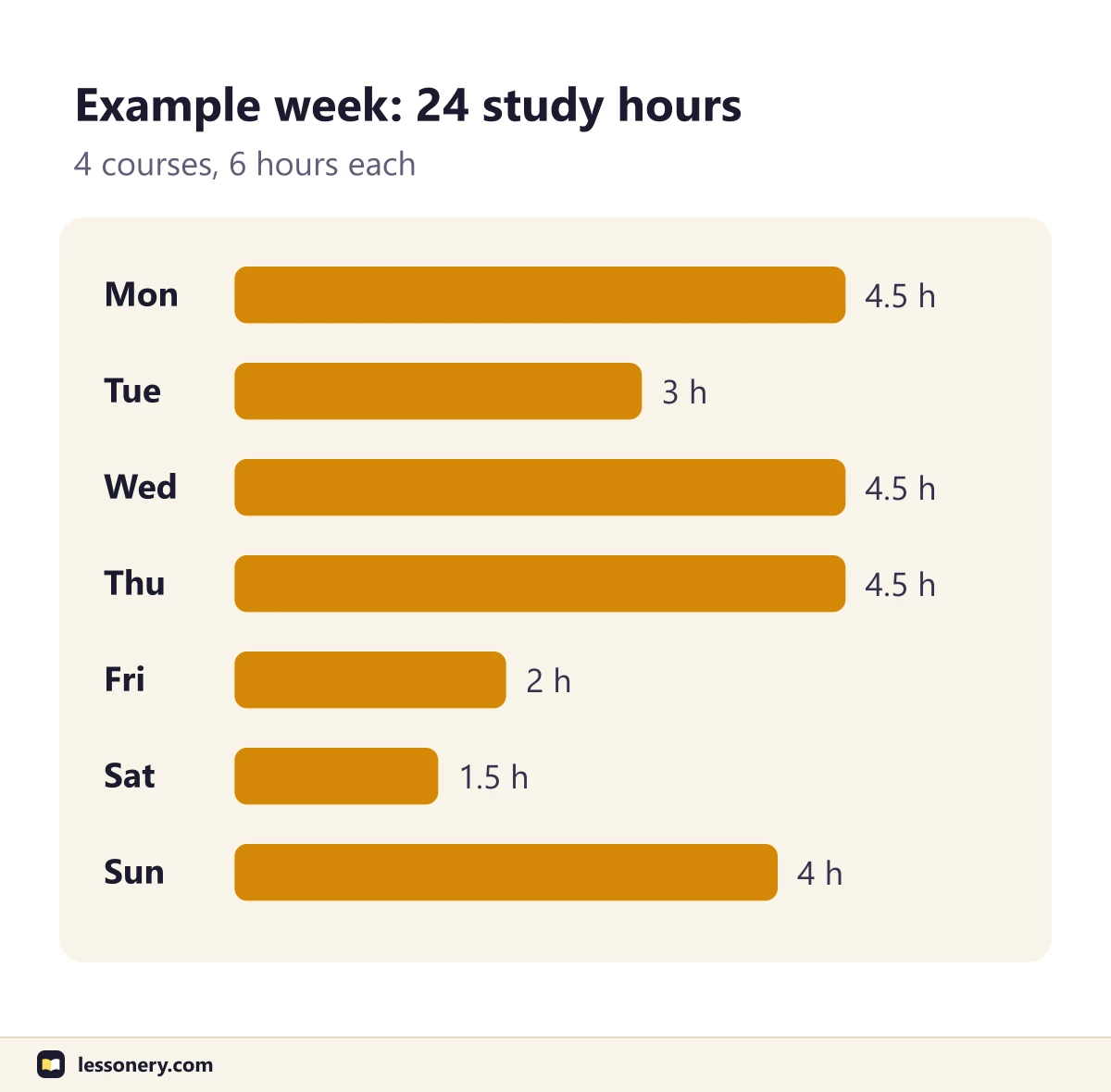
The same 24 hours, counted by course:
| Course | Blocks | Hours |
|---|---|---|
| Biology | Monday 1, Wednesday 1, Thursday 2, Friday 1, Sunday review 1 | 6 |
| Statistics | Monday 2, Wednesday 2, Friday 1, Sunday review 1 | 6 |
| History | Monday 1.5, Tuesday 1, Thursday 1, Saturday 1.5, Sunday review 1 | 6 |
| Economics | Tuesday 2, Wednesday 1.5, Thursday 1.5, Sunday review 1 | 6 |
| Total | 24 |
A few choices in this example follow the guidelines above. Each morning gap between classes goes to the class that just ended. No block is longer than 2 hours. Friday and Saturday are light, which leaves room to catch up on a missed block. Classes, study and the job come to 44 hours, and the 30-minute planning slot is extra.
What research supports, and what is only guidance
No source cited in this article tested one timetable layout against another. The hour ratios and the 2-hour cap are university guidance. Three parts of a weekly schedule do have research behind them.
Spreading study over time. A practice guide from the US Institute of Education Sciences, Organizing Instruction and Study to Improve Student Learning (Pashler and colleagues, 2007), recommends spacing learning over time and rates the evidence for it as moderate. It advises reviewing important course content several weeks to several months after it was first taught. The guide is written for teachers. A weekly review that goes back over earlier material is one way for a student to apply it, and a spaced repetition schedule is a more exact one.
Deciding when and where in advance. A study block with a time and place works like an if-then plan: "If it is Monday at 1:30 p.m., then I am in the library doing statistics problems." Gollwitzer and Sheeran (2006) pooled 94 independent tests of such plans and found a medium-to-large positive effect on reaching goals (d = .65). Those tests covered many kinds of goals, not study timetables specifically.
Time management in general. A meta-analysis by Aeon, Faber and Panaccio (2021) of 158 studies found that time management was moderately related to academic achievement (r = .262 across 76 studies) and mildly related to hours spent studying (r = .137 across 6 studies). The authors note that most of the studies measured both at one point in time, so they show an association, not a cause.
Note: A schedule decides when you will study. What you do inside the block matters too: see the guide to the active recall method for one well-studied option.
Common problems and fixes
| Problem | Fix | Source |
|---|---|---|
| The week is too full to fit the study hours | Review paid work, sport, family and volunteer commitments, then reprioritize | UNSW |
| A block gets missed | Rearrange the schedule and move the block to another slot | UNSW |
| Something unexpected throws the plan off | Readjust the schedule and keep going | UNC |
| Tasks keep overrunning their blocks | Estimate realistically, then double the estimate | Cornell |
| Blocks say only "study" | Name the course and the task | Cornell |
| The schedule exists but you don't start | Treat it as procrastination, not planning | See below |
If the timetable is fine and starting is the hard part, the steps in how to beat procrastination apply. If your workload stays unmanageable after you have cut what you can, or the stress is affecting you, talk to an academic advisor, a counselor or your school's student support service.
Frequently asked questions
How many hours a day should I study?
There is no single figure. In the example week above, 24 study hours over seven days works out to about 3.4 hours a day on average, with a range from 1.5 to 4.5. Your own number depends on your class hours and your institution's guidance on hours per credit.
How is a weekly study schedule different from an exam study schedule?
A weekly schedule repeats through the term and covers routine work for every course. An exam schedule is temporary: it counts back from exam dates and shifts time toward the subjects being examined. Use the weekly one until the exam period, then switch.
Should I schedule sleep and meals?
The guidance says yes. Cornell lists sleeping and eating among fixed commitments and tells students to build in time for sleep. UNC suggests marking a bedtime and wake-up time on the calendar.
What if my week changes, for example with shift work?
Keep the weekly planning slot and rebuild around that week's fixed hours. UNC's guide recommends setting aside 15 to 30 minutes each week for this, and UNSW advises rearranging the schedule when a study session is missed.
Is paper or an app better for a weekly study schedule?
The sources don't prefer one. UNC notes that online calendars such as Google Calendar can repeat events and send reminders, and it also offers printable weekly planners in 60-minute and 30-minute blocks.