To create a study schedule for an exam, list what the exam covers, count the days and minutes you really have, and place short sessions on those days so that every topic is studied once and then reviewed on later days. Leave some time unassigned, because estimates run over.
The six steps below follow planning guidance from university learning centers and the research on spacing study over time. A worked example for one exam in 10 days comes after them, with minutes that add up, so you can copy the structure and change the numbers.
Quick answer: List the topics, estimate the minutes each needs, count your free days, block sessions of a length you can sustain, add a short review of earlier topics to most sessions, and keep one session free as a buffer. End with a timed self-test before exam day.
What a study schedule is for
A schedule's main job is to spread the same hours over more days. In their review of 10 learning techniques, Dunlosky and colleagues (2013) gave distributed practice, meaning study spread over time, one of only two "high utility" ratings. The US Institute of Education Sciences practice guide Organizing Instruction and Study to Improve Student Learning lists "space learning over time" as its first recommendation, with a moderate evidence rating.
Queen's University's learning strategies service puts the same idea in planning terms: its study plan handout advises distributing, for example, 15 hours of study over five or six days instead of two or three.
The second job is to show whether the work fits the time. You can't see that until topics and days are written side by side.
How to create a study schedule in six steps
1. List what must be covered
Start with the exam, not the calendar. The Open University's exam checklist asks how long the exam is, how many sections it has, what types of question appear and which carry more marks.
Then divide the content into chunks. Cornell's Learning Strategies Center, in its five-day study plan, suggests chunking by chapter, topic or lecture. UNC's Learning Center adds a quick diagnostic in its test-prep handout: test yourself on each topic with your materials hidden and score it 1 (don't know), 2 (sort of know) or 3 (know).
2. Estimate the minutes each topic needs
Give the most time to the topics you know least, which is UNC's advice, and write a number of minutes next to each one.
Then assume the number is too low. Roger Buehler, a social psychologist who studies the planning fallacy, describes it as an optimistic bias in which people underestimate how long a task will take them. In his example, university students insist they will finish the next project well ahead of the deadline, yet they typically finish right at it. Among the strategies he says may help are basing predictions on how long similar tasks took before and breaking the plan into smaller steps.
Cornell's guidelines for creating a study schedule offer a blunter rule of thumb: estimate how long something will realistically take, then double it.
3. Count the days and minutes you have
Write out every day between now and the exam. Queen's recommends entering exam dates first, then other fixed commitments, and being realistic about them. What is left is your study time.
Add up the available minutes and compare them with the total from step 2. If the work doesn't fit, the Queen's handout gives two honest options: reduce fixed commitments, or reduce the study time planned for some courses. Finding this out on day 1 is the point of the exercise.
4. Block the sessions
University guidance differs on how long a session should be, and none of the pages cited here presents one length as fixed by research.
| Source | Session length | Breaks |
|---|---|---|
| UNC Learning Center | 30 to 45 minutes of focused work | A break after each block |
| Cornell Learning Strategies Center | No more than an hour or two on one course at a time | Planned short breaks; 25 minutes on and 5 off as a way to get started |
| Queen's Student Academic Success Services | Three-hour blocks | 10 minutes in each hour; 2 hours between blocks |
Cornell's reason for its limit is that concentration decreases rapidly after about 90 minutes. The 25-and-5 pattern is the Pomodoro technique.
For each block, UNC advises noting exactly what you will do, where, and for how long. Queen's suggests working backwards from the exam date, starting with your most difficult course, and placing the hardest material at the times of day you learn best.
5. Add reviews of earlier topics
A schedule that visits each topic once is a list, not a plan. In Cornell's sample, days 2 to 4 each pair a new chunk with brief reviews of the earlier ones, day 5 is reviews and a self-test, and the reviews shrink as a chunk gets older: 30 minutes the day after, then 15, and 10 on the last day.
Queen's builds the review into each block: 10 to 20 minutes on recently studied material, the bulk of the time on fresh material, and about 15 minutes of self-testing on what you just covered.
On how far apart to place reviews, one large study gives numbers. Cepeda and colleagues (2008) had more than 1,350 participants learn facts and review them after gaps of up to 3.5 months. For a test 1 week after the review, the best gap was roughly 20 to 40 percent of that week, and the best gap grew as the test moved further away. The spaced repetition schedule article covers intervals in more detail.
6. Keep a buffer and end with a self-test
Leave at least one session with nothing assigned. UNC's calendar handout tells students to build in buffer time when placing tasks into open slots, and Queen's lists "miscalculating how much studying is needed" among the typical obstacles to a study plan.
Finish with a test, not a reread. Cornell's fifth day ends with a 1-hour self-test on all four chunks, and Queen's final block ends with a practice exam of about 2 hours written under real exam conditions. The reasons self-testing earns that place are covered in how to study effectively for exams.
A worked example: one exam in 10 days
Everything in this section is an example made for this article, not a schedule taken from a source. It assumes one exam on the morning of day 11, five topics, and 90 minutes available on each study day.
Steps 1 and 2 give the list:
| Topic | Self-rating (1–3) | Minutes to prepare |
|---|---|---|
| A | 1 | 90 |
| B | 1 | 75 |
| C | 2 | 60 |
| D | 2 | 60 |
| E | 2 | 60 |
| Total | 345 |
Steps 3 to 6 place it on the calendar:
| Day | New material | Reviews, notes closed | Total |
|---|---|---|---|
| 1 | Prepare A: 90 min | None | 90 |
| 2 | Prepare B: 75 min | A: 15 min | 90 |
| 3 | Prepare C: 60 min | B: 20 min, A: 10 min | 90 |
| 4 | Prepare D: 60 min | C: 20 min, B: 10 min | 90 |
| 5 | Prepare E: 60 min | D: 20 min, A: 10 min | 90 |
| 6 | Buffer: anything unfinished | 90 | |
| 7 | Day off | 0 | |
| 8 | None | E: 20 min; mixed self-test on A–E: 50 min; correct errors: 20 min | 90 |
| 9 | None | Timed practice paper: 60 min; mark it and list weak points: 30 min | 90 |
| 10 | None | Weak points: 60 min; quick recall of all five topics: 30 min | 90 |
| 11 | Exam |
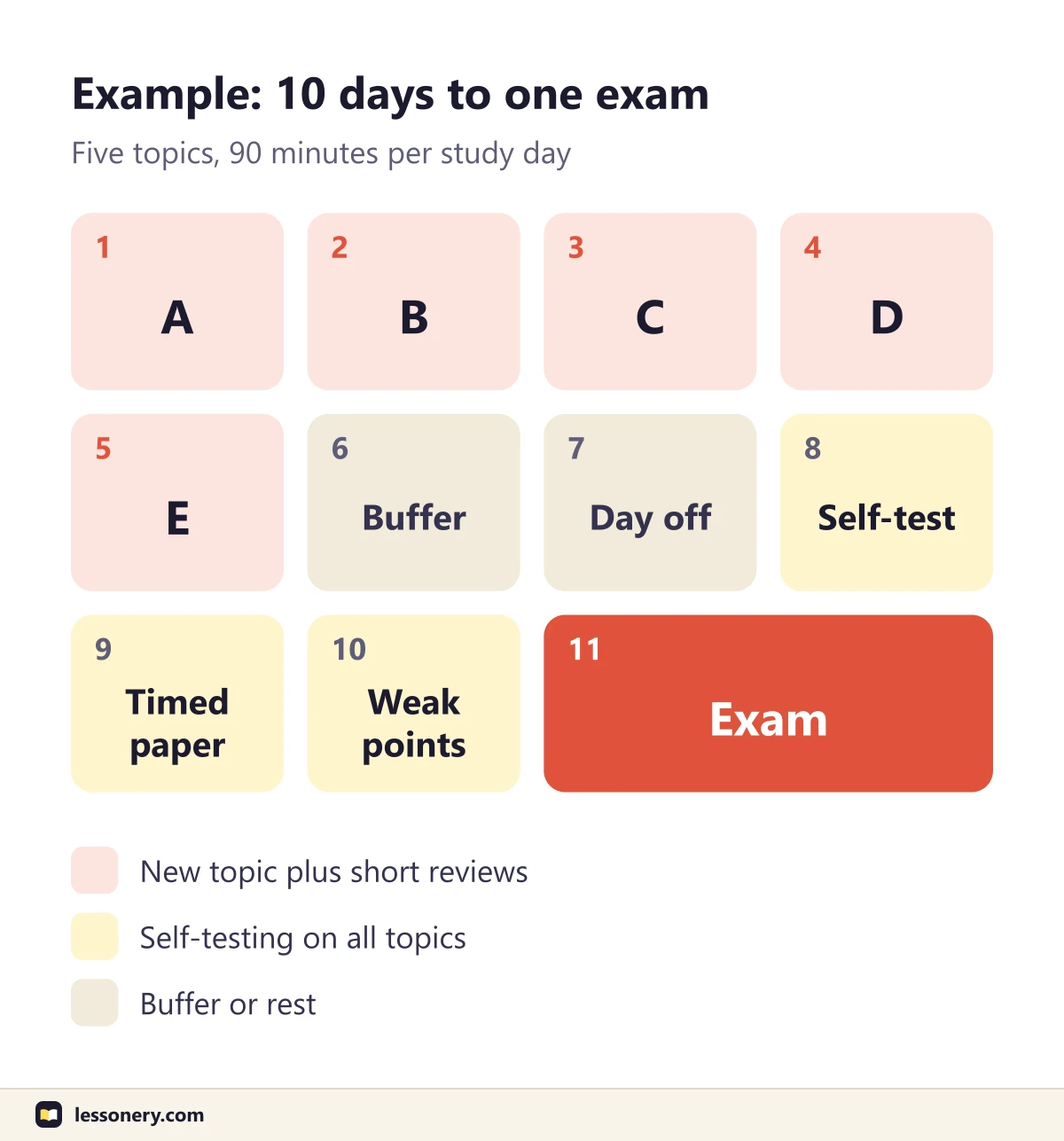
Check the arithmetic before trusting any schedule, including this one:
- Preparing new material: 90 + 75 + 60 + 60 + 60 = 345 minutes.
- Reviews on days 2 to 5: 15 + 30 + 30 + 30 = 105 minutes.
- Self-testing on days 8 to 10: 3 × 90 = 270 minutes.
- Buffer: 90 minutes.
- Total: 345 + 105 + 270 + 90 = 810 minutes, which is nine sessions of 90 minutes, or 13 hours 30 minutes.
Every topic comes back on at least three later days. Topic A, which needs the most minutes, is reviewed on days 2, 3 and 5 and again in the mixed work on days 8 to 10. Topic E, prepared last, returns on days 8, 9 and 10. The shape follows Cornell's five-day plan stretched over a longer period; the numbers are this article's.
How the example compares with two university plans
| Cornell five-day plan | Queen's study plan | Example above | |
|---|---|---|---|
| Length | 5 days | 5 blocks | 10 days, 9 sessions |
| Session | About 2 hours a day | 3 hours per block | 90 minutes |
| Chunks | 4 | 4 (one fewer than the blocks) | 5 |
| Total time | 10 hours 45 minutes | 15 hours | 13 hours 30 minutes |
| Last session | Short reviews and a 1-hour self-test | Four 10-minute reviews and a practice exam of about 2 hours | Weak points and quick recall, the day after a timed paper |
The Cornell total is this article's sum of the minutes in Cornell's sample table; Cornell itself says "about 2 hours" a day. Queen's calls its 15 hours "just an example" and notes that many students study between 10 and 20 hours for each exam.
When the schedule slips
| Problem | What the guidance suggests |
|---|---|
| A topic takes longer than planned | Use the buffer. After that, Queen's suggests redistributing sessions or filling blank periods on the calendar. |
| A day is lost | UNC: "readjust and keep going as best you can." |
| Motivation or energy drops | Queen's: study with a friend, plan something enjoyable for the end of the day, exercise during breaks. |
| Several exams in one week | Cornell: adjust the plan and don't neglect your other courses. Queen's: study for two or three courses in a day and repeat the working-backwards step for each. |
Note: A schedule covers time, not method. Ninety scheduled minutes of rereading is still rereading.
For the term-time routine that sits underneath an exam plan, see the weekly study schedule article. For the final days, see how to prepare for an examination.
Frequently asked questions
How many hours a day should a study schedule include?
The sources differ. Cornell's five-day plan uses about 2 hours a day for one exam. Queen's allows up to three 3-hour blocks a day during an exam period with no classes, but tells students not to study nine hours every day.
How far in advance should you create a study schedule?
Cornell's plan starts five days before an exam, and Queen's suggests a calendar that begins a week or two before exams start. The earlier you create a study schedule, the more days you have to place reviews on, which is what the spacing research supports.
How long should each study session be?
There is no single answer in the guidance cited here. UNC recommends 30 to 45 minutes of focused work followed by a break, Cornell advises against more than an hour or two on one course at a time, and Queen's uses three-hour blocks with a 10-minute break each hour.
Should you study one subject per day or several?
Queen's recommends studying for two or three courses in a day, and Cornell advises switching courses after an hour or two. Both fit the idea of returning to each subject on several separate days.
What if you only have two or three days?
The same steps apply with fewer, shorter reviews. UNC's handout says that with three days you should decide which topics to cover on each day and still leave time to review before the exam.