To study effectively for exams, spend most of your time pulling information out of memory instead of reading it again. A review of 10 learning techniques rated two of them highest, practice testing and spreading study over time, and rated rereading and highlighting low.
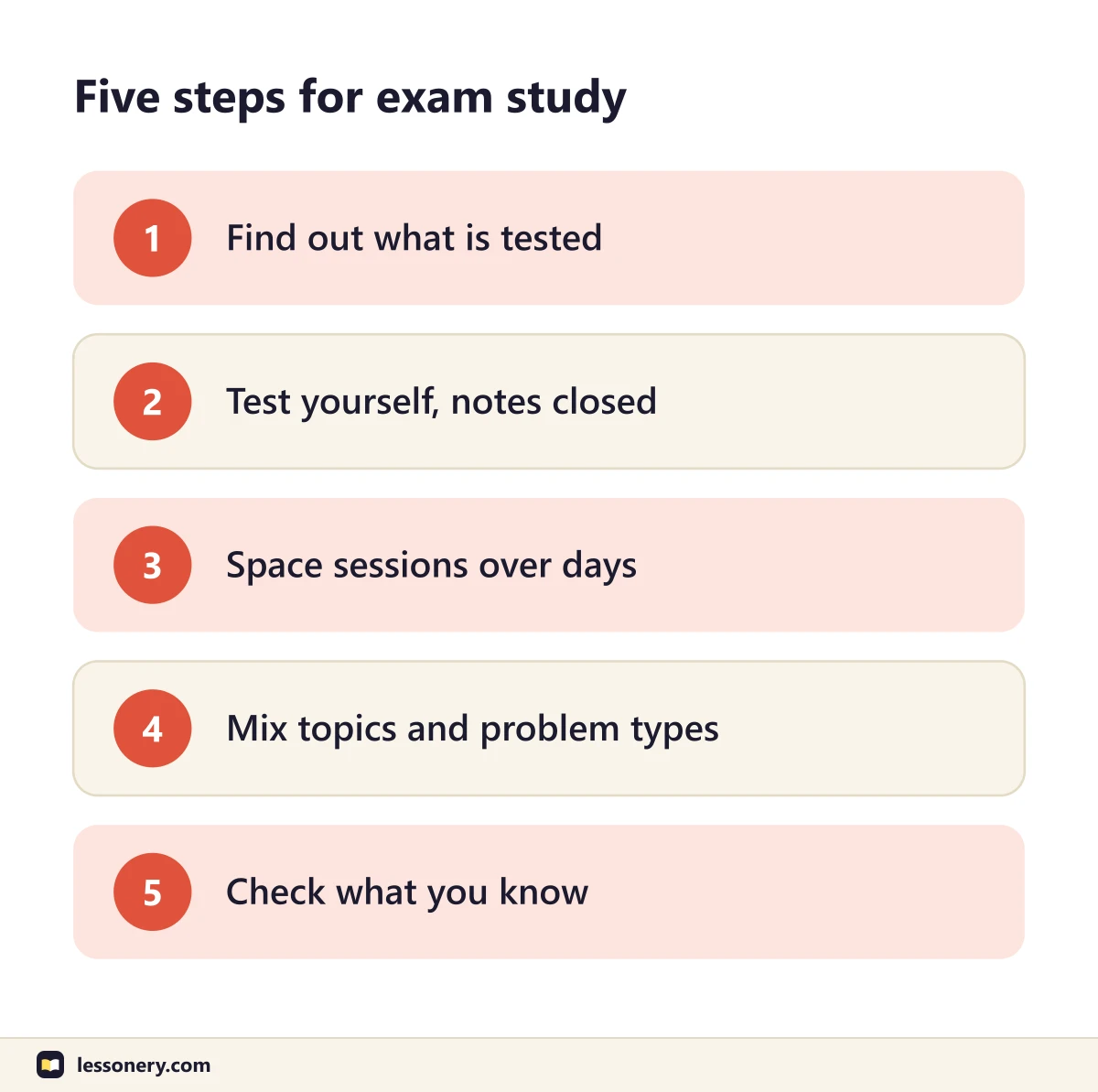
The rest is organization: find out what the exam will ask, return to each topic more than once, mix the topics, and check what you can do with your notes closed. Each step below comes with the study or university guidance behind it.
Quick answer: Find out exactly what the exam covers, then replace rereading with self-testing, spread short sessions over several days, mix topics within a session, and use closed-book checks to decide what to study next. Practice testing and distributed practice were the two techniques rated "high utility" in the review by Dunlosky and colleagues (2013).
What research reviews say about how to study effectively for exams
The main source is the review by Dunlosky, Rawson, Marsh, Nathan and Willingham (2013), which examined 10 learning techniques and rated how well each holds up across different learning conditions, students, materials and kinds of test.
Two received a high utility rating: practice testing and distributed practice. The authors report that both benefit learners of different ages and abilities and have improved performance on many kinds of test.
Three were rated moderate (elaborative interrogation, self-explanation and interleaved practice), mainly because the evidence for them was still limited. Five were rated low: summarization, highlighting, the keyword mnemonic, imagery for text learning and rereading. The abstract notes that most students report rereading and highlighting, yet these techniques do not consistently boost performance.
"Low utility" is narrower than "useless": for summarization and imagery, the stated reason is that the conditions under which they help are limited. All ten ratings are explained in the guide to the most effective study techniques.
A second source is the US Institute of Education Sciences practice guide Organizing Instruction and Study to Improve Student Learning (Pashler and colleagues, 2007). It was written for teachers, but three of its recommendations carry over to self-study: space learning over time (moderate evidence), use quizzes to re-expose students to content (strong evidence), and use tests to identify what still needs to be learned (the lowest evidence level the guide uses).
| Technique | Rating in Dunlosky et al. (2013) | What it looks like in an exam period |
|---|---|---|
| Practice testing | High | Answering questions with your notes closed |
| Distributed practice | High | Several short sessions on a topic, days apart |
| Interleaved practice | Moderate | Different topics or problem types in one session |
| Rereading | Low | Reading notes or the textbook again |
| Highlighting | Low | Marking text as you read |
The ratings are the review's. The third column is a plain description of each technique, not part of the review.
Step 1: Find out what the exam tests
Before you plan any sessions, pin down the format and the content. The Open University's exam format checklist asks how long the exam is, how many sections it has, how many questions you must answer in each, whether any are compulsory, what types of question appear, and whether some carry more marks than others.
For content, UNC's Learning Center suggests listing the topics likely to be tested from the syllabus, textbook, notes and quizzes. You then test yourself on each topic with your materials hidden and rate it 1 (don't know), 2 (sort of know) or 3 (know). Topics rated 1 or 2 get the most time.
Past papers and specimen papers show how questions are worded. UNSW's exam guidance recommends working through practice questions under exam conditions and then checking your answers against the marking criteria. The Open University adds a caution: formats and questions change each year, so a past paper can't predict this year's content.
Note: Use only the past papers and practice materials your teacher or institution makes available, and follow your own institution's rules on what you may bring into the exam.
Step 2: Test yourself instead of rereading
Practice testing means answering from memory: flashcards, practice problems, past questions, or writing what you recall about a topic on a blank page.
One paper that compared self-testing with restudying is Roediger and Karpicke (2006). In two experiments, students studied prose passages and then either took one or three free-recall tests without feedback or restudied the passage the same number of times. On a final test after 5 minutes, restudying produced better recall. On final tests after 2 days or 1 week, the students who had been tested remembered substantially more, even though restudying had left students more confident.
That result concerns recall of prose passages in two experiments, not whole courses or grades. It is best read alongside the review above, which rated practice testing "high utility" across learners of different ages and abilities.
Students don't seem to pick this method unprompted. Karpicke, Butler and Roediger (2009) surveyed 177 college students about how they study. A majority reported repeatedly rereading their notes or textbook, and relatively few reported testing themselves.
Practical forms of self-testing, drawn from Cornell's Learning Strategies Center five-day study plan and UNC's test-prep handout:
- Write everything you remember about a topic on a blank page, then check it against your notes.
- Work problems without looking at the answer key.
- Answer each flashcard before you flip it.
- Take a self-test under conditions close to the real exam.
The guide to the active recall method covers these formats in more detail.
Step 3: Spread your sessions over several days
Distributed practice means studying a topic in several sessions separated by time instead of one long block. The full text of the IES guide summarizes hundreds of laboratory experiments: learners usually remember much more when they meet material on two separate occasions, and when the gap between them is not less than about 5 percent of the time the information has to be retained. Its practical conclusion is to make sure there is enough spacing and rarely worry about too much.
Cepeda and colleagues (2008) tested this on a large scale. More than 1,350 participants learned a set of facts, reviewed them after a gap of up to 3.5 months, and took a final test up to 1 year after the review. The best gap grew as the test moved further away: roughly 20 to 40 percent of the delay for a test 1 week later, falling to roughly 5 to 10 percent for a test 1 year later.
For a test one week after your review, that works out to reviewing a topic about one to three days after you first study it (20 to 40 percent of seven days is 1.4 to 2.8 days). The calculation is this article's, not the paper's, and the study used facts. The IES guide notes that few spacing studies have looked at complex, structured bodies of knowledge.
Sessions can be short. UNC's Learning Center recommends intensive blocks of 30 to 45 minutes and points out that total study time can stay the same; what changes is how it is used. To turn this into dated sessions, see how to create a study schedule, and for review intervals in general, the spaced repetition schedule article.
Step 4: Mix topics and problem types
Interleaved practice means arranging practice so that consecutive problems need different strategies, instead of finishing every problem of one type before starting the next.
In a preregistered trial, Rohrer, Dedrick, Hartwig and Cheung (2020) had 54 seventh-grade mathematics classes in Florida complete either interleaved or blocked assignments over 4 months. On an unannounced test 1 month later, the interleaved group scored 61% and the blocked group 38%.
That is one subject and one age group, and Dunlosky and colleagues rated interleaved practice "moderate" because the evidence for it was limited. It is a reasonable thing to try with problem sets, not a settled rule for every subject.
In practice, once you have learned each problem type, build question sets that draw from several chapters in shuffled order, so you have to decide which method applies before you use it. Cornell's plan applies the same idea to the timetable: mix preparing new material with reviewing older material instead of doing all of one first.
Step 5: Check what you actually know
The feeling of knowing a topic is a poor guide to whether you can answer questions on it. The IES practice guide reports that, without training, most learners cannot accurately judge what they do and don't know, and typically overestimate how well they have mastered material when they finish studying. The guide calls this the "illusion of knowing".
Its suggested fix has three parts:
- Test yourself after a meaningful delay (an hour, a day or a week), not straight after studying.
- Look only at the question, with the answer out of sight.
- Judge how likely you are to get that question right on a quiz, then spend your time on the items you were unsure of.
The panel rated the evidence for teaching this technique as low, because it came mainly from laboratory experiments and not classroom ones.
There is a simple reason rereading misleads. A page you have read twice looks familiar, and familiarity is easy to mistake for being able to produce the answer. A closed-book attempt gives you a result that familiarity can't inflate.
An example 45-minute study session
The session below is an example made for this article to show the five steps working together. Adapt the timings to your subject.
| Minutes | Task | Step it uses |
|---|---|---|
| 0–5 | Blank-page recall of the topic studied two days ago | Testing, spacing |
| 5–30 | Practice questions on today's topic, notes closed | Testing |
| 30–40 | Check answers against notes; rate each subtopic 1, 2 or 3 | Checking |
| 40–45 | Three questions drawn from older topics, in mixed order | Mixing, spacing |
The four parts add up to 45 minutes: 5 + 25 + 10 + 5. Subtopics rated 1 or 2 go to the top of the list for the next session.
Frequently asked questions
How many hours a day should you study for exams?
None of the reviews cited here gives a number of hours. As a planning figure, Queen's University's study plan says many students study 10 to 20 hours for each exam once term work is finished, and advises against studying nine hours every day. UNC's Learning Center makes the point that how you use study time matters more than how long you study.
Is rereading notes a waste of time?
Dunlosky and colleagues rated rereading as low utility, which is not the same as no value. UNC's Learning Center treats reading as "pre-studying": a first pass that prepares you for active work such as self-testing. The problem is relying on it as the main method.
How far ahead should you start studying for an exam?
Guidance varies. Cornell's plan starts five days before a single exam, at about 2 hours a day, and UNSW advises starting at least four weeks before your exam. The research on distributed practice supports starting early enough that each topic can be studied and then reviewed on a later day.
Does studying in a group help?
UNSW suggests using study groups for feedback on practice exams and for testing each other, and UNC recommends explaining material aloud as if you were the teacher. Both make you produce answers instead of reading them, so they fit the research on how to study effectively for exams. By the same reasoning, a group that only rereads notes together would not.
What should you do in the last week before the exam?
Shift from learning new material to timed practice and sort out the practical details. That is covered separately in how to prepare for an examination.