To prepare for an examination in its final week, stop adding new material, switch to timed practice, and settle the practical details early: date, room, permitted materials and travel. On the day, read the whole paper before you write and divide your time by marks.
This covers the last week and the exam room only. Choosing study methods is covered in how to study effectively for exams, and building the longer timetable in create a study schedule.
Quick answer: A week out, confirm the exam's time, place, format and permitted materials. Spend the week on timed practice and on the errors it reveals. Don't plan an all-nighter, which UNSW's exam guidance advises against. In the exam, read the instructions and the whole paper first, give each question time in proportion to its marks, and keep a few minutes to check.
Seven days out: confirm the practical details
Logistics come first because they are cheap to fix a week ahead and expensive to fix on the morning. Cornell's Learning Strategies Center asks students to consider exam logistics as part of studying: whether the exam is in person or online, whether it is timed, and whether you have a quiet space. Each changes how you should practice.
The Open University's exam format checklist and UNSW's exam preparation guidance together give a list like this:
| Confirm | Details |
|---|---|
| Date, time and place | Start and finish times; the room, or the platform for an online exam |
| Format | Length, number of sections, how many questions to answer, compulsory questions, marks per question |
| Materials | What you are expected to bring, plus spare stationery |
| Route | How you will get there, worked out well ahead of time |
| Arrangements | Any exam adjustments you are entitled to, requested early |
On the last row, the Australian National University's exam guidance notes that special examination arrangements have to be set up in advance and need supporting documentation. Your own institution will have its own process and deadlines.
Note: Rules on calculators, formula sheets, dictionaries, notes in open-book exams and digital tools differ between schools and between courses. Follow the rules your institution gives you for this exam, and bring only what is allowed.
A final-review plan for the last week of exam preparation
The last week is for retrieving what you have studied, under conditions close to the exam. In the experiment by Roediger and Karpicke (2006), students who took recall tests on prose passages remembered substantially more 2 days and 1 week later than students who restudied the passages, although restudying produced better recall after 5 minutes.
Cornell's page on what to do with practice exams turns that into three rules. Practice under the same time limit as the real test. Use only the resources you will be allowed, which for a closed-book exam means none, including the answer key. If you have several practice tests, take one early as a baseline and another after more study to measure progress.
The plan below is an example made for this article. It assumes one exam and that the main studying is already done.
| Days before | Review task | Practical task |
|---|---|---|
| 7 | List every topic and rate each one 1 to 3 with notes closed | Confirm date, time, place and format |
| 6–5 | Practice questions on the topics rated lowest | Collect permitted materials |
| 4 | First timed practice paper under exam conditions | Note how long each section took |
| 3 | Go through the errors; redo the questions you missed | |
| 2 | Second timed paper, or a mixed set of questions | Check the route and travel time |
| 1 | Short closed-book recall of each topic; stop at a set time | Pack your bag; no all-nighter |
| 0 | Exam | Arrive early |
The 1-to-3 rating comes from UNC's Learning Center test-prep handout, and redoing missed problems is on the list of review activities in Cornell's five-day study plan. If you have far less than a week, see how to cram for an exam.
What research says about sleep before a test
One study measured sleep instead of asking students about it. Okano and colleagues (2019) gave wearable activity trackers to 100 students in an introductory college chemistry class, and 88 completed the study. The researchers then compared sleep across the semester with scores on quizzes and midterm exams.
Three findings matter for exam week:
- Students with longer, better-quality and more consistent sleep tended to have better grades.
- Sleep on the single night before a test showed no relation to performance on that test.
- Sleep duration and quality over the week and the month before a test did correlate with better scores.
In the paper's regression, sleep duration, quality and consistency together accounted for 24.44% of the variance in overall grade performance, a figure its abstract gives as "nearly 25%".
The limits are just as relevant. This was a correlational study of one course at one university, and the authors write that establishing a causal link would require experiments. The sleep-quality score came from the tracker maker's own algorithm. The result does not show that a short night before an exam is harmless; it shows that, in this group, the weeks in which the learning happened were what tracked with grades.
University exam guidance addresses the night before directly. UNSW tells students not to pull an all-nighter, on the grounds that being alert is your greatest asset in the exam.
This section describes research and is not health advice. If poor sleep or anxiety is a regular problem for you, talk to a doctor, a counselor or your school's support service.
How to prepare for an examination on the morning itself
Arrive early. UNSW advises planning to be there at least 30 minutes before the start time, and steering clear of other people's nervousness while you wait.
UNC's Learning Center, in its test day game plan, suggests deciding three things before you sit down: what you will do when you can't make an educated guess, how you will handle items you are unsure of, and what you will do if you run short of time. The point of deciding in advance is that you don't have to invent a policy in the middle of the exam.
Reading the paper before you write
Read the instructions first, then the whole paper. UNSW's guidance is to make sure you clearly understand the directions, survey the paper, mark which questions look easy and which look hard, and check how the marks are distributed.
If your exam has a reading period, ANU suggests using it to get an overview, decide which questions to answer and in what order, and start analyzing what each question asks you to do.
Count how many questions you have to answer. The Open University warns that you lose marks by answering too few and waste time by answering too many; under its rules, answers beyond the required number are not marked.
Before you start writing, put your plan on paper. UNC recommends noting the order you will work in and the time each part gets, on the test or on scrap paper.
Time allocation in the exam room
Divide your time by marks. The Open University's checklist says to base the time for each question on its marks, leaving time to read, plan and check. UNSW gives the simplest case: 90 multiple-choice questions in 90 minutes is about one minute each.
UNC works through a mixed paper: a 50-minute test with 15 multiple-choice questions worth 30 points, 5 short answers worth 10 points and an essay worth 60 points, for which it allots 30 minutes to the essay, 15 to the multiple-choice questions and 5 to the short answers.
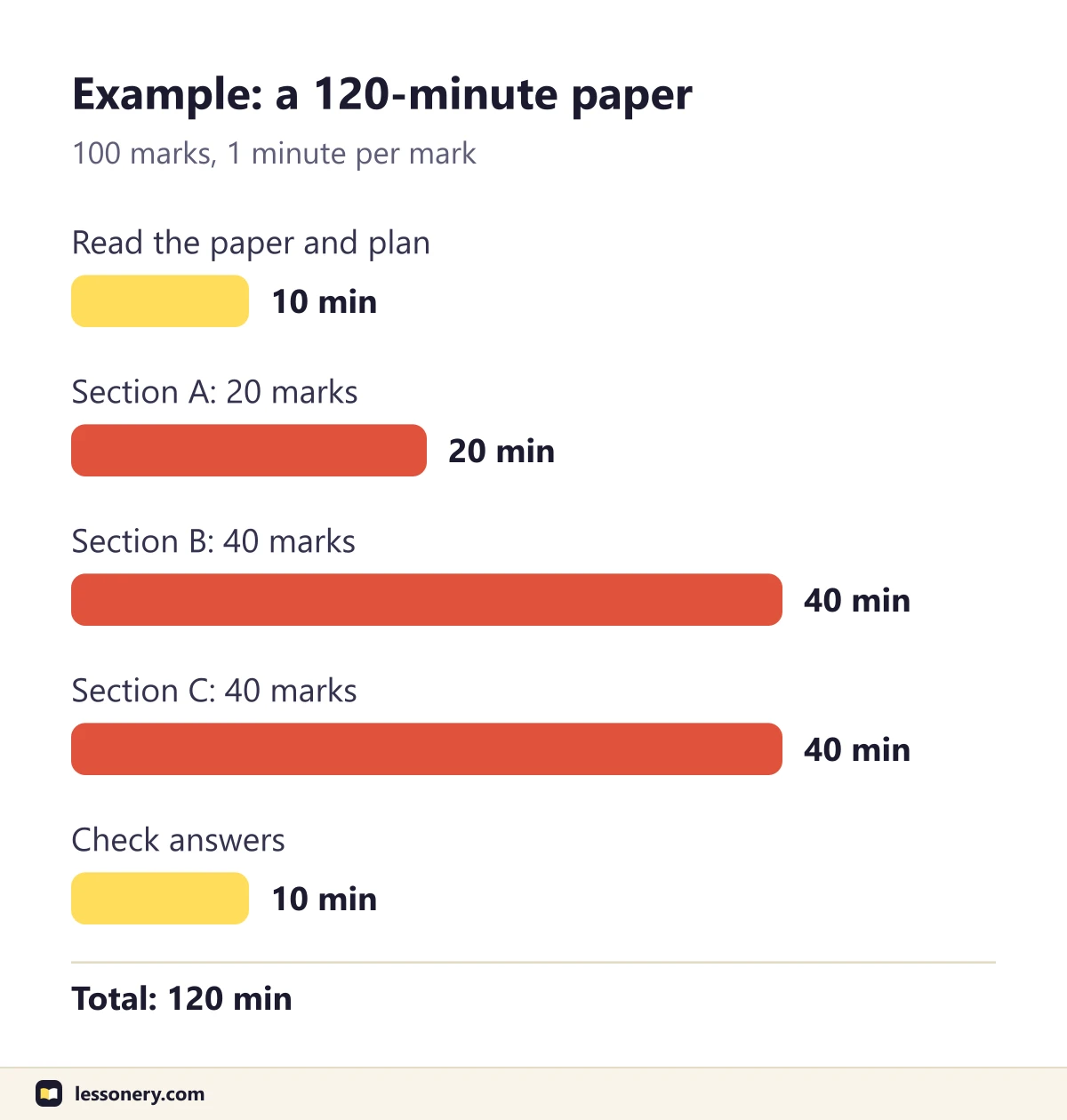
Here is a longer example, made for this article: a 120-minute paper worth 100 marks.
| Part of the exam | Marks | Minutes |
|---|---|---|
| Read the paper and plan | 10 | |
| Section A: 20 multiple-choice questions | 20 | 20 |
| Section B: 4 short answers, 10 marks each | 40 | 40 |
| Section C: 1 essay | 40 | 40 |
| Check answers | 10 | |
| Total | 100 | 120 |
The arithmetic: 120 minutes minus 10 for reading and 10 for checking leaves 100 working minutes for 100 marks, or 1 minute per mark. Each short answer in Section B gets 10 minutes. With 80 marks in the same paper, the rate would be 100 ÷ 80 = 1.25 minutes per mark.
ANU's advice for keeping to the plan is to write the time you have decided on next to each question and check the clock at regular points. For question-level tactics on one format, see multiple choice test taking strategies.
If you get stuck or run short of time
| Situation | What the guidance says |
|---|---|
| You can't answer a question | UNC: mark it, move on, and come back at the end. |
| You reach your planned time | UNSW: move on, and leave plenty of space so you can return. |
| Stress builds during the paper | UNSW describes a short routine for staying calm: pause, take a few slow, deep breaths, relax your shoulders, hands, face and jaw, then carry on more slowly. |
| You finish early | ANU: use all the time. Reread your answers, check that you understood each question and that none was missed. |
UNSW's advice on order is to start with the questions you find easy, which builds confidence and gets your memory working. UNC offers two options: work through sections in order of point value, or answer what you know best first. Either way you bank the most marks if time runs out.
Some stress before an exam is normal, as ANU's guidance says. If anxiety regularly gets in the way of your exams, ANU's exam page and UNC's page on test anxiety both direct students to their counseling services. Ask what your own school or university offers.
Frequently asked questions
What should you do the day before an examination?
The example plan above keeps the day before to a short closed-book recall with a fixed stopping time. UNSW's guidance for the last hours is practical: check what you are expected to bring, organize your materials, make sure you know how to get to the venue, and don't pull an all-nighter.
Is it worth staying up late to study the night before?
UNSW advises against an all-nighter because alertness matters in the exam. The study by Okano and colleagues can't settle the question by itself, since it tracked students' ordinary sleep and did not assign anyone to stay up, but it found that sleep over the preceding week and month was what related to scores.
How early should you arrive for an exam?
UNSW suggests at least 30 minutes before the start time, to allow for delays. Check the instructions for your own exam as well, since they may set a specific arrival or login time.
How do you divide your time in an exam?
Subtract a few minutes for reading the paper and for checking, then divide what is left by the total marks to get minutes per mark. Multiply by each question's marks, write the times on the paper, and move on when a question's time is up.
How do you prepare for an examination that is open-book or online?
The same steps apply, with practice under the real conditions. Cornell advises taking a practice test in the place where you will sit the real one and deciding in advance which materials to keep within reach. Your institution's rules decide what you may use.