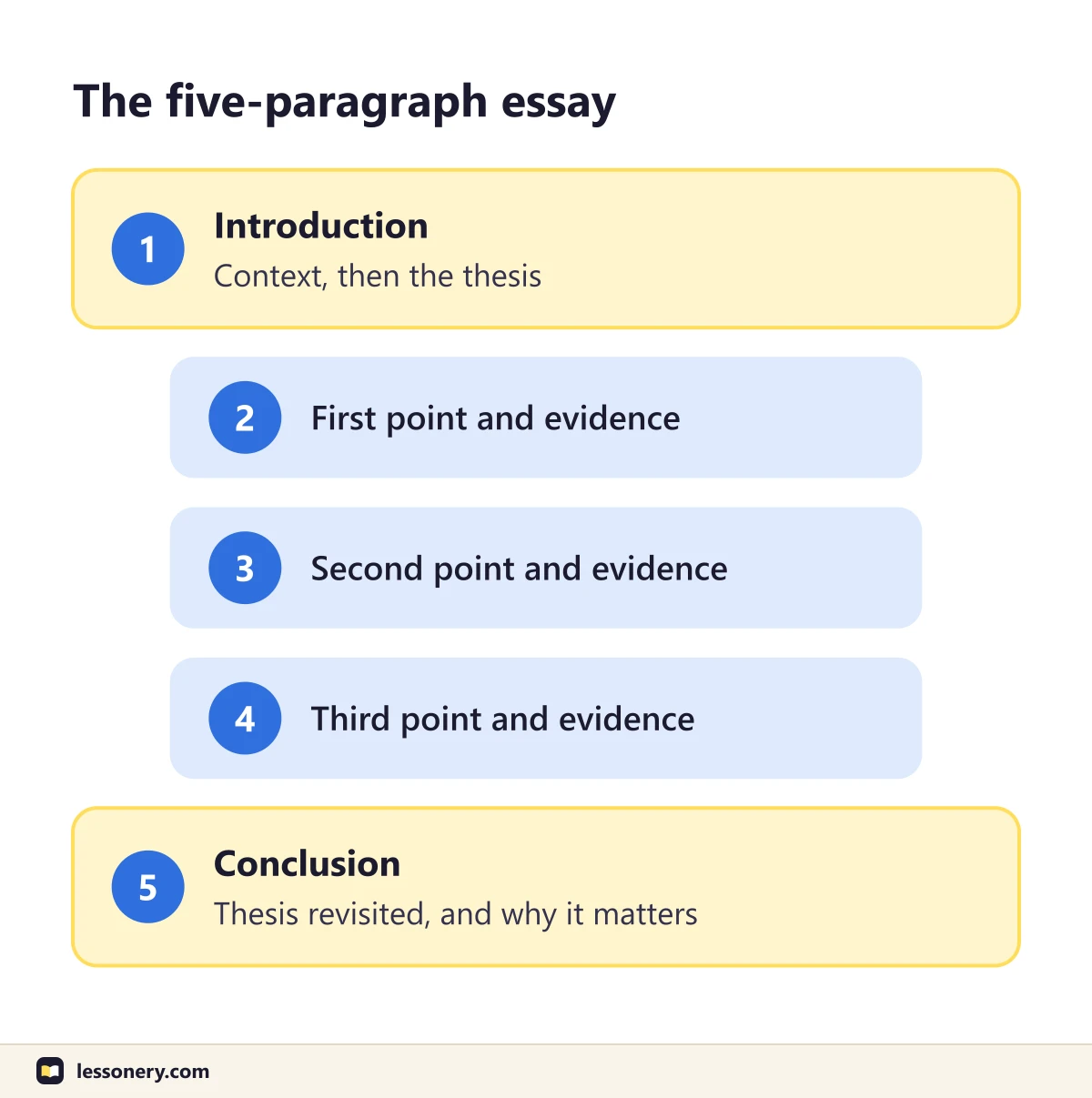
The 5 paragraph essay structure is an introduction that ends in a thesis, three body paragraphs that each support the thesis with one point, and a conclusion. It gives a new writer a fixed place for every part of an argument.
It is also a form with known limits. University writing centers describe it as a starting point that suits timed writing, and as too rigid for much of the writing set at college or university.
Quick answer: A five-paragraph essay has an introduction with a thesis, three body paragraphs (each with a topic sentence, evidence and explanation), and a conclusion that returns to the thesis. It fits essay exams and other short, timed tasks. For longer or more complex arguments, writing centers advise letting the argument decide how many paragraphs you need.
The 5 paragraph essay structure at a glance
The form has three parts spread over five paragraphs. Purdue OWL's guide to argumentative essays describes it as an introductory paragraph, three body paragraphs of evidence that may include discussion of opposing views, and a conclusion.
The UNC Writing Center's handout on college writing compares its shape to an hourglass. The essay opens with something general, narrows to specifics in the middle, and broadens again at the end.
| Paragraph | Its job | What goes in it |
|---|---|---|
| 1. Introduction | Lead the reader to your thesis | Context for the question, then the thesis |
| 2. Body | Support the thesis with a first point | Topic sentence, evidence, explanation |
| 3. Body | Support the thesis with a second point | Topic sentence, evidence, explanation |
| 4. Body | Support the thesis with a third point, or answer an opposing view | Topic sentence, evidence, explanation |
| 5. Conclusion | Return to the thesis in light of the evidence | The points drawn together, and why they matter |
The table is this article's summary of the Purdue OWL and UNC pages cited in the next section.
What each paragraph does
Paragraph 1: the introduction and thesis
The introduction moves the reader from the general subject to your specific claim. The UNC handout on introductions calls it a road map: it states the topic, says why it matters and, in many academic disciplines, includes the thesis.
Start from the assignment question, because the thesis is your direct answer to it. Then match the breadth of your opening to the question. UNC's handout warns against the "dawn of man" opening, a sweeping statement about all of history that could introduce almost any essay.
In this form the thesis closes the paragraph, and in the classic version it names the three points the body will cover. UNC's college writing handout calls this a "listing" thesis and contrasts it with an argumentative one, which takes a position and explains why.
Paragraphs 2 to 4: the body
Each body paragraph develops one idea that supports the thesis. The UNC handout on paragraphs calls this the controlling idea and sets out five steps for building a paragraph around it:
- Decide on the controlling idea and write a topic sentence.
- Elaborate on the idea.
- Give an example, or several.
- Explain each example.
- Complete the idea, or lead into the next paragraph.
Step 4 carries the argument. Purdue OWL's guide makes the same demand: evidence has to be explained, so the reader can see how it supports the thesis. Without that explanation the paragraph is a list of facts.
The handout sets no length for a paragraph. It says unity and coherence define a paragraph, and the number of sentences does not.
Paragraph 5: the conclusion
The conclusion returns to the thesis with the evidence now behind it. Purdue OWL's guide says to readdress the thesis in light of the evidence, not merely restate it, and to add no new information.
The UNC handout on conclusions puts it as "synthesize, don't summarize": show how your points fit together. Its test is the "So what?" game. After each statement in your conclusion, ask why anybody should care, and write the answer.
A sample skeleton
The skeleton below is an example to adapt. It arranges the parts that the Purdue OWL and UNC pages describe.
PARAGRAPH 1: INTRODUCTION
- Context: one or two sentences that lead to the question
- Thesis: your answer to the question, in one sentence

PARAGRAPH 2: FIRST POINT
- Topic sentence: the point, tied to the thesis
- Evidence: a fact, example or quotation, with its source
- Explanation: how the evidence supports the point
- Link to the next paragraph

PARAGRAPH 3: SECOND POINT
- Same four parts

PARAGRAPH 4: THIRD POINT, OR AN OPPOSING VIEW AND YOUR REPLY
- Same four parts

PARAGRAPH 5: CONCLUSION
- The thesis revisited in light of the three points
- Why it matters: your answer to "So what?"
Here is the skeleton filled in. The plan is an example written for this article, and its thesis is an illustration of an arguable claim, not a finding. The evidence it names is described in the next section.
| Paragraph | Example plan |
|---|---|
| Question | Is the five-paragraph essay a useful form for students to learn? |
| 1. Introduction | Context: teachers rely on the form, and critics call it a formula. Thesis: the five-paragraph essay is worth learning as a first form because it trains a writer to state a claim and support it, but it holds the writer back once an argument has more than three parts |
| 2. First point | It teaches the basic move of academic writing, an idea supported by evidence (UNC college writing handout) |
| 3. Second point | It suits writing against the clock, such as an exam answer (UNC handouts on college writing and essay exams) |
| 4. Opposing view and reply | Some argue the form should be kept because tests reward it. Reply: in Albertson's (2007) study of state test essays, other structures were just as likely to earn high scores |
| 5. Conclusion | The form is something to learn and then outgrow. So what: read each assignment for the kind of argument it asks for |
Notice that paragraphs 2 to 4 are three parts of one argument, not three separate topics. That is the adjustment UNC's handout recommends for anyone using the form.
Every piece of evidence in a real essay needs its source. How to paraphrase without plagiarizing covers putting that evidence into your own words and citing it.
What writing centers and research say about its limits
Writing centers treat the form as a learning tool. UNC's college writing handout says it teaches students to state an idea and support it with evidence, and compares it to training wheels on a bicycle: useful while you learn, and not meant to stay on.
The same handout lists what goes wrong when the form is carried into longer work:
- The thesis lists topics and makes no claim.
- Topic sentences repeat the introduction and do not connect the points.
- Paragraphs stand alone, without smooth transitions between them.
- The conclusion repeats what was said.
- The fixed shape decides what ideas go in, so good ideas get bent or left out.
Purdue OWL is briefer. Its guides to both argumentative and expository essays call the five-paragraph approach "by no means the only formula", and the argumentative guide adds that essays on complex issues or with detailed research will likely run longer than five paragraphs.
What studies have found
One study examined whether the formula pays off on tests. Albertson (2007) analyzed more than 1,000 essays written by students in Grades 8 and 10 for a statewide writing assessment in Delaware, in the United States. According to the abstract, more students chose the five-paragraph form, but writers who used other structures were just as likely to earn high scores. What predicted scores was development: writers who used a wider range of strategies to expand their ideas scored higher.
A second study helps explain why the form is taught. Johnson, Smagorinsky, Thompson and Fry (2003) followed one early-career teacher who taught the form to her eighth-grade class because a state-required writing test scored it favorably. According to the abstract, community expectations of passing scores and pressure from colleagues to teach to the test both pushed her toward it.
This is limited evidence: one descriptive study of one state's test and one case study of a single teacher, both read here as abstracts.
What teachers have argued
Writing teachers disagree in print about the form, and these are arguments, not studies. Wesley (2000) argued that its rigidity discourages the analysis students need to become critical thinkers. Wesley recommended still teaching an introduction, body and conclusion, with each allowed to run to more than one paragraph. Nunnally (1991) held that the form has value as a teaching tool, as long as students don't mistake it for the goal.
When the form fits, and when to move beyond it
The form fits when time is short. UNC's college writing handout names essay exams and short speeches, and the UNC handout on essay exams recommends a simple, obvious structure for timed answers: an introduction with a clear thesis, body paragraphs that each make one point with specific examples, and a conclusion that restates the main point and its significance.
| Situation | Does the form fit? | What the sources suggest |
|---|---|---|
| Timed essay exam | Yes | State the thesis first and plan before writing (UNC essay exams handout) |
| Short speech | Yes | Named by UNC as a suitable use |
| An argument with two, four or more parts | No | Let the argument set the number of body paragraphs (UNC) |
| Essay with many sources or detailed research | No | Expect more than five paragraphs (Purdue OWL) |
| Any assignment with its own instructions | Check | The assignment itself often sets the requirements (Purdue OWL) |
Note: In an exam, UNC's advice is to treat the three body paragraphs as three components of one argument. A thesis that only lists topics is weaker than one that argues, though the handout adds that it is probably better than no thesis at all.
The essay exams handout also suggests spending up to about a quarter of the time for a question on notes, a thesis and an outline. How to prepare for an examination covers the weeks before that point.
To move beyond the form, UNC's college writing handout gives a sequence:
- Brainstorm to find your main argument before you decide on a structure.
- Let the argument determine the number of body paragraphs. The handout's examples are two, three or seven.
- Organize those paragraphs around parts of the argument, such as supporting evidence and a counterargument.
- Revise the introduction to match the argument the body develops.
- End by explaining why the essay matters.
Steps 1 to 3 are the work of writing an essay outline, where the number of sections follows from the thesis.
Frequently asked questions
How long is a five-paragraph essay?
The sources cited here give no word count. UNC's handout on paragraphs says length does not define a paragraph, so the total depends on the limit your assignment or exam sets.
Does it need exactly three body paragraphs?
The named form does. UNC's college writing handout says an argument may need two, three or seven body paragraphs, and an essay with a different number is simply no longer a five-paragraph essay. Check whether your assignment requires the fixed form.
Is the 5 paragraph essay structure acceptable at university?
For timed exams, UNC's handout treats it as acceptable. For most other work it describes the form as too rigid, and Purdue OWL expects research-based essays to run longer. Ask your instructor if the assignment doesn't say.
Where does a counterargument go?
Purdue OWL's guide says the body paragraphs may include discussion of opposing views, so one of the three can present an objection and your reply. The same guide suggests that an argumentative essay give one or two paragraphs to opposing views.