Writing an essay outline means deciding, before you draft, what your essay will argue and in what order. You start from the assignment question, answer it in a working thesis, choose the main points that support that answer, and place evidence under each point.
The outline is a tool for you, so it can be rough. What it has to show is the chain from question to thesis to points to evidence.
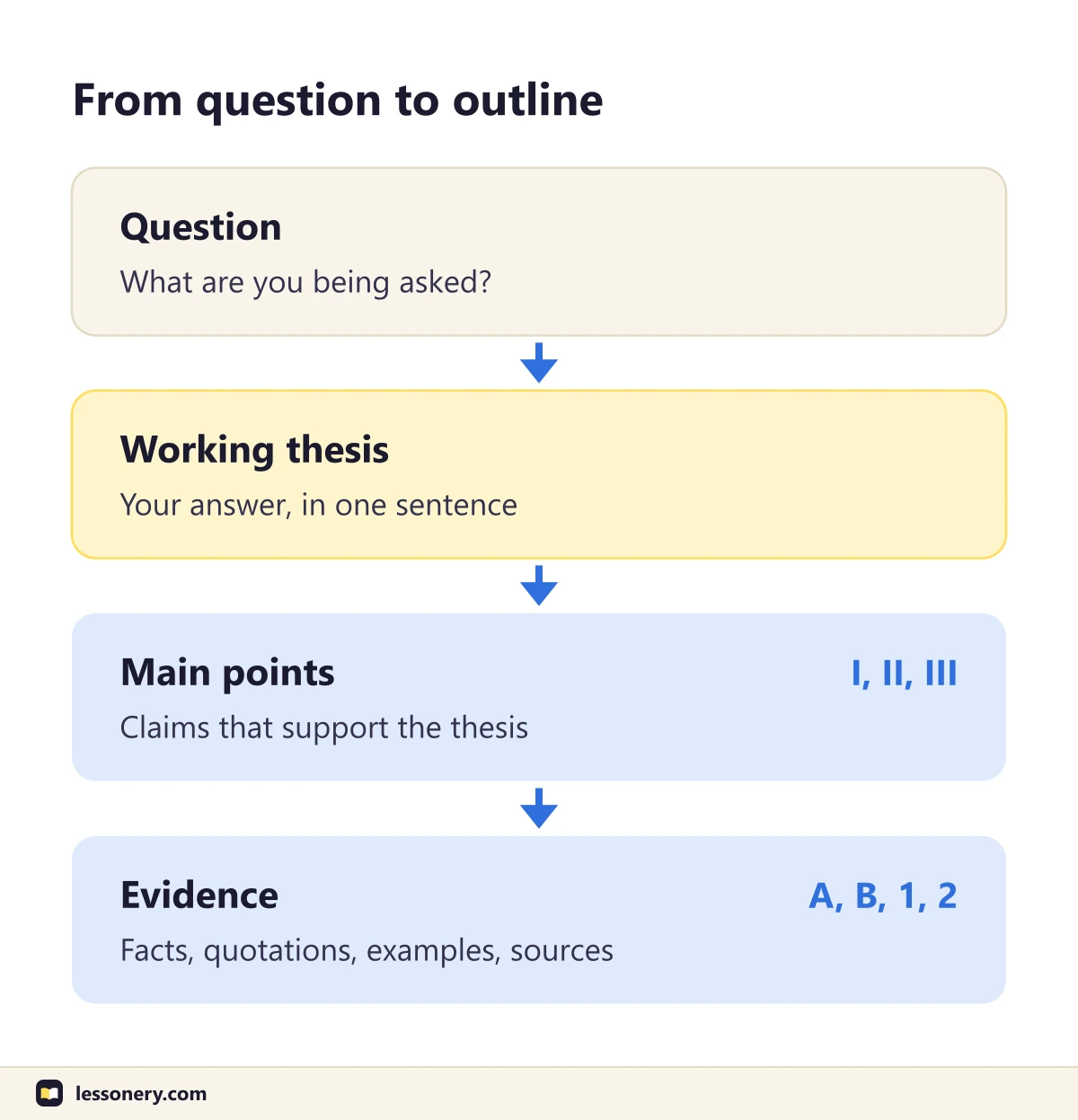
Quick answer: Turn the assignment into a question, write a one-sentence working thesis that answers it, group your ideas into main points, and put the evidence for each point beneath it. The standard alphanumeric format labels the levels I, A, 1, a. Expect to revise the outline as you research and draft.
What an essay outline does
An outline lets you test the structure of an argument before you have written any paragraphs. George Mason University's Writing Center describes it as a way to try out ideas without writing full sentences and to see how each piece of information supports your thesis.
Purdue OWL's page on creating an outline lists what you gain: your ideas are organized, the material is presented in a logical order, and the relationships between ideas are visible.
Timing is the other argument. The University of Toronto's advice on organizing an essay, written by Jerry Plotnick of the University College Writing Centre, points out that restructuring a finished draft is costly.
What research says about outlining before drafting
Experiments have linked outlining to better-rated writing, and a study of real term papers gives a more mixed picture.
| Study | Who and what | What was found |
|---|---|---|
| Kellogg (1987) | College students, with outlines and rough drafts tested | Outlining led to higher-quality writing but did not make writing more efficient. Rough drafts affected neither |
| Kellogg (1988) | Two experiments on outlines and rough drafts | Documents written after a written outline were rated higher by judges. A mental outline helped as much as a written one |
| Graham and Perin (2007) | Meta-analysis of writing instruction studies, grades 4 to 12 | Average weighted effect size of 0.32 on writing quality for prewriting activities |
| Torrance, Thomas and Robinson (2000) | Questionnaires about 715 term papers by undergraduate psychology students | Four strategies identified. Differences in essay quality between them were small |
Kellogg (1987) tested whether outlines and rough drafts improve college students' writing. Kellogg (1988) found the outline benefit again and added a second experiment, in which an outline held only in the writer's head improved the documents as much as one on paper. His explanation was that either kind of outline lets a writer give drafting time to turning ideas into sentences.
In Graham and Perin's (2007) meta-analysis of writing instruction for students in grades 4 to 12, prewriting activities had an average weighted effect size of 0.32 on writing quality, compared with 0.82 for strategy instruction. The abstract reports prewriting as one category, so that figure is not for outlining alone.
With real coursework, the kind of planning seems to matter. Torrance, Thomas and Robinson (2000) sorted undergraduates' accounts of how they wrote 715 term papers into four strategies. "Outline-and-develop", in which content was worked out both before and during drafting, was one of the two weakest. "Detailed planning", which paired an outline with methods such as brainstorming or mind mapping, and "think-then-do", which involved no written outline, appeared to produce better essays. The authors describe the differences as small.
None of this promises a better grade. It does suggest that sorting out your content before you draft is time reasonably spent.
Writing an essay outline step by step
1. Turn the assignment into a question
Rephrase the prompt as a question you can answer. The UNC Writing Center's handout on thesis statements gives the pattern: "Discuss the effect of X on Y" becomes "What is the effect of X on Y?"
2. Answer it in a working thesis
Your thesis is your answer to that question, in one sentence. UNC's handout says a thesis takes a position that others might challenge, and it calls a first attempt a "working thesis" because you will revise it as the argument develops.
Don't wait until your research is finished. Toronto's page says the earlier you begin planning the better: sketch a tentative plan once an argument starts to take shape, then use it to guide your reading.
Test the sentence with two of UNC's questions. Would a reader ask "So what?" Would a reader ask "How and why?" If so, make it more specific.
3. Brainstorm, group and order your points
Purdue OWL gives four moves for this stage: brainstorm, organize, order and label. List every idea you might include, group the related ones, arrange the groups from general to specific, and give each group a heading.
The order should follow your argument. Toronto's page warns against letting the source set the structure, for instance by following a novel's plot or a period's chronology when your thesis calls for a different sequence.
4. Put evidence under each point
Under every main point, list what will support it: a fact, a quotation, an example, a source. George Mason's guide suggests keeping numbers or bullets for this level.
Add a few words on why each item matters. The UNC handout on evidence stresses that readers can't work out for themselves how a piece of evidence connects to your claim.
This step also exposes gaps. Toronto's page notes that a tentative plan shows which points still need evidence, and that tells you what to read next. If the evidence comes from course readings, note taking from a textbook covers collecting it.
Record the source and page beside each item so that you can cite it. How to paraphrase without plagiarizing covers turning those notes into your own sentences.
5. Add a counterargument and the frame
Decide where you will deal with objections. The UNC handout on argument advises taking on one or two serious objections in depth and presenting them fairly.
Then note what the introduction and conclusion will do. In George Mason's sample outline the conclusion ties back to the thesis and answers the "so what" question.
The alphanumeric format and its alternatives
The alphanumeric outline is the most common type, according to Purdue OWL's page on types of outlines. Its levels run in a fixed order.
| Level | Label | Common use |
|---|---|---|
| First | Roman numerals: I, II, III | Main sections or main points |
| Second | Capital letters: A, B, C | Supporting points |
| Third | Arabic numerals: 1, 2, 3 | Evidence, examples, sources |
| Fourth | Lowercase letters: a, b, c | Details of one item |
The labels and their order are Purdue OWL's. The "common use" column follows George Mason's suggestion for a mixed outline. The same label order turns up in class notes taken with the outline method of note taking.
Purdue OWL describes two relatives of this format. A full-sentence outline has the same structure, with every level written as a complete sentence. A decimal outline uses decimal notation, which shows how each level relates to the whole. Toronto's page adds a third distinction: a topic outline, made of fragments, is more open-ended and leaves more of the argument to the drafting stage.
Whichever you choose, Purdue OWL's four components of an effective outline apply:
- Parallelism: headings at the same level share a grammatical form.
- Coordination: headings at the same level carry equal weight.
- Subordination: headings are general, and subheadings are more specific.
- Division: each heading is split into at least two parts.
If nobody is collecting your outline, the format is yours to choose. George Mason's guide accepts bullets, fragments, full sentences or a mix, as long as you understand the pattern. An outline your instructor has asked for should follow the format they set.
A filled-in example outline
The outline below is an example, written for this article, of a short argumentative essay in alphanumeric format. Its evidence lines use the studies described above, so every item can be traced to a source. The thesis is an illustration of an arguable claim, not a research finding.
Question: Should students write an outline before drafting an essay?

Working thesis: An outline is worth the time before drafting, because
experiments link it to higher-rated writing, as long as the plan
stays open to change.

I. Introduction
   A. Context: some writers plan first, others draft to find ideas
   B. Thesis (above)

II. Experiments link outlining to higher-rated writing
   A. Kellogg (1987): college students who outlined wrote better texts
      1. No gain in efficiency
      2. Rough first drafts made no difference
   B. Kellogg (1988): judges rated outlined documents higher
      1. Same result as the 1987 study
      2. A mental outline helped as much as a written one

III. With real term papers, the kind of planning matters
   A. Torrance, Thomas and Robinson (2000): 715 term papers
      1. "Outline-and-develop" was among the weakest strategies
      2. "Detailed planning" appeared to do better
   B. Limits of this evidence
      1. Differences between strategies were small
      2. Based on students' own reports of how they wrote

IV. Counterargument: a plan can box the writer in
   A. Toronto's writing advice: overplanning can stiffen style
      and limit new ideas
   B. Response: treat the outline as a draft and revise it

V. Conclusion
   A. Return to the question in light of II to IV
   B. So what: what this means for planning the next essay
Two things to notice. Every Roman numeral except the first and last is a claim, not a topic label. Every claim has at least two items beneath it.
Where outlines go wrong
Too little planning and too much planning both cause trouble. Toronto's page describes the first as disorganized drafts that take a long time to restructure. Overplanning, it says, can leave less time for writing and revising, stiffen the style, and limit the ideas you discover while writing.
| Problem | What it looks like | Fix |
|---|---|---|
| Vague headings | "Reason 1", "Background" | Write the claim itself. George Mason's guide says an outline should be as specific as possible |
| Structure copied from the source | Points follow the plot or the timeline | Reorder around your thesis, as Toronto's page advises |
| Lone subpoints | An A with no B | Add a second item or merge the point upward (Purdue OWL's division rule) |
| Outline treated as fixed | Good ideas left out because they weren't planned | Revise the plan. George Mason's guide says you can reorder it and depart from it |
| No check after drafting | The draft has drifted from the plan | Make a reverse outline |
A reverse outline is an outline of what you actually wrote. The UNC handout on reorganizing drafts describes the method: note in the margin what each paragraph does, list those notes in order, then check how each point relates to the thesis and to its neighbors. Essay rough draft covers the drafting stage that sits between the two outlines.
Frequently asked questions
How long should an essay outline be?
None of the writing centers cited here sets a length. George Mason's guide says to make the outline as specific as you can, and Purdue OWL notes that even brief notes on your main ideas will help. If the outline is being graded, follow the length your instructor gives.
Do I need a thesis before I start outlining?
A working thesis is enough. George Mason's guide suggests starting once you have a clear thesis, purpose or argument, and adds that the thesis may change as you outline.
Is an outline for a five-paragraph essay different?
It has the same levels with a fixed number of sections: an introduction, three body points and a conclusion. 5 paragraph essay structure explains that form and when to move past it.
What if my essay changes while I'm writing it?
Change the outline. George Mason's guide says you can reorder ideas and depart from the plan as you write, and Toronto's page tells writers to expect revisions as they weigh their evidence.