Note taking from a textbook goes wrong in two familiar ways: copying sentences out of the book, or coloring half the page with a highlighter. The University of North Carolina's Learning Center says neither does much to engage your brain, and the research summarized below gives little support to either.
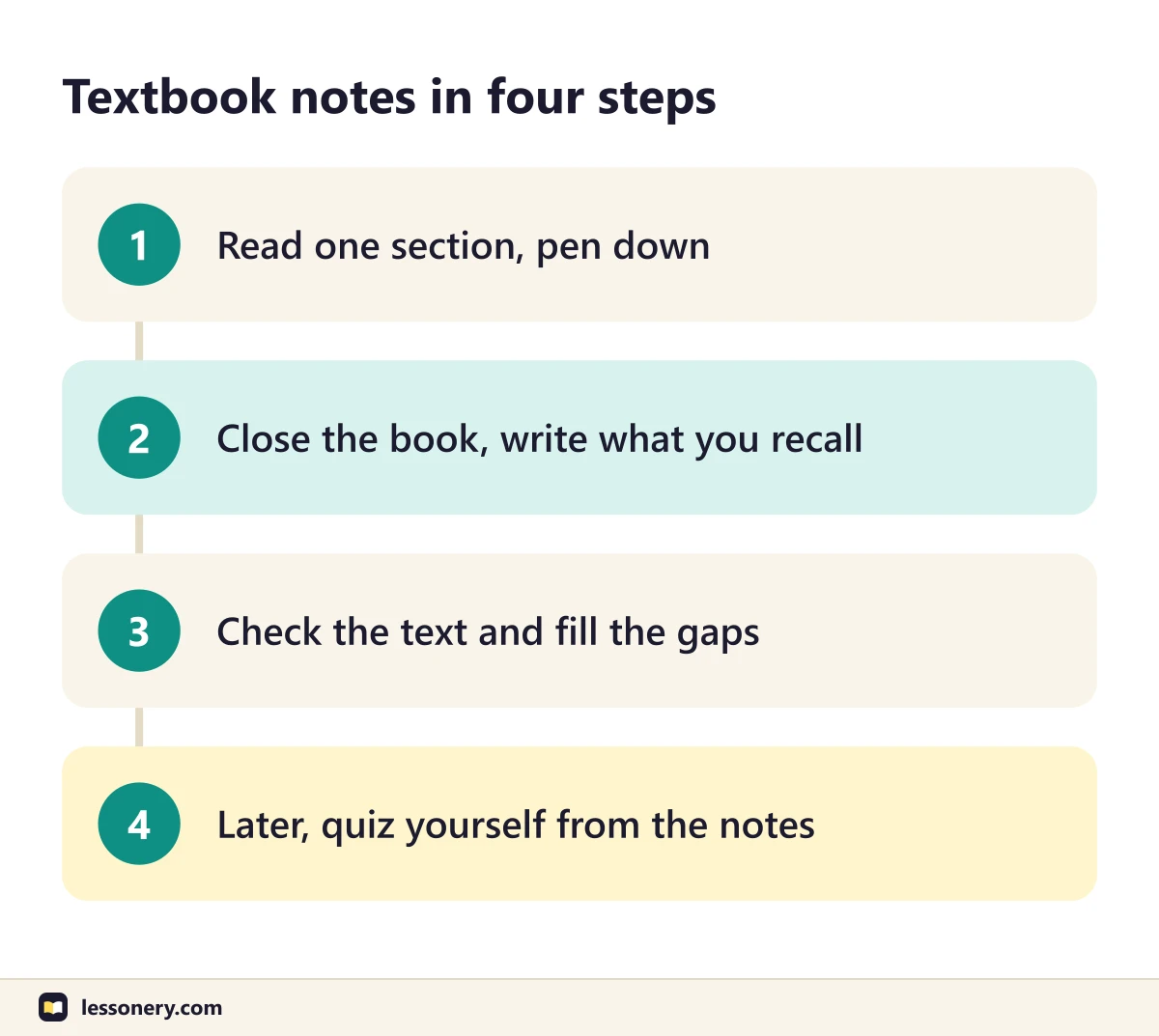
The order that UNC's handouts teach is the reverse of copying as you go. Read a section first. Close the book and write the main points in your own words. Then check what you wrote against the text, and come back later to test yourself.
Quick answer: Read one section with your pen down, then write what you remember in your own words, check it against the book and add page numbers. Keep the notes brief and use them for self-testing. A major research review rated highlighting as low utility, and concluded that summarizing can work for students who are already good at it.
Why copying and heavy highlighting don't do much
Neither copying nor highlighting requires you to put an idea into your own words. UNC's handout on taking notes while reading says copying large amounts of text takes a lot of time and energy without engaging your brain, and that highlighting too much can keep you from focusing on the main ideas.
The best-known review of the research is not encouraging about highlighting. Dunlosky and colleagues (2013) reviewed ten learning techniques and rated highlighting and underlining as low utility. In most situations that had been studied, they wrote, highlighting does little to boost performance.
One experiment they describe (Fowler and Barker, 1974) shows the pattern. Undergraduates had one hour to study about 8,000 words of articles from Scientific American and Science. Some only read, some highlighted freely, and some read copies already highlighted by another student. A week later, after 10 minutes of review, they took a 54-item multiple-choice test. The highlighting groups did not outperform the readers. Students who highlighted did better on the items they had marked and slightly worse on the items they had not.
How much you mark matters. The review notes that when students mark a lot of text, the marked parts no longer stand apart from the rest, and it describes a study (Rickards and August, 1975) in which students limited to underlining one sentence per paragraph later recalled more of a science text than students who did not underline.
A later meta-analysis by Ponce, Mayer and Méndez (2022) pooled 36 articles published between 1938 and 2019. Highlighting done by learners improved memory for the text (average effect size 0.36) but not comprehension (0.20), and it improved learning for college students but not for school students.
Note: "Low utility" is the review's rating of highlighting as a study technique. The authors write that highlighting as students usually do it is not normally detrimental, although one study they describe found a disadvantage on inference questions. Their concern is that it can take the place of more productive strategies.
What research says about notes in your own words
Writing the main points in your own words has better support than copying, with conditions attached.
Dunlosky and colleagues describe an experiment by Bretzing and Kulhavy (1979). High school students in their last two years studied a 2,000-word text for up to 30 minutes. After each page, one group wrote three lines summarizing the main points, a second took up to three lines of notes, a third copied out the three most important lines word for word, a fourth copied only the capitalized words, and a fifth only read.
On a 25-question test that required connecting information across the text, given either shortly afterward or one week later, the summary and note-taking groups scored highest. The copying group and the read-only group came next. The reviewers' reading of this result is that putting the important points in your own words adds something beyond selecting them.
The same review still rated summarization as low utility, and the reasons are useful. It can be effective for learners who are already skilled at summarizing, but many students need extensive training to do it well, and findings on which kinds of test it helps were mixed. Quality matters: in one study the review describes (Bednall and Kehoe, 2011), summarizing did not improve overall performance, and for one concept only 64% of the students' summaries contained the correct definition. Better summaries went with better test scores.
One more caution. In an experiment by Kiewra and colleagues (1989), students who read a text twice without taking notes outperformed students who took notes, according to the paper's abstract. The authors point to the processing demands of taking notes while reading, which is a caution about writing as you go.
The practical conclusion is reasoning, not a finding: notes help when they force you to select and rephrase, and they need checking because a wrong summary teaches you the wrong thing.
Note-taking from a textbook, step by step
These six steps combine UNC's handouts with the textbook reading systems that Cornell teaches.
- Preview the chapter. Scan the headings, bold terms, figures, summary and end-of-chapter questions. UNC's handout on reading textbooks suggests starting at the end, because the summary and questions show what you are expected to learn.
- Turn each heading into a question. Write the question at the top of your notes for that section. This is also the second step of the SQ3R method of reading.
- Read one section with your pen down. UNC advises finishing a section or a page before you write anything, so that you can concentrate on the reading and then summarize instead of copying.
- Close the book and write what you remember. Use your own words and keep it short: the main ideas, not every detail. UNC says it is fine not to recall everything.
- Check and repair. Open the book, correct what you got wrong and add what you missed. The University of New South Wales advises recording the page number beside each note and putting any exact wording in quotation marks.
- Review by testing yourself. Cover the notes and answer your heading questions from memory. Dunlosky and colleagues rated practice testing as high utility, the top rating in their review. The active recall method article explains the technique.
Steps 4 and 6 are the same act: recalling without looking. McDaniel, Howard and Einstein (2009) tested a read-recite-review routine with college students. With fact-based passages it produced better free recall than rereading or note-taking, both immediately and a week later. With longer engineering passages it matched note-taking on multiple-choice and problem-solving questions in less study time.
For session length, UNC suggests reading no more than about 5 to 10 pages at a time. Cornell's Learning Strategies Center describes a similar routine, P2R, built around chunks of about ten pages, and another, S-RUN, in which you underline only what explains the section heading and take notes after reading.
Example: notes on one textbook section
The page below is an example made for this article. The "textbook section" is the passage in Dunlosky and colleagues (2013) that explains why highlighted text is remembered, so the content is accurate. The layout follows the Cornell-style page UNC describes: questions on the left, notes on the right.
| Question (written before reading) | Notes (written from memory, then checked) |
|---|---|
| Why would highlighting help memory? | Isolation effect: an item that differs from its neighbors is remembered better. Example: "cow" in a list of furniture words. A highlighted sentence is the odd item on the page. |
| Does it matter who does the highlighting? | Choosing what to mark should help more than reading marked text, because you have to judge what is important. |
| When does it stop working? | Mark too much and nothing is distinctive. Marking a lot also takes less thought than picking the main point. |
| Added after checking the text | Fowler and Barker (1974): active highlighters gained more on marked material than students given pre-marked text. Small cost for unmarked material. |
| Self-test for later | What is the isolation effect? Why does over-marking weaken it? |
The notes are far shorter than the passage they cover. The last two rows are what copying does not give you: an addition made after checking, and questions to answer at the next review.
Common habits and what to do instead
| Habit | What the sources say | Do this instead |
|---|---|---|
| Copying sentences from the book | The copying group in Bretzing and Kulhavy (1979) scored below the groups that wrote in their own words | Write from memory in your own words, then check |
| Highlighting as you read | Rated low utility by Dunlosky and colleagues; over-marking removes the contrast | UNC's advice: highlight after finishing a paragraph or section, and only one sentence or phrase per paragraph |
| Writing notes after every sentence | UNC advises finishing the section or page first | Read with the pen down, then write |
| Leaving out page numbers | UNSW advises recording them so you can cite and find the passage again | Add the page beside each note |
| Filing the notes and never returning | Practice testing was rated high utility | Answer your heading questions from memory at your next review |
UNC's page on highlighting adds one more step if you do highlight: restate each highlighted idea in your own words in the margin. The guide on how to annotate a text covers margin notes in detail.
If your notes will feed an essay, the page numbers and quotation marks from step 5 are what keep a paraphrase honest. See how to paraphrase without plagiarizing, and follow your institution's rules on citation style.
For the page layout itself, the comparison of different note-taking methods explains when an outline, a chart or a concept map suits the material.
Frequently asked questions
Should you take notes while reading or after?
After each section or page, according to UNC's Learning Center. Its reason is that you can focus while you read and then summarize instead of copying.
Is highlighting a waste of time?
Not entirely. Dunlosky and colleagues rated it low utility because it did little for performance in most studies, but they note it may help when a text is difficult or when students know enough to mark well. A 2022 meta-analysis found that highlighting improved memory for text, though not comprehension.
How long should notes from a textbook chapter be?
No source reviewed here gives a number. UNC's advice is to keep notes brief and focused on main ideas. In the Bretzing and Kulhavy experiment, students wrote three lines per page, but that was the study's instruction, not a rule.
How many pages should you read before taking notes?
UNC suggests pausing after anything from a paragraph to a page when you are writing from memory, and reading no more than about 5 to 10 pages in one sitting.
Does note-taking from a textbook work on a screen?
UNC's handouts apply the same approach to digital reading. For typed notes they suggest creating one document per reading and summarizing the main points before looking back at the text, and for e-textbooks they suggest learning how the platform's navigation and bookmarks work before you start.