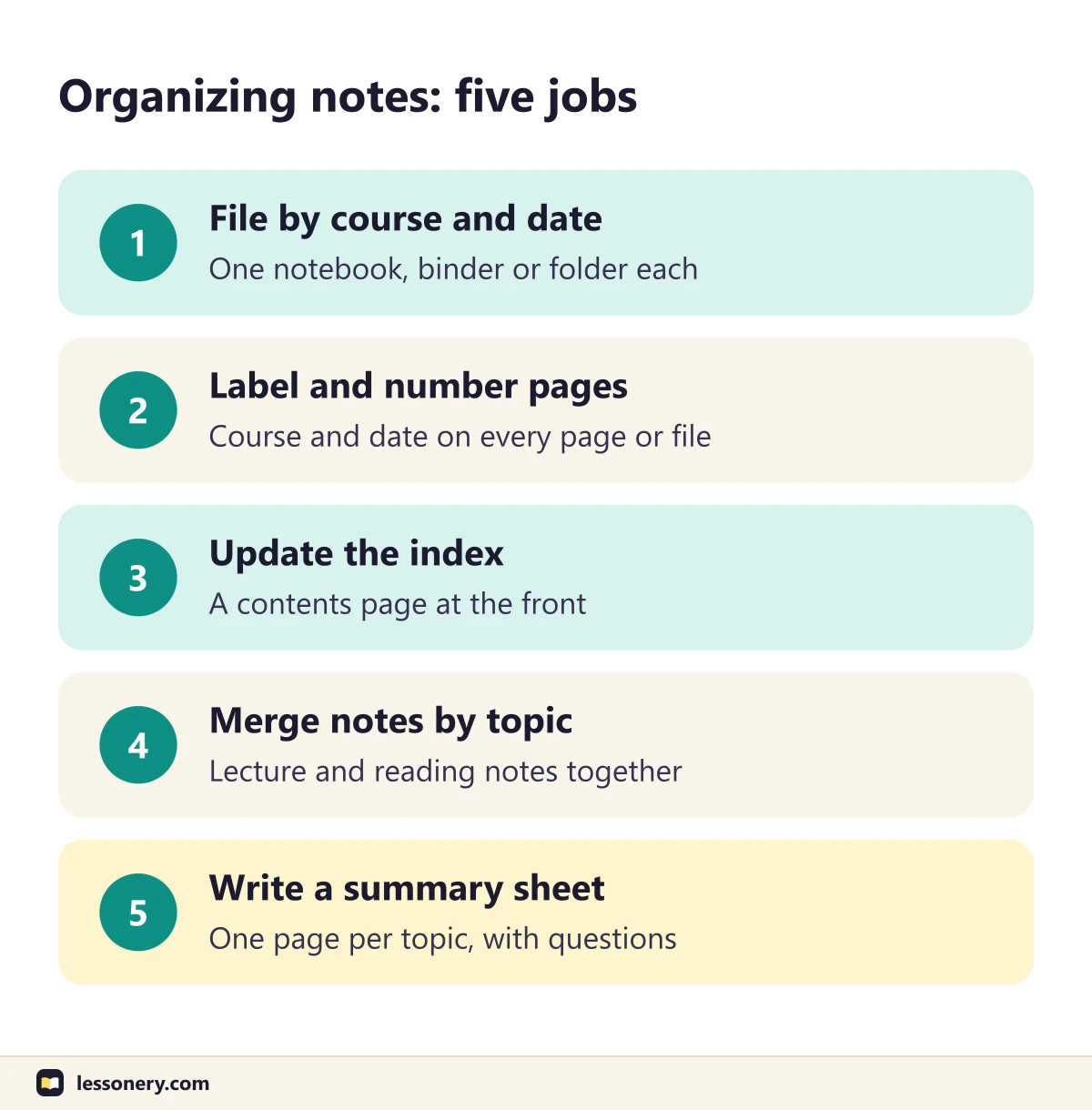
The ways to organize notes that university study guides describe can be grouped into five jobs: keep each course separate and in date order, label every page, keep an index, bring lecture and reading notes together by topic, and condense each topic into a summary sheet before exams.
None of that is learning in itself. The research described below supports reviewing notes, adding to them, rearranging them to show how ideas relate, and testing yourself from them. Organizing is what makes those steps possible weeks later, when you need a page and have to find it.
Quick answer: Give each course its own notebook, binder or folder, and title every page or file with the course and date. Keep a contents page. After class, fill gaps and group lecture and reading notes by topic. At the end of each topic, write a one-page summary sheet and use it to quiz yourself. A short weekly session keeps all of it current.
What research says about reviewing and reorganizing notes
The benefit of notes depends heavily on going back to them. Kobayashi (2005) combined 57 studies that compared taking notes with not taking them and described the effect as positive but modest. A second meta-analysis of 33 studies by Kobayashi (2006) found that taking and reviewing notes, compared with doing neither, had a substantial effect.
How you go back matters too. In a research summary written for college instructors, Kiewra, Colliot and Lu (2018) report that students record, on average, about one third of a lesson's important ideas. They add that students often review in shallow ways, such as recopying and rehearsing notes, and that these activities do little to boost achievement.
Two findings from that summary bear on organizing.
- Add, don't recopy. In a study by Luo and colleagues (2016), students heard a 14-minute recorded lesson and then either revised their notes, adding to them, or simply recopied them. Only the revisers added new lesson ideas, and they outperformed the copiers modestly: by 3% on a fact test and by 13% on a test of relationships between ideas.
- Rearrange to show relationships. The authors describe most notes as linear lists that hide how ideas connect, and recommend graphic organizers such as matrices: tables that set topics side by side. Organizing is one part of their four-part SOAR method (select, organize, associate, regulate). In one study they cite (Daher and Kiewra, 2016), students who made their own SOAR study materials after 30 minutes of training learned 8% more facts and 31% more associations than students using their preferred methods.
Dunlosky and colleagues (2013), who reviewed ten learning techniques, rated practice testing as high utility and summarization as low utility, partly because many students need training to summarize well. That is a reason to use a summary sheet for self-testing and not just for rereading.
Note: No study opened for this article compared physical ways to organize notes, such as binders against notebooks or one folder layout against another. The advice on those points comes from university study guides, not experiments.
Organize by course and date
Keep everything for one course in one place, in the order you made it. A one-page skills handout from the Academic Learning Center at Sul Ross State University, revised in 2013 and drawn from a 1982 study-skills textbook, calls this the cardinal principle: keep all materials for each course separate so they are easy to locate.
The University of North Carolina's Learning Center gives the page-level version: title each page with the class name and date, and keep all notes for a class together in chronological order. The University of Hull's library says a system does not need to be complicated: one notebook or ring binder per module (the UK term for a course unit), with a title and date on each set of notes. Its main advice is to stick to the scheme you choose.
Paper: notebook, binder or folder
The Sul Ross handout compares three containers for paper notes.
| Container | Advantage it lists | Disadvantage it lists |
|---|---|---|
| Spiral notebook | Notes for a course stay bound together | No convenient place for handouts unless it has pockets |
| Loose-leaf binder with dividers | Handouts can be inserted next to the notes they go with | Often heavy and bulky; pages tear loose |
| Folder with double pockets | Notes, handouts and returned work fit in one folder; inexpensive | Papers fall out if the folder is dropped; folders are somewhat fragile |
The handout says any one of these, or a combination, will work.
Headings and an index
Headings make a page searchable by eye. The University of New South Wales advises headings, subheadings and numbered lists inside the notes, plus a list of the abbreviations and symbols you use.
An index makes the whole set searchable. The Open University's guidance on organising your notes says to label and number all your pages if you use loose paper, and to devise an index and keep it up to date. The University of Southampton's library suggests a contents page at the front of each file, and starting a fresh page for each sub-topic so pages can be moved and refiled.
The contents page below is an example made for this article. The entries echo the note-taking research described in this guide.
| Date | Lecture | Topic | Pages | Reading notes |
|---|---|---|---|---|
| October 5 | L7 | Two functions of notes | 31–34 | Ch. 5, pp. 35–36 |
| October 7 | L8 | Reviewing and revising notes | 37–40 | Ch. 5, p. 41 |
| October 12 | L9 | Laptop and longhand studies | 42–46 | Ch. 6, pp. 47–48 |
Digital folders and file names
The same structure works on a computer. UNSW suggests one document per lecture, labeled with the course name, lecture number and date, with all documents and course materials in a folder labeled with the course code. The Open University advises naming folders clearly by content and using subfolders, and notes that files kept in online storage can be reached from any device.
For the names themselves, Iowa State University Library's guide to file naming, part of a general guide for anyone who manages digital files and not written about study notes in particular, gives rules that can be applied to notes:
- Put the most important element first, because that is what the files sort by.
- Write dates as YYYY-MM-DD so that files sort chronologically.
- Use leading zeros in a numbered series (001, not 1).
- Avoid spaces and special characters; separate parts with hyphens or underscores.
- Keep names short: the guide suggests 32 characters or fewer.
Here is an example layout that follows those rules. The course and file names are invented.
BIO101/
  lectures/
    2026-10-05_L07_membranes.docx
    2026-10-07_L08_transport.docx
  readings/
    ch05_membranes_notes.docx
  summaries/
    topic04_membranes_summary.docx
UNC's page notes two practical advantages of digital notes: they are easier to edit and reorganize, and they can be backed up and searched. Whether typing or handwriting is better for learning is a separate question with mixed evidence, covered in the article on taking notes in class.
Consolidate lecture and reading notes
Group notes by topic, not by where they came from. The Australian National University's Academic Skills team advises students to collate all notes for each topic, including lectures, tutorials and set readings.
Do the repair first. UNC says to go back over notes within a day or two to fill in missing pieces and define terms, then to chunk them into categories or sections. This is the adding step that helped in the Luo study. Harvard's Academic Resource Center notes that the side column of a Cornell page can be used to keep track of related textbook pages, which ties the two sets together without rewriting either.
Where a topic compares several things on the same features, a table shows the relationships that a list hides, as Kiewra and colleagues describe. The comparison of different note-taking methods explains charts and the other formats.
For long projects that draw on many sources, some students go further and keep linked single-idea notes. That approach is described in the article on Zettelkasten note-taking.
Make summary sheets before exams
A summary sheet is one page that holds the main ideas of a topic. ANU's advice is to write a one-page summary at the end of each topic, and a one-page master summary for the whole course at the end of the term. For revision you start from the master sheet and work backwards through your notes to the details.
The University of Utah's Learning Center lists what a summary sheet can include: the most important terms and ideas, connections between them, definitions, visuals, examples, questions you think might be on the test, and points you are still confused about. The same handout says rewriting notes may not be beneficial and does not create connections.
The sheet below is an example made for this article.
TOPIC: Reviewing notes                               (example)

Main ideas
- Taking and reviewing notes: substantial effect (Kobayashi 2006)
- Taking alone: positive but modest (Kobayashi 2005)
- Students record about 1/3 of important ideas (Kiewra et al. 2018)

Connections
- Incomplete notes, so revise by adding, not by recopying

Self-test questions
- What did revisers gain over copiers in Luo et al. (2016)?
- Which rating did practice testing receive?

Still unclear
- How long after class was the test in the revision study?
Use the questions, not just the page. Cover the sheet and answer them from memory, as described in the guide to the active recall method.
Watch out: Whether you may bring a summary sheet or formula sheet into an exam is decided by your teacher or institution. Check the rules for each exam.
A weekly tidy-up
All of these ways to organize notes depend on upkeep, and a short weekly session is enough to stop a pile from forming. Cornell's Learning Strategies Center, in its handout on the Cornell system, says to spend at least ten minutes every week reviewing all your previous notes.
The routine below is an example that combines the steps above. The times are illustrative, not figures from a study.
| Step | What you do | Time |
|---|---|---|
| File | Put loose sheets and handouts in the right course, in date order; move stray files into course folders | 5 minutes |
| Label | Add missing dates and page numbers; rename files to your pattern | 3 minutes |
| Index | Add the week's lectures and readings to the contents page | 2 minutes |
| Repair | Fill gaps and expand abbreviations while you still remember the class | 10 minutes |
| Summarize | Add the week's main ideas and two questions to the topic's summary sheet | 5 minutes |
| Test | Answer last week's questions from memory | 5 minutes |
That works out to 30 minutes a week in this example.
Frequently asked questions
Is a binder better than a notebook?
No source opened for this article tested that. The Sul Ross handout lists advantages and disadvantages for each and says any one of them will work. The Hull guide's point is consistency: keep to the scheme you pick.
Should you rewrite your notes to make them neater?
Kiewra and colleagues describe recopying as a shallow review activity that does little for achievement. In the Luo study, students who added to their notes did modestly better than students who recopied them, and Utah's handout advises making a summary sheet in place of rewriting.
How often should you organize your notes?
UNC suggests going back to each set within a day or two, and Cornell's handout suggests at least ten minutes of review every week. A weekly session covers the filing and the index.
Should typed notes go in one long file or many?
UNSW suggests one document per lecture, labeled with the course name, lecture number and date. Dated names in a single folder then sort themselves in order.
What are good ways to organize notes for several courses at once?
The guides cited above agree on separation: one notebook, binder section or folder per course. The Sul Ross handout notes that a loose-leaf binder with dividers can hold all courses together if you prefer a single binder.