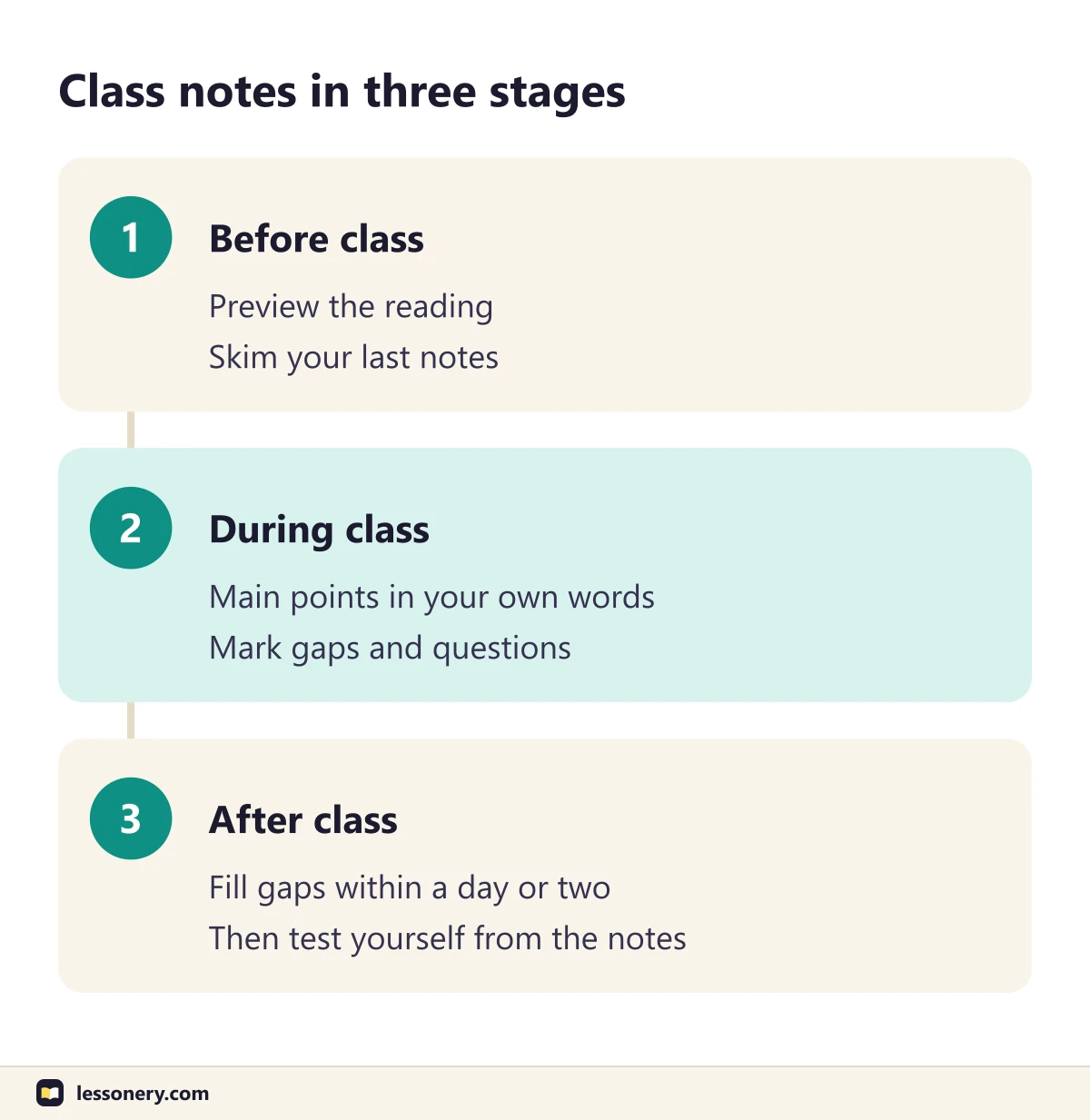
Taking notes in class is three jobs, not one: a few minutes of preparation before the lecture, selective writing during it, and a review soon after. The writing gets most of the attention. The research on note-taking gives at least as much weight to the review.
This guide follows that order. It then looks at the longhand versus laptop question, where the best-known study has not held up consistently when other researchers repeated it.
Quick answer: Before class, preview the reading and skim your last notes. During class, write the main points in your own words and mark gaps and questions instead of trying to capture every sentence. Within a day or two, fill the gaps and test yourself from the notes. Evidence on handwriting versus typing is mixed.
Why taking notes in class helps: two functions
Researchers describe two ways notes help. The first is encoding: the act of writing during the lecture. The second is external storage: having a record to study later. Kiewra's (1989) review of this research reports that taking notes helps even when they are never reviewed, and that reviewing them helps too.
The two do not appear to be equal in size. Kobayashi (2005) combined 57 studies comparing students who took notes with students who did not, and described the encoding effect as positive but modest. A second meta-analysis of 33 studies by Kobayashi (2006) found that taking and reviewing notes, compared with doing neither, had a substantial effect.
There is a practical reason the review matters. In a research summary written for college instructors, Kiewra, Colliot and Lu (2018) report that students record, on average, about one third of a lesson's important ideas. They cite figures of 120 to 180 words per minute for lectures, against 22 words per minute for longhand writing and 33 for typing.
In one study they describe, students wrote down 91% of the broadest main ideas but only 11% of the most detailed points. Notes taken in class are a first draft with holes in it, mostly in the details and examples.
Before class: prepare the page and the topic
Preparation is about knowing the likely main ideas before the lecturer says them. The University of North Carolina's Learning Center lists four things to do before class:
- Preview the assigned reading to find the likely main ideas.
- Check the syllabus for the topic and focus of the session.
- Look over your notes from the previous session.
- Title the page with the course and date, and keep each course's notes together in order.
The University of New South Wales adds two more in its note-taking guide: download the slides if they are available, and sit near the front.
During class: what to write down
Be selective. Given the speeds above, a complete record is out of reach, so taking notes in class is mostly a matter of choosing.
Listen for the signals
Both guides list similar cues that a point matters: the introduction and the closing summary, phrases such as "there are four main...", repetition, and a change in the lecturer's voice or gestures. UNSW adds that you need to separate main points from examples and elaboration.
Write phrases in your own words
UNSW recommends phrases instead of full sentences, a consistent set of abbreviations and symbols, and paraphrasing except where exact wording matters. It says to keep technical terms as given. UNC makes a distinction by content: for conceptual material, concentrate on the main points; for factual material, it says writing down most of the lecture can help with short-answer recall, provided you study those notes within 24 hours.
Leave gaps and mark questions
When you miss something, UNSW's advice is to write a keyword, leave a space and fill it in later. UNC suggests noting your questions and anything confusing so you can follow it up. A question mark in the margin shows you exactly where to look after class.
Don't copy the slides
If slides are provided, UNSW advises using them as an outline and adding what the lecturer says, not copying them word for word. Harvard's Academic Resource Center suggests annotating the slides directly when they are available, adding your questions and clarifications beside the point they belong to.
The layout of the page is a separate choice. The comparison of different note-taking methods explains when an outline, a chart or the Cornell note-taking system fits a lecture.
After class: fill the gaps, then test yourself
Go back to the notes within a day or two. That is UNC's timing, and UNSW and Harvard both say to review soon after the lecture and then again later.
The first pass is repair. Fill the gaps you marked, define terms, expand abbreviations, and flag what you still don't understand so you can ask about it. Kiewra, Colliot and Lu describe a study (Luo and colleagues, 2016) in which students heard a 14-minute recorded lesson and then either revised their notes, adding to them, or simply recopied them. Only the revisers added new lesson ideas, and they outperformed the copiers modestly: by 3% on a fact test and by 13% on a test of relationships between ideas.
The second pass is self-testing. Dunlosky and colleagues (2013), who reviewed ten learning techniques, rated practice testing as high utility. Applied to notes, that means covering the page and trying to recall it, or writing questions in the margin and answering them without looking. The articles on the active recall method and on a spaced repetition schedule explain how to do this and how to time it.
Longhand or laptop: what the studies found
The evidence is mixed. Harvard's guide, for one, recommends handwriting where possible, but the best-known study pointing that way has not been consistently reproduced.
| Study | What was done | What was found |
|---|---|---|
| Mueller and Oppenheimer (2014) | Three studies. In the first, college students watched TED Talks, took notes by hand or on a laptop with no internet, and were tested 30 minutes later | Equal scores on factual questions; laptop note-takers did worse on conceptual questions |
| Morehead, Dunlosky and Rawson (2019) | A direct replication, with added groups using an eWriter device or taking no notes | Performance did not consistently differ between groups |
| Urry and colleagues (2021) | A direct replication of the first study at Tufts University, plus a combined analysis of eight similar studies | No significant difference in quiz scores between laptop and longhand |
| Flanigan and colleagues (2024) | A meta-analysis of 24 studies of typed versus handwritten college lecture notes | Higher achievement after taking and reviewing handwritten notes (g = 0.248); more notes when typing (g = 0.919) |
The original finding
Mueller and Oppenheimer (2014) reported that laptop notes contained more words and more word-for-word overlap with the lecture. Students who took more notes did better, and so did students whose notes were less verbatim. The authors' explanation was that typing invites transcription without processing. The pattern held when students were told not to write verbatim, and in a further study in which they could review their notes before a test one week later. The paper's abstract puts it in one line: in three studies, students who took notes on laptops did worse on conceptual questions than students who wrote longhand.
The replications
Morehead, Dunlosky and Rawson (2019) ran a direct replication. Some results leaned toward longhand, but no group consistently outperformed another, including the group that took no notes, and the differences shrank further after students studied their notes. Pooling the direct replications gave small effects favoring longhand that were not statistically significant. The authors called it premature to say which method is superior.
In the study by Urry and colleagues (2021), 145 undergraduates at Tufts University took part, and the paper's abstract reports the comparison for 74 laptop and 68 longhand note-takers. As in the original, laptop notes were longer and more verbatim. Quiz scores did not differ significantly. The authors point out a limit: students could not review their notes before the quiz, so the result speaks to the encoding function only.
When review is included
That limit matters, because the picture changes somewhat once review is part of the design. Luo and colleagues (2018) found that laptop note-takers recorded more words and more verbatim strings, while longhand note-takers recorded more images. As Kiewra, Colliot and Lu describe the study, students watched a 23-minute narrated slide lesson. Tested straight afterward with no review, the laptop group scored higher on text-based questions and the two groups were level on image-based ones. When students reviewed their notes for 15 minutes first, the longhand group scored higher on both. The authors concluded that the best medium depends on the lecture and on whether the notes are reviewed.
The meta-analysis by Flanigan and colleagues (2024) pooled 24 studies of college students from 21 articles. It found that taking and reviewing handwritten notes led to higher achievement, while typing produced a greater volume of notes.
One finding cuts the other way. In Bui, Myerson and Hale (2013), participants who tried to transcribe a lecture on a computer had the best recall on immediate tests, and, when notes could be studied, transcribers recalled more on a delayed test than participants who took organized notes. Without study, organized notes did better on the delayed test.
Watch out: Distraction is a separate issue from typing. In a simulated classroom, Sana, Weston and Cepeda (2013) found that participants who multitasked on a laptop during a lecture scored lower on a test, and so did participants who were in direct view of someone multitasking. If you type, the article on how to not get distracted while studying has practical steps.
A fair reading of all this: neither tool is clearly better for learning during the lecture itself, handwriting may have an edge once notes are reviewed, and in the one simulated-classroom study above, using a laptop for other things lowered test scores for the user and for people who could see the screen. Follow your teacher's or institution's rules on devices where they exist.
Example: one lecture from start to finish
The plan below is an example made for this article. The actions come from the guides above; the times are illustrative estimates, not figures from a study.
| When | What you do | Time |
|---|---|---|
| Evening before | Skim the headings and summary of the assigned chapter; reread the last page of your notes | 10 minutes |
| First minute of class | Write the course, date and topic at the top of a new page | 1 minute |
| During the lecture | Record main points as phrases; leave a space and a keyword where you fall behind; put "?" beside anything unclear | Length of the lecture |
| Same evening or next day | Fill the gaps from the slides or textbook; define new terms; write four or five questions in the margin | 15 minutes |
| Three days later | Cover the notes, answer the margin questions from memory, then check | 10 minutes |
Frequently asked questions
Is taking notes in class better by hand or on a laptop?
Studies disagree. The original 2014 finding in favor of longhand was not consistently reproduced in two direct replications. A 2024 meta-analysis found an advantage for handwritten notes when they are taken and reviewed, and found that typing produces more notes.
Should you write down everything the teacher says?
No, and you could not if you tried: the figures cited by Kiewra and colleagues put lectures at 120 to 180 words per minute and longhand writing at 22. University guides recommend selecting main points, with fuller notes for fact-heavy material that you will study soon afterward.
How soon should you review class notes?
UNC's Learning Center says within a day or two. UNSW's guide says that if you typed your notes, you should review them within 24 hours.
What if the lecturer talks too fast?
Write a keyword and leave a gap, as UNSW suggests, then fill it in after class. If the lecture is recorded, Harvard's guide suggests watching it once at normal speed while taking notes as you would live.
Do notes still help if you never look at them again?
Somewhat. Kobayashi's 2005 meta-analysis describes the benefit of taking notes without review as positive but modest. The benefit of taking and reviewing them was described as substantial in his 2006 analysis, so notes you never review leave value unused.