A spaced repetition schedule is a plan for reviewing the same material several times with gaps in between, instead of in one long session. The research on spacing does not hand you one correct set of intervals. It found that the best gap depends on how long you need to remember the material, which for a student usually means how far away the test is.
Two papers by Nicholas Cepeda and colleagues speak most directly to gap length, and the example plan further down is built on them.
Quick answer: Review each topic several times on different days, and set the gaps by your test date. Cepeda et al. (2008) found that the best single gap was roughly 20 to 40% of a one-week test delay and 5 to 10% of a one-year delay. Dunlosky et al. (2013) summarize this as about 10 to 20% of the time you need to remember the material. A gap that is too short costs more than one that is too long.
What a spaced repetition schedule is
A spaced repetition schedule sets when you will come back to something you have already studied. UC San Diego's psychology department defines spaced practice, also called distributed practice, as spreading study over several shorter sessions across days or weeks instead of concentrating it in one block before an exam. The benefit is known as the spacing effect.
Three terms from the research make the rest easier to follow.
| Term | Meaning |
|---|---|
| Gap | The time between two study sessions on the same material |
| Test delay (retention interval) | The time between your last review and the test |
| Massed practice | Repeating the material back to back with no gap, as in cramming |
What the spacing research found
Spacing beats massing: Cepeda et al. (2006)
Cepeda, Pashler, Vul, Wixted and Rohrer (2006) pooled 317 experiments from 184 articles on verbal recall tasks, mostly lists and word pairs. Across 271 comparisons involving more than 14,000 participants, people recalled 47.3% of the items after spaced study and 36.7% after massed study, with total study time held equal. Only 12 of the 271 comparisons showed no effect or a negative effect of spacing.
The review also found that the two timings work together: the gap that produced the best retention got longer as the delay before the test got longer.
It had a weak spot, which the authors pointed out in their next paper. Most of the experiments used very short intervals. Only about a dozen looked at test delays as long as one day, and just a handful went past one week.
The best gap depends on the test date: Cepeda et al. (2008)
Cepeda, Vul, Rohrer, Wixted and Pashler (2008) tested long intervals directly. They recruited 1,354 adults from an online research panel (average age 34, living in many countries) and taught them 32 obscure trivia facts until each fact had been answered correctly once.
After a gap of 0 to 105 days, each person had a second session: two rounds of questions on every fact, with the correct answer shown after each response. The final test came 7, 35, 70 or 350 days after that second session. People were randomly assigned to one of 26 combinations of gap and test delay.
For every test delay, recall first rose as the gap got longer and then slowly fell. The table shows where the peak was on the recall test.
| Test delay | Best gap among those tested | Best gap estimated from the fitted curve | Estimated gap as a share of the delay |
|---|---|---|---|
| 7 days | 1 day | about 3 days | 43% |
| 35 days | 11 days | about 8 days | 23% |
| 70 days | 21 days | about 12 days | 17% |
| 350 days | 21 days | about 27 days | 8% |
- The best gap grows with the delay, but not in proportion. The authors summarize it as falling from about 20 to 40% of a one-week delay to about 5 to 10% of a one-year delay.
- The effect was large. For a fixed amount of study time, the best gap produced 64% higher final recall than a gap of zero days.
- Too short is worse than too long. As the gap increased, accuracy climbed steeply and then declined much more gradually, so the cost of overshooting the best gap was much smaller than the cost of undershooting it.
Dunlosky and colleagues (2013), who rate distributed practice as having high utility, condense the finding into a rule of thumb: performance was best when the gap was approximately 10 to 20% of the time the material needed to be retained. Their examples are sessions 12 to 24 hours apart to remember something for one week, and 6 to 12 months apart to remember it for five years.
The US Institute of Education Sciences gives teachers a related recommendation in its practice guide on organizing instruction and study: review important course content "after a delay of several weeks to several months." It rates the evidence for that recommendation as moderate.
Do the gaps have to get longer each time?
Current evidence doesn't require it. An expanding schedule is one in which each gap is longer than the last, for example 1, 3, 7 and then 14 days. The manual for the flashcard program Anki illustrates the same pattern with a card seen today and then 3, 15 and 45 days later.
Cepeda et al. (2006) found that expanding gaps either helped or did about the same as fixed gaps, and called that conclusion tentative because individual studies conflicted. A later meta-analysis by Latimier, Peyre and Ramus (2021) covered 29 studies of spaced retrieval practice. Spacing the practice beat massing it (an effect size of g = 0.74, which the authors call a strong benefit), but expanding and equal-gap schedules did not differ significantly (g = 0.034). The authors conclude that their results do not support what they describe as a widely held belief that gaps should keep growing until the test.
An expanding schedule is fine if it suits your calendar. The research doesn't show it beating equal gaps, so use whichever pattern you will keep to.
How to build your own schedule, step by step
- Start from the date you need the material. For most courses that is the exam. Count the days between first learning a topic and that date.
- Work out a gap from that number. Using the 10 to 20% rule of thumb from Dunlosky et al., the table below shows what the gap works out to.
- When in doubt, go longer. This applies the Cepeda et al. (2008) finding that a gap past the best point costs less than a gap short of it.
- Make each review a self-test, then check your answers. The second session in the 2008 study was a test with feedback, not a reread. The active recall method covers ways to do this.
- Mix old and new material. UCSD suggests that each session cover a new portion of the course and also revisit earlier content, and gives a split of 75% new material to 25% review as one example.
- Add a late review for anything you need beyond this exam. Cepeda et al. (2008) write that for information you want to keep for several years, a review delayed by at least several months is likely to give a highly favorable return on the time spent.
| Time until the test | 10 to 20% of that time |
|---|---|
| 1 week | about 1 day (Dunlosky et al.: 12 to 24 hours) |
| 2 weeks | about 1.5 to 3 days |
| 4 weeks | about 3 to 6 days |
| 10 weeks | 7 to 14 days |
| 1 year | about 5 to 10 weeks |
Apart from the first row, these figures are this article's arithmetic applied to the rule of thumb, not results from a study.
Note: Cepeda et al. (2008) studied one gap between two sessions and counted the test delay from the second session. A plan that counts from the first lesson and uses three or four reviews is a simplified extension of that finding, not something the experiment tested.
An example schedule: one lecture, exam four weeks later
This schedule is an example to adapt, made for this article, not a plan from a study. The lecture is on Monday, November 2, 2026 and the exam on Monday, November 30, 2026, which is 28 days later. Twenty percent of 28 days works out to 5.6 days, rounded here to 6.
| Date | Day | What to do |
|---|---|---|
| Monday, November 2 | 0 | Attend the lecture. Afterward, turn your notes into 10 to 15 questions. |
| Sunday, November 8 | 6 | Review 1: answer every question from memory, check, mark the misses |
| Saturday, November 14 | 12 | Review 2: all questions again, missed ones twice |
| Friday, November 20 | 18 | Review 3: same routine |
| Thursday, November 26 | 24 | Review 4: same routine |
| Monday, November 30 | 28 | Exam |
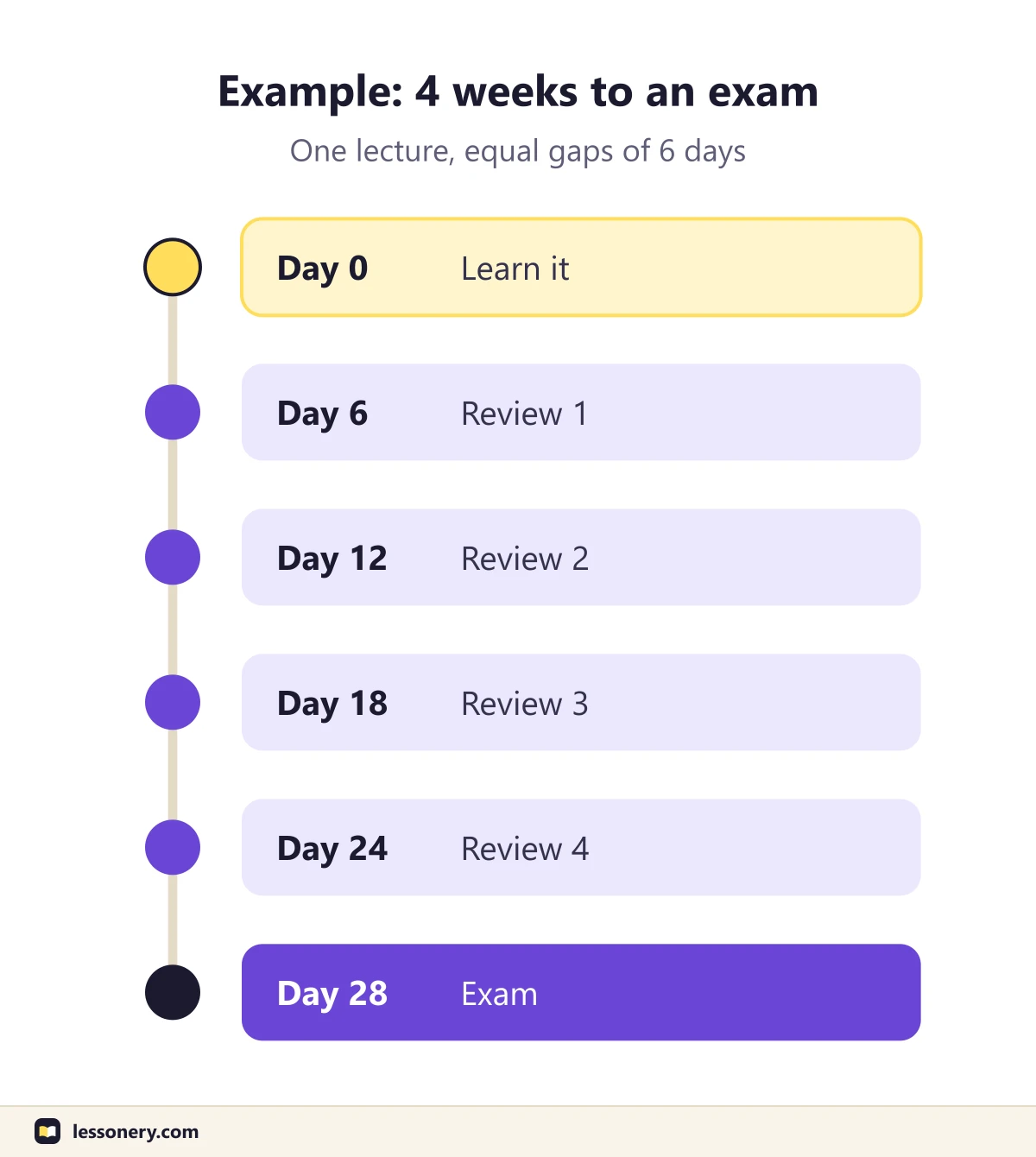
The gaps are equal because, as noted above, expanding gaps have not been shown to work better. Each lecture gets its own row of dates, so in practice one review session covers several lectures at different stages. A weekly study schedule is the easiest place to hold those sessions.
Expect the first review to feel rough. Dunlosky et al. describe a classic experiment by Bahrick (1979) in which students relearned Spanish word translations in sessions 0, 1 or 30 days apart. The 30-day group had forgotten the most at the start of each session and remembered the most on a final test 30 days after the last one.
Where a schedule goes wrong
| Problem | What the research says | What to do |
|---|---|---|
| All the reviews fall in the last two or three days | UCSD notes that gains from repeating material in one sitting usually fade within a few days | Start the calendar several weeks before the exam |
| Gaps of minutes or hours when the test is weeks away | In Cepeda et al. (2008), a gap that was too short cost more than one that was too long | Lengthen the gap toward 10 to 20% of the time left |
| Rereading at each review | The reviews in the 2008 study were tests followed by the correct answer | Answer from memory first, then check |
| Dropping the plan after a missed day | In Cepeda et al. (2008), a gap longer than the best one cost relatively little | Do the review when you can and carry on |
If the exam is days away and none of this has happened yet, the advice in how to cram for an exam is the more useful starting point.
The evidence has limits too. The 2008 study used isolated trivia facts and adult volunteers online, not a course syllabus. Dunlosky et al. cite the IES guide's own caution that few spacing studies have examined complex, structured bodies of information, and add that the classroom data that exist are promising.
Frequently asked questions
What is the best spaced repetition schedule?
There isn't one fixed answer. In Cepeda et al. (2008) the best gap ranged from about 1 to 3 days for a test one week away to about three or four weeks for a test nearly a year away.
How many reviews does each topic need?
The research doesn't give a number. Dunlosky et al. report that studies varying the number of practice sessions found that more sessions led to better retention, and that the benefit of each extra correct recall gets smaller.
What if my exam is only a week away?
Short gaps still help. For a one-week delay, Dunlosky et al. suggest sessions 12 to 24 hours apart, and in Cepeda et al. (2008) a one-day gap was the best of those tested for a test seven days later.
Does spacing mean studying for more hours?
No. The comparisons in both Cepeda papers held study time equal and changed only when the sessions happened. For help placing review sessions among your other deadlines, see how to create a study schedule.