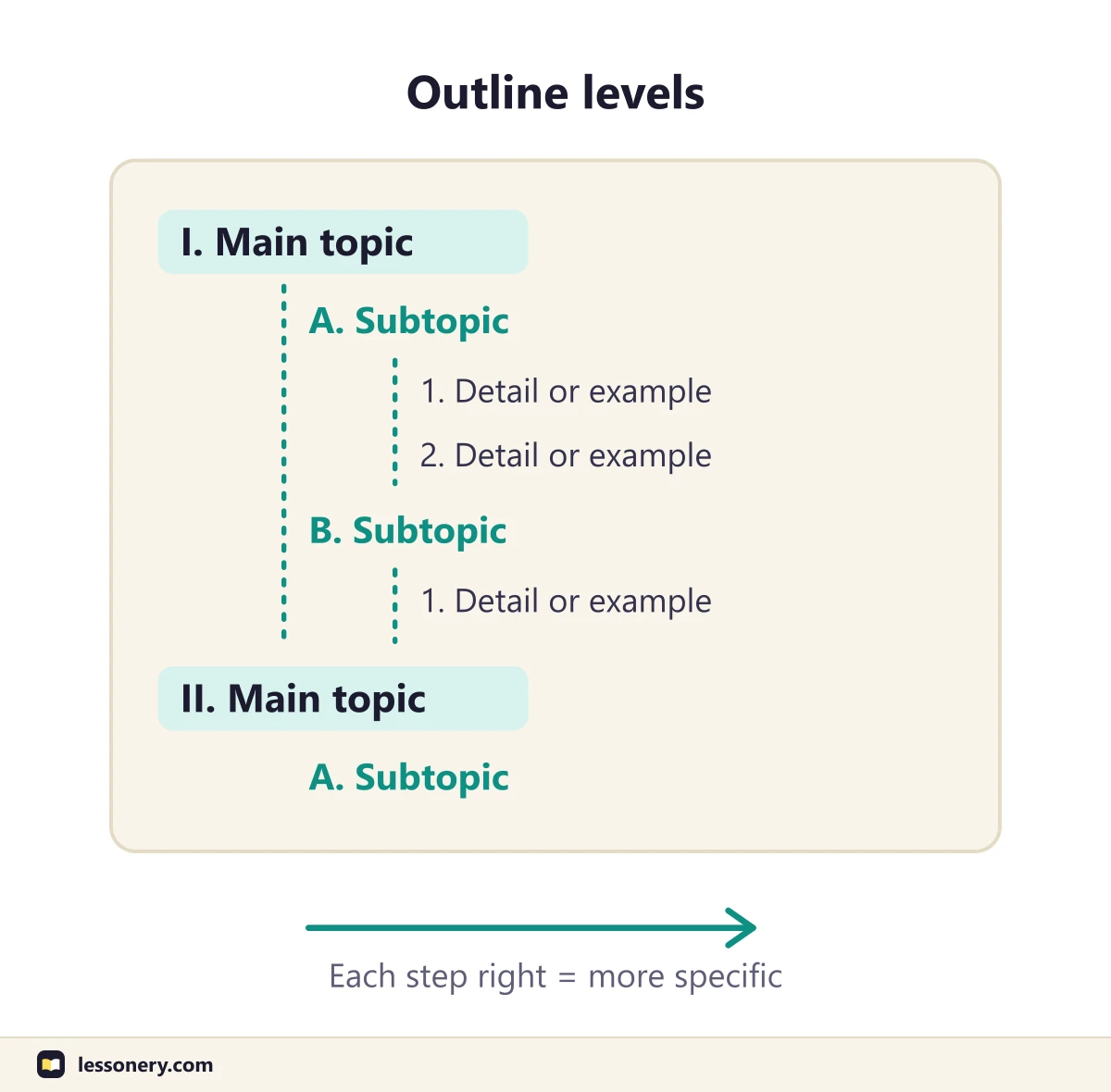
The outline method of note taking arranges a lecture or chapter as a hierarchy. Main topics start at the left margin, and each level of supporting detail is indented one step further to the right, so the page shows which idea belongs under which.
It suits material that is presented in an organized way. It gets harder when a lecture moves fast or jumps between topics, and it is a poor match for content built on diagrams or worked problems.
Quick answer: Write each main topic at the left margin, indent subtopics beneath it, and indent details and examples again beneath each subtopic. When the subject changes, go back to the margin. Numbers and letters are optional, because the indentation already shows the levels.
What the outline method of note-taking is
The outline method records two things at once: the content and how the pieces of content relate. The University of Tennessee at Chattanooga's guide to common note-taking methods describes it this way: the most general information starts at the left, more specific facts are indented to the right, and the relationships are carried by the indentation.
The University of York's guide calls it a structured, hierarchical format that ranks information by importance, using main topics and subpoints marked with numbers, letters or bullets.
How to outline with levels and indentation
The steps below follow the York guide and Colorado State University's page on note-taking strategies.
- Head the page. Write the topic at the top. The University of North Carolina's Learning Center suggests adding the class name and date to every page.
- Put the first main topic at the left margin. Treat it as a headline.
- Indent for subtopics. Each idea that belongs under the main topic goes on its own line, one step to the right.
- Indent again for details. Facts, examples and definitions that support a subtopic go one step further right.
- Return to the margin when the subject changes. A new main topic starts a new block.
Write phrases, not full sentences. The same Learning Center page advises concise, structured notes with abbreviations, symbols and bullets, whatever the format.
Labels: numbers, letters or nothing
Labels are a choice, not a requirement. The Chattanooga guide says no numbers, letters or Roman numerals are needed because the spacing already separates major points from minor ones.
If you want labels, the conventional set is the one in the University of Houston's format sheet for outline notes. It follows the same order that Purdue OWL gives for an alphanumeric outline: Roman numerals, capital letters, Arabic numerals, then lowercase letters.
| Level | What it holds | Where it sits | Formal label |
|---|---|---|---|
| 1 | Main topic | At the left margin | I, II, III |
| 2 | Major subtopic | Indented once | A, B, C |
| 3 | Minor subtopic | Indented twice | 1, 2, 3 |
| 4 | Detail | Indented three times | a, b, c |
Dashes or bullets do the same job with less to decide during a lecture. Labels can help afterward, because they let you point to a single line, such as II.B, when you discuss the notes or plan an essay from them.
A filled-in example
The outline below is an example written for this article. It shows how notes might look for a lecture on a well-known review of study techniques, Dunlosky and colleagues (2013), and every entry comes from that review's abstract.
Learning techniques: Dunlosky et al. (2013)

I. What the review did
   A. Examined 10 learning techniques
   B. Rated each: high, moderate or low utility
      1. Do benefits hold across learners, materials, tasks?

II. High utility
   A. Practice testing
   B. Distributed practice

III. Moderate utility
   A. Elaborative interrogation
   B. Self-explanation
   C. Interleaved practice
      1. Promising, but evidence still limited

IV. Low utility
   A. Summarization
   B. Highlighting / underlining
   C. Keyword mnemonic
   D. Imagery for text learning
   E. Rereading
      1. B and E: widely used, no consistent benefit
This content is easy to outline for three reasons: it has a small number of main topics, every technique belongs to exactly one of them, and nothing in it depends on a diagram.
The same notes without labels look like this:
High utility
   - Practice testing
   - Distributed practice
When the outline method fits and when it doesn't
The outline method of note-taking works when you can hear the structure of the lesson as it happens. The university guides agree closely on where that is true.
| Situation | Does outlining fit? | Source |
|---|---|---|
| The lecture moves from general points to specific ones | Yes | Chattanooga |
| There is enough time in class to decide what goes under what | Yes | Chattanooga |
| The course is taught in a traditional, organized way | Yes | York |
| The class is mostly written information, not charts or other visuals | Yes | Colorado State |
| The lecture is too fast | No | Chattanooga, York |
| The lecture jumps between topics | No | Colorado State |
| The subject relies on charts, diagrams or problem solving, such as physics or math | No | York, Colorado State, Chattanooga |
The guides list drawbacks even where the method fits. Chattanooga notes that an outline may not show sequential relationships and needs more thought in class to organize accurately. York adds that it is difficult to insert new information later without disrupting the structure, and that outlining can turn into passive note-taking. Colorado State warns that it can lead to writing down too much.
Watch out: For a lecture that is dense and fast, the Chattanooga guide points to the sentence method instead: write each new point on its own numbered line. It warns that such notes are hard to review until you edit them to show how the points relate.
What research says about outline notes
No study described here tested students who used the outline method of note-taking against students who used another method over a whole course. The research is about pieces of the question.
Outline notes were useful for review in one experiment. Kiewra and colleagues (1988) gave 44 undergraduates one of three kinds of notes for reviewing a lecture (the complete text, a linear outline or a matrix, which is a table) or no notes at all. Any notes beat no notes. Outline and matrix notes produced higher recall, and matrix notes produced the greatest transfer. These were notes supplied by the researchers, not written by the students.
The deeper levels are where notes run thin. In a study described in a review by Kiewra, Colliot and Lu (2018), students recorded 91% of a lesson's most general ideas, 60% of the next level, 35% of the third level and 11% of the most detailed level. In outline terms, the lines at the margin get written and the most indented lines are the ones most likely to be missing.
Hearing the structure helps. The same review describes an experiment by Titsworth and Kiewra (2004) in which one version of a lecture included spoken cues to its organization, such as naming each topic and category as it began. Students who heard the cues recorded about 40% more organizational points and 45% more details. That fits the guides' advice that outlining works best when the lecture itself is delivered in outline form.
A framework from the instructor helps too. A meta-analysis of 33 studies by Kobayashi (2006) found that providing a framework or the instructor's notes did more to strengthen the effects of note-taking and review than training or verbal instructions alone. In two experiments with 195 undergraduates, Kiewra and colleagues (1995) found that an outline framework listing subtopics in the order of the lecture led to more note-taking than a condensed matrix framework with fewer subtopics.
Organized notes are not always better than a transcript. Bui, Myerson and Hale (2013) ran three experiments in which participants either wrote organized notes or tried to transcribe the lecture. In the first, which also compared handwriting with typing, those who transcribed on a computer had the best recall on immediate tests, and the later experiments looked at computer note-taking only. On delayed tests, organized notes produced the best recall. When participants could review their notes before a delayed test, the result reversed and transcribers recalled more. The evidence is mixed, and it depends on whether and when you review.
Using your outline after class
An outline is easy to turn into a self-test. Both the Chattanooga and York guides point out that main points and headings can be turned into questions. Cover the indented lines under "II. High utility" in the example and ask yourself which techniques belong there. That is retrieval practice, which the article on the active recall method explains.
Fill the gaps soon. Kiewra, Colliot and Lu (2018) recommend rereading notes shortly after a lesson and adding what you remember but did not write down.
You can combine formats. An outline can sit in the notes column of a page set up for the Cornell note-taking system, with questions added beside it. For content where ideas connect in several directions, mind mapping is an alternative, and the overview of different note-taking methods compares the rest. The same levels are used for planning written work, covered in the article on writing an essay outline.
Frequently asked questions
Do you have to use Roman numerals in the outline method?
No. The University of Tennessee at Chattanooga's guide says markings are not necessary because the spacing shows which points are major and which are minor. Dashes, bullets or plain indentation all work.
Is the outline method of note-taking good for math and science classes?
The university guides say it is less suitable there. York lists physics, chemistry and maths as poor fits because they are visual or built on problem solving, and Chattanooga makes an exception for some science classes such as physics or math.
What is the difference between the outline method and the Cornell method?
The outline method is a way of arranging the notes themselves by level. The Cornell system is a page layout with a notes column, a cue column for questions and a summary. They can be used together, with the outline written in the notes column.
Does the outline method work on a laptop?
York's guide says the method suits online learners and digital note-taking. Whether typed or handwritten notes lead to better learning is a separate and unsettled question, covered in the article on taking notes in class.