The Cornell note taking system is a way of ruling a page so that the notes you take in class become questions you can test yourself on later. You draw two lines, write your notes in the wide column, then add questions and a short summary once the class is over.
It was developed by Walter Pauk, an education professor at Cornell University, and the university's Learning Strategies Center still teaches it. Below are the page layout, the five steps as Cornell lists them, a filled-in example and what studies of note-taking and review found.
Quick answer: Divide the page into a 2.5-inch cue column on the left, a 6-inch notes column on the right and a 2-inch summary strip at the bottom. Take notes in class, write questions in the cue column soon after, then cover the notes and answer the questions aloud. Reflect on the material and review all your notes every week.
Where the Cornell note-taking system comes from
Cornell's Learning Strategies Center says the system was originally developed by Walter Pauk, an education professor at the university, who set it out in his book How to Study in College. The center's page cites chapter 10 of the tenth edition, published in 2010, which Pauk wrote with Ross Owens.
The University of Cincinnati's Learning Commons dates the method to the 1950s and describes its purpose as building a study guide and a reference system inside your notes. Cornell's own public note-taking module adds that there is not one right way to use Cornell notes.
The Cornell page layout
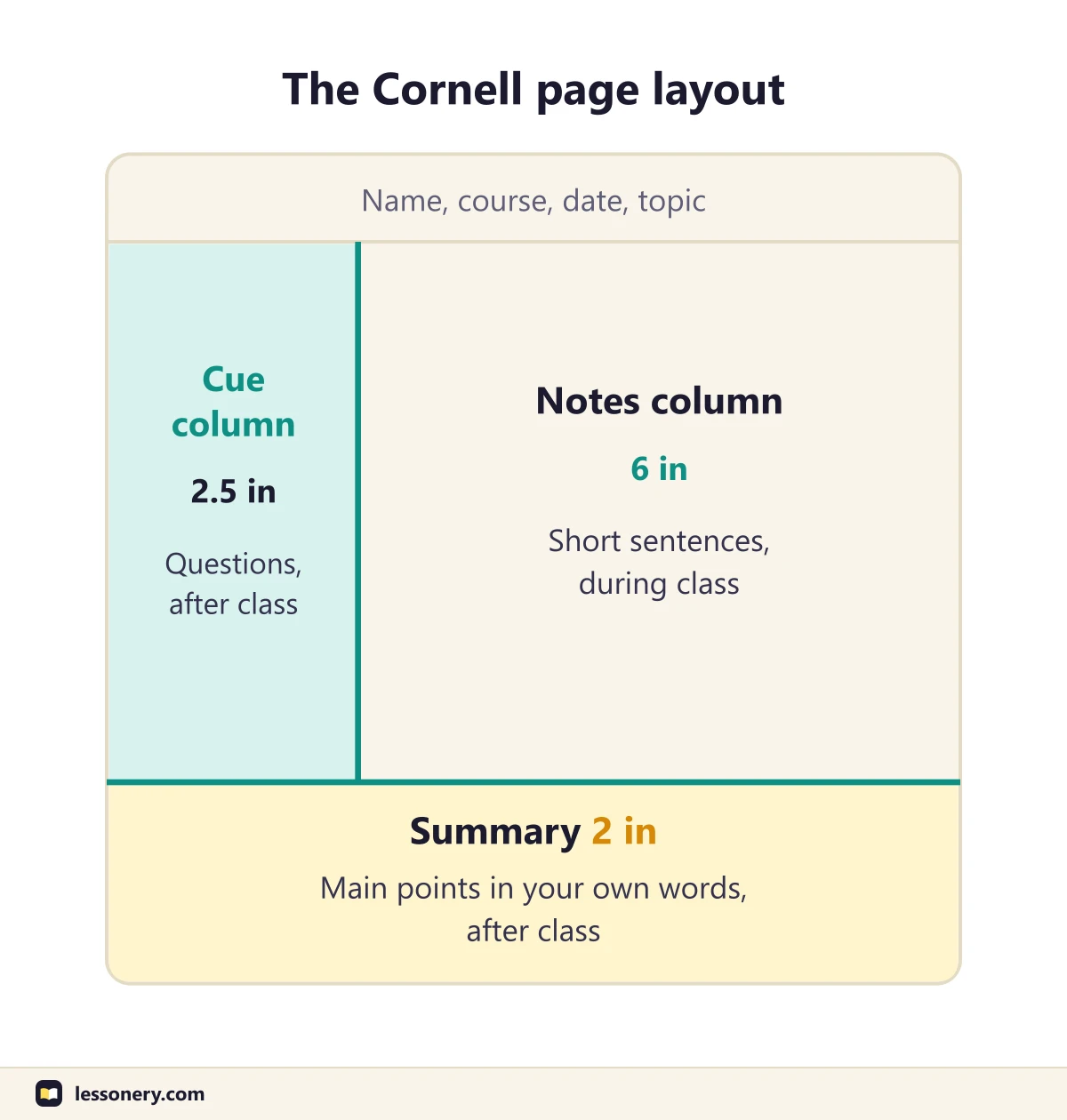
The page has three areas, and each is filled at a different time. The University of Manitoba's Academic Learning Centre, in a handout based on Cornell's page, gives the measurements: a vertical line 2.5 inches from the left edge marks off the cue column, the note-taking column is the remaining 6 inches, and a horizontal line 2 inches from the bottom marks off the summary. That works out to roughly 6.4 cm, 15 cm and 5 cm.
Note: On other paper sizes, keep the proportion: a study by Quintus and colleagues, discussed below, describes the left column as one third of the page and the right column as two thirds.
| Area | Size | When you fill it | What goes in it |
|---|---|---|---|
| Notes column (right) | 6 inches wide | During class | Lecture notes in short sentences and abbreviations |
| Cue column (left) | 2.5 inches wide | Soon after class | Questions or keywords, lined up with the notes they refer to |
| Summary (bottom) | 2 inches high | After class | The main points of the page, in your own words |
The Cincinnati page adds a header for every page: your name, the course title, the date and the lecture topic.
The five steps, as Cornell's Learning Strategies Center lists them
Cornell's handout, adapted from the seventh edition of Pauk's book, lists five steps: record, questions, recite, reflect and review.
- Record. During the lecture, write in the notes column using what the handout calls telegraphic sentences: short, clipped phrases instead of full ones. The Manitoba handout suggests leaving a gap wherever you miss something so that you can fill it in after class.
- Questions. As soon after class as possible, write questions in the cue column based on the notes beside them. Cornell's handout says this clarifies meanings, shows how ideas relate and strengthens memory, and that it sets you up for exam study later.
- Recite. Cover the notes column with a sheet of paper. Looking only at the questions or cue words, say the answers aloud in your own words.
- Reflect. Ask yourself questions about the material. The handout's examples include what the facts mean, what principle they rest on, how you could apply them and how they fit with what you already know.
- Review. Spend at least ten minutes every week reviewing all your earlier notes.
The summary strip does not appear in Cornell's five-step list. The Manitoba handout places it in the questions step: at the end of your notes for that class, write a brief summary in your own words. It treats this as a warning signal too, because if you cannot summarize the page you probably have not understood it yet.
A filled-in example
The page below is an example made for this article, not a template from Cornell. It shows notes for a sample lecture on concept maps, and the facts in it come from Joseph Novak and Alberto Cañas's paper on the theory underlying concept maps.
| Cue column (written after class) | Notes column (written in class) |
|---|---|
| What is a concept map? | Concept map = graphical tool for organizing + representing knowledge |
| Who developed it, and where? | Novak, 1972, research at Cornell on children's science knowledge |
| What counts as a concept? | Concept = regularity in events or objects, given a label |
| What do linking words do? | Linking words on the line between 2 concepts say how they relate |
| What is a proposition? | 2+ concepts joined by linking words = a meaningful statement |
| How is the map arranged? | Hierarchy: most general concepts at top, specific ones below |
| What are cross-links? | Links between concepts in different parts of the map |
| Summary | A concept map shows knowledge as labeled concepts joined by linking words into statements. It runs from general ideas at the top to specific ones below, with cross-links between its parts. |
To recite from this page, cover the right-hand column, read a question and answer it aloud. Then uncover the notes and check.
What research on note-taking and review says
Studies of Cornell notes themselves are few and small
There is little direct research on the Cornell format, and the one classroom comparison read for this article found no advantage. Quintus and colleagues (2012) compared two sections of a child development class at a US high school, with 16 students in each. One section was taught Cornell notes and required to use them; the other took notes in any way the students chose. Over about seven weeks the classes sat three unit tests, and the scores did not differ significantly on any of them. On the last test the averages were 83.44% for the student-choice section and 83.06% for the Cornell section.
The authors list limitations: both sections were required to take notes, and there was no way to know whether students used their notes to study. One small classroom study shows that Cornell notes did not raise scores there, not that they cannot help. The same paper cites an earlier study, by Faber and colleagues (2000), in which students who were taught the Cornell method scored significantly better than students who were not, so the direct evidence is mixed.
Research on note-taking formats in general is limited too. Reed, Rimel and Hallett (2016) searched for note-taking interventions with college students that ran over several sessions and found only 10 studies published between 1990 and 2014. Seven tested guided notes, two tested split-page notes and one tested notes that students restructured themselves. Across the nine group studies the weighted average effect on content learning and note quality was 0.54 (Hedges's g). The abstract does not report results for the split-page format separately.
Reviewing your notes matters more than the format
The stronger evidence is about what you do with notes after class. A meta-analysis of 33 studies by Kobayashi (2006) found that the combined effect of taking and reviewing notes, compared with doing neither, was substantial.
Kiewra, Colliot and Lu (2018) reach a similar conclusion in their review: studies that compare the two functions of note-taking generally find that reviewing the notes contributes more than the act of taking them. In one study they describe, students who took notes on a 20-minute lesson and then reviewed them scored 51% on a test, while students who took notes but had none to review scored 44%.
That is the case for the Cornell page: it is designed around review, not around recording.
The cue column is a self-testing tool
Dunlosky and colleagues (2013) reviewed ten learning techniques and rated practice testing and distributed practice (spreading study over time) as high utility. In the section on practice testing they name the Cornell system as one way for students to test themselves: leave a blank column in class, enter key terms or questions in it shortly afterward, and use them for self-testing when reviewing the notes later. The review did not test Cornell notes as a format.
The same review rated summarization as low utility, noting that it helped some students on some tasks but only under limited conditions.
What follows is reasoning, not a finding. The recite step is practice testing, and the weekly review spreads study over time, so those two steps line up with the review's highest-rated techniques. The summary strip is summarization. On that reading, the cue column deserves more of your time than the summary. The articles on the active recall method and on building a spaced repetition schedule explain the two techniques.
Handwritten or typed
Cornell's page states that taking notes by hand is more effective than typing on a laptop. The evidence is more mixed than that sentence suggests. Mueller and Oppenheimer (2014) reported across three studies that students who took notes on laptops did worse on conceptual questions than students who wrote longhand. A direct replication by Morehead, Dunlosky and Rawson (2019) found that test performance did not consistently differ between groups.
A later meta-analysis of 24 studies by Flanigan and colleagues (2024) found higher achievement after taking and reviewing handwritten notes (g = 0.248), although typing produced more notes. The article on taking notes in class goes through these studies one by one. None of them tested a typed Cornell page against a handwritten one.
Where the Cornell system goes wrong
Four of the five steps happen after class, so most of the ways to go wrong do too. The fixes below come from the Cornell, Manitoba and Cincinnati handouts.
| Mistake | Fix from the handouts |
|---|---|
| The cue column stays empty | Write the questions as soon after class as possible |
| You reread the notes instead of testing yourself | Cover the notes column and answer each question aloud |
| You try to write down every word | Use short sentences and abbreviations, and leave lines between points for later additions |
| The summary repeats phrases from the notes | Write it in your own words; if you cannot, go back over the page |
| You never return to old pages | Review all your earlier notes for at least ten minutes every week |
The format has costs. Colorado State University's teaching institute lists two: it takes time to set up the page, and summarizing after the lecture takes effort. In the Quintus study, some students in the Cornell section complained about the format and the extra work.
If the layout does not suit a course, the comparison of different note-taking methods covers the alternatives, including the outline method and mind mapping.
Frequently asked questions
Who created the Cornell note-taking system?
Walter Pauk, an education professor at Cornell University, developed it and described it in his book How to Study in College. The University of Cincinnati's Learning Commons dates the method to the 1950s.
How wide is the cue column in Cornell notes?
The University of Manitoba handout puts the dividing line 2.5 inches from the left edge, which leaves 6 inches for notes. On other paper sizes, a cue column of about one third of the page width keeps the same proportion.
Can you use the Cornell system on a laptop or tablet?
Yes. The method is a layout plus a review routine, and a two-column table reproduces both. Studies comparing typed and handwritten notes have had mixed results, and none described here compared the two for Cornell pages.
Is the Cornell method better than other note-taking methods?
The studies described here do not show that. The classroom comparison by Quintus and colleagues found no significant difference in test scores between Cornell notes and notes taken in the students' own way, although its authors cite an earlier study with a positive result. Self-testing and regular review have stronger support, and you can add them to any format.