Zettelkasten note taking means keeping your notes as a box of small, numbered slips, one idea on each, that refer to one another. "Zettelkasten" is German for slip box. The method is modeled on the card index of the German sociologist Niklas Luhmann (1927–1998), whose papers are held at Bielefeld University.
What Luhmann did is well documented by the researchers who look after his archive. Whether the method helps students learn has barely been tested: the one study found for this article was small and combined the slip-box with a review schedule.
Quick answer: Write each idea on its own note in your own words, give every note a fixed number, link it to related notes and keep a keyword index that points to a few entry notes. Luhmann built his for decades of research, so it fits long projects that draw on many sources. No controlled study opened for this article tested the method by itself, so treat it as a way to organize notes, not as a learning technique with measured results.
What Luhmann's slip-box was
It was a paper card index that he kept for more than four decades. Bielefeld University's page on the Niklas Luhmann-Archiv (in German) describes about 90,000 notes written between 1951 and 1996. The university acquired his papers in 2011 and is transcribing the notes for an online edition.
The fullest account in English comes from Johannes Schmidt, the scientific coordinator of that project. In an article in the journal Sociologica, Schmidt (2018) describes roughly 90,000 handwritten cards in A6 format, kept in two collections. The two sources differ by a year on the end date: the archive page says the notes were written up to 1996, and Schmidt dates the second collection from 1963 to 1997.
| First collection | Second collection | |
|---|---|---|
| Years, as Schmidt dates them | About 1951 to 1962 | 1963 to 1997 |
| Cards | About 23,000 | About 67,000 |
| Top-level sections | 108 | 11 |
| Keyword index | About 1,250 entries | 3,200 entries |
| Links between cards (Schmidt's estimate from a sample count) | About 20,000 | About 30,000 |
Schmidt names four features that made the box usable.
- A fixed address for every card. Card 1/1 is followed by 1/2. A later card that picks up one idea from 1/1 is numbered 1/1a and filed between them, and 1/1a1 branches off again. One card in the second collection carries the number 21/3a1p5c4fB1a.
- No strict subject hierarchy. The top-level sections were only loosely tied to what was filed under them, and a new card had to relate only to the card it was placed behind, not to an overall classification. In Schmidt's words, "there is no top and no bottom."
- Links. On a card, Luhmann wrote the number of another card, often in a distant part of the box. Some cards at the start of a section list up to 25 such references.
- A keyword index. For each term it typically gives only one to four card numbers. The rest are reached by following the links.
The notes were not copied passages. Schmidt writes that Luhmann's reading notes were "not simply excerpts": he made rough notes during the day and rewrote them in the evening as new cards, asking how what he had read could connect with cards already in the box. Luhmann called the box a "second memory." One of his own cards, in Schmidt's translation, says that "without writing, there is no thinking."
Schmidt also records the costs. A card that was not linked into the web "becomes lost irretrievably," some parts of the box appear untouched since they were written, and by Luhmann's own account the upkeep took up much of his time.
The principles of Zettelkasten note-taking
Guides for students reduce the system to a few rules. The Learning Center at Washington University in St. Louis, in an article by one of its peer coaches, gives three starting steps: write "atomic" notes that each hold a single idea in your own words, learn the three types of notes described below, and give every note a unique ID. It also tells readers to link each note to related ones.
| Principle | How guides teach it | What Schmidt describes in Luhmann's box |
|---|---|---|
| One idea per note | A short note on a single thought | Small A6 cards; an idea picked up from a card got a card of its own |
| Your own words | Summarize, don't copy | Reading notes that were "not simply excerpts," rewritten each evening |
| A fixed address | A number or code on every note | A number per card that never changed |
| Links | Connect each note to related ones | References on cards; about 20,000 and 30,000 in the two collections |
| An entry point | Tags on each note (the Missouri guide below) | A keyword index with one to four card numbers per term |
The first row is the guides' rule. Schmidt describes small cards and branching, but he does not report a one-idea-per-card rule of Luhmann's.
Guides also sort notes into types. The University of Missouri Libraries' guide to the method describes fleeting notes (quick daily jottings), source notes (on one book or article) and numbered notes (the refined ones, built from the other two). The Washington University article calls the last two literature notes and permanent notes.
Schmidt's account of Luhmann's box does not use those labels. The Missouri guide lists Sönke Ahrens's book How to Take Smart Notes (2017) among its further reading and describes it as that author's "particular interpretation" of the method.
A small worked example
This example was made for this article. The content comes from research described in the article on taking notes in class, and the numbering is a simplified version of the scheme Schmidt illustrates.
1    Notes help in two ways: by taking them (encoding) and by
     having them to review (storage). Kiewra 1989.
     See 1a, 2

1a   Taking notes with no review: positive but modest effect.
     Kobayashi 2005, 57 studies.      See 1b

1b   Taking AND reviewing, compared with neither: substantial
     effect. Kobayashi 2006, 33 studies.
     My conclusion: plan the review.      See 1a, 2, 3

2    Students record about one third of a lesson's important
     ideas. Kiewra, Colliot and Lu 2018.
     So notes are a first draft.      See 1b

3    Practice testing: rated high utility. Dunlosky et al. 2013.
     So review by self-testing.      See 1b

INDEX   review: 1b    self-testing: 3    gaps in notes: 2
Card 1a branched off card 1 when a second source added detail. Card 3 came from different reading weeks later, and the link to 1b is what ties it to the earlier cards. The index lists one entry card per keyword.
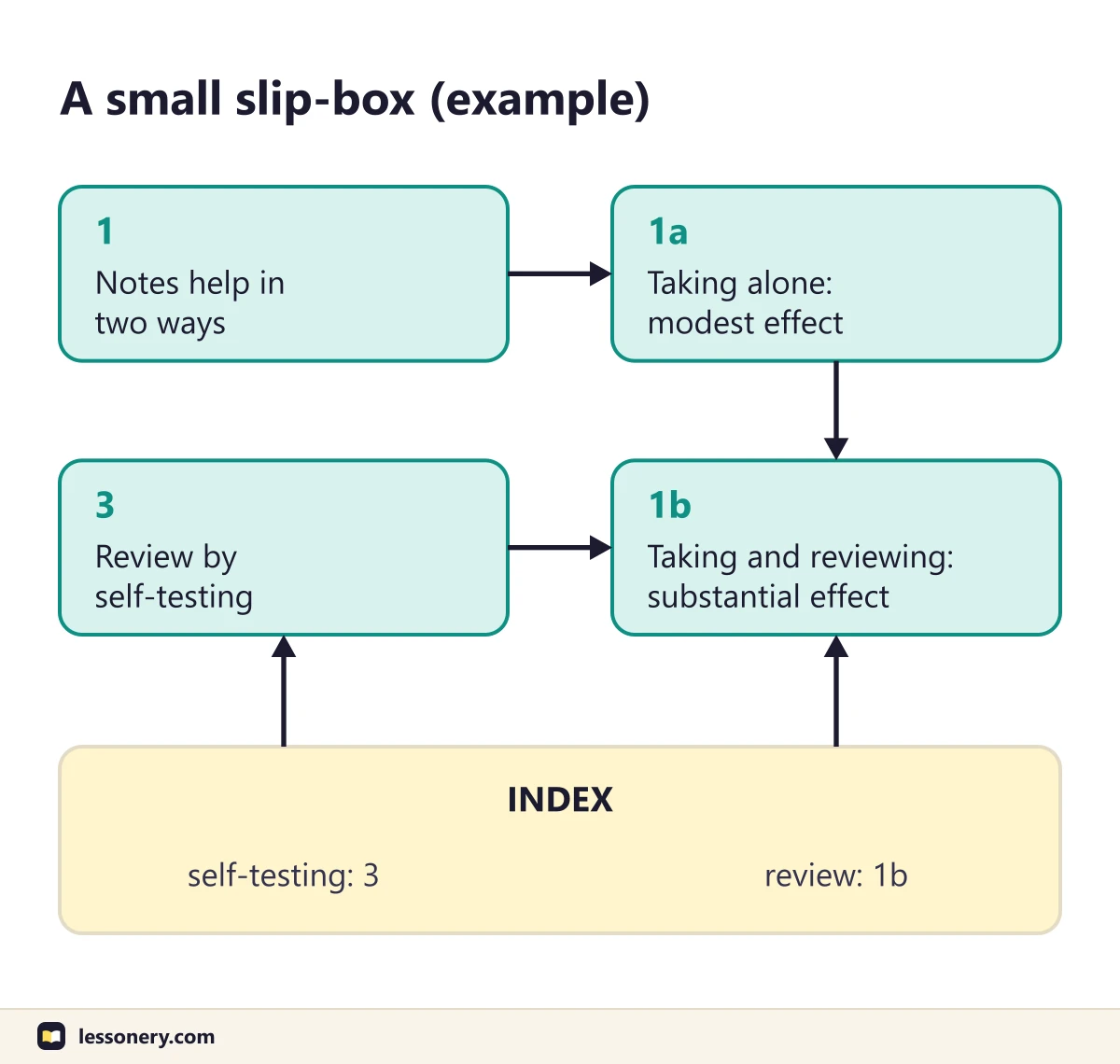
Asked "How should I review lecture notes?", you would look up "review" in the index, start at 1b and follow its links to 3, 2 and 1a. Four cards from four sources then sit in front of you in an order that already resembles a paragraph.
How a student could use it for a long project
The steps below combine Schmidt's description with the Missouri guide's workflow. They suit a dissertation, a thesis or an extended essay that draws on many sources.
- Take rough notes while you read. Record the source and page. The University of New South Wales advises putting page numbers beside paraphrases and quotations.
- Rewrite soon afterward. Turn each idea worth keeping into one short note in your own words. The Missouri guide suggests converting fleeting notes in the evening and breaking down source notes at least weekly.
- Number and place it. Decide which existing note it continues, supports or contradicts, and give it the next number or a branch of that note's number.
- Add links in both directions. Schmidt reports that Luhmann went back to older cards to add references when new cards made them necessary.
- Update the index. Add a keyword only when a note opens a new topic.
- Draft from the box. Start from an index entry, follow the links and lay the notes out in order. The guide to writing an essay outline covers the next stage.
The box can be paper or digital. Luhmann's was paper, and Schmidt points out that looking up a card by hand took more time than a click. The Washington University article mentions index cards in a physical box as well as digital tools, and the Missouri guide shows the workflow in the reference manager Zotero, as one example of the type.
Watch out: A note in your own words still needs its source. Keep the reference and page on every card, mark exact wording with quotation marks, and follow your institution's citation rules. The guide on how to paraphrase without plagiarizing explains the difference.
What research says, and what it doesn't
The method itself
One experiment was found for this article. Malashenko and colleagues (2023) recruited a convenience sample of 40 students, 20 per group, for an online course on corporate innovation management. One group was trained to make linked Zettelkasten-style notes and to review them in four sessions, at intervals of 1 day, then 3, 5 and 7 days. The other group took notes in its usual way and reviewed once. On a 50-mark test given two weeks after the course was provided, the trained group averaged 40.25 and the other group 29.05. The paper does not say that students were assigned to the groups at random.
That result can't show what the slip-box did. The trained group also reviewed four times on a spaced schedule, and distributed practice is one of the two techniques Dunlosky and colleagues (2013) rated as high utility, as the article on a spaced repetition schedule explains.
Luhmann's output is not evidence either. Schmidt notes that his publication list ran to more than 500 titles, but one scholar's record cannot separate the method from the person.
Research on its parts
| Principle | Closest research | What it found |
|---|---|---|
| Your own words | Bretzing and Kulhavy (1979), as described by Dunlosky et al. (2013) | High school students who wrote short summaries or notes scored higher than students who copied lines word for word |
| Explaining connections | Elaborative interrogation and self-explanation in Dunlosky et al. (2013) | Both rated moderate utility |
| Linking ideas | Schroeder et al. (2018), a meta-analysis of concept maps | Moderate benefit (g = 0.58); creating a map (g = 0.72) helped more than studying one (g = 0.43) |
| Coming back to notes | Kobayashi (2006), 33 studies | Taking and reviewing notes had a substantial effect compared with doing neither |
Dunlosky and colleagues (2013) add a caution about writing in your own words. They rated summarization as low utility because many students need extensive training to do it well, and results depended on the quality of the summaries. The concept-map figures come from Schroeder and colleagues (2018), who pooled 142 effect sizes, and the review figures from Kobayashi (2006).
None of these studies used slips, numbers or an index. They are consistent with the idea behind the method: rephrasing and connecting ideas is more useful than copying them. They do not show that a slip-box produces that benefit better than an outline or a set of well-reviewed course notes.
When it doesn't fit
For a single exam on a fixed syllabus, notes filed by course and date are simpler to keep, and reviewing notes and self-testing both have direct evidence. The article on ways to organize notes covers that route.
A slip-box also fails quietly. As Schmidt warns, a card with no link into the rest is hard to find again.
Frequently asked questions
What does Zettelkasten mean?
It is German for "slip box." In study advice it now refers to the method of keeping single-idea notes that link to each other.
How many notes did Luhmann write?
About 90,000, according to both Bielefeld University and Schmidt (2018). Schmidt counts roughly 23,000 cards in the first collection and 67,000 in the second.
Do you need software for Zettelkasten note-taking?
No. Luhmann used handwritten A6 cards. Software makes following a link faster.
Is a Zettelkasten good for exam revision?
That has not been tested separately. In the one experiment described above, the Zettelkasten group also reviewed on a spaced schedule. For exams, practice testing has far more evidence behind it, as the guide to the active recall method explains.
How is it different from Cornell or outline notes?
Those are page formats for recording one lecture or chapter, compared in the article on different note-taking methods. A Zettelkasten is a way of storing and connecting notes from many sources over months or years.