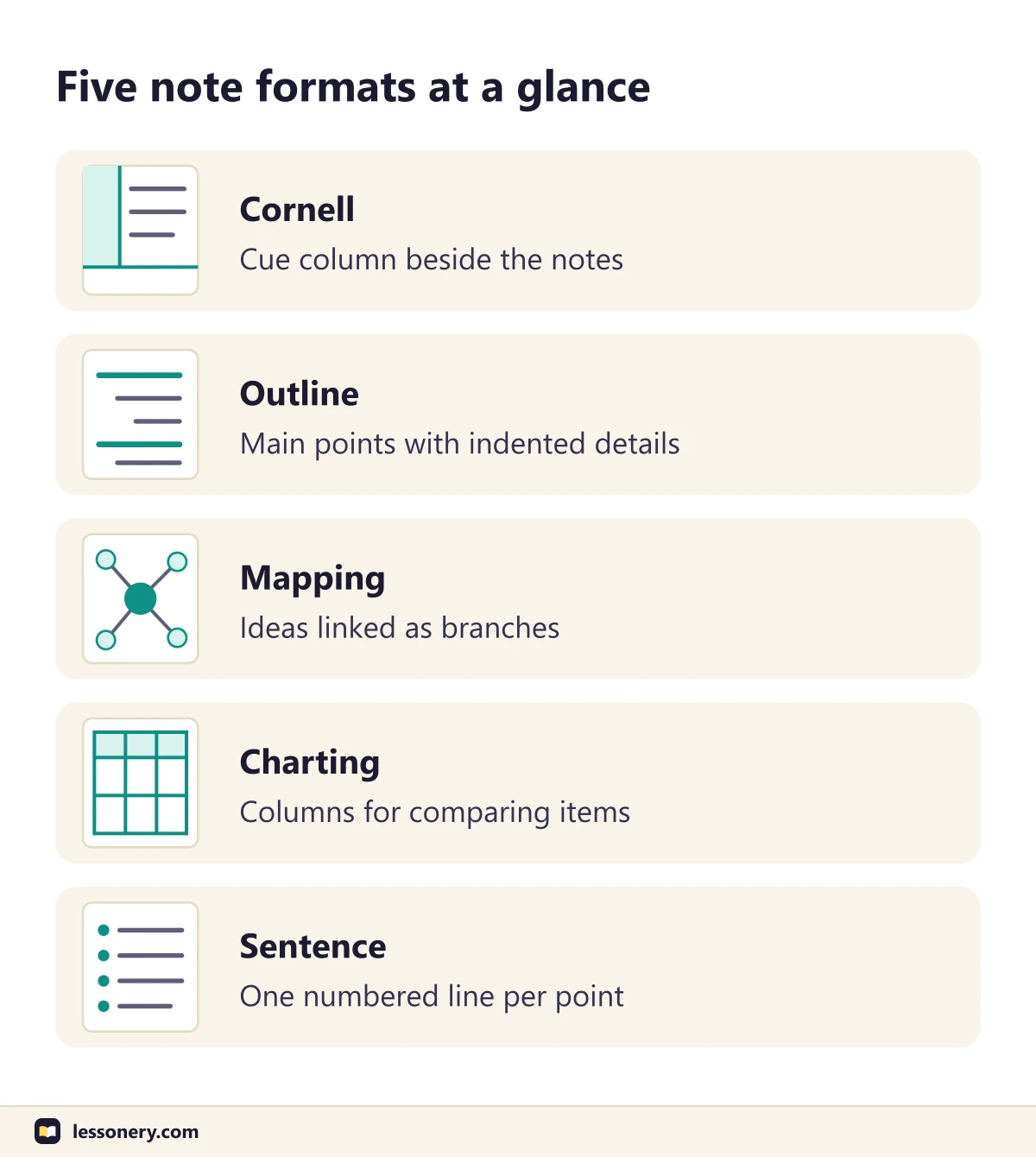
The different note taking methods that university learning centers teach are five page formats: Cornell, outline, mapping, charting and sentence. All five record the same lecture. They differ in the shape the notes take on the page and in how much organizing you have to do while the teacher is still talking.
No format is the correct one. The University of North Carolina's Learning Center lists these five and says there is no "right" format, only one that works for you. The research described below points the same way: in the one experiment that compared formats directly, none came out ahead for lecture notes, and reviews of note-taking research find the larger benefit in reviewing the notes afterward.
Quick answer: University guides describe Cornell notes as usable in any lecture. Use an outline when the lecture is clearly organized, a map when ideas connect to each other, a chart when several things are compared on the same features, and numbered sentences when the content comes too fast to organize. Whatever the format, plan time to review the notes.
Different note-taking methods at a glance
The table summarizes how two university guides, from the University of Tennessee at Chattanooga and Cal Poly's Writing and Learning site, describe each method. The two pages agree on nearly every point.
| Method | What the page looks like | Fits when | Drawback the guides list |
|---|---|---|---|
| Cornell | Notes in a wide right-hand area, cues in a narrow left margin added after class | Any lecture situation | None listed; the cues have to be written after class |
| Outline | General points at the left margin, specific points indented under them | The lecture follows an outline and leaves you time to think | Cannot be used if the lecture is too fast |
| Mapping | A diagram that links each idea to related ideas | Content is heavy but well organized, or you don't know how a guest lecturer will present | You may miss the shift from a major point to supporting facts |
| Charting | Columns with headings set up before class | The lecture has a distinct format, such as chronological, and tests cover facts and relationships | You have to identify the right categories first |
| Sentence | Each new thought, fact or topic on its own numbered line | Content is heavy and fast, and you can hear the points but not how they fit together | Major and minor points look the same until you edit |
The five formats in brief
Each method below has its own detailed article. This section gives only what you need to tell them apart.
Cornell
The page is ruled before class: a wide area for notes and a narrow left margin for cues. After class you write a cue beside each significant idea, then cover the notes, say the cue aloud and recite what you can. Cornell's Learning Strategies Center credits the system to Walter Pauk, an education professor at the university.
The cue margin is what separates Cornell from the other four. It turns the page into a self-test. The full layout and steps are in the guide to the Cornell note-taking system.
Outline
The most general points sit at the left margin and each more specific point is indented under the one it belongs to. Both guides say numbers, letters and Roman numerals are optional, because the indentation alone shows the hierarchy.
Outlining records relationships as well as content, which cuts editing later. The price is that you have to decide where each point belongs while you listen. See the outline method of note-taking for a worked page.
Mapping
A map is a graphic version of the lecture in which each fact or idea is linked to the others. Harvard's Academic Resource Center says mapping suits topics that involve processes or cycles, and adds that a map offers little room for detail. The article on mind mapping for note-taking shows how to build one.
Charting
You set up columns with category headings before the lecture, then drop words and phrases under the right heading as you listen. The guides describe the result as an easy review tool for memorizing facts and studying comparisons. It only works if you can identify the categories before the lecture starts. The chart method has its own article.
Sentence
Every new point goes on a new line, numbered as you go. Cal Poly's guide says it takes limited thinking during class, is slightly more organized than writing in paragraphs and gets down more or all of the information. The numbering does not show which points are major, so these notes need rewriting or regrouping before they are easy to review. More detail is in the article on the sentence method.
What research says about note formats
The studies described here do not crown a winner among page formats. Three findings are worth knowing.
Formats compared directly showed no advantage for lectures
Kiewra and colleagues (1989) ran one experiment with a lecture and one with a text. According to the paper's abstract, students took conventional notes or used one of two structured formats: a skeletal framework or a matrix, which is a table-style layout like a chart. No format had an advantage when the material came from a lecture.
The same study compared three ways of using notes: taking them twice without review, taking them once and reviewing them later, and reviewing borrowed notes twice. The take-and-review group did better on factual recall and recognition tests, though not on higher-order tests.
Reviewing notes adds more than taking them
Researchers separate two functions of notes: the benefit of writing them (encoding, also called the process function) and the benefit of having them to study (storage, or the product function). In a review of this research, Kiewra, Colliot and Lu (2018) write that studies comparing the two generally find the product function stronger, while arguing that both matter.
Kobayashi (2005) combined 57 studies that compared taking notes with not taking them, to isolate the encoding effect, and described that effect as positive but modest.
A second meta-analysis by Kobayashi (2006) covered 33 studies in which students both took and reviewed notes. Compared with doing neither, the effect was substantial. Giving students a framework or the instructor's notes improved results more than training or verbal instructions alone did.
For choosing a method, the reasoning that follows is simple: a format that makes review easy is worth more than a format that looks tidy. That is a point in favor of the Cornell cue margin and of charts, both of which are built for review.
Maps and self-testing have their own evidence
Schroeder and colleagues (2018) pooled 142 effect sizes from studies with 11,814 participants in total and found a moderate benefit of learning with concept maps (g = 0.58). Creating a map (g = 0.72) helped more than studying one that was already made (g = 0.43). The meta-analysis is about learning with concept maps in general, compared with other instructional conditions. Its abstract reports no separate result for mapping as a way to take notes during a live lecture.
Dunlosky and colleagues (2013), who reviewed ten learning techniques, rated practice testing as high utility. They mention the Cornell system as one way to do it: the column of key terms or questions written shortly after class is used for self-testing when the notes are reviewed. The review did not evaluate Cornell notes as a format.
Note: None of these studies tested all five methods against each other. Read them as evidence about review, self-testing and mapping, not as a ranking of formats.
Example: one lecture segment in three formats
The example below was made for this article. The "lecture" is the two-functions research from the previous section, so the content is accurate, but the wording and layout are an illustration to adapt.
Sentence notes
1. Notes have 2 functions: encoding + storage.
2. Encoding = benefit from the act of taking notes.
3. Storage = benefit from reviewing the notes later.
4. Note-taking alone: positive but modest effect (Kobayashi 2005, 57 studies).
5. Taking + reviewing: substantial effect (Kobayashi 2006, 33 studies).
Outline notes
Functions of notes
   Encoding (taking)
      - benefit from the act of writing
      - alone: positive but modest (Kobayashi 2005)
   Storage (reviewing)
      - benefit from studying the notes later
      - taking + reviewing: substantial (Kobayashi 2006)
Chart notes
| Encoding | Storage | |
|---|---|---|
| What it is | Benefit from taking notes | Benefit from reviewing notes |
| Evidence | Positive but modest | Substantial when combined with taking |
| Source | Kobayashi 2005, 57 studies | Kobayashi 2006, 33 studies |
The sentence version took no decisions to write. The outline shows which facts belong under which function. The chart puts the two functions side by side, so the comparison is visible at a glance. To make any of the three a Cornell page, add a left margin with cues such as "Two functions of notes?" and "Which effect is modest?"
How to choose between note-taking methods
The different note-taking methods suit different lectures, so match the format to the lecture, not to a habit. These steps draw on the guides above.
- Check how the lecture is organized. UNC's Learning Center suggests looking at the syllabus and previewing the reading before class to see the likely main ideas. By the guides' descriptions, a lecture that moves from general points to specific ones suits an outline, and one with a distinct format, such as a chronological sequence, suits a chart.
- Check the pace. If the lecturer moves too fast for you to sort points as they arrive, the guides point to the sentence method or a chart, not an outline.
- Decide when the organizing will happen. Outlines and charts are organized during class. Sentence notes and Cornell cues are organized afterward. Harvard's guide describes sentence notes as something you reorganize after class.
- Plan the review. UNC advises going back over notes within a day or two to fill gaps and define terms. This is the moment to regroup sentence notes into an outline or a map.
You can combine methods. The Cornell layout only fixes where things go on the page, so the notes area can hold an outline, numbered sentences or a small map. Cornell's Learning Strategies Center tells students to try different methods and see what works in different situations.
The format matters less than what happens around it. The article on taking notes in class covers what to do before, during and after a lecture, and note-taking from a textbook covers reading.
Frequently asked questions
What is the most effective note-taking method?
The studies described here do not identify one. In the experiments by Kiewra and colleagues (1989), conventional, skeletal and matrix notes performed alike for lecture material. Reviewing notes had the clearer benefit, so a format you will actually review is a reasonable choice.
Which note-taking method is best for fast lectures?
The University of Tennessee at Chattanooga and Cal Poly guides both suggest the sentence method when content is heavy and fast and you can't yet see how the points connect. They suggest charting for fast, heavy content when you know the categories in advance.
Which method works for math and science?
The same two guides say indented outlining is usually best except in some science classes such as physics or math. Harvard's Academic Resource Center suggests mapping for processes and cycles. For worked problems, see the article on Cornell notes in math.
Can you use more than one method in the same course?
Yes. UNC's Learning Center says no single format is right, and Cornell's Learning Strategies Center suggests trying different ones in different situations. Harvard's guide describes one combination: sentence notes in class, reorganized afterward.
Do these methods work for typed notes?
The different note-taking methods are page layouts, so any of them can be typed. One difference showed up in a study by Luo and colleagues (2018): students writing by hand recorded more images from the lecture than students using laptops. Whether typing or handwriting leads to better learning has mixed evidence, covered in the article on taking notes in class.