Cornell notes in math use the same ruled page as in any other subject, with different things in each area. Worked problems fill the notes column. The cue column holds problem types, rules and "why" questions about the steps. The summary states the method in words.
This is an adaptation, not an official version: the university handouts quoted below arrange math notes in slightly different ways. Research on worked examples gives a reason to try it. The only studies of Cornell notes in math classes found for this article are two pieces of unpublished student research.
Quick answer: Rule the page as usual. In class, copy each problem and every step into the wide column, along with the reasons your teacher gives aloud. Soon after class, label each problem's type in the cue column and add questions such as "Why move everything to one side first?" At review, cover the working and solve the problem again.
What changes when you use Cornell notes in math
The layout stays the same: a narrow cue column, a wide notes column and a summary strip. The guide to the Cornell note-taking system gives the measurements and the five steps. What changes is the content.
| Area | In most subjects | In a math class |
|---|---|---|
| Notes column | Main points as short phrases | Problems worked line by line, with definitions, rules and formulas |
| Cue column | Questions about the facts | Problem type, the rule behind a step, why-questions, warnings about errors |
| Summary | Main points of the page | The method in words: when it applies, the steps, how to check |
Three university handouts point the same way, each with its own layout:
- Utah State University's Aggie Math Learning Center says that examples of problems are not enough, because a professor explains what is happening without always writing it down. Its sheet puts regular notes on the left and a "What's going on?" side on the right, where you explain how and why you move from step to step.
- Cameron University's two-column sheet for math class has you copy the steps on the left and write the professor's explanation on the right. Five to six lines at the bottom are kept for formulas, hints, questions or a summary.
- A handout from the University of Wisconsin-Milwaukee's student success office adapts the Cornell page for problem-based notes: one column for working the problem, the other for explaining all of the steps.
All three put the working on the left and the explanation on the right, and all three say that a math page needs the reasons as well as the steps.
The version used here departs from them on one point: the working goes in the wide right-hand column, where there is room for it. The questions are added afterward in the cue column, which is the order in Cornell's own handout: record during the lecture, write questions as soon after class as possible.
How to fill the page, step by step
- Head the page. Cameron's sheet says to write the book section or the topic at the top.
- In class, write one step per line. Copy the problem as it was set, then every step. Add what the teacher says about a step, in a few words, beside it. Cameron advises leaving white space so you can add details later.
- Soon after class, fill the cue column. Four kinds of cue are useful on a math page, and the grouping is this article's:
- a label for the problem type, so you can recognize it again
- the name of the rule or formula a step uses
- a why-question about a step
- a warning about an error to avoid
- Write the summary. State the method, not the answers.
- Review by solving. Cover the working, read the problem and solve it again on blank paper. Then answer the why-questions aloud.
For why-questions, the US Institute of Education Sciences practice guide on teaching algebra (Star and colleagues, 2015) offers ready-made wording. Its questions for discussing a solved problem include "Why do they work in this order?" about the steps and "Will this strategy always work? Why?"
On step 5, the University of North Carolina's Learning Center suggests giving yourself about 10 to 15 minutes with a problem before you look at any resources.
A filled-in example
The page below is an example made for this article. The two equations, the zero factor property and the warning about canceling come from Paul Dawkins's online algebra notes, hosted by Lamar University, in the section on solving quadratic equations by factoring. The cue questions and the summary were written here.
| Cue column (written after class) | Notes column (written in class) |
|---|---|
| What is standard form? Why can't a be 0? | Standard form: ax² + bx + c = 0, a ≠ 0. Otherwise there is no x² term |
| State the zero factor property. Why does it need a zero? | If ab = 0, then a = 0 and/or b = 0. Only works for 0: ab = 6 does not mean a or b is 6 |
| Type: quadratic that factors | Problem 1. Solve x² − x = 12 |
| Why move the 12 first? | x² − x − 12 = 0 |
| Which rule gives two equations? | (x − 4)(x + 3) = 0, so x − 4 = 0 or x + 3 = 0 |
| How do I check a solution? | x = 4 or x = −3. Check x = −3: (−3)² − (−3) = 9 + 3 = 12 |
| Type: no constant term | Problem 2. Solve 5x² = 2x |
| Why not divide both sides by x? | 5x² − 2x = 0, then x(5x − 2) = 0. Do not cancel x: a solution is lost |
| Which solution would canceling lose? | x = 0 or x = 2/5 |
| What if it won't factor? | Factoring does not always work. Completing the square and the quadratic formula always do (next section) |
| Summary | To solve a quadratic by factoring, move every term to one side so the other side is 0, factor, set each factor equal to 0 and solve. Check by substituting. Factor x out; never divide by it. |
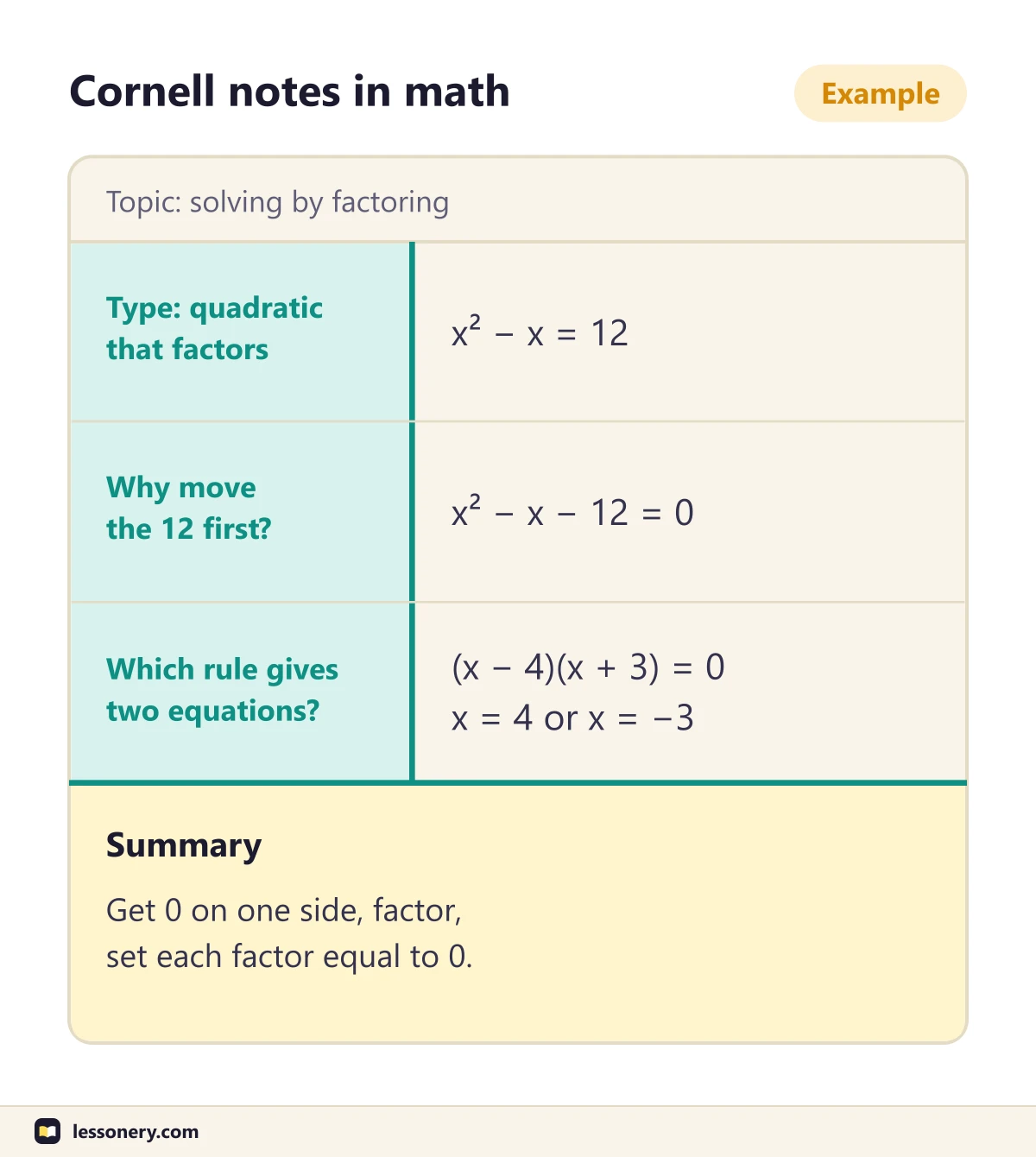
To review this page, cover everything below "Solve x² − x = 12" and work the problem on blank paper. Uncover one line at a time to check. Then answer each cue in the column aloud.
What research says
Studies of Cornell notes in math are few and unpublished
The search for this article found no peer-reviewed experiment on Cornell notes in mathematics. It found two pieces of student research, read here only as abstracts.
Wilkinson (2012), a doctoral dissertation at Walden University, compared 131 seventh- and eighth-grade students at a suburban public middle school. One group was trained in Cornell note-taking and a control group was not. Scores on curricular exams after the training did not differ significantly: the Cornell group averaged 77.4 and the control group 79.3. Students who reported high or moderate levels of note review scored significantly higher than students who reported little review.
Swenson (2018), a master's capstone at Hamline University, describes one teacher using Cornell notes and another format, Foldables, in two Algebra 2 classes over one trimester. The abstract concludes that both improved achievement on unit exams, with higher test averages for Cornell notes, and that Foldables gave higher vocabulary quiz averages. It does not give the number of students or mention a class that took ordinary notes.
Neither study settles the question.
Worked examples have better support
The Institute of Education Sciences practice guide Organizing Instruction and Study to Improve Student Learning (Pashler and colleagues, 2007) recommends alternating worked examples with problems the student solves alone, and rates the evidence as moderate. It describes laboratory experiments in algebra in which eighth- and ninth-grade students either alternated four worked examples with four problems or solved eight problems. The students who alternated took less time and did better on the test afterward.
A later meta-analysis by Barbieri and colleagues (2023) pooled 55 studies from 43 articles, from elementary school to postsecondary settings. The average effect of worked examples on mathematics performance was medium (g = 0.48). Studies that used correct examples alone showed larger effects than studies that used incorrect examples, alone or mixed with correct ones.
The algebra guide's own recommendation to use solved problems is rated as minimal evidence. Of four studies that met the clearinghouse's standards, three found positive effects and one found negative effects when solved problems were compared with reflective questioning.
These studies are about studying an example and then solving a similar problem, which is the reason for the cover-and-solve review above. The article on how to study for a math final builds a week around that pairing.
Why-questions: mixed evidence
Explaining steps to yourself is called self-explanation. Dunlosky and colleagues (2013) rated it as moderate utility in their review of ten learning techniques. They report benefits for solving several kinds of math problems, including algebraic formulas and geometric theorems, and note that almost every study tested students within minutes of learning.
A meta-analysis limited to mathematics, by Rittle-Johnson, Loehr and Durkin (2017), found that prompting students to explain led to a small to moderate improvement in procedural knowledge, conceptual knowledge and procedural transfer when tested straight away. Evidence from classrooms and from delayed tests was, in the authors' words, much more limited.
One result points the other way. In the Barbieri meta-analysis, worked examples paired with self-explanation prompts were associated with smaller effects than worked examples without them, and the authors conclude that the pairing "may not be a fruitful design modification."
Quality matters too. Dunlosky and colleagues describe a study in which ninth graders with poor algebra skills, given minimal training, produced many more paraphrases than explanations. A why-cue answered with "because that's the next step" is a paraphrase. An answer names the rule: "because the zero factor property needs a zero on one side."
None of these studies tested questions written in the margin of a notes page.
Naming the problem type
Rohrer, Dedrick, Hartwig and Cheung (2020) ran a randomized trial in 54 seventh-grade mathematics classes. For four months, classes received assignments that were mostly blocked by type or mostly interleaved, meaning that no two consecutive problems needed the same strategy. On an unannounced test one month later, the interleaved group scored 61% and the blocked group 38%.
That trial is about practice sets, not notes. The link to the cue column is reasoning: a mixed exam does not tell you which chapter a question came from, so a label such as "quadratic that factors" is practice at recognizing the problem before you solve it.
Where it goes wrong
| Mistake | Fix | Where the fix comes from |
|---|---|---|
| Copying only what is on the board | Add the spoken reason beside the step | Utah State's sheet |
| Leaving gaps in the working | Review within a few hours and make sure you understand each line | Utah State's sheet |
| Rereading the solved problem | Cover it and solve it again | UNC's Learning Center |
| Never returning to the page | Refer to the notes while doing homework and review them regularly | Cameron's sheet |
Frequently asked questions
Are Cornell notes good for math?
The studies found for this article do not show that they raise math scores. In the one comparison with a control group, a dissertation with 131 middle school students, the scores of the group trained in Cornell notes did not differ significantly from those of the control group. A master's capstone reported improved achievement on unit exams, but its abstract mentions no class that took ordinary notes.
How is this different from two-column math notes?
In Cameron's two-column sheet, the steps and the explanations are both written during class. A Cornell page adds a column that is filled after class and used for self-testing, which the article on the active recall method explains.
Should every math page have a summary?
The printed version of Cornell's handout asks for one at the bottom of each page. On a math page it can be short: the method in a sentence or two, plus any formula you need. See the Cornell method note-taking example pages for summaries in other subjects.
Is it better to study worked examples or to solve problems?
The 2007 practice guide recommends alternating them and rates the evidence for that as moderate. It notes that as students gain expertise, fewer examples and more problem solving appear to work better.