The short answer to how to study for a cumulative final: list every unit of the course, find out how the exam weights them, test yourself on the old units before you reread anything, and practice with questions from all the units mixed together. A cumulative final is an end-of-course exam that covers the whole term instead of just the weeks since the last test.
The hard part is the early material, which you learned weeks or months ago. The five steps below deal with that first, and an example plan with minutes that add up comes after them.
Quick answer: Take stock of all units with your notes closed, give more time to units that carry more marks and that you know least, and re-test old units early so they can be reviewed again on later days. Finish with mixed question sets and a timed practice paper.
What research says about cumulative exams
One argument for cumulative exams is that they make students return to earlier material. The US Institute of Education Sciences practice guide Organizing Instruction and Study to Improve Student Learning (Pashler and colleagues, 2007) advises teachers to give cumulative midterm and final examinations, because such exams push students to study all of the course material at points that are far apart in time. This sits under the guide's first recommendation, to space learning over time, which it rates as having moderate evidence.
Three studies compared courses with and without cumulative exams, and their results differ.
| Study | Course | What was compared | Result |
|---|---|---|---|
| Khanna, Badura Brack and Finken (2013) | Introductory psychology and upper-division courses | Cumulative and noncumulative finals | Higher content exam scores right after cumulative finals, and more retained up to 18 months later; introductory students benefited more than upper-division students |
| Lawrence (2013) | Introductory psychology | Cumulative exams through the semester, or unit exams followed by a cumulative final | Better on the cumulative part of the final; two months later, a benefit only for lower-scoring students |
| Bailey and colleagues (2021) | Introductory biology | Cumulative and noncumulative midterms | No effect on final exam scores; no overall difference five months later |
The first two rows are taken from the papers' abstracts. The third study, at Brigham Young University, compared two sections taught by the same instructor. Only 62 students returned for the retention exam five months later. Among them, the authors found an interaction that they read as cumulative midterms helping students with lower reasoning-test scores, and they list the small returning sample and the lack of random assignment among the study's limits.
These studies compare how courses are examined, not how one student studies. What they share with the steps below is going back to old material after a gap.
Step 1: Take stock of every unit
Write down every unit the final can draw on before you study any of them. The University of North Carolina's Learning Center, in its guide to preparing for finals, suggests finding the topics in your syllabus, textbook, notes and old exams.
Then check each unit with your materials hidden. UNC offers two ways:
- Rate each topic 1 (don't know it), 2 (sort of know it) or 3 (know it well enough to teach it or solve most problems).
- Using only the syllabus, write an outline of the course content from memory, then fill the gaps from your notes in a second color. UNC notes this suits conceptual material better than problem solving.
The second color is the useful output: it marks what you could not recall, unit by unit.
Step 2: Weight the units by exam emphasis
A cumulative final does not have to give every unit the same marks, and only your teacher or syllabus can tell you the split. The Open University's exam format checklist includes the questions to ask: how many sections the paper has, what types of question appear, and whether some questions carry more marks than others.
Two rules from university guidance turn that into priorities. The University of Guelph Library's exam guide says to put unfamiliar or new content ahead of content you already understand well, and content most likely to be on the exam ahead of content less likely to appear. UNC says to study the lowest-rated topics first.
Stanford's Center for Teaching and Learning lists "reviewing everything" among its misguided study techniques: restudying what you already know feels productive without closing any gaps.
Step 3: Re-test old material before you reread it
Start each old unit with a closed-book attempt, not with the notes. In the review of 10 learning techniques by Dunlosky and colleagues (2013), practice testing and distributed practice (study spread over time) were the two techniques rated "high utility", and rereading was rated low.
In two experiments by Roediger and Karpicke (2006), students studied prose passages and then either took free-recall tests without feedback or restudied the passage. On a final test after 5 minutes, restudying produced better recall. On final tests after 2 days or 1 week, the students who had been tested remembered substantially more.
The delay matters as well. The full text of the IES guide says the main action is to review important content at least several weeks, and ideally several months, after it was first met. It describes a classroom study in which eighth-graders in a US history class had a review either 1 week or 16 weeks after the first lesson. On a test 9 months after the review, the 16-week group did significantly better, which the guide puts at an almost 100 percent increase. The guide adds that few spacing studies have looked at complex, structured bodies of knowledge.
When you study for a cumulative final, the calendar has already done part of the spacing. Unit 1 was taught weeks ago, so a review now is a delayed one. That is this article's reasoning, not a finding. The practical point is to re-test old units early in your plan, so each one can be recalled again on a later day.
Ways to re-test a unit:
- Write everything you remember about it on a blank page, then check your notes.
- Answer the questions from the old test on that unit with the marked copy out of sight.
- Redo the problems you missed on quizzes and homework, which is one of the review activities in Cornell's five-day study plan.
More formats are in the guide to the active recall method, and review intervals in the spaced repetition schedule article.
Step 4: Mix the units in practice
Once each unit has been re-tested, practice with questions from several units in shuffled order. On a cumulative final, nothing tells you which unit a question comes from, so deciding what kind of question it is becomes part of the task.
In a preregistered trial, Rohrer, Dedrick, Hartwig and Cheung (2020) had 54 seventh-grade mathematics classes in Florida complete either interleaved (mixed) or blocked assignments over 4 months. On an unannounced test 1 month later, the interleaved group scored 61% and the blocked group 38%.
That is one subject and one age group, and Dunlosky and colleagues rated interleaved practice "moderate" because the evidence for it was still limited. For problem-based courses, the approach is worked out in how to study for a math final.
Guelph's guide to studying for exams gives a checklist for a practice test you build yourself. Among its items: the test covers all the exam material, uses a randomized question order and matches the exam's format.
Step 5: Use old tests and assignments as material
Marked tests from earlier in the term supply questions and show what went wrong the first time.
Guelph's page on analyzing exam errors advises looking for patterns in the questions you lost marks on. It separates five kinds of error, from content you never studied to careless slips, and each points to a different fix. They are set out in a table in how to study for a midterm. If a test was never returned, Guelph suggests asking your instructor to see it.
If your teacher provides practice papers, Cornell's page on practice exams suggests taking one early as a baseline and another after more study, under the same time limit and with only the resources the real exam allows.
Note: Use only the tests your teacher returned and the practice materials your institution makes available. Rules on formula sheets, calculators and open-book resources are your institution's to set.
An example: how to study for a cumulative final in 12 days
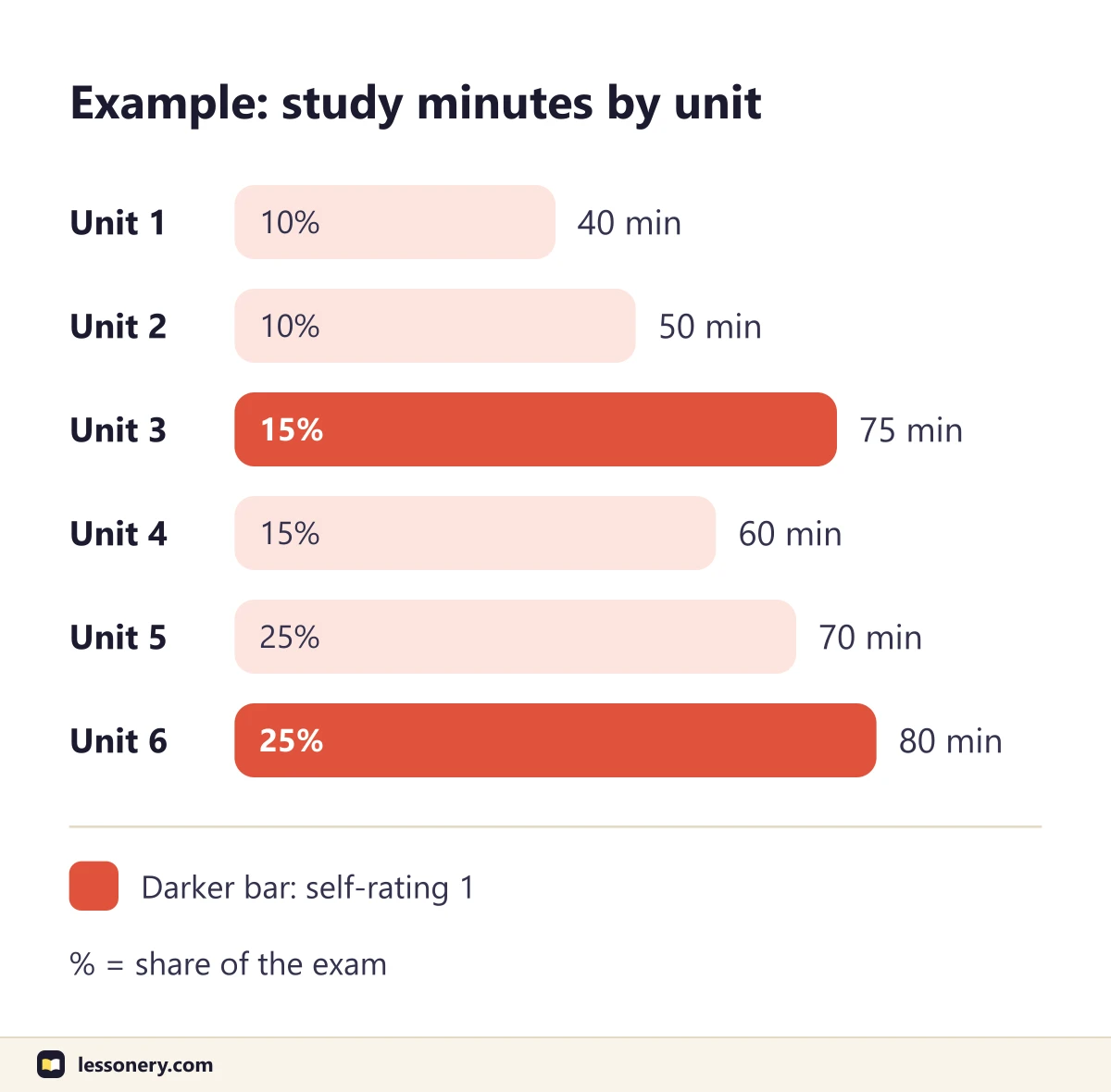
Everything in this section is an example made for this article. It assumes one exam on day 13 and a course of six units. Test 1 covered units 1 and 2, test 2 covered units 3 and 4, and units 5 and 6 have not been tested. The shares of the final are invented for the example.
| Unit | Earlier test | Share of final | Self-rating (1–3) | Minutes |
|---|---|---|---|---|
| 1 | Test 1 | 10% | 3 | 40 |
| 2 | Test 1 | 10% | 2 | 50 |
| 3 | Test 2 | 15% | 1 | 75 |
| 4 | Test 2 | 15% | 2 | 60 |
| 5 | None | 25% | 2 | 70 |
| 6 | None | 25% | 1 | 80 |
| Total | 100% | 375 |
| Day | Main work | Reviews, notes closed | Minutes |
|---|---|---|---|
| 1 | Stock-take: list units, outline from memory, rate, collect old tests: 60 | None | 60 |
| 2 | Unit 3: 75 | None | 75 |
| 3 | Unit 6: 80 | Unit 3: 10 | 90 |
| 4 | Unit 5: 70 | Unit 6: 10, unit 3: 10 | 90 |
| 5 | Unit 4: 60 | Unit 5: 10, unit 6: 10 | 80 |
| 6 | Unit 2: 50 | Unit 4: 10, unit 3: 10 | 70 |
| 7 | Unit 1: 40 | Unit 2: 10, unit 5: 10, unit 6: 10 | 70 |
| 8 | Day off | 0 | |
| 9 | Mixed set across all six units: 60; correct errors: 30 | 90 | |
| 10 | Timed practice paper: 60; mark it and log errors: 30 | 90 | |
| 11 | Buffer and weak points from the error log: 60 | 60 | |
| 12 | Mixed set on the weakest units: 40; quick recall of all six: 30 | 70 | |
| 13 | Exam |
The arithmetic:
- Stock-take: 60 minutes.
- Unit work: 75 + 80 + 70 + 60 + 50 + 40 = 375 minutes.
- Short reviews on days 3 to 7: 10 + 20 + 20 + 20 + 30 = 100 minutes.
- Mixed practice, timed paper and buffer on days 9 to 12: 90 + 90 + 60 + 70 = 310 minutes.
- Total: 60 + 375 + 100 + 310 = 845 minutes, or 14 hours 5 minutes.
Each unit session starts with a closed-book attempt and ends with repairs. Unit 3, an old unit rated 1, goes first so that it comes back on days 3, 4 and 6 and again in the mixed work. Unit 1, rated 3 and worth 10%, goes last. To place this plan on a calendar, see how to create a study schedule.
Frequently asked questions
How far ahead should you start to study for a cumulative final?
Cornell's plan starts five days before a single exam of four chunks. The example above uses 12 days because it has six units, and each old unit needs to be re-tested and then reviewed on later days.
Should you study the old units or the new ones first?
No source cited here tested the order. Guelph's rule is to put unfamiliar and likely content first, and UNC's is to start with the lowest-rated topics.
Do you have to reread all your notes for a cumulative final?
Not as the main method. Dunlosky and colleagues rated rereading as low utility, and UNC suggests outlining the course from memory first and using the notes only to fill the gaps.
How do you study for several cumulative finals at once?
Make one stock-take per course and then divide your days between them. The article on a final exam study schedule covers mapping exam dates and alternating subjects, and how to study effectively for exams covers the methods.