To study for nursing exams, spend less time rereading and more time answering questions that make you apply and prioritize. Do practice questions, read the rationale for every option, draw concept maps from memory and work through cases.
That advice follows from how the exams are written, which the first section documents. This article covers study methods only. It gives no clinical guidance: your course materials and instructors are the authority on content, and nothing here promises a result on any course or licensing exam.
Quick answer: Nursing exam questions often ask you to use knowledge in a patient situation, so practice doing that. Answer practice questions before you look at the options, read why each option is right or wrong, log the reason for every miss, map each unit from memory and rehearse cases step by step. Spread the work across the week.
Why nursing exams reward application over recall
The clearest statement comes from the body that writes the licensing exam used in the United States and by most Canadian nursing regulators. The 2026 NCLEX-RN Test Plan, published by the National Council of State Boards of Nursing, says its questions are written and coded using Bloom's taxonomy, a classification of thinking skills that runs from remembering facts to more complex reasoning. It states that the majority of items are written at the application level or higher.
Licensing arrangements differ by country, and your school writes its own course exams. One nursing school describes its own in similar terms. A test success module from the Southern Illinois University Edwardsville School of Nursing says its exam questions are based on Bloom's revised taxonomy. Its advice is to study to understand, not to memorize, and to ask yourself why something happens as you study.
The table follows the levels in that module, with study tasks drawn from it and from the University of North Carolina at Chapel Hill Learning Center's handout on higher-order thinking.
| Level | What the question asks | A study task for that level |
|---|---|---|
| Remember | Recall a fact, such as a classification | Flashcards for terms |
| Understand | Explain how or why something works | Summarize it in your own words |
| Apply | Use the knowledge in a patient situation | Practice questions; list situations where it applies |
| Analyze | Tell similar things apart, relate data, set priorities | List contributing factors; compare similar items |
| Evaluate | Make a judgment, such as which outcome to expect | Decide which approach is most effective, and why |
Facts still matter. The module calls remembering the foundation for nursing practice, and UNC's handout says to start with the lower levels and work upward.
What the research says about these study methods
The research supports testing yourself, with limits worth knowing. Most of it studies teaching methods in courses, not students studying alone.
Practice questions. Messineo, Gentile and Allegra (2015) followed 161 undergraduate nursing students in a general psychology course at the University of Palermo, Italy. The paper says students were randomly assigned to one of two activities. For about eight weeks, one group took a multiple-choice test on each week's topic and saw immediately which answers were right and wrong. The other group reread the same content as question-and-answer pairs. On a cumulative test about two weeks after the last lesson, the tested group scored higher. The course was psychology, not nursing content, and 40 students in the rereading group were dropped after a data-recording failure.
A wider review points the same way. Trumble, Lodge, Mandrusiak and Forbes (2023) examined 56 studies, containing 63 experiments, on distributed (spaced) practice and retrieval practice in health professions education. In 43 of the 63 experiments, one or both strategies produced significantly better academic grades than the control or comparison group. The studies were too varied to pool, and the reviewers found too little information to say whether adding feedback made retrieval practice more effective.
The kind of question. A 2025 review of retrieval practice in the health professions by Serra and colleagues argues that retrieval practice helps most when it matches the processing the exam requires. Their example comes from medicine: flashcards give repeated exposure to separate facts, while licensing exam questions present case-based scenarios. The authors add that advice focused only on the number of practice questions misses how students should approach the questions, get feedback and review them.
Rationales. The closest experimental evidence comes from outside nursing. Butler, Godbole and Marsh (2013, first published online in 2012) had participants read prose passages and answer short-answer questions, followed by the correct answer, by an explanation, or by no feedback. Two days later the two kinds of feedback did equally well on repeated questions. On new questions that tested transfer of the same concepts, explanation feedback did better.
Concept maps and cases. Faraji and colleagues (2025) pooled more than 40 controlled studies of concept mapping as a teaching method, most with nursing students and a few with nurses. Performance scores rose more in the concept-mapping groups. The authors report very high variation between studies and signs of publication bias, and the outcomes measured ranged from knowledge to critical thinking. The paper also states its own study count inconsistently (44 in the abstract and results, 48 in the discussion), so its figures deserve caution. For case-based learning, Xiang and colleagues (2025) pooled 13 studies with 1,396 participants, all in Chinese nursing education. Scores on a critical-thinking disposition questionnaire were higher than with traditional teaching, again with very high variation between studies.
These reviews support trying the methods below. They do not show how much any one student will gain.
How to study for nursing exams with practice questions and rationales
Use questions as a way to learn, and not just as a check at the end. The steps below draw on the SIUE module and on tip sheets from the University of Arizona College of Nursing.
- Cover the content first. The SIUE module advises reading before class and using the course objectives or study guide to frame your studying.
- Answer before you look. Arizona's sheet on test-taking strategies for nursing students says to read the question slowly, noting its subject, its important words and whether it asks for what is true or what is false, then picture the correct response before reading the choices.
- Commit, then read every rationale. A rationale is the explanation of why an option is correct or incorrect. The SIUE module models this with a reason for each wrong option as well as the right one. Read them all, including for questions you got right.
- Record why you missed. Was it a fact you didn't know, a word in the question you skipped, or two options you couldn't separate?
- Come back later. Arizona's sheet on six learning strategies suggests self-quizzing on your notes about 24 hours later and several more times during the week. The guide to a spaced repetition schedule explains the reasoning.
For prioritization questions, Arizona's test-taking sheet suggests running the question through three filters: whether it involves airway, breathing or circulation, Maslow's hierarchy of needs, and where in the nursing process the question sits. The sheet offers these as ways to read an exam question, and this article does not explain them. Use the frameworks your own program teaches. For "select all that apply" items, the same sheet says to judge each option separately as true or false. General tactics for this format are in multiple choice test taking strategies.
Note: Use the question banks and practice exams your program, textbook or library provides. Questions taken from a real exam are off limits, and your institution's rules decide which tools and materials you may use.
An example question log and study week
The log below is an example made for this article. The entries are invented and describe how a question was missed, not clinical content.
| Question type | What I did | What the rationale showed | Next step |
|---|---|---|---|
| Prioritization: which client to see first | Picked the client whose condition I knew best | The question asked which client comes first; I chose by familiarity, not by a priority framework | Five more prioritization questions on Thursday |
| Select all that apply | Chose two options that seemed to go together | Each option stands alone as true or false | Judge every option separately |
| Medication question | Right answer, but a guess | I could not explain why the other three were wrong | Concept map of that unit from memory |
A week built around one unit might look like this. It is an illustration, and the numbers are arbitrary.
| Day | Task |
|---|---|
| Monday | After class, write what you recall for 10 minutes, then check it against the unit objectives |
| Tuesday | 15 practice questions on the unit; read every rationale; log the misses |
| Wednesday | Concept map of the unit from memory; fill the gaps from your notes |
| Thursday | One case from the textbook, written out step by step |
| Friday | 15 mixed questions that include earlier units; redo the logged misses |
| Weekend | Study group: quiz each other and explain one concept each |
Concept maps and case-based study
A concept map shows how ideas connect, which is what analysis-level questions ask about. Arizona's sheet on concept and mind maps separates the two. A mind map radiates from one main concept. A concept map can hold several, with cross-links labelled by action verbs such as "causes", "requires" or "leads to". It adds that a map made from memory works as a self-quiz.
UNC's Learning Center gives a routine for studying with concept maps: draw the map from memory, fill the gaps from your notes and readings, concentrate on how the concepts link, explain each part aloud, then redraw it without looking. The article on mind mapping note taking covers layout.
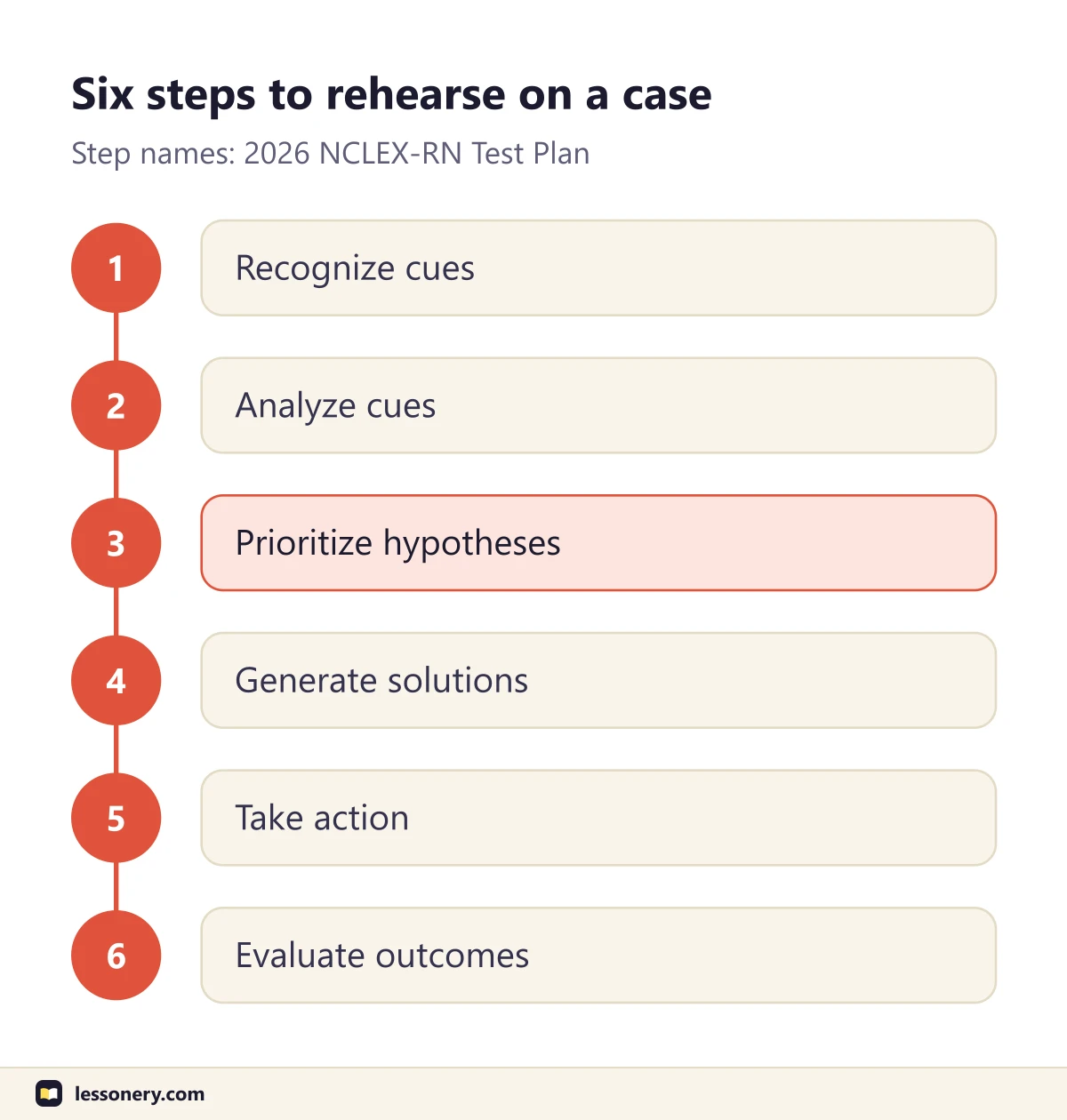
For cases, the NCLEX-RN Test Plan describes case studies of six linked questions that share one unfolding client situation and follow six steps of clinical judgment. You can rehearse a case from your textbook or course materials in the same order, writing a short answer at each step and checking it against the source.
Where this goes wrong
Three patterns waste the effort:
- Counting questions. A target number says nothing about how the questions are reviewed, which is the gap Serra and colleagues point to.
- Recognizing instead of reasoning. A question you have seen before is easier the second time because you remember it. That point is this article's reasoning, not a research finding, and it is why the log's next step is new questions of the same type.
- Leaving it to the last night. The SIUE module advises spacing your studying over days or weeks and not trying to learn everything the night before.
The same module notes that too much anxiety can interfere with studying and with the test, and it directs students to the university's counseling services. If anxiety regularly gets in your way, speak to a counselor, a doctor or your school's support service.
Frequently asked questions
How many practice questions should I do each day?
No source cited here gives a number, and Serra and colleagues describe guidance built only on question counts as incomplete. By that reasoning, a smaller set with every rationale read is a better use of an hour than a large set skimmed.
Is memorizing enough when you study for nursing exams?
No, though it is where you start. The SIUE module describes remembering as the foundation for nursing practice, and it shows sample questions at every level from remembering to evaluating.
Do study groups help?
Arizona's sheet on study groups says they work well when every member comes prepared. It suggests no more than four members, who quiz each other, draw a concept map from memory and work practice questions while reviewing the rationales. The SIUE module suggests limiting a group to three or five members and keeping sessions to about 60 to 90 minutes.
Will these methods get me through my licensing exam?
Nobody can promise that. The research above reports average differences between groups, mostly on course tests. For a licensing exam, start from the official test plan and your program's advice. General exam planning is covered in how to study effectively for exams.