Useful multiple choice test taking strategies are mostly reading habits. Read the whole question, decide what you think the answer is before you look at the options, cross out what you know is wrong, and keep moving so every question gets a look.
None of this replaces knowing the material. It stops you from losing marks on questions you could have answered.
The usual advice about changing an answer is to trust your first instinct. Studies that counted answer changes on real exams found a different pattern, described below with its limits.
Quick answer: Read the stem (the question part) in full, answer it in your head before reading the options, eliminate options you know are wrong, mark doubtful questions and come back to them, and budget your time by marks. In studies of real exams, more changed answers went from wrong to right than from right to wrong, so a review of the questions you marked is time well spent.
The parts of a multiple-choice question
A multiple-choice question has a stem, which is the question or unfinished statement, and a set of options. One option is correct, or best. The others are distractors: wrong options written to look plausible.
That design is why McMaster University's Student Success Centre warns against treating these exams as the easy kind. Some options are worded specifically to mislead, and the centre's advice is to study the principles well enough to apply them, because memorizing alone is not enough.
Multiple choice test taking strategies for each question
The four steps below come from university learning centers, which describe them in much the same way.
1. Read the stem first, every word
McMaster's guide says to read every single word of the question, even if that feels unnatural, and to circle words that change the meaning, such as all, some, only and unless.
Duke University's Academic Resource Center lists what to look for: qualifiers (often, usually, sometimes), absolute words (always, never) and negatives (not, none, and prefixes such as un- and dis-). It suggests underlining them. A missed "not" turns a question you know into a question you get wrong.
2. Answer before you look at the options
McMaster calls this the cover-up method: hide the options, answer as if it were a short-answer question, then compare your answer with the choices. Duke suggests jotting your answer in the margin. The Learning Center at the University of North Carolina at Chapel Hill puts it as predicting the answer in your own words and then finding the best match.
The logic is simple. If you already hold an answer, you are checking the options against something, and a distractor that only sounds right has less to work with.
3. Read every option, then eliminate
Don't stop at the first option that looks right. UNC's guide says to read all the choices, because one may seem correct while a better one sits further down, and to physically cross out the ones you know are wrong.
Duke adds that you are looking for the best answer: a choice can be true without being the best of the set. It suggests checking for options that are nearly identical, for overstatements such as "always" or "never", and for choices that don't fit the grammar of the stem. You can test an option by reading the stem and the option together as one sentence.
Watch out: These are checks, not rules. A statement containing "always" is sometimes true. Treat such a word as a reason to look harder at the option, then decide on what you know about the subject.
4. Mark it and move on
If you're stuck, Duke's advice is to mark the question and move on, because you may be able to answer it after seeing the rest of the test, and then to go back to every question you skipped. UNC's test day handout makes the same point and notes that other questions sometimes contain information that helps.
If you fill in a separate answer sheet, UNC suggests marking it as you go instead of all at the end, to avoid skipped questions and marking errors.
A worked example
The question below was written for this article as an illustration. It is not from any real exam.
Example question. Which statement about triangles drawn on a flat surface is always true?
- A. All triangles have three equal sides.
- B. The interior angles add up to 180 degrees.
- C. A triangle never contains a right angle.
- D. Most triangles have four sides.
Here is how the four steps apply:
- Stem. Underline "always". The question wants a statement with no exceptions.
- Predict. Cover the options. Something true of every triangle: three sides, three angles, angles that total 180 degrees.
- Options. A says "all", yet some triangles have unequal sides. C says "never", yet right-angled triangles exist. D is false. B matches the prediction.
- Decide. Choose B and move on. Nothing to mark.
Managing your time across the paper
Plan your time before you answer anything. UNC's test day handout suggests surveying the test first: count the questions, note the question types and see how the points are distributed. Then give each part time in proportion to its points.
Its illustration is a 50-minute test with 15 multiple-choice questions worth 30 points, 5 short answers worth 10 points and an essay worth 60 points. The suggested split is 30 minutes for the essay, 15 for the multiple choice and 5 for the short answers.
For a paper that is all multiple choice, a three-pass plan keeps one hard question from eating the time for five easy ones. The table is an example to adapt, built for a paper of 60 questions in 90 minutes, which works out to an average of 90 seconds per question.
| Pass | Time (example) | What you do |
|---|---|---|
| First pass | 60 minutes | Answer every question you can in about a minute. Mark any you guessed or doubted and keep going. |
| Second pass | 20 minutes | Return only to the marked questions. Reread the stem before you look at your first answer. |
| Final check | 10 minutes | Confirm no question is blank (if blanks cost nothing to fill) and that the answer sheet rows line up. |
Changing an answer: what the first-instinct studies found
The belief that changing an answer usually makes things worse has been tested by counting what happens when students do change answers. The counts point the other way.
Kruger, Wirtz and Miller (2005) named the belief the "first instinct fallacy". The counts that follow come from an article summarizing that research, written by Wirtz, Kruger, Miller and Mathur and published by New York University's Stern School of Business, not from the 2005 paper itself. In it the authors report that independent coders examined the midterm (mid-course) exams of 1,561 introductory psychology students at the University of Illinois and found 3,291 answer changes: 51% from wrong to right, 25% from right to wrong and 23% from wrong to wrong. When asked, students believed that the most likely result of changing an answer was a wrong response. The same article cites a review of 33 studies, none of which found that test takers did worse by changing answers.
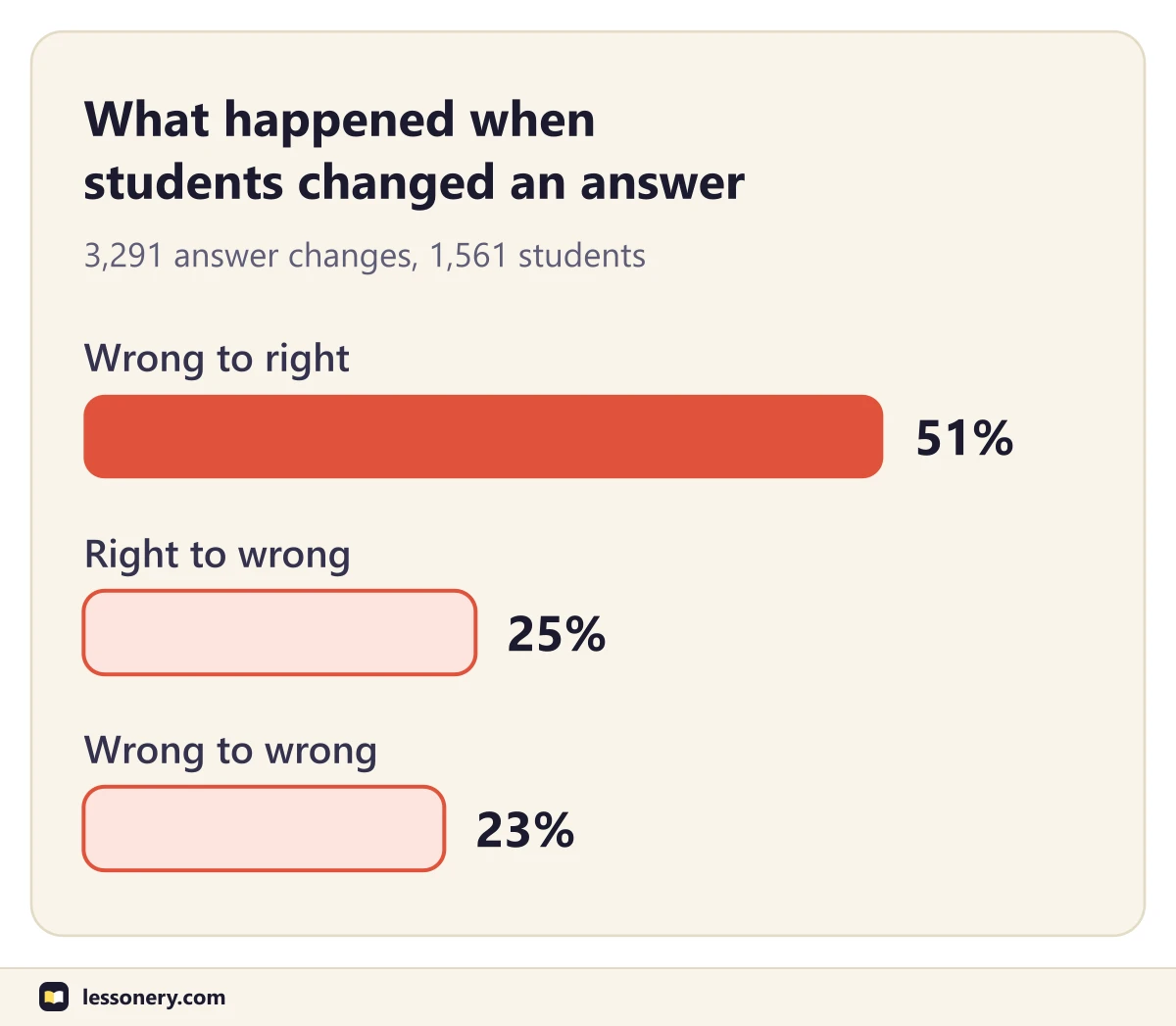
The authors' explanation for why the belief survives is regret. Switching away from a correct answer produces more "if only" thoughts than sticking with a wrong one, so those switches are remembered better.
Later studies found a similar pattern:
| Study | Who took part | What was found |
|---|---|---|
| Bauer, Kopp and Fischer (2007) | 79 third-year medical students in Munich, 78-question exam | 5.2% of answers were changed once. Among the 72 students who changed answers, the average shares were 48.2% wrong to right, 21.6% right to wrong and 30.2% wrong to wrong, for an average gain of 1.4 points. |
| Merry, Elenchin and Surma (2021) | Students in physiology and biology courses, two exams | On average, 2.8 changes from incorrect to correct and 1.0 from correct to incorrect. |
| Couchman and colleagues (2016) | Undergraduates taking a real exam, two studies | Sticking and revising both led to more correct than incorrect outcomes. Confidence rated at the moment of answering predicted performance; beliefs formed after the exam did not predict it well. |
The limits of this research
These studies do not show that changing answers is good in itself. Students changed few answers (5.2% in the Munich study), and the changes they made were ones they chose to make. The numbers describe answers a student had some reason to revisit, not answers switched at random.
Three details matter:
- In the Munich study, changing the same answer a second time brought no real gain (0.11 points on average), which the authors attribute to guessing.
- Merry and colleagues found that how much a student gained from changes on one exam did not predict the gain on the next.
- Kruger's group writes that they are not claiming first instincts are always wrong, or that you should always second-guess yourself.
A practical reading comes from a Learning Scientists summary of the Couchman study: as you answer each question, note whether you knew it or guessed, mark the guesses, and revisit only those before you hand in the paper.
Guessing: check how the test is scored
Whether to guess depends on the scoring rules, so find them out beforehand. Duke's guide points out that on some tests a wrong answer costs more than a blank, and in that case leaving a guess unanswered can be the better choice. Where wrong answers carry no penalty, McMaster's advice is to guess instead of leaving a blank.
Eliminating first improves a guess. Crossing out two of four options turns a 1 in 4 chance into 1 in 2, which is simple arithmetic and not a finding from any study.
Rules on scratch paper and writing in the question booklet differ between schools and exam boards. Follow your own exam's rules.
Preparing for a multiple-choice exam
Multiple choice test taking strategies work on the day only if the knowledge is there, so practice in the format you'll be tested in. UNC recommends answering practice questions yourself before checking the answer, and asking of each wrong option what would have to change to make it correct.
Answering from memory before checking is a form of retrieval practice, covered in the guide to the active recall method. For planning the weeks before the test, see how to study effectively for exams and how to prepare for an examination. If the test is tomorrow, read how to cram for an exam.
Frequently asked questions
Is your first answer usually right on a multiple-choice test?
Often, yes: in the Couchman studies, sticking with an answer led to more correct than incorrect outcomes. That is not a reason to refuse to change one. Among answers that students did change, more went from wrong to right than from right to wrong, so if rereading the question gives you a reason to doubt your answer, these studies suggest acting on it helps more often than it hurts.
Should you guess when you don't know the answer?
It depends on the scoring. If wrong answers are not penalized, university guides advise guessing over leaving a blank. If a wrong answer costs more than a blank, check the rules and decide question by question.
How long should you spend on each question?
Divide the time by the number of questions, or by marks if the paper mixes question types, and hold some back for a second pass. In the example plan above, the average is 90 seconds, but the first pass spends about a minute per question.
Should you answer the easy questions first?
McMaster and UNC's test day handout both suggest it. Starting with what you know builds confidence and keeps you from spending too long on hard questions before you have collected the marks you can get.