The strategies to improve reading comprehension with the most research behind them are active ones: preview the text, ask and answer questions about it, put each section into a sentence of your own, and check whether it is making sense. Two kinds of knowledge sit underneath all of them: knowing the words, and knowing something about the topic.
Most of the strong evidence cited here comes from school students, so each section says who was studied. The University of North Carolina's Learning Center teaches the same routines for university reading.
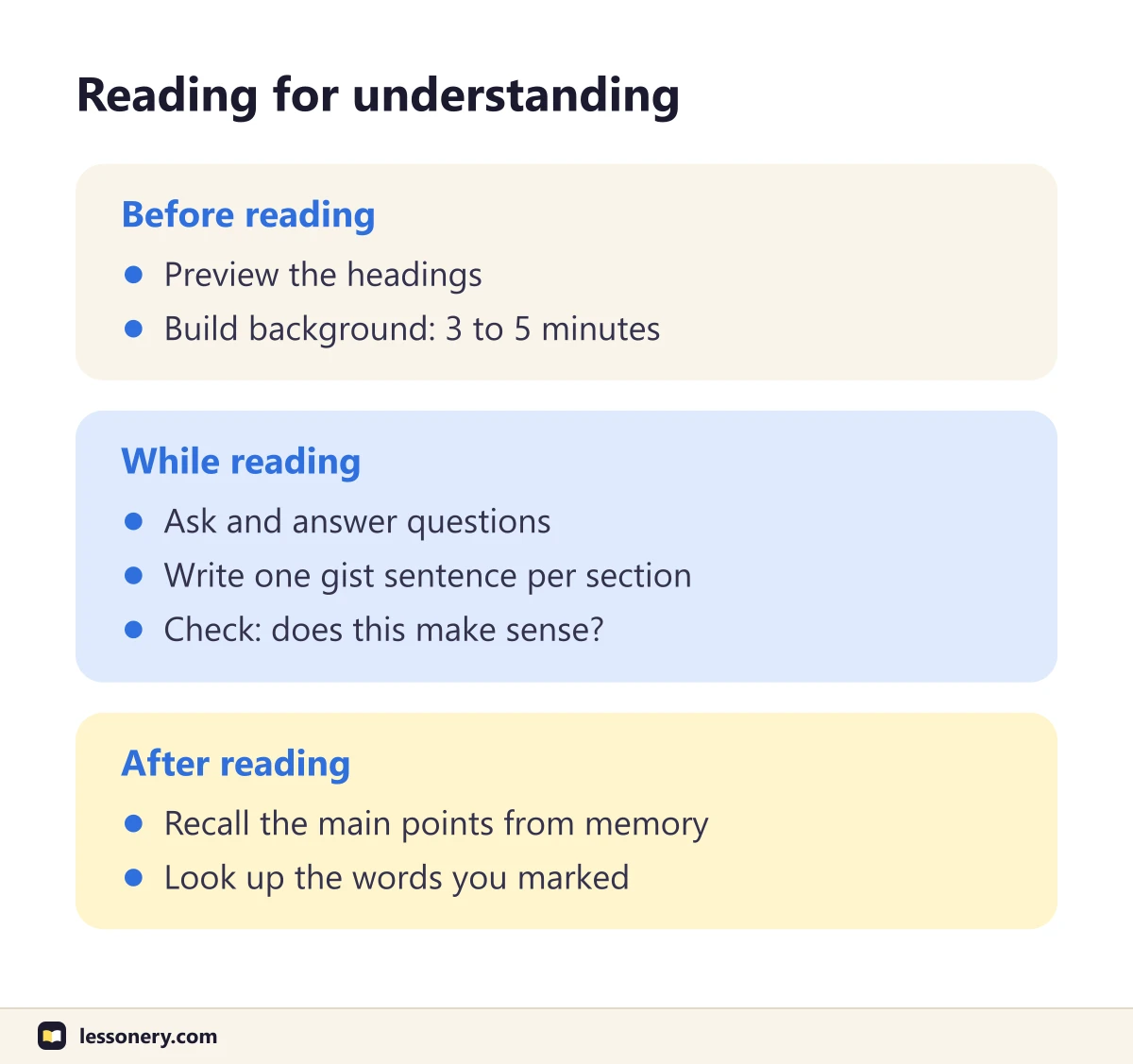
Quick answer: Before reading, preview the headings and spend a few minutes on the topic's background. While reading, ask questions of the text, write a one-sentence gist of each section, and stop to ask whether it makes sense. Afterwards, recall the main points without looking. US Institute of Education Sciences practice guides rate comprehension-strategy and vocabulary teaching as having strong evidence.
Which strategies to improve reading comprehension have evidence
Two practice guides from the US Institute of Education Sciences (IES) are the main sources here. Each was written by a panel of researchers and educators who reviewed studies against the What Works Clearinghouse standards and graded the evidence for every recommendation.
The first, Improving Adolescent Literacy (Kamil and colleagues, 2008), is aimed at upper elementary, middle and high school classes. It gives a "strong" evidence rating to explicit vocabulary instruction and to direct, explicit teaching of comprehension strategies, and it names summarizing, asking and answering questions, paraphrasing and finding the main idea.
The second, Providing Reading Interventions for Students in Grades 4–9 (Vaughn and colleagues, 2022), covers students with reading difficulties. Its recommendation on comprehension also has a strong rating, based on 34 studies, and has four parts. Those four parts shape the rest of this page.
| Strategy | What you do | Where the support comes from |
|---|---|---|
| Build background | Spend a few minutes on the topic before the hard text | IES 2022, part A; review by Smith and colleagues (2021) |
| Ask and answer questions | Pose three types of question as you read | IES 2022, part B; IES 2008 |
| Write the gist | One sentence per section, in your own words | IES 2022, part C; IES 2008 |
| Monitor | Stop and ask whether it makes sense | IES 2022, part D; Thiede and colleagues (2003) |
| Learn the words | Work out or look up unknown terms | IES 2008; IES 2022, part A |
The 2008 panel adds three cautions. Studies compared strategies with ordinary teaching, not with each other, so nobody can say which strategy is best. Teaching more than one strategy appeared to work better than teaching one. And many researchers think the active participation of the reader matters more than the particular strategy.
Note: Both guides were written for teachers of US school students, from upper elementary to high school, and the 2022 guide is about readers who struggle. Evidence from university students is mentioned where a source provides it.
Before you read: preview and build background
Preparation comes first in both the university advice and the IES guide. The Learning Center at the University of North Carolina at Chapel Hill suggests three moves: decide what you need the reading for, recall what you already know, and scan the headings, diagrams, tables, bold terms and summary before you start.
Background knowledge gets its own step in the IES 2022 guide, which calls it "world knowledge." The full text of the guide recommends a brief introduction of 3 to 5 minutes before a demanding text. Its suggestions include reading an easier, shorter passage on the same topic first, watching a 2 to 4 minute video clip, or asking questions about the topic.
The review evidence used here is from children. A review by Smith, Snow, Serry and Hammond (2021) examined 23 studies of primary school pupils and found that weaker readers could partly make up for their reading skills when they knew a lot about the topic. The effect varied with the type of text.
For a student, the easier passage might be the textbook's chapter summary or an introductory overview, read before the journal article your course assigned.
While you read: ask and answer questions
Asking and answering questions helps you link what the text says with what you already know. That is the IES 2022 guide's reason for teaching three types of question, in this order.
| Question type | Where the answer is | Example |
|---|---|---|
| Right There | In one sentence of the text | How many participants did the studies include? |
| Think and Search | In different parts of the text | Under which conditions was the difference larger? |
| Author and Me | In the text combined with what you already know | Would this finding apply to my own timed exam? |
The examples are made up for a textbook section about reading on paper and on screens. The guide calls the third type an inferential question, and it suggests getting comfortable with the first type before moving on.
If you can't think of a question, the guide offers stems to complete: "What happens when…?", "Why does…?", "How do … and … compare?", "What would happen if…?". UNC's list goes further for university reading: compare two concepts, look for the evidence behind a claim, and judge the argument.
Turning headings into questions before you read is also the second step of the SQ3R method of reading, which has its own article.
Summarize: write the gist of each section
A gist is one short sentence that says who or what a section is about and the most important thing about it. The IES 2022 guide gives a five-step routine, paraphrased here:
- Find and mark the most important person, place or thing in the section.
- Mark and list the important information about it.
- Piece that information together into a statement.
- Write the statement in your own words.
- Check that it is a short, complete sentence that makes sense and leaves nothing important out.
When the "who or what" is hard to spot, the guide says to look for words that appear often and at the words in the title, headings and diagrams.
The evidence carries a caveat. Dunlosky and colleagues (2013), in a review of ten learning techniques, rated summarization as low utility. They write that it can be effective for learners who are already skilled at summarizing, but that many learners, including some undergraduates, need extensive training first. The IES routine is one attempt to supply that training in small steps.
UNC's version for longer academic texts is to stop after each small section and write the main point plus two or three supporting details. Writing them in the margin is one way to annotate a text.
Monitor: check that it is making sense
Monitoring means noticing, while you read, whether you understand. The IES 2022 guide observes that students may not know when they do not understand what they are reading, and it treats being able to say "I don't understand this" as the first step.
Its routine is to stop at the end of a section and ask what that section was about. If you can't say, the guide suggests four responses:
- Reread the section slowly and carefully.
- Find the words or phrases that are stopping you.
- Ask yourself what else you know about the topic.
- Look for more information from a classmate, a teacher or another source.
One experiment supports checking after a pause instead of straight away. Thiede, Anderson and Therriault (2003) had readers write five keywords capturing the main ideas of each text, either after a delay, immediately after reading, or not at all. The delayed group judged their own understanding more accurately, regulated their study more effectively, and scored higher on comprehension tests.
One way to apply this is to read two or three sections, then go back and write keywords for the first one. If the keywords won't come, that section needs another pass.
Vocabulary: deal with words you don't know
Some readers struggle with a text because they do not know the meanings of its words, the 2022 guide notes, and the 2008 guide's first recommendation, rated strong, is explicit vocabulary instruction. The 2022 guide gives a three-step routine for working a word out from context:
- Mark the word.
- Reread its sentence and look for clues to the meaning.
- If that is not enough, reread the sentences before and after.
The guide is frank that this sometimes fails. If the surrounding sentences don't settle it, ask or look the word up. It also recommends learning common prefixes and suffixes, and Latin and Greek roots. For ways to make new terms stick, see memorization techniques for studying.
Example: a 45-minute reading session
The plan below is an example to adapt, not a prescription from any of the sources. Only the 3 to 5 minutes of background comes from the IES guide; the other timings are illustrative.
| Minutes | Stage | What you do |
|---|---|---|
| 0–5 | Background | Read the chapter summary or an easier overview of the topic |
| 5–8 | Preview | Scan headings, figures and bold terms. Write down what you need from the reading |
| 8–35 | Read in sections | For each section: one question, one gist sentence, unknown words marked |
| 35–40 | Repair | Reread the sections you could not summarize. Look up the marked words |
| 40–45 | Recall | Close the text. Write five keywords for each early section, then the main points from memory |
The last row follows UNC's advice to outline from memory and self-test after reading. It is the same idea as the active recall method.
What helps less, and when to ask for help
Rereading the whole text has an uneven record. The Dunlosky review rated rereading as low utility: most of its benefits were shown on tests of recall, the benefit for comprehension was less clear, and it was typically much less effective than some other techniques. Rereading one confusing section slowly, as the IES routine suggests, is a narrower and more targeted use.
Highlighting alone has similar limits, which the article on annotating covers.
If reading stays difficult in every subject despite these routines, that is worth raising with a teacher or your institution's learning support or disability service. The 2008 IES guide recommends intensive, individualized help from trained specialists for struggling readers. This page cannot assess anyone's reading, and a specialist can.
Frequently asked questions
What is the most effective strategy to improve reading comprehension?
No single one has been shown to be best. The 2008 IES panel wrote that studies do not allow strategies to be ranked against each other, and that teaching several together appeared to work better than teaching one. Asking questions and summarizing appear in both IES guides.
Does rereading improve comprehension?
Sometimes. In the Dunlosky review, most benefits of rereading appeared on recall tests, and the benefit for comprehension was less clear. Rereading a specific passage you could not summarize is a different use, and one the IES 2022 guide recommends.
Do these strategies work for university students?
Most of the experiments behind the IES guides involved school students, so the direct evidence for undergraduates is thinner. The Dunlosky review found that summarizing can be effective for learners who are already skilled at it. UNC's Learning Center teaches previewing, questioning, summarizing and self-monitoring for university reading.
How can I tell whether I understood what I read?
Try to state the gist of a section in one sentence without looking. Then, after reading further, come back and write five keywords for it. In the Thiede study, readers who wrote keywords after a delay judged their understanding more accurately than those who wrote them at once.