Research on how to beat procrastination points at four things about the task in front of you: how unpleasant it feels, how far away the deadline is, how sure you are that you can do it, and how close the distractions are. The steps in this article are aimed at those four things.
It goes through what the main studies found, including a well-known result about deadlines that did not hold up when one of its experiments was repeated, and turns the findings into steps. It is general information about study habits, not counseling.
Quick answer: Procrastination is putting off something you intended to do even though you expect the delay to cost you. A large review found it strongly and consistently linked to unpleasant tasks, distant deadlines, low confidence and impulsiveness. The steps that follow: shrink the first step, decide in advance when and where you will start (an if-then plan), and move distractions out of reach.
What procrastination is
Procrastination is a specific kind of delay. In his review of the research, Piers Steel (2007) defines it this way: to procrastinate is "to voluntarily delay an intended course of action despite expecting to be worse off for the delay."
Each part of that definition matters. The delay is voluntary, the action is one you meant to take, and you expect to pay for waiting. Moving an essay to next week because this week holds two exams is scheduling. Opening the essay file every evening and closing it again is procrastination.
It is also common. The University of North Carolina's Learning Center opens its procrastination page with "Everyone procrastinates, but that doesn't mean it's inevitable." Steel's review cites earlier estimates that chronic procrastination affects some 15% to 20% of adults.
What the research says about why people procrastinate
The strongest predictors are features of the task and its timing, plus a few personal traits. Steel (2007) carried out a meta-analysis, a study that pools the results of many earlier studies, based on 691 correlations between procrastination and its possible causes and effects.
| Reason | What Steel (2007) found | One move to try |
|---|---|---|
| Unpleasant task | Task aversiveness was a strong, consistent predictor, especially when a task is boring or attempted when energy is low | Do it when your energy is high |
| Far-off deadline | Task delay was a strong predictor: the further away the deadline or reward, the more procrastination | Set a goal for today |
| Low confidence | Self-efficacy, the belief that you can do the task, was a strong predictor | Start with a part you can do |
| Close distractions | Impulsiveness and distractibility were strong predictors | Put the phone out of reach |
| Worry, rebelliousness, thrill-seeking | Neuroticism, rebelliousness and sensation seeking showed only a weak connection | Look at the four rows above first |
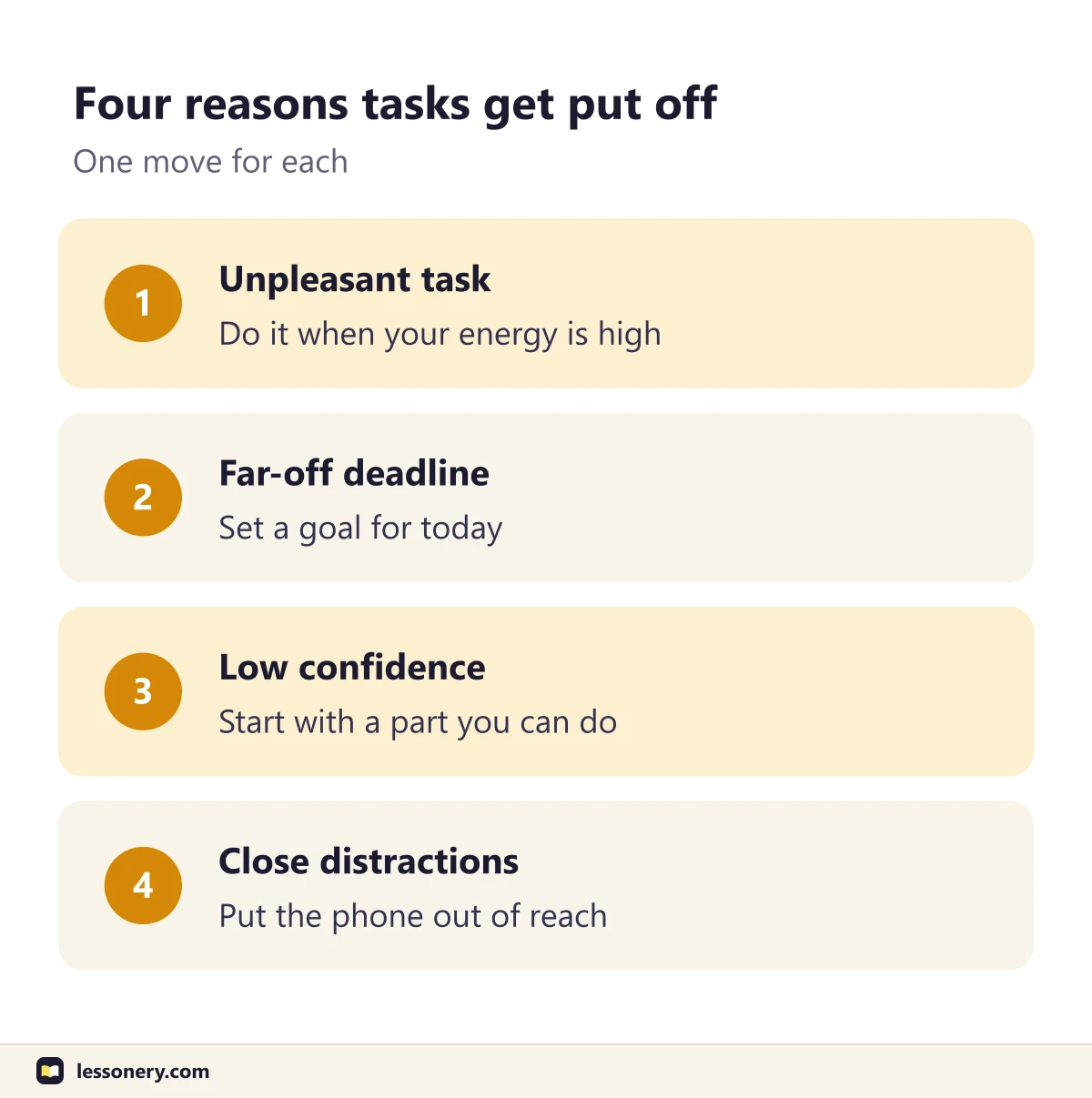
The review also found low conscientiousness, including its facets of self-control and organization, to be a strong predictor. The table lists the predictors that the steps below work on.
Steel ties these together with what he calls temporal motivation theory. In plain words: you want to do a task more when you expect to succeed and when it is rewarding, and less when the payoff is far away and you are sensitive to delay. An essay due in six weeks loses to a video available now, until the deadline gets close.
Mood is part of it too. In a theoretical review, Sirois and Pychyl (2013) argue that procrastination has a great deal to do with short-term mood repair: putting off an aversive task makes you feel better now, and the cost lands on your future self.
The delay does have costs, though the size varies. Tice and Baumeister (1997) followed students in two longitudinal studies. Early in the semester, procrastinators reported less stress and less illness than other students. Late in the term they reported more of both, were sicker across the whole period, and received lower grades on all assignments. Across 41 samples in Steel's review, the average correlation between procrastination and academic performance was −.19, which he describes as weak but consistently negative.
How to beat procrastination: six steps from the research
If you want to know how to beat procrastination on a particular task, first work out which of the four reasons applies, then pick the matching step. None of the steps needs a new app.
1. Make the first step small and near
A near goal shortens the delay. Steel reports that a considerable amount of research found goal setting reduces procrastination, including daily writing goals for academic writers and daily quizzes in a self-paced course. UNC's Learning Center gives the study version: on the day an assignment is set, divide it into the smallest possible chunks, then commit only to the next one, such as the introduction of a paper.
Small also helps confidence. Steel, drawing on Bandura's work, notes that the belief you can do a task is shaped especially by seeing others complete it and by completing tasks successfully yourself.
2. Write an if-then plan
An if-then plan, which researchers call an implementation intention, names the situation that will trigger the action: "If it is 4:00 p.m. on Tuesday and I am in the library, then I will write the first paragraph." Gollwitzer and Sheeran (2006) pooled 94 independent tests of such plans and found a medium-to-large positive effect on goal attainment (d = .65), including on getting started.
Those tests covered many kinds of goals, not only studying. In the first, correlational study of an earlier paper, Gollwitzer and Brandstätter (1997) reported that difficult goals were completed about three times more often when people had attached such a plan to them.
3. Use deadlines, but don't count on them
The evidence on self-set deadlines is disputed. Ariely and Wertenbroch (2002) reported that people were willing to set costly deadlines for themselves, that these deadlines improved performance, and that they still worked less well than some deadlines imposed by someone else.
Hyndman and Bisin (2026) repeated that paper's second study, a proofreading task, with adults enrolled at a large public university in the United States. They report that the results did not replicate: changing the deadlines had a negligible effect on the performance measures, and evenly spaced deadlines set by the experimenters did not stand out for reducing procrastination.
Given that, treat an interim deadline as a prompt for step 2, not as a fix by itself. UNC suggests one practical form: tell a study partner your goals and timeline, and report progress once or twice a week.
4. Move distractions out of reach
Steel recommends what psychologists call stimulus control: keep cues for the work around you and remove cues for the tempting alternative. He cites a 1978 study in which procrastination decreased for students who studied in the same location. His own example is email: making it less visible, or slower to open, should decrease procrastination.
UNC's version is to open only the materials you need, turn off Wi-Fi when the task allows it, and put your phone on airplane mode. There is more on this in the guide to not getting distracted while studying.
5. Make the task less unpleasant
Because task aversiveness is one of the strong predictors, changing how the task feels is a direct route. Steel's review found the effect is stronger when a task is boring or attempted when energy is low. That fits the advice in UNC's guide to calendars to schedule your hardest studying for when you are most alert. Steel also describes pairing a task with something you like, for example forming a study group if you enjoy company.
A fixed work period can also lower the barrier. UNC suggests setting a time limit, such as 25 minutes of work followed by a 5-minute break, which is the pattern used in the Pomodoro Technique.
6. Treat a slip as information
UNC recommends an inventory: each time you put something off, mark it in your weekly planner, so you can see which tasks and times of day are involved. The same page cites research suggesting that forgiving yourself for past procrastination can reduce later procrastination.
A filled-in example: an essay due in three weeks
This plan is an illustration written for this article, not a template from any of the sources. Adapt the times and tasks to your own course.
| Step | What the plan says (example) |
|---|---|
| Smallest next chunk | "Read the essay question and write three possible angles" (20 minutes) |
| If-then plan | "If it is Monday at 4:00 p.m., then I go to the second floor of the library and open the question sheet" |
| Interim checkpoints | Outline to a study partner by Friday of week 1; full draft by Friday of week 2 |
| Distractions | Phone in bag on airplane mode; only the reading list and a document open |
| Less unpleasant | First session at 10:00 a.m. Saturday, the time of week with most energy; work with a classmate |
| After a slip | Missed Wednesday: marked it in the planner, moved the chunk to Thursday at 4:00 p.m. |
Putting chunks like these into a calendar is covered in the guide to a weekly study schedule.
How strong the evidence is
Programs to reduce procrastination show positive results, but two meta-analyses differ on how large the effect is. van Eerde and Klingsieck (2018) pooled 24 intervention studies with 1,173 participants and reported a large reduction in procrastination that held at follow-up. Cognitive behavioral therapy appeared to reduce it more than the other types of intervention.
A second meta-analysis was more cautious. Rozental and colleagues (2018) pooled 12 studies with 718 participants that compared a psychological treatment with a control group. They found a small overall benefit (g = 0.34), wrote that the benefits "must be seen as quite modest", and rated 92% of the studies as high risk of bias on blinding, meaning participants and assessors knew who received the treatment.
Note: The advice here on how to beat procrastination comes from correlational findings, a meta-analysis of if-then plans across many kinds of goals, and university study guidance. No source cited here tested this exact set of steps together.
When procrastination comes with distress
Rozental and colleagues point out that not everyone who procrastinates has a problem that needs treatment, but that for some people it becomes problematic and comes with anxiety, lowered mood and decreased well-being.
The steps above are study skills, not treatment. If putting things off is causing you significant stress, or it comes with lasting low mood or anxiety, talk to a doctor, a counselor or your school's student support service. The University of Toronto Scarborough gives its own students the same advice on its managing procrastination page: follow up with a health care provider when procrastination causes significant stress.
Frequently asked questions
Is procrastination the same as laziness?
Not by the research definition. Steel's definition requires that you intended to do the task, and the strong predictors in his review include how unpleasant the task is and how distant the deadline is. The University of Toronto Scarborough page calls the laziness label a myth and describes procrastination as avoiding the negative feelings a task brings up.
Do some people work better under pressure?
UNC's Learning Center lists this belief among the myths to challenge. In Tice and Baumeister's two studies, students who procrastinated received lower grades on all assignments and reported more stress late in the term. Steel's review found a weak but consistently negative link between procrastination and academic performance.
Is procrastination a time management problem?
Partly. A meta-analysis by Aeon, Faber and Panaccio (2021) found that students who reported better time management also reported less procrastination (r = .49 across 14 studies). Sirois and Pychyl's argument about mood suggests planning is only part of it, which is why the steps above also change how the task feels. For the planning part, see these time management tips for students.
How long does it take to stop procrastinating?
The sources here don't give a figure. In van Eerde and Klingsieck's meta-analysis, the length of an intervention had no significant effect on how much procrastination fell.