Four memorization techniques for studying that researchers have tested are mnemonics: first-letter phrases, the keyword method, the method of loci and chunking. Each one gives a fact a hook, such as a letter, an image, a place or a group, so you have something to pull on when you need the fact back.
They are narrow tools. In the research below, each one helps with a particular kind of material, mostly lists and word pairs, and mostly on tests taken soon after study. For facts you need weeks later, the same research points to self-testing and spaced review as the base, with a mnemonic added where it fits.
Quick answer: Use first-letter mnemonics for short ordered lists, the keyword method for concrete vocabulary, the method of loci for longer sequences, and chunking for numbers and codes. A 2013 research review rated the keyword mnemonic as low utility because its benefits were limited to certain materials and short delays, and rated practice testing and distributed practice as high utility.
What a mnemonic does, and what it cannot do
A mnemonic is a device that ties new information to something easier to recall: a word, a picture, a familiar place. It stores a label. It does not store the reasoning behind the label.
That is why the University of North Carolina's Learning Center puts "understand first" near the top of its list of memorization strategies. Material that makes sense is easier to memorize, so the page advises working on understanding before memorizing.
The gap between recalling and understanding shows up in data. Mocko and colleagues (2024) surveyed 1,323 introductory statistics students at a large research university in the southeastern United States who had been taught 14 mnemonics during one term. In the authors' summary of the study for a statistics education webinar, acronym-type mnemonics were recalled more often, while longer phrase-type mnemonics were more often explained and applied. Remembering the letters was not the same as being able to use them.
Four techniques and what research found about each
First-letter mnemonics: acronyms and acrostics
A first-letter mnemonic turns the initials of a list into a word (an acronym) or a sentence (an acrostic). UNC's example is "Please Excuse My Dear Aunt Sally", a phrase whose first letters match the order of operations in arithmetic.
One controlled test comes from Radović and Manzey (2019). In their first experiment, 65 university students learned an eight-step procedure on a computer: 33 were given an acronym with one letter per step, and 32 were not. The acronym group learned the sequence faster (a mean of about 910 seconds against 1,151, with four outlying learning times left out of that comparison). Once the procedure was learned, the two groups did not differ significantly in speed or accuracy on uninterrupted trials.
So the measured benefit was in learning the order. A first letter is a small cue: it can remind you of an item you already know, and it tells you what comes next. It fits short ordered lists such as steps, stages and classifications.
The keyword method
The keyword method links a new word to a similar-sounding word you know, then joins the two meanings in one mental image. Dunlosky and colleagues (2013), who reviewed ten learning techniques, give this example: for the French la dent (tooth), the keyword is "dentist", and the image is a dentist holding a large molar with a pair of pliers.
The review reports that the method has helped with foreign vocabulary, definitions of obscure English words and science terms, medical terminology and other paired facts, in learners from second graders (around age 7) to college students. In the first demonstration it describes, by Raugh and Atkinson (1975), college students who used supplied keywords for Spanish words did significantly better on a translation test than students who studied the word pairs without keywords.
The same review then lists three limits:
- It needs keyword-friendly material. Concrete nouns work. Abstract words are hard to turn into images, and most studies used material chosen to suit the method.
- The keywords were usually supplied. Few studies had students invent their own, and those had mixed results.
- The benefit may not last. Wang, Thomas and Ouellette (1992) tested separate groups immediately and one week later. The keyword group beat a rote-repetition group on the immediate test, but the advantage vanished for students tested only after a week.
Classroom results were mixed too, with benefits for fifth graders (around age 10) learning Spanish words but none for high school students in language courses. On that basis the authors rated the keyword mnemonic as low utility and wrote that they could not recommend it be widely adopted. Low utility is their term for limited reach, not a finding that it never helps.
The method of loci (memory palace)
The method of loci stores items as images placed along a route you know well. Ondřej's (2025) systematic review describes four steps:
- Choose a space with distinct locations.
- Turn each item into a vivid, often unusual, mental image.
- Place each image at one location, in order.
- To recall, walk the route in your mind and collect the items.
In a training study, Dresler and colleagues (2017) assigned 51 men with no mnemonic experience to method of loci training, working-memory training or no training. The loci group had a 2-hour introduction and then practiced 30 minutes a day for 40 days. On free recall of a 72-word list, tested 20 minutes and 24 hours after study, the loci group improved significantly more than both other groups, and the difference was still there at a retest four months later.
The review's meta-analysis compared the method with rehearsal on immediate serial recall, which means recalling items in order straight after study. For its combined adult sample (3,006 participants aged 17 to 88) it reports a large effect, d = 0.88, the figure given in the abstract. For young adults alone (936 participants aged 17 to 44) the effect was small, d = 0.42. The combined figure also includes studies of older adults, where the estimate was large (d = 1.05, from before-and-after results).
The author found very strong evidence of publication bias in the young-adult and combined analyses and writes that small-study effects likely inflated the effect sizes. The review rates the evidence as low to very low quality, mainly because of a high risk of bias in the studies, and as very low for young adults. In its table of young-adult studies, most lists had between 10 and 40 items, and the participants were predominantly undergraduates at European and American universities. It also notes practical costs: building a memory palace takes time, and encoding quickly takes considerable practice.
Watch out: Most of this evidence is about recalling lists. The results above are word counts, not course grades, so treat the method as a way to hold a sequence, such as the points of a talk, not as a way to learn a subject.
Chunking
Chunking means grouping small items into larger meaningful units, so you carry fewer pieces. The term comes from George Miller's 1956 paper, which described tests in which people could repeat back about seven decimal digits but only about five one-syllable words. Miller argued that immediate memory is limited by the number of units, or chunks, not by the amount of information in them.
Miller's example is a trainee radio operator learning Morse code. At first each dot and dash is a separate chunk. With practice they become letters, then words, then phrases. He also describes a researcher, Sidney Smith, who drilled himself on recoding groups of binary digits into single symbols and could then repeat back about 40 of them.
Later estimates of the limit are smaller. Cowan (2010) puts it at 3 to 5 meaningful items in young adults once rehearsal and grouping are prevented. Either way the practical point is the same: you can't hold many separate pieces at once, but each piece can be large if it means something to you.
Memorization techniques for studying, compared
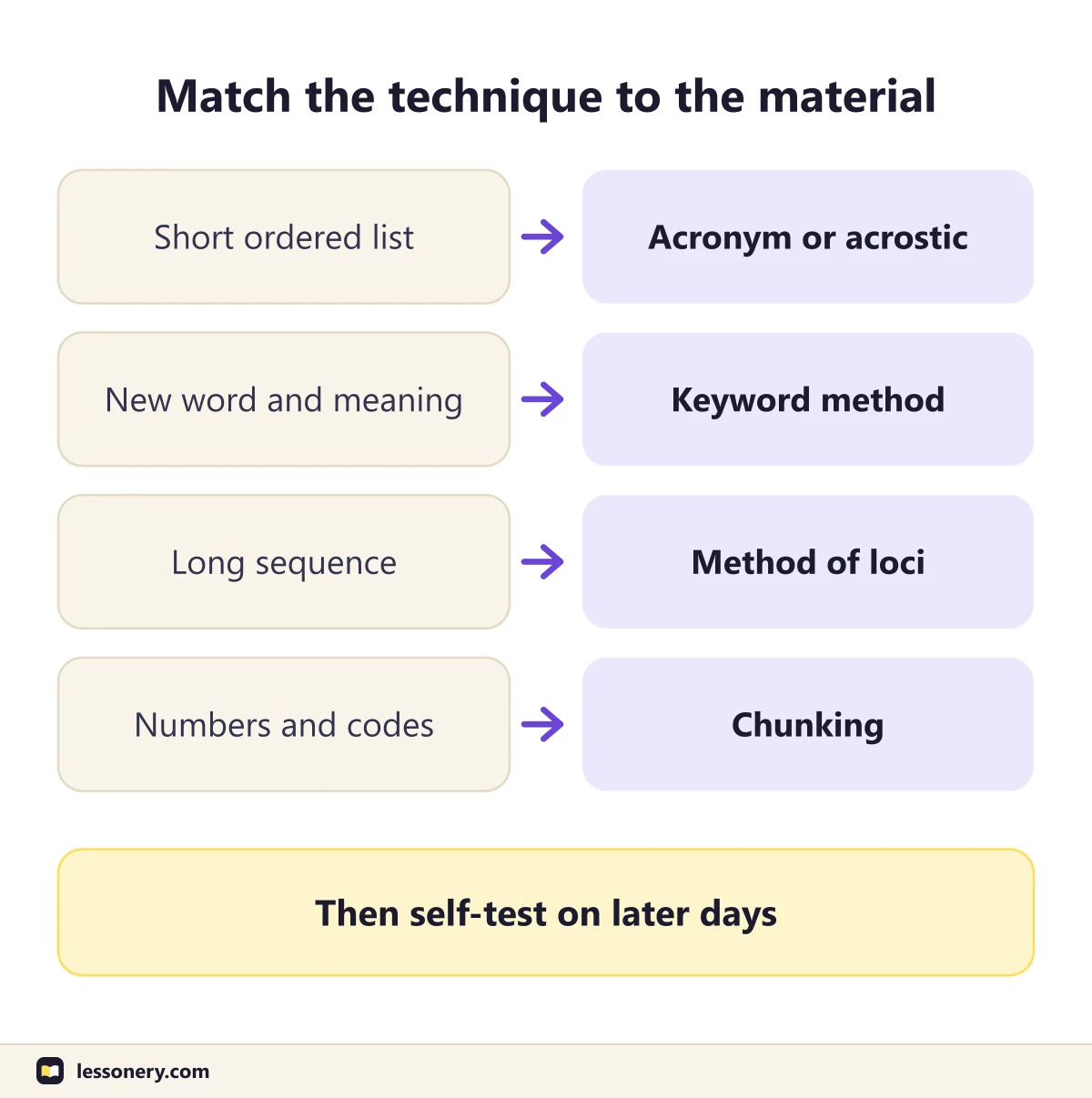
| Technique | What you do | What the research found | Fits |
|---|---|---|---|
| Acronym or acrostic | Make a word or sentence from first letters | Students given an acronym learned an eight-step sequence faster; no difference once learned (Radović and Manzey, 2019) | Short ordered lists |
| Keyword method | Link a sound-alike word to the meaning in one image | Helps with concrete word pairs on immediate tests; advantage gone after one week in Wang et al. (1992); rated low utility (Dunlosky et al., 2013) | Concrete vocabulary and terms |
| Method of loci | Place images along a familiar route | On immediate ordered recall against rehearsal, a large effect across all adults (d = 0.88) and a small one in young adults (d = 0.42); evidence rated low to very low quality (Ondřej, 2025) | Longer sequences |
| Chunking | Group items into meaningful units | Memory span is limited in chunks, about 3 to 5 in young adults (Cowan, 2010) | Numbers, codes, long strings |
A filled-in example
The three cases below are an illustration written for this article, not a procedure from any of the studies.
| What to remember | Technique | How it looks |
|---|---|---|
| The 12-digit code 471983265014 | Chunking | Three groups of four: 4719, 8326, 5014 |
| French la dent means tooth | Keyword method | Keyword "dentist"; image of a dentist holding a large molar (the example from Dunlosky et al.) |
| The four techniques in this article, in order | Method of loci | Front door: a row of capital letters. Hallway: a dentist. Kitchen: a map pinned to the fridge. Bedroom: a bar of chocolate snapped into squares |
Then check it. Close the page, wait, and try to produce each item from the cue alone. The US Institute of Education Sciences practice guide Organizing Instruction and Study to Improve Student Learning says the best time to judge whether you know something is after a delay of an hour, a day or a week, with only the question in front of you.
Where mnemonics stop helping
As memorization techniques for studying go, mnemonics give you a first route to a fact. Keeping the fact is a separate job, and the Dunlosky review gives that job to two other techniques: practice testing and distributed practice, the only two of the ten it rated as high utility. In one comparison it describes (Fritz and colleagues, 2007), recall of foreign vocabulary after the keyword method was either no different from recall after practice testing or lower one week later.
A later analysis is somewhat kinder. Donoghue and Hattie (2021) pooled 242 studies of the same ten techniques and found an average effect of d = 0.50 for mnemonics, against 0.56 across all ten. They argue that low-rated techniques should not be dismissed, while noting that most outcomes in the studies were factual and most were measured within a day.
A reasonable reading of both: build the hook with a mnemonic when the material suits one, then keep it with self-testing, covered in the guide to the active recall method, on a spaced repetition schedule. The overview of the most effective study techniques explains how all ten were rated.
Frequently asked questions
What is the most effective way to memorize for an exam?
None of the memorization techniques for studying described here earned that label in the research. Dunlosky and colleagues (2013) gave their highest rating to practice testing and distributed practice, which means testing yourself and spreading sessions over time. Mnemonics can be added for lists and vocabulary that suit them.
Does the memory palace technique work for studying?
Studies find that it improves ordered recall of word lists, but the 2025 review's estimate for young adults was a small effect (d = 0.42), and it rated the overall evidence as low to very low quality. In Dresler and colleagues' 2017 training study the gain was still present four months later, after 40 days of half-hour practice. Its effect on course results has not been established in the studies described here.
How many things can you hold in memory at once?
Miller (1956) reported a span of about seven digits. Cowan (2010) estimates 3 to 5 meaningful chunks in young adults when rehearsal and grouping are prevented.
Do mnemonics help you understand a topic?
Not by themselves. In the survey of 1,323 statistics students by Mocko and colleagues (2024), the mnemonics students recalled most often were not the ones they explained and applied most often. UNC's Learning Center advises understanding the material first and memorizing second.