The active recall method is studying by pulling information out of your memory instead of reading it again. You close the book, write or say what you can remember, then check what you missed. Researchers usually call it retrieval practice or practice testing.
A 2013 review of ten study techniques gave practice testing one of only two "high utility" ratings, and the experiments behind that rating are simple enough to copy with your own notes.
Quick answer: Active recall means testing yourself from memory (blank-page recall, flashcards, practice questions) and then checking the answers against your notes. In Roediger and Karpicke (2006), students who recalled a passage instead of rereading it remembered more of it two days and one week later, although rereading did slightly better on a test five minutes after studying.
What the active recall method is
Active recall is any study activity in which you produce the answer from memory before you look at it. The psychology department at UC San Diego describes retrieval practice as recalling information without looking at notes, slides or the textbook, and notes that the benefit is also known as the testing effect.
The phrase itself is old. In their review of learning techniques, Dunlosky and colleagues (2013) quote the psychologist Edward Thorndike, who wrote in 1906 that "the active recall of a fact from within is, as a rule, better than its impression from without."
The contrast is with restudying: rereading notes, looking over slides, going back through highlighted lines. Restudying puts the material in front of you. Recall makes you rebuild it without help, which is also what a closed-book exam asks for.
The method doesn't need a formal test. Dunlosky et al. use "practice testing" for low-stakes or no-stakes testing that students can do on their own, such as flashcards and end-of-chapter questions.
What the key studies found
Roediger and Karpicke (2006): recall versus rereading
Roediger and Karpicke (2006) ran two experiments with undergraduates at Washington University in St. Louis. In the first, 120 students read two short science passages, one about the sun and one about sea otters. Each student studied one passage a second time for 7 minutes and, for the other passage, spent 7 minutes writing down everything they could remember, with no feedback. A final recall test came 5 minutes, 2 days or 1 week later.
The result depended on the delay. After 5 minutes, students recalled more of the passage they had restudied: 81% of its ideas, against 75% for the passage they had been tested on. After 2 days the order reversed, with 68% for the tested passage against 54%. After 1 week it was 56% against 42%.
The second experiment, with 180 students, compared three plans: four study periods of reading, three periods of reading followed by one recall test, and one period of reading followed by three recall tests. Five minutes later the read-only group led (83%, 78% and 71%). One week later the order had flipped: 61% for the group that recalled three times, 56% for the group that recalled once and 40% for the read-only group.
The read-only group had read the passage about 14 times in total, the three-test group about 3.4 times. Asked at the end of the first session how well they would remember the passage in a week, the read-only group gave the highest ratings.
Karpicke and Blunt (2011): recall versus concept mapping
Karpicke and Blunt (2011) tested recall against a more active rival than rereading. Eighty undergraduates studied a science text in one of four ways: reading it once, reading it in four consecutive study periods, reading it and then drawing a concept map (a diagram of linked ideas) with the text open, or reading it, recalling as much as possible, rereading and recalling again. Study time was matched between the mapping and recall groups.
On a short-answer test one week later, the recall group averaged .67 of the available points and the concept-mapping group .45, across questions about stated facts and questions that required inferences.
In a second experiment with 120 students, each person used both methods on different texts. Of those, 101 (84%) scored higher on the text they had practiced recalling, and the advantage held even when the final test was to draw a concept map from memory. Before the test, 90 of the 120 had predicted that concept mapping would work as well or better.
The authors add a caution that matters for how you study: a concept map drawn with the text closed would itself be a form of retrieval practice.
Reviews and classroom research
Dunlosky et al. (2013) rated practice testing as having high utility because testing effects had been shown across many test formats, kinds of material, learner ages, outcome measures and delays. The US Institute of Education Sciences reached a similar judgment in its practice guide on organizing instruction and study, which rates the use of quizzes to re-expose students to course content as backed by strong evidence.
For real classrooms, Agarwal, Nunes and Blunt (2021) screened nearly 2,000 abstracts and coded 50 experiments carried out in schools and classrooms, with 5,374 participants in total. Of the 49 effect sizes they extracted, 57% showed medium or large benefits from retrieval practice.
How strong the evidence is, and where it stops
The evidence for the active recall method is strong for remembering material after a delay. It is thinner in a few specific places.
- The benefit appears on delayed tests. In Roediger and Karpicke's data, rereading won when the test came five minutes later.
- Feedback matters. Dunlosky et al. report that some studies found no advantage for testing without feedback over restudying, mostly when students got few practice answers right. Testing followed by the correct answer beat restudying consistently.
- Most laboratory work used university students. The review notes that a large majority of studies involved college students, although testing effects have also been found with younger learners, including elementary school students.
- Classroom evidence comes from a limited set of countries. Agarwal and colleagues note that only 6% of the experiments they reviewed were conducted in what they call non-WEIRD countries.
- Complex material is disputed. van Gog and Sweller (2015) argued that the testing effect shrinks or even disappears as learning material becomes more complex, meaning it contains many interacting elements. Karpicke and Aue (2015) replied that the review left out studies showing retrieval benefits with complex material and that the null results came from the particular retrieval tasks used. The question is not settled.
These studies measured recall and test performance on the material that was studied. None of them promises a grade.
How to do active recall, step by step
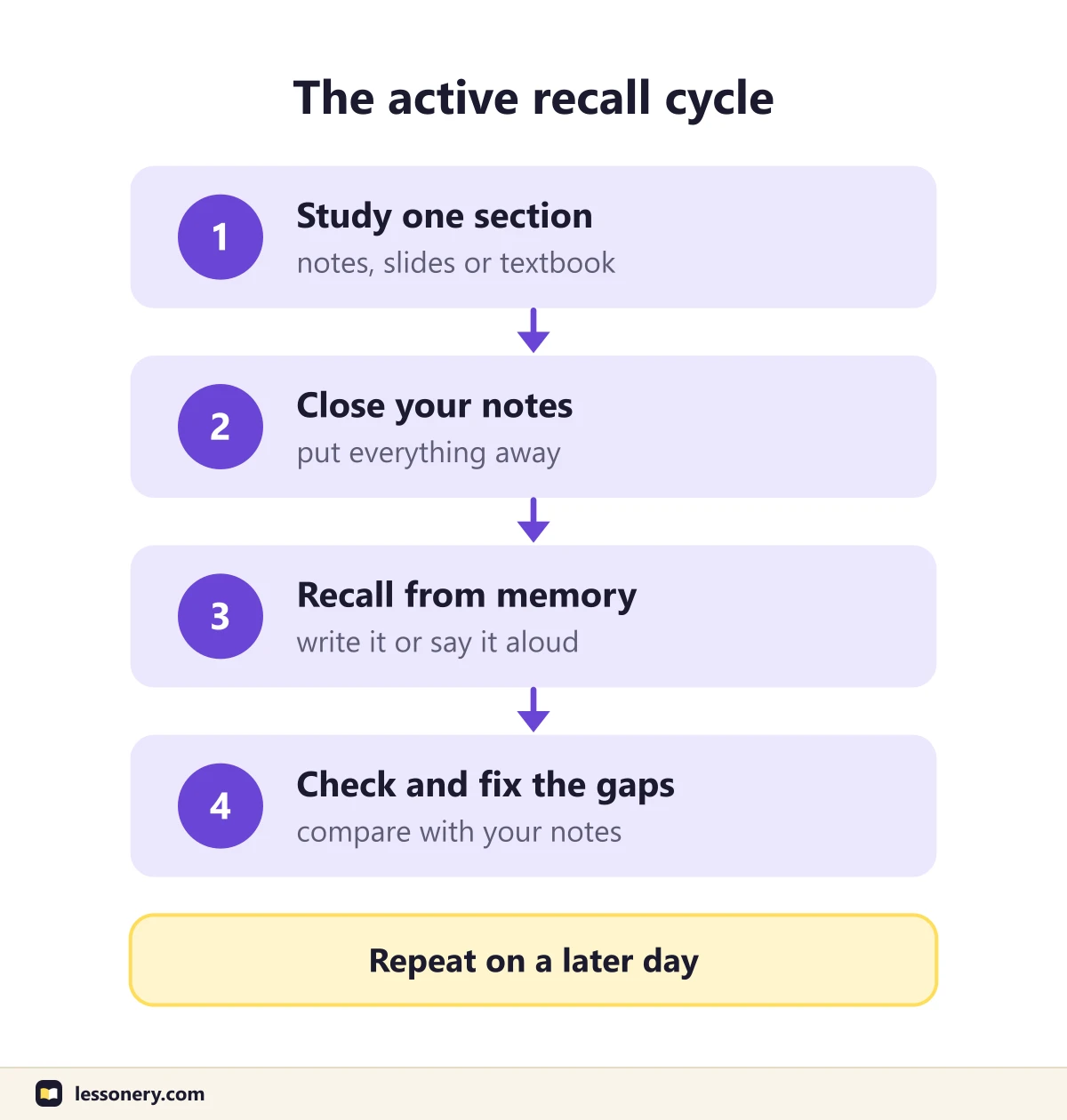
UCSD's guide gives the basic cycle:
- Study one section of your notes, slides or textbook.
- Put the material away.
- Recall what you just learned, in your head or on paper.
- Open the material again and check what you recalled.
- Mark what you missed or got wrong, and study those parts.
- Repeat the cycle.
Five ways to run the recall step
Flashcards, practice questions and cover-and-check are the methods UCSD's guide lists.
- Blank-page recall. Write everything you remember about a topic on an empty page, as the students in both experiments above did.
- Flashcards. Put a question on one side and the answer on the other, and answer before you turn the card.
- Practice questions. Use end-of-chapter questions, questions from your teacher, or ones you write yourself. UCSD suggests matching the question types to your exam.
- Cover and check. Cover a slide or a section of notes, recall it, then uncover it.
- A cue column. Dunlosky et al. point to the Cornell note-taking system, in which you write terms or questions in a blank column beside your notes and use them later to test yourself.
Explaining a topic aloud with your notes closed is recall too, and the Feynman study technique builds a routine around it.
Three settings that change the result
Dunlosky et al. (2013) draw three practical points from the research:
- Produce the answer, don't just recognize it. The available evidence suggests that practice tests requiring you to generate a response (free recall, short answer) are more effective than fill-in-the-blank or recognition formats. The authors say more work is needed before firm rules can be given.
- Don't stop at the first correct answer. Practice testing is most useful when you continue until you have answered an item correctly more than once, within a session and across sessions.
- Spread the tests out. Several studies found little or no gain from repeating tests back to back, compared with sizable gains when the tests were spaced. A spaced repetition schedule covers how far apart to put them.
A filled-in example: 15 minutes of recall on one topic
This is an example written for this article, not a procedure from any of the studies. The material is the first Roediger and Karpicke experiment described above.
Step 1: blank-page recall (5 minutes), written with the page closed.
Students read passages. Some reread, some wrote down what they remembered. A week later the recall group remembered more, I think about 56% against 40-something. Rereading was better at first?
Step 2: check (3 minutes). Correct: the one-week figures were 56% and 42%. Missing: who took part, the 2-day result, and the exact early result.
Step 3: write question cards for the gaps (2 minutes).
| Question | Answer |
|---|---|
| Who took part in experiment 1? | 120 undergraduates at Washington University in St. Louis |
| Which condition was ahead after 5 minutes, and by how much? | Rereading, 81% against 75% |
| What were the results after 2 days? | Recall 68%, rereading 54% |
| What were the results after 1 week? | Recall 56%, rereading 42% |
Step 4: answer the cards from memory (5 minutes), then again on a later day. A card answered wrongly goes back in the pile until it has been answered correctly more than once.
Common mistakes and how to fix them
| Mistake | Why it is a problem | Fix |
|---|---|---|
| Skipping the check | Dunlosky et al. note that feedback protects against repeating an error made on a practice test | Compare every answer with your notes |
| Judging by how familiar the page feels | In Roediger and Karpicke's second experiment the read-only group was the most confident and remembered the least after a week | Judge by what you can produce with the page closed |
| Dropping a card after one right answer | Results were better when items were recalled correctly more than once | Keep a card until you have been right on it at least twice |
For how practice testing compares with the other techniques in the Dunlosky review, see the most effective study techniques.
Frequently asked questions
Is active recall the same as retrieval practice?
Yes. "Retrieval practice", "practice testing" and "the testing effect" are the terms researchers use. Active recall is the informal name for the same method.
Is rereading a waste of time?
Not entirely. In Roediger and Karpicke (2006), rereading produced the best scores on a test five minutes later, and in Karpicke and Blunt (2011), reading a text four times beat reading it once. Dunlosky et al. (2013) rate rereading as having low utility and suggest practice testing in its place.
Does active recall work for math and other problem-solving subjects?
Dunlosky et al. count working through practice problems as a form of practice testing. Whether the testing effect holds up as material gets more complex is disputed, as the exchange between van Gog and Sweller (2015) and Karpicke and Aue (2015) shows.
How long should a session of the active recall method be?
The research doesn't set a length. In Roediger and Karpicke's experiments the recall periods lasted 7 or 10 minutes, for passages of 256 and 275 words. Dunlosky et al. note that most studies found benefits with modest amounts of practice-testing time.