
The maths study tips in this article all concern how you practice, and each is tied to a study or to university guidance. Solve problems most days, study worked examples and then take the steps away one at a time, explain each step, return to old topics, and mix the problem types.
"Math" and "maths" are the same subject, named differently in different countries. This article uses "math" from here on. It covers study across a term. For the week before an exam, see how to study for a math final.
Quick answer: Do some problems most days instead of one long weekly session. Learn a new problem type from a worked example, then supply more of the steps yourself each time until you solve one alone. Say why each step is allowed. Start each session with a few older problems, mix problem types once you know them, and write down what each mistake teaches you.
Maths study tips at a glance
| Habit | What you do | What the source reports |
|---|---|---|
| Daily problems | Solve a few problems most days | Queen's University advises doing some math every day |
| Faded worked examples | Study a solved problem, then write more of the steps yourself | Barbieri et al. (2023): a medium average effect of worked examples across 55 studies |
| Explaining steps | Say what was done and why | Rittle-Johnson et al. (2017): small to moderate gains right after study, less evidence for lasting gains |
| Spaced practice | Come back to a topic in later weeks | Emeny et al. (2021): higher test scores a month later in two classroom experiments |
| Mixed practice | Shuffle problem types | Rohrer et al. (2020): 61% against 38% on a test one month later |
| Using mistakes | Find the cause of each error and write the fix | Metcalfe (2017): corrected errors benefit learning in laboratory studies |
Do some problems most days
Start with regular practice. Queen's University's guide to problem solving in Canada advises spreading the work across the week and doing some math every day. It suggests reviewing each day's lecture notes for about 10 to 15 minutes, summarizing them in three or four points, and holding a weekly review of about 20 to 30 minutes per course.
More is not automatically better. The Learning Center at the University of North Carolina at Chapel Hill, in its math and physics learning strategies, recommends choosing problems selectively instead of solving every assigned one, and working on a problem for about 10 to 15 minutes before you open your notes or the solution.
The Ohio State University mathematics department adds two habits for homework: treat it as a learning tool and not just something to hand in, and show your full working so that errors are easier to find.
Study worked examples, then fade them
A worked example is a problem with every solution step written out. The US Institute of Education Sciences practice guide Organizing Instruction and Study to Improve Student Learning recommends alternating worked examples with problems that students solve themselves, and rates the evidence as moderate. Its summary of the research is that students learn more this way than when they are only given problems to solve.
A later meta-analysis, a study that pools the results of earlier studies, puts a number on it. Barbieri, Miller-Cotto, Clerjuste and Chawla (2023) combined 55 studies of worked examples in mathematics, from elementary school to postsecondary education. The average effect on mathematics performance was g = 0.48, which the authors call medium. (An effect size such as g expresses the difference between groups on a standard scale.)
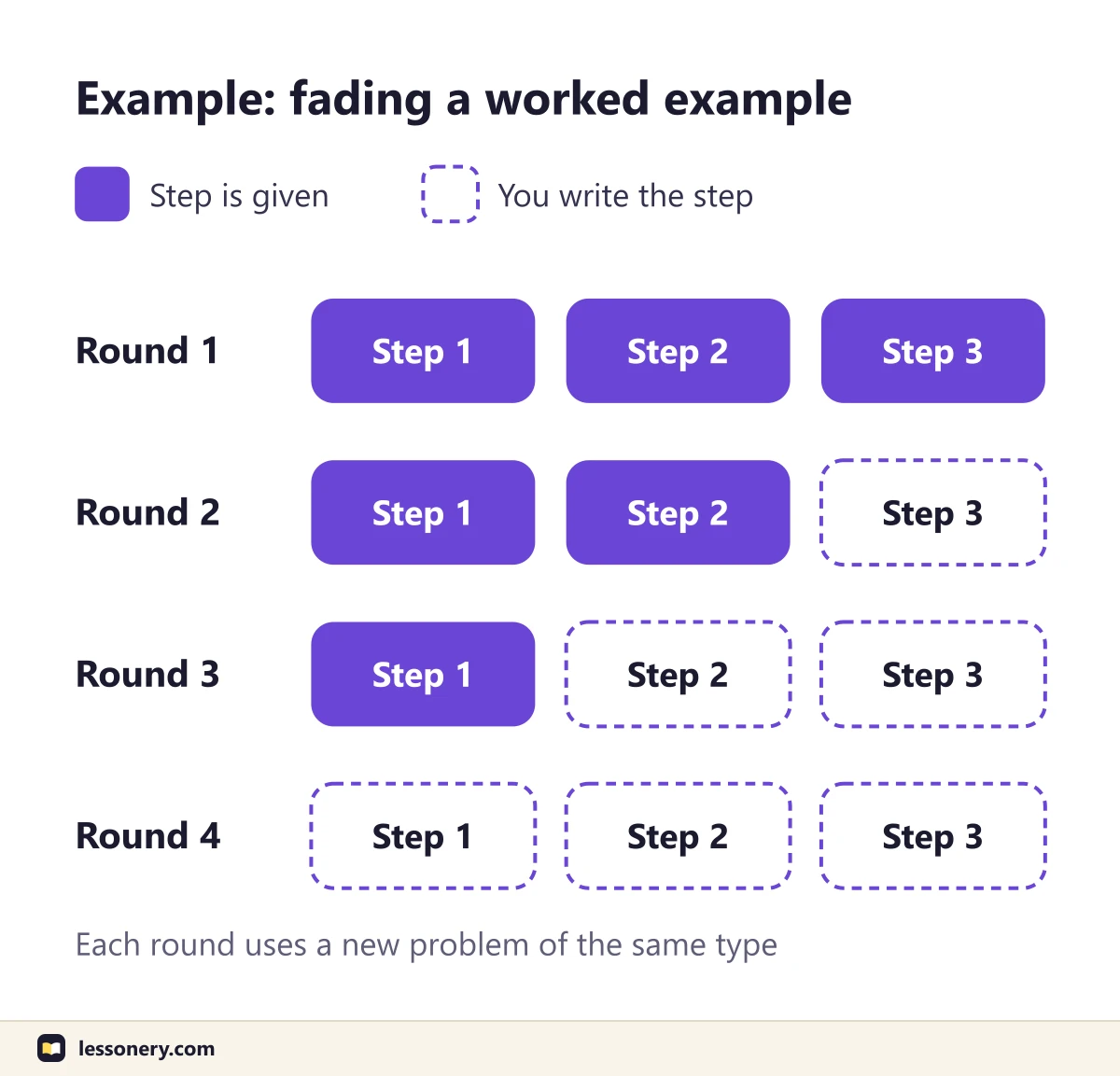
Fading means moving from a full example to a full problem in stages. The full text of the practice guide describes it as giving the early steps of a problem and asking students to provide more and more of the later steps as they gain expertise, and says this also seems to benefit learning. It adds that as expertise grows, fewer examples and more problem solving appear to work better.
Atkinson, Renkl and Merrill (2003) tested one refinement. Their abstract notes that in earlier research, fading reliably helped on near-transfer tasks (problems close to the examples) but not on far-transfer tasks. In their two experiments, combining fading with prompts to name the principle behind each worked step produced medium to large effects on both, without extra study time.
An example: fading one worked example
The example below was made for this article. The problem type is a two-step linear equation, and the worked solution has three steps.
Solve 3x + 5 = 20
Step 1: subtract 5 from both sides    3x = 15
Step 2: divide both sides by 3        x = 5
Step 3: check                         3(5) + 5 = 20
| Round | Problem | Steps you read | Steps you write |
|---|---|---|---|
| 1 | 3x + 5 = 20 | 1, 2 and 3 | None. Say why each step is allowed. |
| 2 | 2x + 7 = 19 | 1 and 2 | 3 |
| 3 | 5x + 4 = 39 | 1 | 2 and 3 |
| 4 | 4x − 7 = 21 | None | 1, 2 and 3 |
The answers are x = 6, x = 7 and x = 7 for rounds 2 to 4. In a textbook, you can fade an example by covering the lower part of its solution with a sheet of paper. Doing this alone is an adaptation of a method the guide describes for teachers.
Explain each step
Self-explanation means telling yourself why a step is valid as well as what the step is. The review of ten learning techniques by Dunlosky and colleagues (2013) rated it moderate in utility, mainly because the evidence for it was still limited.
For mathematics, the evidence is mixed. Rittle-Johnson, Loehr and Durkin (2017) pooled studies in which learners were prompted to self-explain. Prompting led to a small to moderate improvement in procedural knowledge, conceptual knowledge and procedural transfer when these were tested straight after the intervention. Evidence that it reliably helps in classrooms, or that the gain lasts over a delay, was much more limited. The Barbieri meta-analysis adds a caution: worked examples paired with self-explanation prompts were associated with smaller effects than worked examples without them.
Rittle-Johnson and colleagues write their recommendations for teachers, but two of them can be used alone: explain correct information, and explain why a common misconception is wrong. Queen's offers a simple script for a worked example, asking of each step what was done, how, and why. UNC suggests taking turns explaining steps with classmates and then checking that you can solve the same problems alone. The Feynman study technique is a fuller routine built on explaining.
Space and mix your practice
Spaced practice returns to a topic after a gap. Mixed (interleaved) practice puts different problem types next to each other. Both were tested in Rohrer and Taylor (2007). In one experiment, college students practiced one type of problem either in a single session or spread across sessions. In the other, they practiced several types either grouped by type or randomly mixed. On tests one week later, the spaced group performed much better and the mixed group far better.
A classroom study gives more detail on spacing. Emeny, Hartwig and Rohrer (2021) ran two experiments with Year 7 students (ages 11 to 12) at a school in the United Kingdom, with 44 students in the first and 55 in the second. Students did 12 practice problems in one session, or split them over three sessions one week apart. A month later, spaced practice had produced higher test scores in both experiments.
The same study asked students to predict their scores. Predictions were fairly accurate after spaced practice and overconfident after practice in a single session. The authors suggest that one session of similar problems can feel fluent without showing whether the learning will last.
The authors note limits. Students saw the solution after every problem and corrected their work, and the authors suspect spacing may lose its benefit without that feedback. They also cite one laboratory experiment that found no spacing benefit for a mathematics task.
For mixing, a large classroom trial is Rohrer, Dedrick, Hartwig and Cheung (2020), in 54 seventh-grade classes: the group given interleaved assignments scored 61% and the group given blocked ones 38% on an unannounced test a month later. The math final article describes that trial and its caveats.
In practice, open each session with two or three problems from earlier weeks, and once a week do a shuffled set. That routine is this article's suggestion, not a tested schedule. A spaced repetition schedule explains how review gaps are usually set.
Use your mistakes
A wrong answer is information about what to practice next. Ohio State advises analyzing each one. If you knew the material and slipped, note the slip and work more carefully if it recurs. If you can't find the mistake, ask your teacher or a classmate. It also recommends a notebook page headed "Warning: Errors to Avoid" with the correct method for each kind of error.
A review by Metcalfe (2017) summarizes laboratory studies on errors in learning generally, not in mathematics alone. Its abstract reports that making an error and then receiving corrective feedback benefits learning, and it stresses feedback that examines the reasoning that led to the mistake.
That concerns your own errors. For printed examples, the Barbieri meta-analysis found larger effects from correct examples alone than from incorrect examples, alone or mixed with correct ones.
UNC's version for homework is short: after an attempt, note which parts you missed, why, and how you would spot the right strategy next time. An example error log, with a column for the kind of error, is shown in the math final article.
Note: Rules on calculators, formula sheets, working with classmates on graded homework and AI tools differ between schools. Follow the rules your institution sets for each piece of work.
A sample week of math study
The week below is an example made for this article. It assumes lectures on Monday and Wednesday. The minutes are arbitrary, apart from the two review lengths taken from Queen's.
| Day | Task | Minutes |
|---|---|---|
| Monday | Lecture day. Review the notes and summarize them in three or four points. | 15 |
| Tuesday | Monday's topic: one worked example, then problems with the steps faded. | 45 |
| Wednesday | Lecture day. Review and summarize the notes. | 15 |
| Thursday | Two problems from last week, then Wednesday's topic. | 45 |
| Friday | Mixed set: six problems from three different weeks, shuffled. Note each error. | 40 |
| Saturday | Rework this week's errors from a blank page. List questions for your teacher. | 30 |
| Sunday | Weekly review. Preview the next lecture. | 30 |
That works out to 220 minutes, or 3 hours 40 minutes, outside class. To place these blocks around other subjects, see the weekly study schedule guide.
Frequently asked questions
How many hours a week should you study math?
The research cited here doesn't set a number. As a planning figure, Queen's suggests about 8 to 10 hours per week on each course, counting classes, labs and homework. How the time is used matters too: UNC warns against doing so many problems that familiarity is mistaken for mastery.
What should you do when you're stuck on a problem?
UNC suggests struggling with it for about 10 to 15 minutes first, writing down the strategies that might apply. Queen's advises noting exactly where you got stuck and why, so you can ask a specific question, and taking a break when you are frustrated.
Do these maths study tips also work for exam revision?
They are the same methods on a shorter timescale. The math final article turns them into a seven-day plan with a diagnostic, mixed sets and a timed paper. Self-testing in general is covered in the active recall method.