The note taking sentence method is one of the plainest formats that university learning centers teach. Every new thought, fact or topic goes on its own line, and you number the lines as you go. Nothing is sorted during class.
That makes it useful when a lecture moves too fast to organize, and weak as something to study from until you rework it. The guides that teach the method say both things, so the rework gets as much space below as the method itself.
Quick answer: Write each new point on a new line and number it. Use the method when content comes fast and you can't yet see how the points fit together. After class, add what you missed, mark the main points, group the related lines under them and rewrite the notes in an organized format such as an outline or a chart.
What the sentence method of note-taking is
The instruction is one sentence long. The University of Tennessee at Chattanooga's guide to common note-taking methods and Cal Poly's page on note-taking systems give it in the same words: "Write every new thought, fact or topic on a separate line, numbering as you progress."
The University of York's library guide to the sentence method adds detail. Each new idea is written as a whole sentence, capturing as much of the information as is sensible. The numbers track the sequence of ideas and make the notes easier to refer to later. Afterward, you review the notes to identify the main points and themes.
The word sentence is applied loosely. York asks for whole sentences but suggests abbreviations to keep up with the speaker, and the sample notes in the Chattanooga and Cal Poly guides are clipped, abbreviated fragments, not grammatical sentences. What the guides share is one point per line.
How to take sentence notes in class
The steps come from the guides above and from Austin Peay State University's Writing Center handout on sentence notes.
- Start a new line for each new point. A new fact, a new idea or a change of topic each gets its own line.
- Number the lines as you go.
- Shorten the wording. Abbreviate, as York suggests, and drop words you can restore later.
- Don't sort. The Austin Peay handout says to transcribe information quickly as you hear it and to separate unrelated ideas with new lines. Deciding what belongs under what is a job for after class.
If you fall behind, the guide to taking notes in class passes on the University of New South Wales's advice: write a keyword, leave a space and fill it in afterward.
When the sentence method helps and where it falls short
The guides agree on when to reach for it: a lecture with a lot of content that you can follow point by point but can't yet organize.
| What the guides say | Source | |
|---|---|---|
| When to use it | The lecture has some organization but is dense and quick. You can pick out the separate points but can't yet tell how they connect | Chattanooga, Cal Poly |
| When to use it | You can't outline because you can't tell major ideas from subpoints from the way the lecturer presents | Harvard |
| Strength | A little more organized than writing in paragraphs, and it captures more of the information, possibly all of it | Chattanooga, Cal Poly |
| Strength | Simple to learn, needs no preparation and adapts easily to digital formats | York |
| Weakness | The numbers don't show which points are major and which are minor | Chattanooga, Cal Poly |
| Weakness | Hard to edit without rewriting, and hard to review until editing shows how the points relate | Chattanooga, Cal Poly |
| Weakness | Needs fast writing or typing, produces a lot of notes and may take attention away from listening | York |
The Harvard row is from the Academic Resource Center's page on note-taking, which adds that the method works best if you have time afterward to go back and organize the sentences, having heard the whole lecture.
One of those strengths needs a qualification. Getting all of the information down is out of reach for anyone writing or typing at ordinary speed. In a research summary for instructors, Kiewra, Colliot and Lu (2018) cite lecture speeds of about 120 to 180 words per minute, against 22 words per minute for longhand writing and 33 for typing, and report that students record, on average, about one third of a lesson's important ideas.
What research says about sentence notes
Research on the sentence method of note-taking itself is scarce. One recent trial used it as the comparison condition, and a few older studies bear on its central trade: capturing more now and organizing later.
One trial with sentence notes as the comparison group
Yıldırım (2026) randomly assigned 134 second-year education students at a university in Türkiye to one of four ways of taking notes during a five-week course unit of two hours a week. Three groups used Cornell notes, a two-column format or digital tools. The fourth, the control group, took sentence notes, described in the paper as linear and unstructured, with no organization imposed.
All groups took the same 20-question multiple-choice test before the unit, one week after it and again four weeks later. One week after, no pair of groups differed significantly. On the last test, the Cornell group scored significantly higher than the sentence group (adjusted averages of 15.0 and 12.4), and no other pair differed significantly.
The author describes the differences between methods as limited and says the sample and the length of the study limit how far the results generalize. The procedure section does not mention the sentence group regrouping their notes afterward, which is the step the university guides attach to the method.
Capturing more versus organizing as you go
Bui, Myerson and Hale (2013) ran three experiments in which participants either wrote organized notes or tried to transcribe the lecture. In the first, which also compared handwriting with typing, those who transcribed on a computer had the best recall on immediate tests, and the later experiments looked at computer note-taking only. On delayed tests, organized notes produced the best recall. When participants could review their notes before a delayed test, the result reversed and transcribers recalled more.
Two points from Kiewra, Colliot and Lu fit that pattern. The number of lesson points in a student's notes is positively correlated with achievement, and studies that compare the two functions of notes generally find that having notes to review contributes more than the act of taking them.
Read together, and this is reasoning from those studies and not a tested result, a method built for capture looks most useful when the notes are used afterward. Sentence notes that are never reworked are likely to keep the cost of the method without much of its benefit.
How to rework sentence notes after class
The rework is part of the note-taking sentence method, not an extra. Harvard's page, York's guide and the Austin Peay handout all include it, and the handout says the notes should be rewritten later using a structured method.
- Go back soon and add, don't recopy. Kiewra, Colliot and Lu describe a study by Luo and colleagues (2016) in which students heard a 14-minute recorded lesson and then either revised their notes, adding to them, or simply recopied them. Only the revisers added new lesson ideas, and they outperformed the copiers modestly: by 3% on a fact test and by 13% on a test of relationships between ideas.
- Mark the main points. Read the numbered lines and identify the main points and themes, which is York's instruction.
- Cluster the related lines. The Chattanooga and Cal Poly guides describe editing as clustering the points that are related. The line numbers let you list which lines belong together before you rewrite anything.
- Rewrite in a format that shows relationships. The same research summary notes that notes in linear form, a series of sentences and lists, obscure the associations among ideas, and it recommends organizers such as a matrix, which is a table. The outline method suits content that runs from general to specific, and the chart method suits comparisons.
- Turn the main points into questions. Writing questions beside the notes and answering them from memory is the review step of the Cornell note-taking system, and the active recall method explains why self-testing is worth the time.
A filled-in example
The notes below are an example made for this article. They show sentence notes for a short lecture segment on why class notes are incomplete, and every figure in them comes from the research summary by Kiewra, Colliot and Lu (2018) cited above.
In class: sentence notes
1. Students record about 1/3 of a lesson's important ideas.
2. Lectures run at about 120-180 words/min.
3. Longhand = 22 words/min; typing = 33.
4. Main ideas get noted (91% of top level); finest details don't (11%).
5. More complete notes go with higher achievement.
6. Revising notes afterward (adding to them) beat recopying: +3% facts, +13% relationships.
After class: the same notes regrouped
Why class notes have holes

Cause: speed
   - lectures about 120-180 words/min (2)
   - longhand 22 words/min, typing 33 (3)
Result: incomplete notes
   - about 1/3 of important ideas recorded (1)
   - 91% of top-level ideas, 11% of finest details (4)
Why it matters
   - more complete notes go with higher achievement (5)
Fix
   - revise soon after, adding what you recall (6)
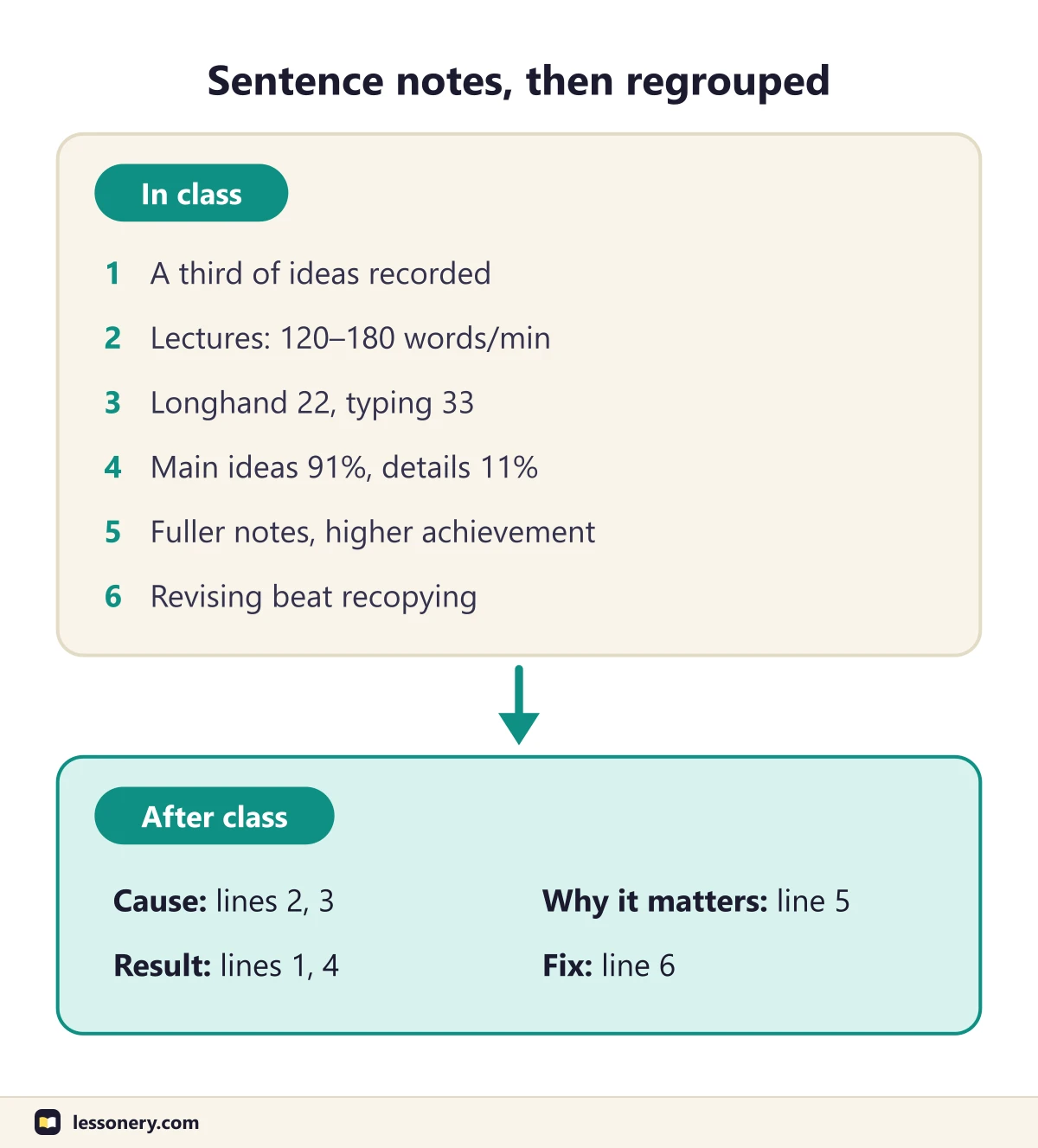
In the numbered version, line 1 is a result that was heard before its cause, and nothing shows that lines 2 and 3 explain it. The regrouped version makes four headings visible that the list hid. A question such as "Why do notes capture only a third of a lesson?" beside the first block turns it into a self-test.
Frequently asked questions
Do you have to write complete sentences in the sentence method?
The guides differ. York's guide and the Austin Peay handout ask for whole sentences, though York suggests abbreviations, and the sample notes in the Chattanooga and Cal Poly guides are shortened fragments. What they share is one point per numbered line.
Is the sentence method of note-taking good for fast lectures?
That is the case the guides recommend it for: content that is heavy and comes fast, when you can hear the separate points but not how they connect. The same guides warn that the notes are hard to review until they are edited.
What is the difference between the sentence method and the outline method?
An outline sorts points into levels while you listen, by indenting details under main topics. Sentence notes leave every point at the same level and postpone the sorting. The comparison of different note-taking methods sets the formats side by side.
Can you type sentence notes?
Yes. York's guide says the method adapts easily to digital formats, and the figures cited by Kiewra and colleagues put typing at 33 words per minute against 22 for longhand. Whether typed or handwritten notes lead to better learning has mixed evidence, covered in the article on taking notes in class.