The core of how to study for a chemistry test is solving problems with the solutions closed, then checking two things: whether the units worked out, and whether you can say what the particles are doing. Studies in chemistry education since the 1980s report that being able to solve a problem does not necessarily mean understanding the concepts involved.
The sections below cover that research and then the practical parts of how to study for a chemistry test: the three levels chemists move between, worked examples, units, an error log and a mixed practice set.
Quick answer: Write out each problem before you look at the solution, carry the units through every step, and for each reaction practice moving between what you observe, what the particles do and what the equation says. Log every error with its cause, rework it a few days later, and finish with mixed problem sets.
Why solving chemistry problems is not the same as understanding them
A right answer to a numerical problem does not show that the idea behind it is understood. That is the finding of a line of studies in the Journal of Chemical Education.
Nurrenbern and Pickering (1987) looked at how students' ability to solve chemistry problems related to their understanding of molecular concepts. Their argument was that teaching students to work problems and teaching them about the nature of matter are two different things. Two follow-ups reached similar conclusions. Pickering (1990) compared students' performance on numerical and conceptual problems in first-year general chemistry and second-year organic chemistry, and reported that a student who could solve a problem did not necessarily understand the concepts in it. Sawrey (1990) made the same comparison at the introductory college level and found that even the higher-achieving students had difficulty with concept questions.
Those summaries come from the papers' abstracts. The practical reading is that a test can ask both kinds of question, and practice on calculations alone may not prepare you for the conceptual ones.
Northern Arizona University's guide to studying chemistry says the same from the teaching side: memorize the information you must know, including reactions, but treat conceptual understanding as the goal. It describes that as being able to apply a core idea to a new situation and to predict and explain chemical systems.
The three levels: macroscopic, submicroscopic and symbolic
One explanation for why chemistry is hard to learn is that a single topic is described in three ways at once. The idea comes from the chemistry educator Alex Johnstone, and Taber (2013) reviews it in Chemistry Education Research and Practice.
In Johnstone's original description, chemists view their subject on at least three levels. At the first, materials can be seen and handled and their properties described. At the second, substances are represented by formulae and their changes by equations. At the third, atoms, molecules and ions are used to explain why substances behave as they do. These are now often labeled macroscopic, symbolic and submicroscopic.
Johnstone's concern was the learner. In a passage Taber quotes, he wrote: "The trained chemist can keep these three in balance, but not the learner." He argued that students are often expected to cope with all three levels at the same moment.
Taber adds two cautions. The model has been adapted in so many ways that no standard version exists; Talanquer (2011) likewise describes reinterpretations that sometimes lead to confusion. And the symbols do double duty: the same equation can stand for substances or for molecules. Taber's example is the equation in the table below.
| Level | What it describes | 2H₂ + O₂ → 2H₂O read at this level |
|---|---|---|
| Macroscopic | Substances and their properties | Hydrogen and oxygen react and a new substance, water, forms |
| Submicroscopic | Molecules, atoms and ions | 2 hydrogen molecules and 1 oxygen molecule become 2 water molecules |
| Symbolic | Formulae and equations | The equation, which also gives the mole ratio: 2 mol of H₂ to 1 mol of O₂ |
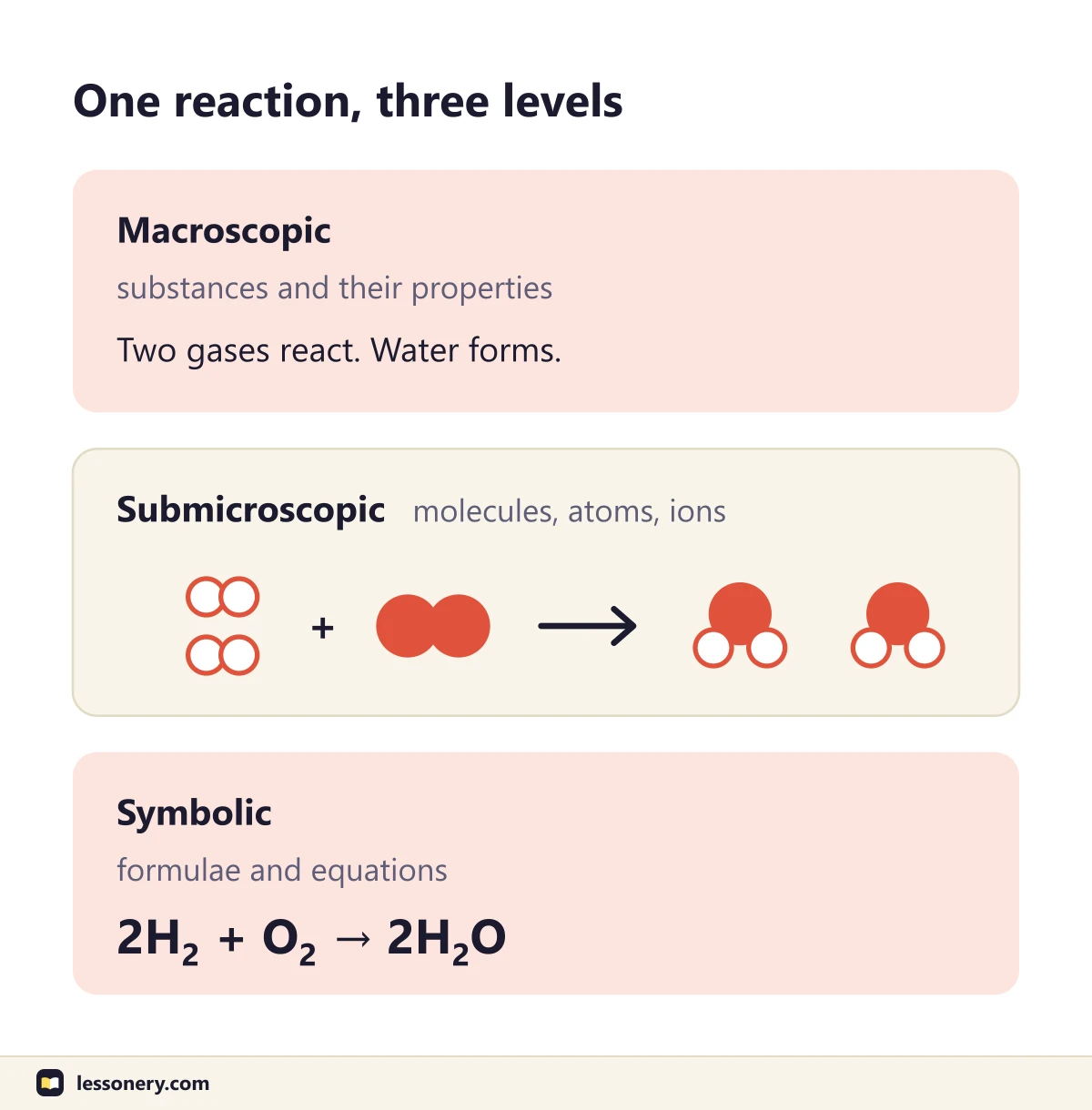
One study suggests a way to practice the middle row. Davidowitz, Chittleborough and Murray (2010) had first-year university students with little previous chemistry interpret and draw diagrams of reactions at the particle level and relate them to equations. Across consecutive year groups, answers to stoichiometry questions (calculations of reacting amounts) improved consistently. As the abstract describes it, this is a comparison of cohorts over several years, and it does not mention a control group.
For self-study, that means drawing the particles for a reaction before you calculate with it. The NAU guide's version is "Think like a molecule".
Solve first, then check: problems and worked examples
Write your answer before you look at the solution. A study-habits handout written in 2011 for one organic chemistry course at the University of Wisconsin-Madison describes the trap: you look at a problem, think for a moment, read the printed solution and tell yourself you knew that. It suggests judging your progress by whether you can do the book problems without looking at the answers.
The NAU guide adds a time limit. If you cannot solve a problem in about 15 minutes, you are probably missing a step or a detail, and should go back to the textbook and your notes, then return to the problem later.
For a type of problem you can't start, study a solved one first. The US Institute of Education Sciences practice guide Organizing Instruction and Study to Improve Student Learning recommends alternating worked examples with problems you solve yourself, and rates the evidence for this as moderate. The article on how to study for a math final describes the experiments behind that recommendation.
How you read the example matters. In a technical report on eight students learning mechanics, Chi and colleagues (1987) recorded what the students said while studying worked examples. The more successful problem solvers explained and justified each step and tied it to principles in the text. The less successful ones often did not. The groups were formed after the fact and the sample is tiny, so this is a description, not a test.
A handout on math and science courses distributed by the University of California, Merced, and credited to the University of Texas Learning Center, turns it into steps: explain each step of the example in your own words, close the book, work the example yourself, then check where you went wrong.
Units and dimensional analysis
Dimensional analysis, also called the factor-label method, means treating units like numbers: they are multiplied, divided and canceled along with the values. The OpenStax textbook Chemistry 2e explains the method and its rule for setting up any calculation: orient every factor so that the unwanted units cancel and the unit you want is left.
The worked problem below is an example written for this article.
Problem: What mass of water forms when 4.0 g of hydrogen gas
reacts completely with oxygen?

Equation: 2H₂ + O₂ → 2H₂O

4.0 g H₂ × (1 mol H₂ / 2.016 g H₂)
         × (2 mol H₂O / 2 mol H₂)
         × (18.02 g H₂O / 1 mol H₂O)
         = 36 g H₂O
Each factor cancels the unit before it: grams of hydrogen, then moles of hydrogen, then moles of water. If the units left at the end are not grams of water, the setup is wrong, and you know that before you check the number.
Two habits from the University of British Columbia's Science Peer Academic Coaches fit here: say aloud the steps needed for each type of problem, and do one question for every formula on the formula sheet.
Note: Whether you get a formula sheet, a periodic table or a calculator is decided by your institution. Practice with the same materials you will have in the test.
Keep an error log
An error log records each problem you got wrong, the cause and the correct method. The handout distributed by UC Merced suggests asking, after a test, where your greatest source of error was: careless errors, lack of time, lack of understanding, uncertainty about which method to choose, missing prerequisite knowledge or test anxiety. Carnegie Mellon University's teaching center describes exam wrappers, short forms that ask students to characterize their errors on a returned exam and look for recurring patterns.
The log below is an example with three invented entries.
| Problem | What I did | Cause | Correct method |
|---|---|---|---|
| Moles of hydrogen gas in 4.0 g | Divided by 1.008 g/mol | Concept: hydrogen gas is H₂ | Use 2.016 g/mol |
| Molarity of 5.85 g of NaCl in 500 mL of solution | Divided the moles by 500 | Units: mL not converted to L | 0.100 mol / 0.500 L = 0.200 M |
| What is left when 4 H₂ molecules and 4 O₂ molecules react? | Said nothing is left | Did not use the ratio in the equation | 2 H₂ react per O₂: 4 H₂O form, 2 O₂ remain |
Rework every logged problem from a blank page a few days later. A column of unit errors calls for more dimensional analysis. A column of concept errors calls for particle drawings.
How to study for a chemistry test with a mixed practice set
Once you can do each type of problem, mix the types. In a chapter exercise you know the method before you read the question. In a test you have to choose it.
The evidence for mixing is strongest for mathematics. In a randomized trial by Rohrer, Dedrick, Hartwig and Cheung (2020), 54 seventh-grade mathematics classes in Florida did mostly interleaved (mixed) or mostly blocked assignments for four months, and on an unannounced test one month later the interleaved group scored 61% against 38%. In a university physics course, Samani and Pan (2021) found that interleaved homework produced higher scores on surprise tests, while scores on graded mid-course exams did not differ significantly. No chemistry trial of this kind was found for this article.
The set below is an example. It uses the data from the sections above, and the answers are in the last column.
| Problem | Type | Answer |
|---|---|---|
| Convert 250 mL to liters | Unit conversion | 0.250 L |
| How many moles are in 36.0 g of water (18.02 g/mol)? | Mass to moles | 2.00 mol |
| 4 H₂ molecules and 4 O₂ molecules react. Draw what is present afterwards. | Particle level | 4 H₂O and 2 O₂ |
| What is the molarity of 5.85 g of NaCl (58.44 g/mol) in 500 mL of solution? | Concentration | 0.200 M |
| What mass of oxygen reacts with 4.0 g of hydrogen gas? | Stoichiometry | 32 g |
Cover the last two columns before you start. For how to fit sets like this into the days before a test, see how to create a study schedule.
Frequently asked questions
Do I have to memorize things for a chemistry test?
Some of it. The NAU guide says to memorize the information you must have at hand, reactions included, while treating understanding as the goal. For the memorizing itself, the review by Dunlosky and colleagues (2013) rated rereading as having low utility and practice testing, which includes flashcards, as having high utility; the active recall method covers it. For reactions, the Wisconsin course handout suggests three sets of cards, each hiding a different part: the product, the reagent or the starting material.
Why can I follow the worked solutions but not solve test problems?
Following a solution and producing one are different tasks, and a test asks for the second. The Wisconsin course handout's advice is to write out your answer to every assigned problem before you look at the printed solution. Write an attempt first, even an incomplete one.
Does changing how you study chemistry change your grade?
One study points that way without settling it. Cook, Kennedy and McGuire (2013) gave a 50-minute lecture on learning strategies to a first-year class of nearly 700 science majors after the first exam. Students who attended ended with an average final grade a full letter grade higher than students who were absent, although the two groups had not differed significantly on the first exam. The comparison is between students who attended and students who stayed away, not between randomly assigned groups, so other differences between them cannot be ruled out.
How is studying chemistry different from studying biology?
This guide concentrates on calculations, units and symbols. The guide on how to study for a biology test concentrates on vocabulary and pathways, and how to study for a science exam covers the methods shared by all sciences.