If you are working out how to study for a test the night before, the evening has room for four jobs: choose what to review, test yourself on it, write one page of what you still miss, and pack your bag. Then stop at a time you set in advance.
One evening is a last review, not a study plan. The research on why study packed into a short stretch fades quickly is covered in how to cram for an exam. This article is only about the evening itself.
Quick answer: Spend the first 20 minutes sorting the test topics into known, half-known and unknown with your notes closed. Give most of the evening to self-testing on the half-known topics and the main ideas of the biggest unknown ones, in short blocks with breaks. Finish with one summary page, pack what you need, and stop at a fixed time.
What one evening of study can and cannot do
The last evening is review time, not time for new material. The Open University's advice on making a revision timetable is to use the day or so before an exam to go back over material instead of trying to cover new ground.
The cram article describes what the research on last-minute study found: study packed into one stretch can help on a test taken soon afterwards, and it is worse for lasting memory than the same study spread over days. By that account an evening of review may help with tomorrow's test. It is a poor way to keep a course in memory.
How you use the hours matters as well. Roediger and Karpicke (2006) had students study prose passages and then either restudy them or take free-recall tests without feedback. On a final test after 5 minutes, restudying produced better recall. On final tests after 2 days or 1 week, the students who had been tested remembered substantially more.
A test the next morning sits between those two delays, so the study can't say which approach wins overnight. What a closed-book attempt adds on the last evening is information: each answer you can't produce marks a gap to restudy. The US Institute of Education Sciences practice guide Organizing Instruction and Study to Improve Student Learning recommends using tests and quizzes to identify content that still needs to be learned, while giving that recommendation the lowest evidence level the guide uses.
Before you start: what to review and what to skip
Sorting comes first, because one evening cannot cover everything. The Learning Center at the University of North Carolina at Chapel Hill suggests, in its test-prep handout, listing the topics likely to be tested from the syllabus, textbook, notes and quizzes. You then hide your materials, test yourself on each topic and rate it 1 (don't know), 2 (sort of know) or 3 (know).
A University of Waterloo guide to studying strategically at the last minute adds how to choose among the weak topics. It advises against trying to learn everything. Focus on material that feels manageable and earns the most points, and don't get stuck on highly specific concepts until the main points are covered.
The table below turns those two sources into a sorting rule. The rule was made for this article as an example; adjust it to your test.
| Your rating | Tonight | Why |
|---|---|---|
| 2: sort of know | Review first, by self-testing | Manageable, and each gap is small |
| 1: don't know, worth many marks | Main ideas only | Waterloo: main points before specifics |
| 1: don't know, worth few marks | Skip | There is not time for everything |
| 3: know | One quick closed-book check | Confirms the rating was right |
Two things are safe to drop for the evening. One is rereading whole chapters: UNC's Learning Center says in its guide to studying smarter that simply reading and rereading texts or notes is not active engagement with the material. The other is the narrow detail of a topic you have never studied.
How to study for a test the night before: an example evening by the hour
The plan below is an example written for this article. It assumes a test the next morning and a free evening from 5:00 p.m. The clock times are arbitrary. Keep the order and shift the hours to fit your day.
| Time | What you do |
|---|---|
| 5:00–5:20 p.m. | List the topics the test covers. Rate each 1, 2 or 3 with notes closed. Mark what you will skip. |
| 5:20–6:00 p.m. | Block 1: topics rated 2. Recall or solve first, then check your notes. |
| 6:00–6:10 p.m. | Break. |
| 6:10–6:50 p.m. | Block 2: main ideas of the high-mark topics rated 1. Read a summary, close it, recall. |
| 6:50–7:30 p.m. | Dinner, away from the desk. |
| 7:30–8:10 p.m. | Block 3: practice questions in the test's format, timed. Mark them. |
| 8:10–8:20 p.m. | Break. |
| 8:20–8:50 p.m. | Second pass: blank-page recall of blocks 1 and 2. Restudy only what you missed. |
| 8:50–9:10 p.m. | Write one page: formulas and the points you still missed. |
| 9:10–9:30 p.m. | Pack your bag, check the time and place, set an alarm. Stop. |
That works out to 190 minutes of study (20 + 40 + 40 + 40 + 30 + 20), a little over three hours, plus 20 minutes of packing. The 40-minute blocks sit close to the 30 or 45 minutes UNC's Learning Center gives for an intensive study session.
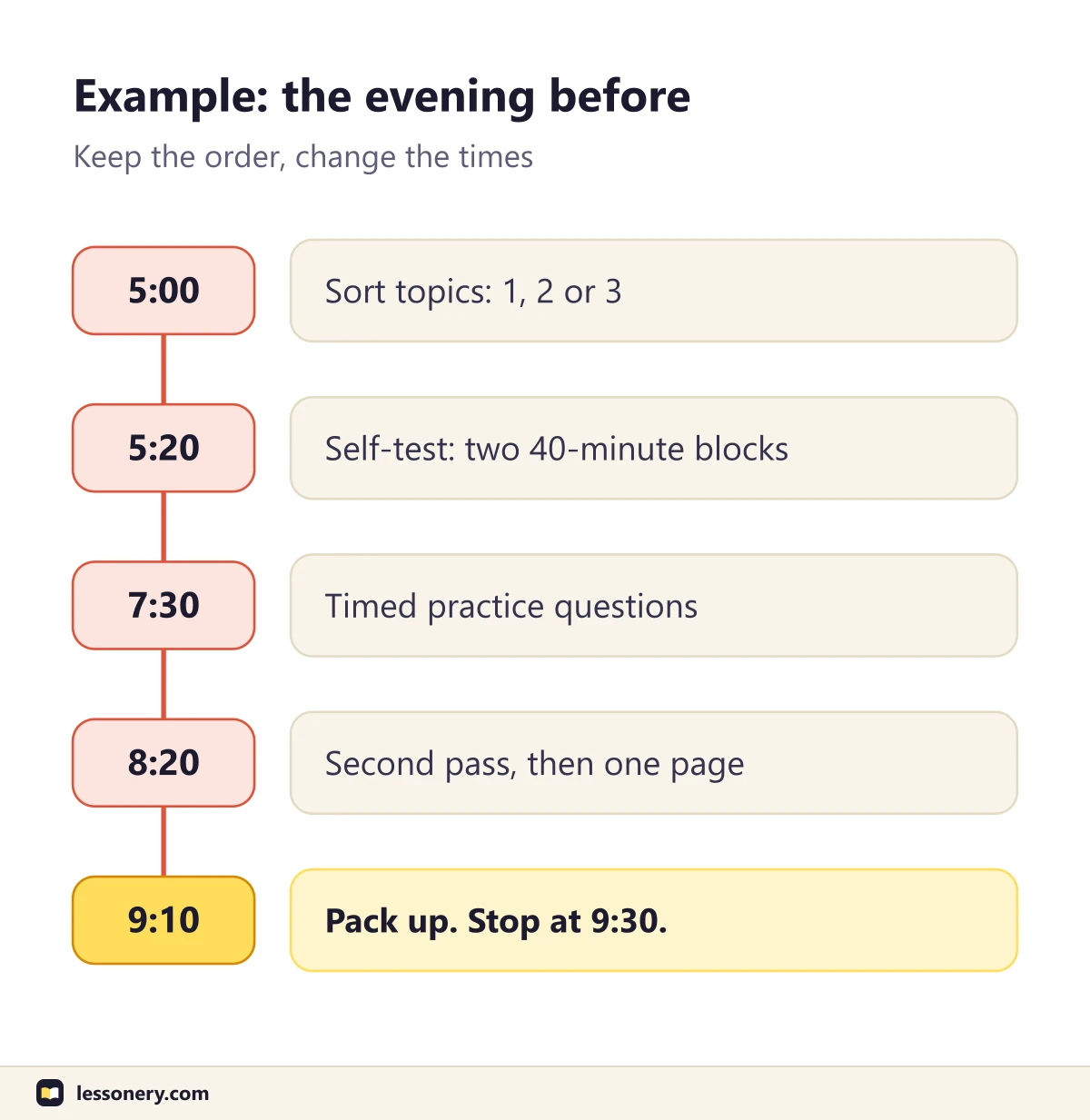
The second pass at 8:20 is there for a reason. The cram article reports a review of 317 experiments, by Cepeda and colleagues (2006), in which repeating material after a gap led to better average recall than repeating it back-to-back. In the example, the second pass starts 2 hours 20 minutes after block 1 ends and 1 hour 30 minutes after block 2 ends. That is a small gap, but it is a gap.
If you can only study for the test late on the night before, keep the first row and the last two. Sorting tells you where the hour should go, the one page gives you something to read in the morning, and packing removes a job from tomorrow.
How to self-test in one evening
Self-testing means producing the answer before you look at it. UNC's handout and Cornell University's Learning Strategies Center, in its five-day study plan, list forms that need little preparation:
- Hide your notes and write down what you remember about a topic, then check.
- Work problems without looking at the answer key.
- Answer each flashcard before you turn it over.
- Explain a concept aloud to someone, or to an empty room.
- Take a self-test under conditions close to the real test.
The last day of Cornell's plan is all review: one hour of short reviews and a one-hour self-test on everything the exam covers. An evening version is Block 3 in the example: questions in the format your test will use, against the clock.
For problem-based subjects such as mathematics and the sciences, Waterloo's guide says to spend most of the time actively practicing problems and to write the main formulas on a sheet of paper. The Ohio State University mathematics department gives similar advice: list the formulas you need and practice writing them. The article on how to study for a math final covers problem practice in detail, and the active recall method covers self-testing in general.
Note: Rules on formula sheets, calculators, notes and digital tools differ between schools and courses. Practice tonight under the rules that apply to your test, and use only the practice materials your teacher or institution provides.
Pack up and plan the morning
Packing is part of the evening, not an extra. UNSW Sydney's exam preparation guidance tells students to check what they are expected to bring, add spare stationery, and know how they will get to the exam well ahead of time. It suggests planning to arrive at least 30 minutes before the start. Waterloo's guide adds a small item: set an alarm.
An example checklist, to adapt:
[ ] Test time and room (or login details) confirmed
[ ] Pens, pencils, eraser, spares
[ ] Permitted items only: calculator, formula sheet, ID
[ ] The one summary page, for the morning
[ ] Route and leaving time
[ ] Alarm set
In the morning, read the one page once. UNC's test day game plan advises giving yourself plenty of time to arrive so you can settle, and deciding in advance what you will do if you run short of time. The final-week article on how to prepare for an examination covers reading the paper and dividing your time.
Stop on time: what research says about sleep
The example plan stops at 9:30 p.m. because university guidance says to protect the night. UNSW's page tells students not to pull an all-nighter, on the grounds that being alert is your greatest asset in the exam. Ohio State's advice is to rest well the night before.
The research here is general and observational. Okano and colleagues (2019) gave wearable activity trackers to 100 students in an introductory college chemistry class, and 88 completed the study. The researchers then compared sleep across the semester with scores on quizzes and midterm exams.
Students with longer, better-quality and more consistent sleep tended to have better grades. Sleep on the single night before a test showed no relation to performance on that test, while sleep over the week and the month before did correlate with scores.
The limits matter. This was a correlational study of one course at one university, and the authors write that showing cause would need experiments. The result does not show that a short night before a test is harmless. It shows that, in this group, the weeks in which the learning happened were what tracked with grades.
Guidance on the evening is not uniform. On the Open University's page about coping with exam stress, one contributor recommends taking the night off before an exam, while a student describes revising the night before a morning exam and says it comes down to what works for you.
This section describes research and is not health advice. If you often can't sleep before tests, or anxiety regularly gets in the way, talk to a doctor, a counselor or your school's support service.
Frequently asked questions
Does it help to study for a test the night before?
It can help with the test itself, though no source cited here promises a result. As the cram article explains, study packed into a short stretch can help on a test taken soon afterwards and fades faster than spaced study. If the material returns in a later exam, plan to study it again over more days.
Should I learn new material the night before a test?
Mostly no. The Open University advises using the last day or so to review instead of covering new ground. If a topic you never studied carries many marks, Waterloo's advice applies: learn its main points and leave the specifics.
Is rereading my notes enough?
Rereading is the weaker choice for finding gaps. UNC's Learning Center describes reading and rereading as not actively engaging with the material, and a page you have already read looks familiar whether or not you can reproduce it. A closed-book attempt shows which parts are missing.
Can I write things down at the start of the test so I don't forget them?
Queen's University's guide to studying for exams suggests a "memory dump": writing down anything you are worried about forgetting before you start on the questions. Do it only after the exam has begun, and only if your exam's rules allow rough notes on the paper.