A final exam study schedule is a calendar for the whole exam period: every exam date, plus named study blocks for each course on the days before it. When several exams sit close together, the two decisions that matter are how many hours each exam gets and how each day is divided between subjects.
Final exams, or finals, are the exams at the end of a term or semester. This guide covers the case where several of them fall within a week or two, with a worked example whose hours add up.
Quick answer: Put every exam on a calendar, estimate the study hours each one needs, and work backwards from each exam date to place blocks on the days before it. Study two or three courses a day in separate blocks, and end each course's plan with a timed self-test.
What a final exam study schedule has to do
A plan for one exam only has to spread topics over days. That method is covered in how to create a study schedule. A plan for a normal term week repeats the same blocks every week, as in the weekly study schedule article.
An exam-period schedule has a different problem: the courses compete for the same days. An hour given to one course is taken from another, so you need an hours budget before you fill in any days, and the first exam has the fewest days in front of it.
The planning guidance below comes mainly from two university handouts: the study plan from Student Academic Success Services at Queen's University in Canada, and the five-day study plan from Cornell University's Learning Strategies Center.
How to build a final exam study schedule in four steps
1. Map the exam dates
Start with a calendar that shows the whole period. The Queen's handout suggests one that begins a week or two before exams start, with each day divided into three slots: morning, afternoon and evening.
Enter each exam in its slot (a 9:00 a.m. exam in the morning slot, a 2:00 p.m. exam in the afternoon slot) together with its share of the course mark. Then add your other fixed commitments, and be realistic about them.
Queen's adds that the plan works best in a period with no classes, with the term's readings and assignments already finished. If they aren't, you have to complete them and study in the same days.
2. Estimate the hours each exam needs
For every exam, the Queen's handout asks for two numbers: the hours needed to catch up on unfinished term work, and the hours you want to spend studying. It tells you to weigh your goals, the difficulty of the course and how much the exam is worth. As a reference point, it says many students study 10 to 20 hours for each exam once term work is done.
Add the hours up and compare them with the free slots on the calendar. If they don't fit, Queen's gives two options: reduce fixed commitments, or reduce the catch-up or study time for some or all courses.
Two checks help with the estimates. Cornell's guidelines for creating a study schedule say people usually underestimate how long tasks take, and advise estimating realistically and then doubling the number. The University of North Carolina's Learning Center, in its guide to preparing for finals, suggests rating each topic from 1 (don't know it) to 3 (know it well), which shows where each course stands.
3. Divide the days between subjects
Queen's method is to work backwards. Starting with your most difficult course, go back from its exam date and assign study blocks to free slots until you reach the hours you planned. Repeat for each course. The handout says there is no perfect plan: the aim is to spread each course's sessions across several days. Its example is 15 hours over five or six days instead of two or three.
It also suggests scheduling a course's blocks at the time of day its exam will be held.
Cornell's plan gives each exam a five-day run-up of about 2 hours a day: days 1 to 4 each prepare one new chunk of material, earlier chunks are briefly reviewed from day 2, and day 5 is short reviews followed by a 1-hour self-test. Cornell notes that the plan has to be adapted when two or three exams fall in one week. With exams a few days apart, the run-ups overlap, so some days carry two or three courses.
4. Alternate subjects within a day
The guidance agrees on switching:
- Cornell: don't study one course for more than one to two hours at a time. It says concentration drops rapidly after about 90 minutes.
- Queen's: study for two or three courses in a day.
- The University of Guelph Library's exam guide: study for more than one course each day, so that every course gets time.
- UNC: use several shorter sessions across the week, and switch between subjects.
A handout from Claremont McKenna College adds two points. Stagger your practice tests so you are not taking one straight after another, and when exams are on different days, take a little time to relax after one before starting final preparation for the next.
Breaks are part of each plan. Queen's separates its three-hour blocks by 2 hours and suggests a 10-minute break in each hour. UNC suggests 25 minutes on and 5 off, the pattern of the Pomodoro technique.
What university learning centers recommend
| Source | When to start | Block length | How a course's plan ends |
|---|---|---|---|
| Cornell Learning Strategies Center | Five days before each exam | About 2 hours a day per exam; one to two hours on a course at a time | A 1-hour self-test on all four chunks |
| Queen's Student Academic Success Services | A calendar from a week or two before exams begin | Up to three blocks of about 3 hours, 2 hours apart | A practice exam of about 2 hours under real exam conditions |
| UNC Learning Center | No start date given; several smaller sessions across the week | 25 minutes on and 5 off, or 45 and 15 | Not specified |
| Claremont McKenna College | 10 to 14 days ahead when exams come one after another | 2-hour blocks with 15-minute breaks | A practice test 3 to 4 days before, under the real time and material limits, then self-testing from study guides in the last 1 to 2 days |
All four spread each course over several days, and the three that describe the last stage build it around testing yourself, not rereading. They differ on block length, from 25 minutes to 3 hours. Queen's also sets a ceiling: try not to study nine hours every day, and it is fine not to use every available minute. If stress or lack of sleep is making the exam period hard to cope with, talk to a counselor, a doctor or your school's student support service.
A worked example: three finals in 11 days
Everything in this section is an example made for this article: the courses, days and hours are invented. It assumes classes are over, day 1 is a Monday, and blocks are 2 hours long, with up to three a day.
| Course | Exam | Hours planned | 2-hour blocks |
|---|---|---|---|
| Statistics | Day 5 (Friday), 9:00 a.m. | 12 | 6 |
| Chemistry | Day 9 (Tuesday), 2:00 p.m. | 16 | 8 |
| History | Day 11 (Thursday), 9:00 a.m. | 12 | 6 |
| Total | 40 | 20 |
Chemistry gets the most hours because, in this example, it is the hardest course. Working backwards from each exam gives this calendar:
| Day | Morning | Afternoon | Evening | Hours |
|---|---|---|---|---|
| 1 (Mon) | Statistics | Chemistry | 4 | |
| 2 (Tue) | Statistics | Chemistry | Statistics | 6 |
| 3 (Wed) | Statistics | Chemistry | History | 6 |
| 4 (Thu) | Statistics: timed paper | History | Statistics: errors and recall | 6 |
| 5 (Fri) | Statistics exam | Off | Off | 0 |
| 6 (Sat) | Chemistry | History | Chemistry | 6 |
| 7 (Sun) | History | Chemistry | 4 | |
| 8 (Mon) | Chemistry: timed paper | Chemistry: errors and recall | 4 | |
| 9 (Tue) | Chemistry exam | Off | 0 | |
| 10 (Wed) | History: timed essay practice | History: errors and recall | 4 | |
| 11 (Thu) | History exam | |||
| Total | 40 |
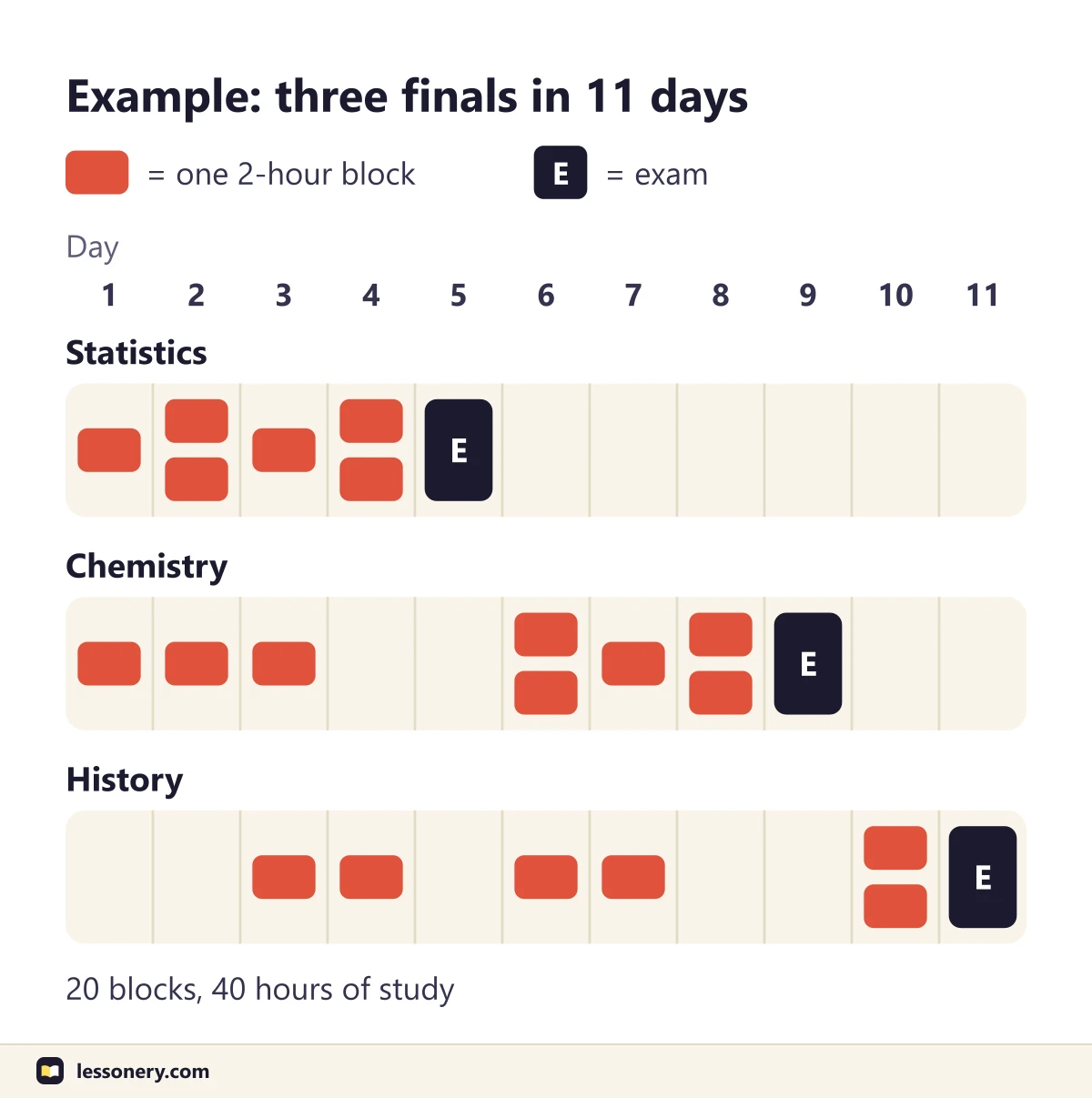
Check the arithmetic:
- By day: 4 + 6 + 6 + 6 + 0 + 6 + 4 + 4 + 0 + 4 = 40 hours.
- Statistics: 1 + 2 + 1 + 2 = 6 blocks on days 1 to 4.
- Chemistry: 1 + 1 + 1 + 2 + 1 + 2 = 8 blocks on days 1, 2, 3, 6, 7 and 8.
- History: 1 + 1 + 1 + 1 + 2 = 6 blocks on days 3, 4, 6, 7 and 10.
- Blocks: 6 + 8 + 6 = 20, and 20 × 2 hours = 40 hours.
A few choices follow the guidance above. No day has more than three blocks, and consecutive blocks on a full day belong to different courses. Each course ends with a timed paper at the time of day of its real exam, followed by a block for fixing errors. Nothing is scheduled after an exam on the day it is taken.
The example also shows the limit of starting on day 1. Statistics, the first exam, gets only four study days, fewer than the five or six days Queen's uses in its own example. Starting its blocks before classes end would fix that.
Inside a block, Queen's suggests opening with 10 to 20 minutes on recently studied material and closing with about 15 minutes of self-testing on the new material. If an exam covers the whole course, see how to study for a cumulative final for choosing the chunks.
What research supports, and what is only guidance
No source cited in this article compared one way of arranging an exam period with another. The block lengths, the two-or-three-courses rule and the working-backwards method are university guidance.
The idea underneath them has research behind it. In their review of 10 learning techniques, Dunlosky and colleagues (2013) gave distributed practice, meaning study spread over time, one of only two "high utility" ratings. The US Institute of Education Sciences practice guide Organizing Instruction and Study to Improve Student Learning lists "space learning over time" as its first recommendation, with a moderate evidence rating.
Alternating courses can look like interleaved practice, but the classroom trial of interleaving cited on this site tested something narrower. In the trial by Rohrer, Dedrick, Hartwig and Cheung (2020), 54 seventh-grade mathematics classes in Florida completed either interleaved or blocked assignments over 4 months, and on an unannounced test 1 month later the interleaved group scored 61% and the blocked group 38%. That study mixed problem types within one subject. It did not test switching between courses.
The case for alternating is arithmetic: with two or three courses a day, each course lands on more separate days, which is the spacing those two sources support.
Note: A schedule decides when you study, not how. Methods for the blocks are in how to study effectively for exams, and the last days before each paper are covered in how to prepare for an examination.
Frequently asked questions
How many hours a day should you study during finals?
The sources give ranges, not a rule. Queen's allows up to three blocks of about 3 hours a day but tells students to try not to study nine hours every day. The example above has 40 hours in the 10 days before the last exam, an average of 4 hours a day, and never goes above 6.
Which final should you study for first?
Queen's advice is to place blocks for your most difficult course first when you work backwards from the exam dates. The calendar adds a constraint: the earliest exam has the fewest days, so its blocks fill the first days whatever its difficulty.
When should you make a final exam study schedule?
Queen's suggests a calendar that begins a week or two before exams start, and the Claremont McKenna handout advises starting 10 to 14 days ahead when exams come one after another.
What if you fall behind the schedule?
Queen's lists miscalculating how much study a course needs among the typical obstacles. Its suggestions are to redistribute your study sessions, fill some blank periods on the calendar, or lower your grade expectations for that course.