The QEC note taking method organizes notes around big ideas instead of around the order in which a lecture was delivered. Each idea is recorded as a question, a conclusion that answers it, and the evidence that connects the two. QEC stands for Question, Evidence, Conclusion.
The format comes from the author Cal Newport, who introduced it in his book How to Become a Straight-A Student and has described it on his blog since 2007. He recommends it for what he calls non-technical courses, such as history and English. No study found for this article has tested the format, so the evidence section below is about related research.
Quick answer: For each big idea in a lecture or reading, write the question being asked, the evidence offered and the conclusion reached. To study, read each question, then say the conclusion and some of the evidence aloud without looking. Cal Newport, who created the method, suggests it for non-technical courses and other formats for science and math.
What the QEC note-taking method is
Newport's shortest description is in a 2009 post on note-taking strategies for three types of class: instead of transcribing what the professor says, reduce the notes to a series of questions paired with conclusions, and put between each pair the evidence that connects them. In a 2007 summary of that part of his book he calls each unit a Q/E/C module and says the format applies to notes from lectures and from reading.
| Part | What it is, in Newport's description |
|---|---|
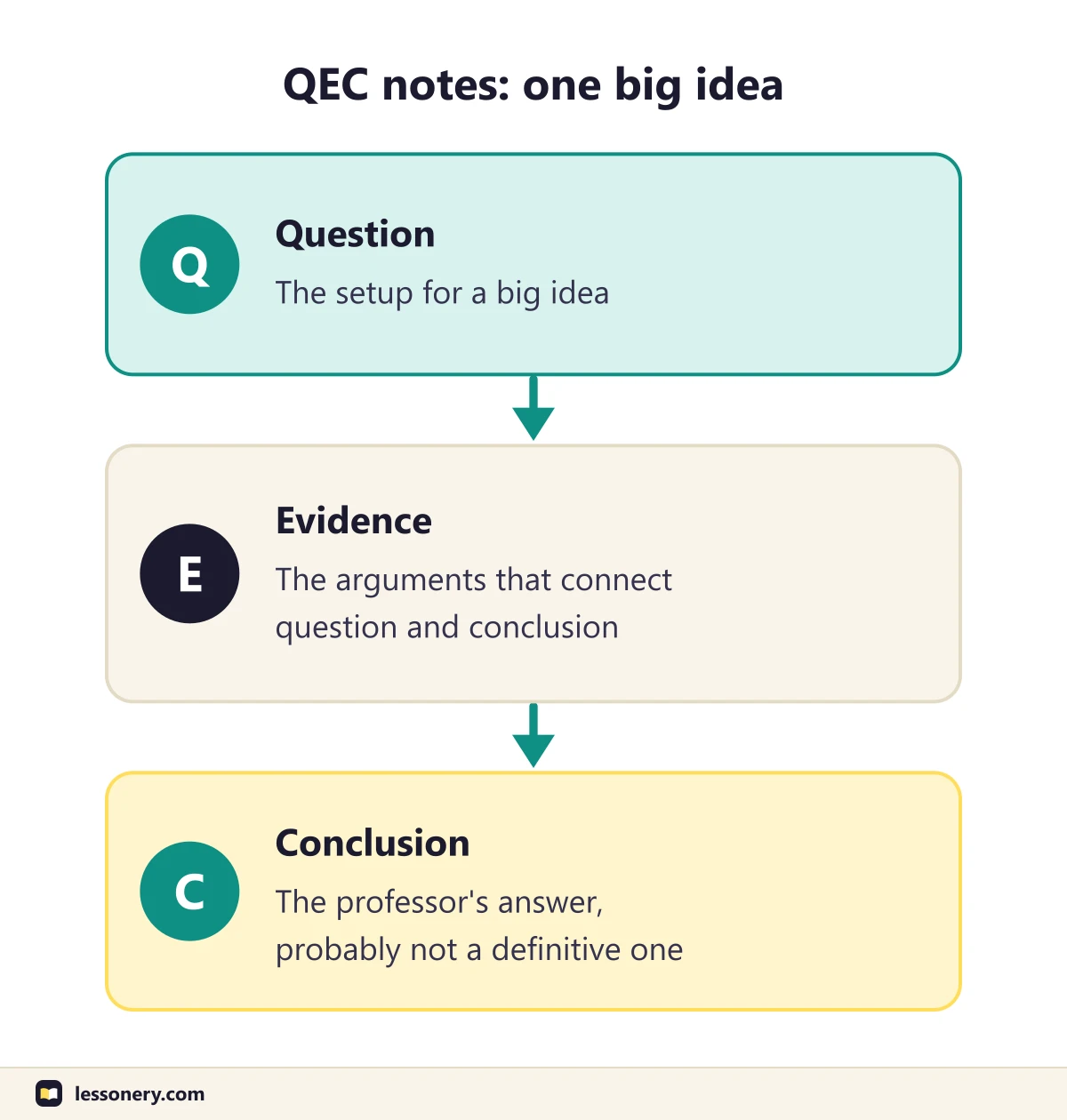
| Question | The setup for a big idea the professor is presenting |
| Evidence | The arguments used to get from the question to the conclusion |
| Conclusion | The professor's answer to the question, which is probably not a definitive one |
The reasoning behind it is in his post on the goal of note-taking. Newport argues that the slow part of studying is turning raw information into ideas you can use in an exam answer, so that work should be done in the classroom, and only processed information should go into the notebook. He adds that Q/E/C is not the only format that can do this.
Note: Newport gives what he calls an informal estimate that taking notes this way cuts 20 to 30 minutes from test preparation for each hour of class. That is his own estimate, not a measured result: the post cites no study, and none found for this article has tested it.
How to take QEC notes
The steps below follow Newport's posts and a handout on QEC notes from Austin Peay State University's Writing Center.
- Write the question. Name what the lecturer is setting out to answer. The Austin Peay handout calls this the guiding question that opens each section of the page.
- List the evidence under it. Keep the entries concise. The handout suggests key quotations, facts, data and examples.
- Write the conclusion. One statement that answers the question. The handout notes that it can also serve as a thesis.
- Clean up after class. Newport says the method takes practice and that it helps to spend 5 to 10 minutes after class cleaning up your thoughts.
A lecture doesn't always announce its question first. If it only becomes clear later, leave a space for it and fill it in during the clean-up, the same advice the guide to taking notes in class gives for anything you miss.
From a reading
Newport uses the same three parts for reading assignments. For the most difficult ones, his post on hard readings suggests gathering the professor's guidance and any published commentary first, writing a short summary of the main points at the top of the notes, and then taking standard Q/E/C notes while reading. The article on note-taking from a textbook covers other ways to take notes from reading.
Studying from the notes
Newport's review routine, which he calls quiz and recall, is to go from question to question. For each, try to recreate the conclusion and a sampling of the evidence without peeking, saying the answer aloud as if lecturing a class. If you can't do it without major errors, review the notes and try again later. He adds that you don't need to remember every piece of evidence, only enough to recreate the main idea.
Which subjects the QEC method suits
Newport limits the method to one kind of course. His 2009 post sorts classes into three types and gives each its own format.
| Course type, with Newport's examples | Format he suggests |
|---|---|
| Non-technical (history, English) | Question, evidence, conclusion |
| Technical without math (biology, psychology) | Short questions with short answers, grouped into clusters by topic |
| Technical with math (calculus, macroeconomics) | As many sample problems as possible, with the intermediate steps |
The Austin Peay handout gives a similar list: history, philosophy and literature. It says the format supports planning argumentative and analytical essays.
A plausible reason for the fit, offered here as reasoning and not as a finding, is the kind of writing these courses ask for. The University of North Carolina's Writing Center describes an argument in academic writing as a main idea, often called a claim or thesis, backed up with evidence, and says writing assignments almost always ask for more than a summary of information. A page of Q/E/C notes already has that shape: each conclusion is a claim, with its evidence above it. The same parts appear when writing an essay outline.
It fits less well where a course is mostly facts to know. Newport says in a 2008 post on exam preparation that his book overlooked classes that require a large number of facts and concepts, and he points to question clusters for them.
A filled-in example
The notes below are an example made for this article, not taken from Newport's book. They show one Q/E/C module for a lecture on handwritten and typed notes. The studies and figures come from the article on taking notes in class, which links to each paper.
QUESTION
Do students learn more from lecture notes written by hand
than from notes typed on a laptop?

EVIDENCE
- Mueller & Oppenheimer 2014: three studies. Laptop note-takers
  did worse on conceptual questions.
- Their explanation: typing invites word-for-word transcription.
- Morehead, Dunlosky & Rawson 2019: direct replication.
  Performance did not consistently differ between groups.
- Urry et al. 2021: direct replication. No significant
  difference in quiz scores.
- Flanigan et al. 2024: meta-analysis of 24 studies. Higher
  achievement after taking AND reviewing handwritten notes
  (g = 0.248). Typing produced more notes (g = 0.919).

CONCLUSION
Mixed. The 2014 result was not consistently reproduced.
Handwriting may have an edge once notes are reviewed.
The conclusion is not a settled answer, which matches Newport's remark that the professor's conclusion is probably not definitive. To study from this module, cover everything below the question, say the conclusion and two or three pieces of the evidence aloud, then check.
What the evidence says about QEC notes
The QEC note-taking method has not been tested directly in any study found for this article. The posts by Newport cited here present it as practical advice and cite no studies of the format. The research below is about ingredients the method shares with other techniques.
| Part of the method | Related research | Why it is not a test of QEC |
|---|---|---|
| Writing your own questions | King (1992) | Self-questioning was a study strategy compared with summarizing and note review, not a note format |
| Questions that focus attention | Rickards and McCormick (1988) | The questions were given to the students |
| A fixed structure for notes | Kobayashi (2006) | The frameworks were provided to students, not built by them |
| Reciting answers from memory | Dunlosky et al. (2013) | The review covers self-testing in general |
Self-questioning. King (1992) randomly assigned 56 underprepared college students to three strategies for learning from lectures: self-questioning (19 students), summarizing (19) or reviewing their notes (18). According to the abstract, self-questioners performed better than summarizers and significantly better than note-reviewers.
Questions before each part of a lecture. In a study by Rickards and McCormick (1988), as described in a research summary by Kiewra, Colliot and Lu (2018), college students listened to an 800-word lecture divided into 16 sections. Some were given a question before each section. They recorded 20% of the lecture's critical information in their notes, against 2% for the others, and recalled about 25% more.
A structure for notes. A meta-analysis of 33 studies by Kobayashi (2006) found that providing a framework or the instructor's notes did more to strengthen the effects of note-taking and review than training or verbal instructions alone. Those frameworks came from the instructor. A Q/E/C page is a structure you have to build yourself.
Answering from memory. The review step is self-testing. Dunlosky and colleagues (2013), who reviewed ten learning techniques, rated practice testing as high utility. The review also covers elaborative interrogation, which means generating an explanation for why a stated fact is true and is the nearest of the ten to the habit of asking what supports a conclusion. It was rated moderate, partly because it had not been adequately evaluated in educational settings. The article on the active recall method explains how to self-test.
Limits, and what to combine QEC with
The method keeps little detail by design. Newport asks for big ideas and a sampling of evidence, while Kiewra, Colliot and Lu report that students already record, on average, only about one third of a lesson's important ideas, and that the number of lesson points in notes is positively correlated with achievement. For an exam that tests specifics, thin notes are a risk. That is reasoning from those two sources, not a tested result.
It also asks you to judge what the conclusion is while the lecture is still running, which is why the clean-up after class matters.
Newport describes one addition himself. In his post on the story telling method, he suggests giving yourself a five-minute spoken summary of the lecture's main concepts after each class. His argument, which the post does not test, is that a large pile of notes can mean long nights of review even when they are taken carefully in Q/E/C form.
The format can also sit on a Cornell page. As one way to combine them, the question goes in the cue column and the evidence and conclusion in the notes column, which sets up the cover-and-recite review described in the guide to the Cornell note-taking system. The overview of different note-taking methods covers formats for lectures with no argument to follow.
Frequently asked questions
What does QEC stand for in note-taking?
Question, Evidence, Conclusion. Each big idea is written as the question being asked, the evidence offered and the conclusion reached. Newport writes it as Q/E/C.
Who created the QEC note-taking method?
Cal Newport. In his guide to his note-taking posts he says he first introduced the Question/Evidence/Conclusion system in his book How to Become a Straight-A Student, and his posts describing it date from 2007 onward.
Is the QEC method good for math and science?
Newport recommends other formats there. For technical courses without math he suggests short questions and answers grouped into clusters, and for courses with math he suggests recording as many sample problems as possible with their steps.
Is the QEC method better than Cornell notes?
No study found for this article compares them. They are also not rivals: QEC is a way of structuring the content, and the Cornell system is a page layout with a review routine, so the two can be used on the same page.
Should you type or handwrite QEC notes?
Newport recommends a laptop on the grounds that typing is faster. Studies comparing typed and handwritten notes have had mixed results, as the example above summarizes, and none of them tested Q/E/C notes.