A rhetorical analysis outline is a plan for an essay about how a text works on its audience. It does not plan an essay about whether the text is right.
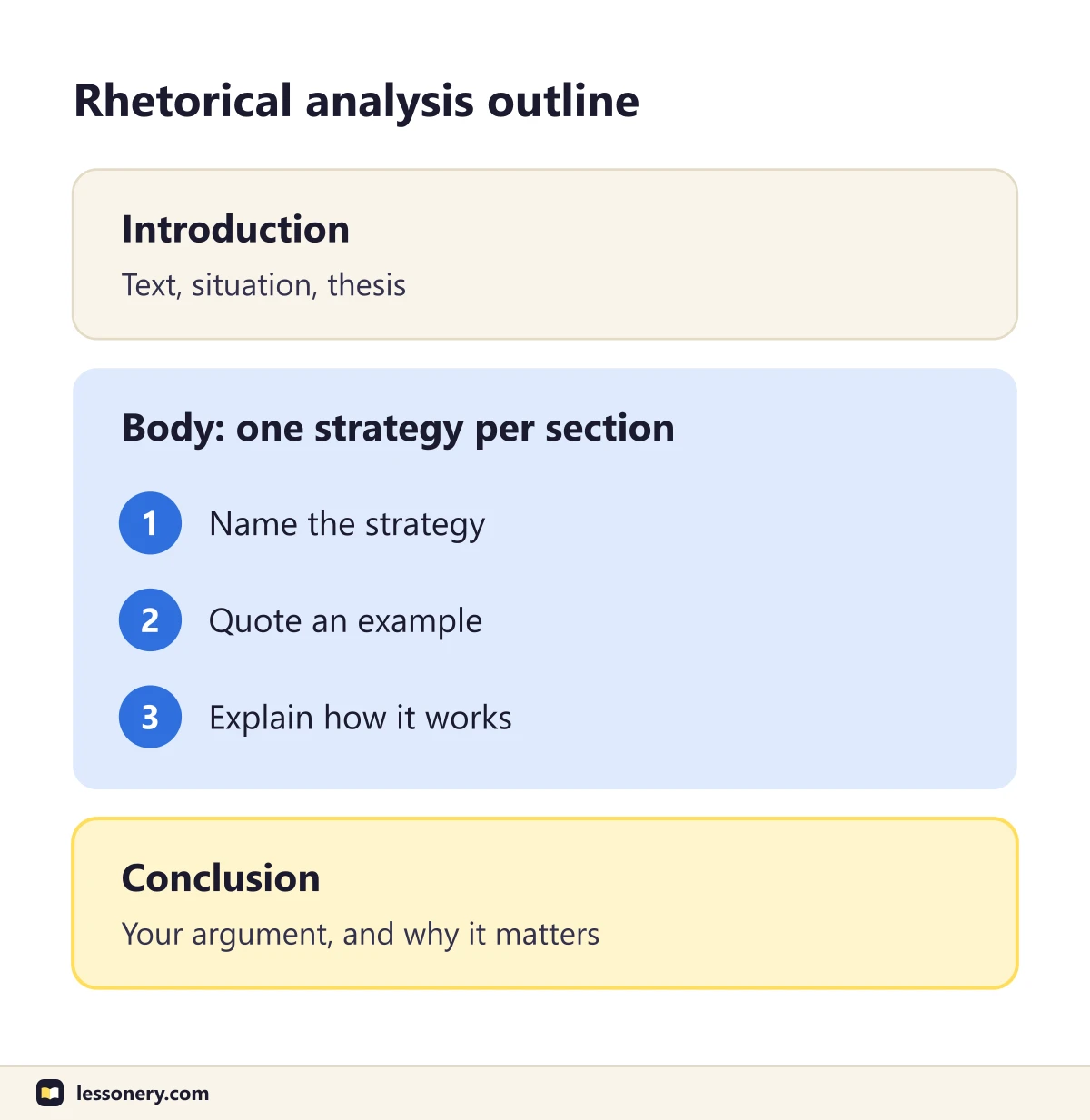
The parts are the usual ones: introduction, thesis, body, conclusion. What changes is the body, where each section names something the author does, shows where, and explains what it does to the reader or listener.
Quick answer: Before outlining, note the text's author, audience, purpose and setting, and the strategies it uses. Then plan an introduction that gives that context and ends in a thesis about how the text achieves its purpose, body sections that each cover one strategy with examples and an explanation of its effect, and a conclusion that says why the analysis matters.
What a rhetorical analysis does
A rhetorical analysis explains how the parts of a text produce an effect. The Texas A&M University Writing Center's guide defines it as an essay that breaks a work of non-fiction into parts and explains how those parts work together to persuade, entertain or inform.
It is not a verdict on the topic. Texas A&M's guide stresses that you are not saying whether you agree with the argument. The Utah Valley University Writing Center's handout says the same: the analysis does not agree or disagree with the author, and builds its own argument about how effectively the author persuades.
Your judgment of the text is still the point of the essay. Miami University's Howe Writing Center describes three moves, which are describing the text, analyzing it and evaluating it, and says the evaluation is your argument.
What to note before you outline
The rhetorical situation
Purdue OWL's page on the rhetorical situation lists five elements: the text itself, its author, its audience, the purposes of both author and audience, and the setting, meaning the time, place and environment of the communication.
Utah Valley's handout turns these into questions. Who is the audience, and how do you know? Why did the author create the work? What historical or current context influenced it?
The appeals
The three appeals go back to Aristotle. In Book I of the Rhetoric, in W. Rhys Roberts's translation, he names three modes of persuasion: one that depends on the speaker's personal character, one on putting the audience into a certain frame of mind, and one on the proof, or apparent proof, in the words of the speech. Writing guides call them ethos, pathos and logos.
| Appeal | Aristotle's description | What to look for (Utah Valley's handout) |
|---|---|---|
| Ethos | The speaker's character makes the speech credible | Credible sources, credentials, personal experience |
| Pathos | The speech stirs the hearers' emotions | Humor, vivid imagery, emotional or relatable topics |
| Logos | The argument itself proves, or appears to prove, the case | Data and statistics, appeals to common sense |
Texas A&M's guide points out that a single speech or document can make all three appeals. Purdue OWL's page on Aristotle's terms adds that the usual one-word translations are narrower than the originals, and that treating pathos and logos as simply emotion against reason is too limited.
Appeals are not the only thing to look for. Utah Valley's handout notes that a written piece may also work through word choice and sentence structure.
Rough notes first
Texas A&M's guide suggests answering four things in a sentence or two each before you plan: the goal of the piece, the techniques used and why, examples of each technique, and why they did or didn't work. Marking the text as you read makes that easier, and how to annotate a text covers a system for it.
The rhetorical analysis outline, section by section
| Section | What to plan | Source |
|---|---|---|
| Introduction | Name the text, give brief background, and summarize the rhetorical situation: author, audience, purpose, context | Purdue OWL |
| Thesis | A claim about how the text achieves its purpose, and how well. Not a summary, and not a view on whether the author is right | Purdue OWL, Utah Valley |
| Each body section | A topic sentence naming one strategy, at least one direct example, what the strategy is for and how well it persuades, and a link back to the thesis | Utah Valley |
| Conclusion | Your main argument restated briefly, then why it matters | Texas A&M |
The introduction row follows Purdue OWL's page on organizing a rhetorical analysis, which sits in its section on visual documents and gives general tips for the essay. It describes body paragraphs in similar terms to Utah Valley's: present a part of the text, analyze how it works, and connect it to the thesis. It also has one piece of advice for the opening, which is to make clear that the essay is a rhetorical analysis, so the reader knows what kind of essay to expect.
For the thesis, Texas A&M's guide recommends choosing the three or four techniques for which you can make the strongest case, out of the many an author uses.
The general mechanics of outlining, including the I, A, 1 labels used in the example below, are covered in writing an essay outline. Turning the finished outline into paragraphs is the subject of essay rough draft.
Three ways to order the body
Between them, Texas A&M's guide and Purdue OWL's page describe three orders for a written or spoken text.
| Order | How it works | Described by |
|---|---|---|
| By appeal or technique | Every instance of one appeal or technique, then the next, ending with a discussion of overall effectiveness | Texas A&M, Purdue OWL |
| Least to most effective | Techniques taken in order of how well they work | Texas A&M |
| Chronological | Techniques discussed in the order they occur. With texts that tell a story, Purdue OWL warns that this can slide into plot summary | Texas A&M, Purdue OWL |
Purdue OWL describes a fourth, spatial order for visual documents, which follows the path the eye takes across a page or screen.
Note: Purdue OWL's page opens with the statement that there is no one perfect way to organize a rhetorical analysis essay, and it warns against plug-in formulas. If your assignment sets a structure, use that one.
A filled-in example: the Gettysburg Address
The outline below is an example written for this article. Its text is Abraham Lincoln's Gettysburg Address, which is in the public domain. The readings of the speech are this article's own illustration of the method, not findings from a source.
The background facts come from the Library of Congress exhibition on the address. Lincoln was the second speaker on November 19, 1863, at the dedication of the Soldiers' National Cemetery at Gettysburg, after Edward Everett had spoken for two hours. The next day Everett wrote to Lincoln, praising the speech's "eloquent simplicity & appropriateness" and comparing his own two hours with Lincoln's two minutes.
Quotations follow the Library's transcription of the standard text. Five manuscript copies are known, and the Library's transcription of the Nicolay copy notes that the two copies it holds differ somewhat from the generally printed version.
Text: Abraham Lincoln, Gettysburg Address, November 19, 1863

Working thesis: Lincoln turns a cemetery dedication into a call
to finish the war. He does it by tying the dead to the nation's
founding, by speaking as "we" throughout, and by building his
sentences on repetition and contrast.

I. Introduction
   A. Text and occasion: dedication of the Soldiers' National
      Cemetery; Lincoln speaks after Everett's two-hour oration
   B. Situation: an audience gathered to honor the dead, in a
      civil war that is still being fought
   C. Thesis (above)

II. He starts from the founding, which gives the war a purpose
   A. Example: "Fourscore and seven years ago"; a nation
      "dedicated to the proposition that all men are created
      equal"
   B. Example: the war is "testing whether that nation or any
      nation so conceived and so dedicated can long endure"
   C. How it works: an appeal to reasoning. If the war is a
      test of the founding idea, the deaths have a meaning

III. He speaks as "we" and lowers his own importance
   A. Example: "We are met"; "we cannot dedicate"; no "I" in
      the standard text
   B. Example: "The world will little note nor long remember
      what we say here"
   C. How it works: an appeal to character. The speaker
      stands with the mourners, not above them

IV. Repetition and contrast carry the feeling
   A. Example: "we cannot dedicate, we cannot consecrate, we
      cannot hallow this ground"
   B. Example: "what we say here" set against "what they did
      here"
   C. Example: "of the people, by the people, for the people"
   D. How it works: an appeal to emotion through sentence
      structure. Each repeated phrase adds weight to the
      contrast between words and deeds

V. Conclusion
   A. Argument: the speech moves the dedication from the
      ground to "us the living" and "the unfinished work"
   B. Why it matters: Everett's letter points to brevity and
      fit with the occasion as what he admired
Three things to notice. Every body heading is a claim about what Lincoln does, so none of them is a bare label such as "Ethos". Each one has quoted evidence beneath it. Each ends with a line on how the choice works, the step Utah Valley's handout asks for in every body paragraph.
The order here is partly chronological, since section II covers the opening, and partly by technique. Nothing in the guides cited here rules out a mix. A real essay would also need a citation for every quotation, in the style your course uses.
Where a rhetorical analysis outline goes wrong
| Problem | What it looks like | Fix |
|---|---|---|
| Summary in place of analysis | Sections retell what the text says | Give each section a strategy and its effect (Purdue OWL, Utah Valley) |
| Arguing the issue | The thesis says the author is right or wrong | Argue about how the text persuades (Texas A&M) |
| Naming without explaining | "The author uses pathos" and nothing more | Add the example and how it creates the effect (Utah Valley) |
| No situation | The audience and occasion are never mentioned | Put author, audience, purpose and context in the introduction (Purdue OWL) |
What research says about analyzing how texts work
No study cited here tested a rhetorical analysis outline against another way of planning. Two sources are close to the topic.
Graff (2010) describes an assignment piloted in spring 2008 in which students analyzed three texts on a common issue and wrote an argument about how those texts represented it. According to the abstract, students asked a semester later believed the project had made lasting changes to how they read and wrote. That is one instructor's assignment and students' own reports.
The US Institute of Education Sciences practice guide Teaching Secondary Students to Write Effectively (2016) recommends integrating writing and reading to emphasize the features of effective texts, and says that reading with the writer in mind and writing with a reader in mind strengthen both skills. It rates the evidence for that recommendation as moderate: eight studies with students in grades 6 to 12, seven of which found positive effects on at least one writing outcome.
Frequently asked questions
Does a rhetorical analysis outline have to use ethos, pathos and logos?
No. Organizing by the three appeals is one of the options Purdue OWL and Texas A&M describe, not a requirement. Texas A&M's guide tells you to pick the techniques you can make the strongest case for, and its own sample thesis is built on tone, diction and common ground.
How many body sections should the outline have?
No source here sets a number. Texas A&M's guide suggests three or four techniques, which would give three or four body sections. The fixed form is described in 5 paragraph essay structure, along with its limits.
Can I write a rhetorical analysis of an image or an advertisement?
Yes. Texas A&M's guide says the same analysis applies to a mainly visual argument such as a cartoon or advertisement, and to a speech. The spatial order described above is Purdue OWL's suggestion for visual texts.