To annotate a text, mark only what matters and write short notes in the margin in your own words: the main point of each section, your questions, and links to what you already know. The marks show where things are. The margin notes are where the thinking happens.
The research on marking alone is lukewarm. A 2022 meta-analysis found that students' own highlighting improved their memory of a text but not their comprehension of it.
Quick answer: Read a paragraph or section first. Then mark the one phrase that carries its main idea, circle terms you need to look up, and write a margin note in your own words. Keep to a small, fixed set of symbols, such as ? for questions. A major review of study techniques rated highlighting by itself as low utility.
What it means to annotate a text
Annotating is marking up a text as you read so that you build a systematic summary of it as you go. That is how the Learning Center at the University of North Carolina at Chapel Hill defines it. The center lists what it is for: pulling out and organizing the important material, checking your understanding as you read, and making exam review faster.
A Harvard Library guide to reading habits, written by librarian Susan Gilroy, describes annotation as a running written conversation with the text. Its advice is to work with a pen or pencil, write ideas and reactions in the margins, develop your own symbols, and ask the text questions.
Neither source treats highlighting as the main job. UNC says to highlight sparingly and on purpose, and the Harvard guide tells readers to put the highlighter away. The next section explains why.
What research says about highlighting alone
Highlighting without anything else has weak support. Dunlosky and colleagues (2013), who reviewed ten learning techniques, rated highlighting and underlining as having low utility. In most situations and with most participants studied, they write, highlighting did little to boost performance. It may help when students know enough to mark well or when a text is difficult, and it may hurt on tasks that require inferences.
That last point rests on one study, which the reviewers say needs replication. Peterson (1992) had education majors study a 10,000-word history chapter for 90 minutes, with or without underlining, and tested them a week later after a 15-minute review. All groups did about equally well on factual questions. Students who had underlined and reviewed their marked text did worse on questions that required connecting ideas across the chapter.
Later work adds detail. Ponce, Mayer and Méndez (2022) pooled 36 published articles from 1938 to 2019, which gave 85 effect sizes.
| Who did the highlighting | Memory of the text | Comprehension |
|---|---|---|
| The learner | Improved (average effect size 0.36) | Not improved (0.20) |
| The instructor, in advance | Improved (0.44) | Improved (0.44) |
Learners' own highlighting helped college students (0.39) but not school students (0.24). So highlighting is not useless, but it did not improve comprehension.
What gets marked appears to matter. The Dunlosky review says the quality of the highlighting is likely to decide whether it helps, and a later experiment fits that. Mason and colleagues (2024) randomly assigned 170 university students reading a digital text to highlight it themselves, read a pre-highlighted version, or read with no highlighting. No condition came out ahead overall. Among students who highlighted, though, the quality of what they chose predicted their literal comprehension and their ability to transfer the knowledge.
Few direct tests of fuller annotation were found for this article. Simpson and Nist (1990) describe a textbook annotation strategy for college students and report that students trained in it continued to perform well over time; only the abstract is freely available. In a study of 371 students in US grades 5 to 8 by Goodwin and colleagues (2020), annotating on paper or on screen was not linked to comprehension once other factors were controlled.
Note: None of this says "stop marking." In an article for teachers in American Educator, John Dunlosky's advice is to keep the highlighter and treat it as the first step, followed by stronger study methods.
A marking system you can keep in your head
Use a few marks, and give each one a single meaning. A US Institute of Education Sciences practice guide (2022), written for teachers of students with reading difficulties in US grades 4 to 9, recommends one kind of mark for words you don't understand, a different one for important information, and the same marks every time.
The set below combines the UNC and Harvard suggestions. It is an example to adapt, not a standard.
| Mark | Use it for |
|---|---|
| Underline or highlight | The one sentence or phrase that carries a paragraph's main idea |
| Circle | Terms to look up, or terms that keep coming up in lectures |
| ? | A question, or a topic to explore further |
| ! | A surprising point or a connection |
| * | A possible example or piece of evidence |
| Margin note | The main point, in your own words |
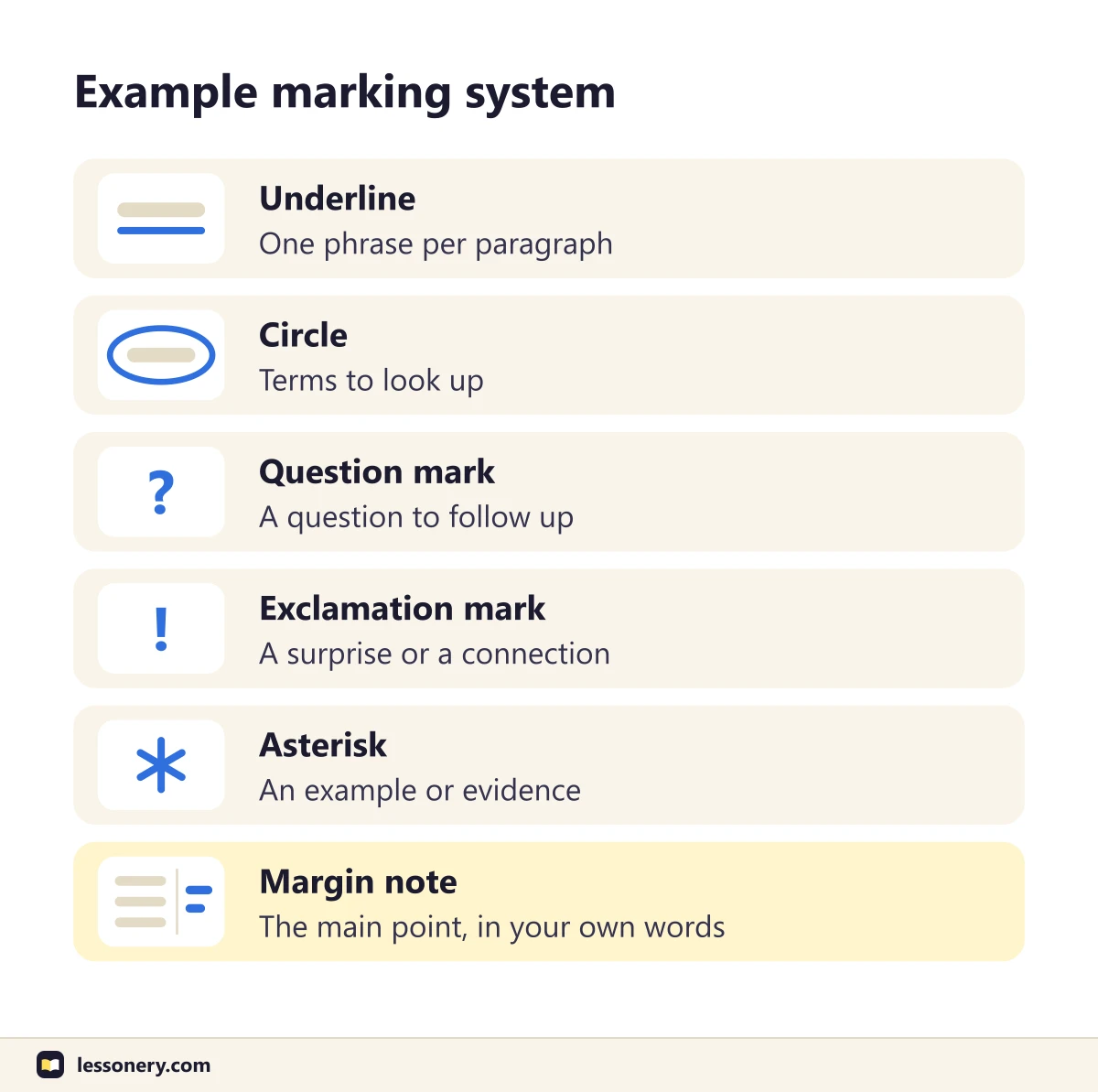
Symbols are conventions. UNC uses an asterisk for evidence, Harvard's guide suggests one for main ideas, and both say to invent your own if that suits you better.
The order to work in
The sequence matters as much as the marks. These steps follow UNC's handouts on annotating and on using highlighters.
- Skim the section first. Then go back to annotate.
- Read a whole paragraph before you mark anything. Think about its main concept, then choose.
- Limit yourself. One sentence or phrase per paragraph, and words or phrases in preference to full sentences.
- Circle what you don't know and look it up afterwards.
- Write the margin note. Add ?, ! or * where they apply.
Annotating in your own words
A margin note earns its place only if the wording is yours. UNC's test is to ask how you would explain the material to a friend, then restate the idea and connect it to what you already know and what you still wonder about.
Copying a phrase into the margin can be done without understanding it. Restating cannot. That is the reasoning, and the research on related techniques is cautiously in line with it. The Dunlosky review rated self-explanation, which means explaining the material to yourself as you learn, as having moderate utility. It found that summarizing can be effective for learners who are already skilled at it, but rated it low because many learners need extensive training first.
One way to sort margin notes is into four kinds. The grouping and the examples are this article's illustration.
| Kind of note | What it does | Example |
|---|---|---|
| Summary | States the paragraph's point | "Own highlighting helps memory, not understanding" |
| Question | Records what you don't follow or want to test | "Why would memory improve but not comprehension?" |
| Connection | Links to a lecture or another reading | "Same idea as week 3: choosing what matters is the hard part" |
| Evaluation | Judges the claim and its evidence | "Strong: 36 articles. But what counted as comprehension?" |
The evaluation questions come from Harvard's guide: what is the writer claiming, what evidence is offered, and how strong is it?
If a margin note later ends up in an essay, it still needs a citation, because the idea belongs to the source even when the words are yours. See how to paraphrase without plagiarizing, and follow your own institution's citation rules.
Example: one annotated paragraph
The passage below was written for this example. Its facts come from the Ponce, Mayer and Méndez meta-analysis and the Dunlosky review described above.
Highlighting is a popular study technique. A 2022 meta-analysis pooled 36 published articles and found that students who highlighted remembered more of a text than students who only read it. Their comprehension did not improve. When an instructor had highlighted the text in advance, both memory and comprehension improved.
| Where | Mark | Margin note |
|---|---|---|
| "meta-analysis" | Circle | Look up: how are the studies combined? |
| "remembered more … comprehension did not improve" | Underline | Own highlighting: memory yes, understanding no |
| "36 published articles" | * | Evidence: a pooled result, not one experiment |
| "Their comprehension did not improve." | ? | Why? Is choosing what to mark the weak point? |
| Last sentence | ! | Instructor's marks helped both. The selection matters |
Digital vs. paper
The same system works on a screen or a page. Research gives paper a slight edge for informational reading without settling the matter.
A meta-analysis by Delgado and colleagues (2018) covered studies published from 2000 to 2017 that compared reading comparable texts on paper and on digital devices: 38 that compared separate groups and 16 that tested the same readers on both (54 by this article's addition), with 171,055 participants in all. Comprehension was better on paper (Hedges' g = −0.21). The gap was larger when reading time was limited, and it appeared for informational texts but not in studies that used only narrative texts. The authors note that earlier findings were inconsistent.
Two studies looked at marking specifically:
- Ben-Yehudah and Eshet-Alkalai (2018) had participants read a college-level expository text in print or on screen, with or without instructions to highlight. Highlighting improved performance only in print, and only on questions that required inference. The authors call for more research.
- Goodwin and colleagues (2020) found that the students in their study highlighted and annotated more on paper than on screen. Paper highlighting was negatively related to comprehension, probably because it often fell outside the important parts of the text, while digital highlighting was positively related.
Those results do not point one way, and none of them shows that one medium is the right choice for annotating. UNC's reading comprehension handout suggests printing a text if you find paper helps you follow it.
For screen reading, UNC's annotation handout points to the highlight and comment functions in PDF readers and the annotation features built into digital textbooks.
Common mistakes and fixes
The fixes below come from the UNC handouts and the IES guide.
| Mistake | Fix |
|---|---|
| Highlighting a sentence the first time you read it | Finish the paragraph, decide its main idea, then mark |
| Marking most of the page | One sentence or phrase per paragraph |
| Margin notes copied from the text | Restate the point as you would explain it to a friend |
| A new symbol every time | A fixed set, each with one meaning |
| Studying by rereading your highlights | Cover the text and answer your own margin questions |
On the last row, UNC warns that rereading highlighted lines can contribute to "illusions of competence": the text feels familiar, which is not the same as being able to use it. Testing yourself on your margin questions is a form of active recall.
Two related routines: the SQ3R method of reading gives you questions to read for, and taking notes from a textbook covers what to do when margins are not enough.
Frequently asked questions
What should you write when you annotate a text?
Write the main point of each paragraph or section in your own words, the questions you still have, and connections to lectures or other readings. Short phrases are enough.
Is highlighting a waste of time?
Not entirely. In the 2022 meta-analysis by Ponce, Mayer and Méndez, learners' own highlighting improved memory for the text, and it helped college students. It did not improve comprehension, which is why highlighting works better as a first step than as a whole method.
Is it better to annotate on paper or on a screen?
The evidence leans slightly toward paper for informational reading, and in one study highlighting helped only in print. Findings are mixed, though, and the studies cover different ages and tasks. If you notice you follow a text better on paper, print it.
How do you annotate a text you can't write in?
Keep the notes outside the book. Harvard's guide says questions can be recorded in a notebook instead of the margins. Write the page number beside each note so you can find the passage again.