To stay focused while studying, give each session one specific task, make that task active (answering questions or solving problems) instead of rereading, and plan a break before your attention runs down. Each of the three has research or university guidance behind it.
Losing focus is common. In studies that stop students during lectures and ask what they are thinking about, a third or more of the answers are off-task. This article is about sustaining attention through a session. Removing phones and other interruptions is a separate job, covered in how to not get distracted while studying.
Quick answer: Write down one concrete task before you start, work on it in a way that makes you produce answers, and take planned breaks. In one experiment, students who were quizzed after each part of a lecture reported mind wandering on 19% of checks, against about 40% for students who were not quizzed.
Why attention drifts during a study session
Researchers call the drift mind wandering, and usually measure it by interrupting people at random moments to ask whether their thoughts are on the task. Most of the classroom evidence comes from lectures, and a review by Szpunar, Moulton and Schacter (2013) collects it.
Two findings from that review matter for studying:
- Off-task thought is frequent. Lindquist and McLean (2011) probed students during three 50-minute psychology lectures and found task-unrelated thoughts on about 33% of probes.
- It grows with time. In the same study, off-task reports rose from 25% at the beginning of a lecture to 44% at the end. Risko and colleagues (2012) showed students a one-hour recorded lecture and found mind wandering on 35% of probes in the first half and 52% in the second. Those students answered 71% of questions about the first half correctly and 57% of questions about the second half.
A smaller study points the same way. Farley, Risko and Kingstone (2013) had 21 undergraduates at the University of British Columbia watch a 40-minute recorded psychology lecture and rate their attention every 5 minutes on a 7-point scale. Average ratings fell from 6.0 in the first 5 minutes to 4.9 in the last.
These studies involve listening to lectures, not working alone at a desk, so they don't tell you how fast your own attention fades over a problem set. What they do show is a pattern: the longer students sat with one passive task, the more their minds drifted and the less they remembered.
Give each session one clear task
A session with a named task gives you something to check your attention against. UNC's Learning Center advises making a daily task list and being "specific and realistic" about how long you plan to spend on each task. The University of Toronto Scarborough's staying focused guide likewise starts with a list of the tasks you need to complete.
Laboratory research on goals fits this advice, with limits. Strayer and Unsworth (2025) gave University of Oregon students a simple reaction-time task and analyzed the results of 80 of them. One group was told to respond as quickly as possible while staying accurate. The other group got specific response-time targets that became harder as the task went on. Asked at random moments what they were thinking about, the specific-goal group reported task-unrelated thoughts on about 35% of probes, against about 47% in the other group. The authors note that an earlier study of theirs found fewer lapses in responding but no change in reported off-task thoughts.
That is a reaction-time task in a laboratory, not studying. It suggests that a specific target can hold attention better than "do your best", and nothing more precise than that.
For a study session, the difference looks like this (the examples are this article's):
| Vague task | Specific task |
|---|---|
| Study chemistry | Work problems 1–10 from chapter 5 with notes closed, then check the answers |
| Go over history notes | Write from memory the four causes covered in Tuesday's lecture, then compare with the notes |
| Read the article | Read sections 1–3 and write a three-sentence summary of each |
Choose active tasks over rereading
In the experiment that tested it most directly, a task that made students produce answers held their attention better than one that only asked them to look. The experiment is by Szpunar, Khan and Schacter (2013). In its second part, 48 Harvard undergraduates watched a 21-minute statistics lecture split into four segments. After each segment, one group took a short quiz, one group studied questions with the answers shown, and one group did unrelated arithmetic.
During the lecture, each student was asked four times whether their mind was wandering. The quizzed group said yes on 19% of probes, the group shown the answers on 39% and the arithmetic group on 41%. The quizzed group also took notes on 24% of the slides, against 9% and 7%. On a final test covering the whole lecture, analyzed across the paper's two experiments, quizzed students scored 90%, against 76% and 68%.
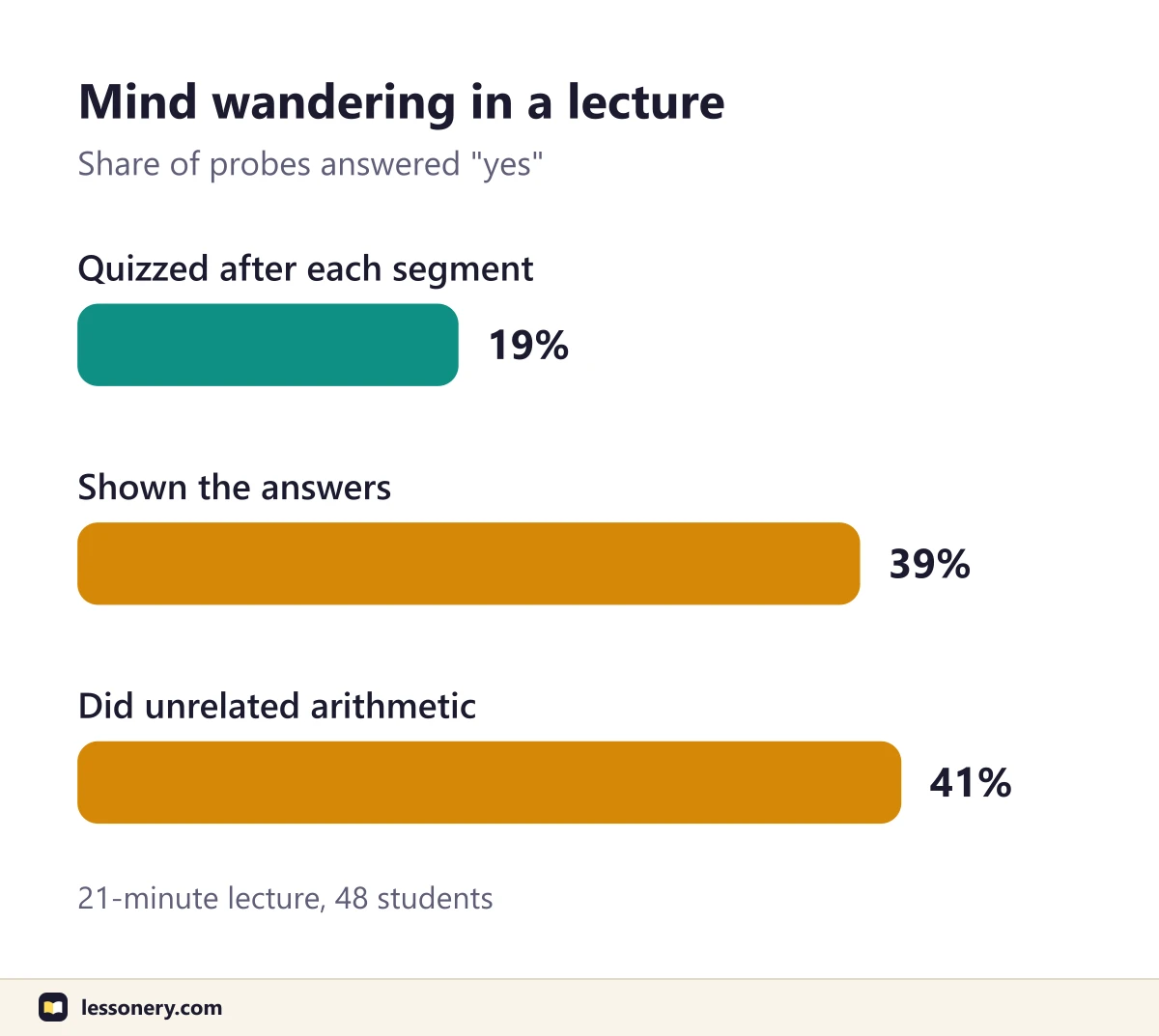
In this experiment, seeing the answers again made almost no difference to mind wandering. Being asked to produce them did. Szpunar and colleagues add in their review that the result came from a single lecture on a single topic and should be treated with some caution.
The finding lines up with broader research on study methods. The review of ten learning techniques by Dunlosky and colleagues (2013) rated practice testing as high utility and found rereading to be of low utility, as the Association for Psychological Science summarizes. UNC's Learning Center puts it bluntly: reading and rereading texts or notes "is not actively engaging in the material".
In practice, turn each stretch of material into something you must answer:
- After each section of a chapter, close the book and write what it said.
- Work problems before you look at the worked solution.
- Explain a concept aloud as if teaching it, a method UNC recommends.
The active recall method article covers these formats in detail, and the ratings for all ten techniques are in the most effective study techniques.
Plan the session length and the breaks
No study cited here establishes a best session length. University guidance gives ranges: UNC's Learning Center recommends intensive sessions of 30 or 45 minutes, and Cornell's Learning Strategies Center advises against working on one course for more than an hour or two at a time.
On breaks, three pieces of research are useful:
- Planned breaks and mood. Biwer and colleagues (2023) studied 87 students at a Dutch university, comparing those who took breaks when they chose with those on fixed schedules (6 minutes after every 24, or 3 minutes after every 12). The self-chosen group studied in longer stretches and reported more fatigue and distractedness and less concentration. Task completion did not differ.
- Short breaks in general. A meta-analysis by Albulescu and colleagues (2022) of 22 samples found that breaks of 10 minutes or less produced a small increase in vigor and a small reduction in fatigue. The effect on performance was not statistically significant.
- Very short breaks in class. Sharpe, Trotter and Hale (2025) studied 253 undergraduates in 90-minute seminars at a UK university. Seminar groups given a 90-second break every 10 minutes averaged 65.13% on an end-of-class quiz, against 56.44% for groups given one 10-minute break halfway. Scores in both conditions fell for material taught later in the seminar. The authors analyzed class averages and did not control for differences between students.
Taken together, these studies suggest that breaks decided in advance are a reasonable default, and that their clearer effect is on how alert you feel, not on how much you get done. The Pomodoro Technique for students is one fixed pattern. That article also covers a later experiment in which a 25-minute pattern showed no advantage over self-chosen breaks.
A filled-in example: a 50-minute session built for focus
This plan is an example made for this article. It applies the three ideas above to one chemistry session. The timings are illustrative and do not come from a study.
| Minutes | What you do | Idea it uses |
|---|---|---|
| 0–2 | Write the task at the top of the page: "Chapter 5, problems 1–10, notes closed" | One clear task |
| 2–17 | Problems 1–5 | Active work |
| 17–20 | Check answers and mark errors | Active work |
| 20–35 | Problems 6–10 | Active work |
| 35–40 | Check answers and mark errors | Active work |
| 40–45 | From memory, write the three ideas the problems relied on | Self-quiz |
| 45–50 | Break away from the desk | Planned break |
The rows add up to 50 minutes: 2 + 15 + 3 + 15 + 5 + 5 + 5.
When you notice you have drifted
Two practical devices come from the sources above. The Toronto Scarborough guide describes a "red dot" method: choose an object you can see from your desk, and whenever you catch yourself looking at it, treat that as the cue to return to the task. Francesco Cirillo's Pomodoro paper suggests writing the intruding thought on paper and carrying on.
Both are practitioner advice. Neither source reports a test of how well they work.
When trouble focusing is more than a study problem
Everything above describes general research with students. It is not a way to assess or treat an attention difficulty. The Toronto Scarborough guide also lists basics that support focus: being hydrated, having eaten recently and getting enough sleep.
Note: If you regularly cannot concentrate even with a clear task and a quiet place, or if poor concentration comes with low mood, worry or exhaustion, speak to a doctor, a counselor or your school's support service.
Frequently asked questions
How long can you stay focused while studying?
Research gives no fixed figure. In the lecture studies described above, off-task thinking was already present early on and increased across 40 to 60 minutes. UNC suggests intensive sessions of 30 or 45 minutes, which is guidance and not a measured limit.
Is it normal for your mind to wander while studying?
It is common in the settings researchers have measured. Students in the lecture studies above reported task-unrelated thoughts on between a quarter and a half of probes, depending on the study and the point in the lecture.
Do breaks help you stay focused while studying?
The evidence is modest. Students on fixed break schedules reported better concentration than students who chose their own breaks in one study, and a meta-analysis found that short breaks reduce fatigue slightly. Neither showed a clear gain in work completed.
Why is reading harder to focus on than solving problems?
One plausible reason, in line with the Szpunar experiment: a task that asks for answers exposes drift quickly, because you cannot answer while thinking about something else. A page can pass in front of your eyes without that check.