Time management tools for students come in six basic types: a calendar, a paper planner, a task list, a time log, a timer and a weekly review. Each one answers a different question, such as when something is due, what to do next, or where last week went.
This article describes types, not products. None of the research below compared one app or brand of planner with another, so there is no ranking here. The studies are about the behavior behind each tool: planning ahead, protecting a block of time, and checking what really happened.
Quick answer: Use a calendar or planner for deadlines and fixed hours, a task list for what to do today, a timer to hold one block of work, a time log to see where time goes, and a short weekly review to adjust. A 2021 meta-analysis found time management moderately related to academic achievement (r = .262) and to wellbeing.
What time management tools are for
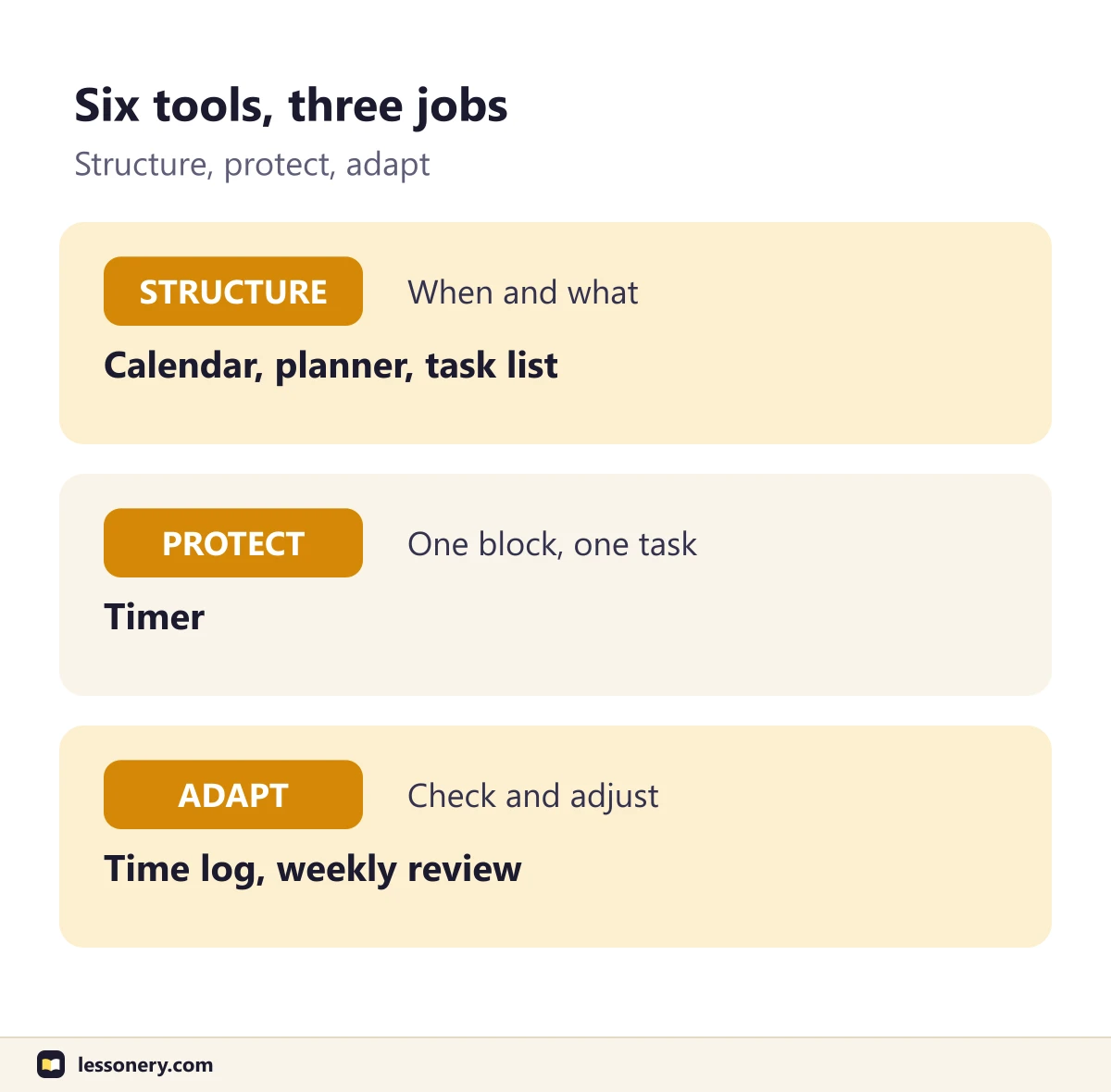
Researchers define time management as a set of decisions, and tools are where those decisions get written down. Aeon, Faber and Panaccio (2021), quoting an earlier paper by Aeon and Aguinis (2017), define it as "a form of decision making used by individuals to structure, protect, and adapt their time to changing conditions."
The paper explains the three verbs. Structuring is mapping activities to time with a schedule, a planner or a similar device. Protecting is setting boundaries around that time, for example saying no to time-consuming requests. Adapting is staying flexible with the structure, and the questionnaire items the authors quote for it include "Uses waiting time" and "Evaluates daily schedule".
| Tool type | The question it answers | Job, in the paper's terms |
|---|---|---|
| Calendar | When is it due, and when will I work on it? | Structure |
| Paper planner | The same, in a form you carry | Structure |
| Task list | What exactly do I do next? | Structure |
| Timer | Is this block for this task only? | Protect |
| Time log | Where did the time go? | Adapt |
| Weekly review | Does the plan still fit? | Adapt |
The last column is this article's way of sorting the tools under the paper's definition. The paper itself does not list tools one by one.
What research says about planning and monitoring
The evidence is about time management behavior in general, and it is mostly correlational. Aeon and colleagues pooled 158 studies with 53,957 participants. Time management was moderately related to academic achievement (r = .262 across 76 studies) and to overall wellbeing (r = .313 across 30 studies). The authors conclude that it "may be primarily a wellbeing enhancer, rather than a performance booster", and they note that most of the studies measured everything at one point in time.
An earlier review by Claessens and colleagues (2007) covered 32 empirical studies from 1982 to 2004. Its abstract reports that time management behaviors went with a greater sense of control over time, more job satisfaction, better health and less stress, while the link with work and academic performance was "not clear". Training seemed to improve time management skills, but that did not automatically carry over to better performance.
On planning ahead specifically, a survey of 324 undergraduates at a US university by Hartwig and Dunlosky (2012) found that about 13% said they planned their study ahead of time, and that higher performers were more likely to do so. Grades in that survey were self-reported and the relationships were small.
The six types of time management tools for students
1. Calendar
A calendar holds dates and fixed hours. The University of North Carolina's Learning Center describes three forms: a wall calendar that shows the whole term at a glance, a paper planner, and an online calendar. For online calendars it lists what the type can do: repeat events, send reminders, color-code, share, and switch between day, week and month views.
Cornell's Learning Strategies Center builds its advice around two calendars. A semester calendar maps due dates and events in one place, and a weekly calendar shows how the hours of one week will be spent. How to fill both is covered in these time management tips for students and in the guide to a weekly study schedule.
A calendar entry with a time and place works like an if-then plan ("if it is Monday at 2:00 p.m., then I am in the library doing statistics"). Gollwitzer and Sheeran (2006) pooled 94 independent tests of such plans and found a medium-to-large positive effect on reaching goals (d = .65). Those tests covered many kinds of goals, not study calendars specifically.
2. Paper planner
A paper planner does the calendar's job in a book you carry. UNC's advice is to keep it with you so you can refer to it and update it. UNSW Sydney suggests keeping a term planner somewhere you can easily get at it and using different colored pens for subjects, assessments and exams.
One research team has compared the two formats. Across three studies, Huang, Yang and Morwitz (2023) report that people using a paper calendar made higher-quality plans and were more likely to carry them out than people using a mobile calendar. The authors attribute this to paper users taking a big-picture view, and add that mobile users' plans improved when the calendar format encouraged a broader view. This summary is from the abstract of a consumer-psychology paper about everyday plans. The abstract does not mention students or grades.
3. Task list
A task list answers "what next?" The University of Toronto Scarborough's page on creating a daily schedule uses a prioritized to-do list: choose one to three priorities for the day, then divide each into small goals that fit a study block. UNSW's version is a "to do" list in order of priority, and UNC suggests a weekly list for each class with a time estimate beside each task.
Making a specific plan may also quiet the unfinished task. In a series of studies, Masicampo and Baumeister (2011) found that a goal left unfinished kept intruding on participants' thoughts while they read something unrelated, and led to worse results on an unrelated anagram (word puzzle) task. Letting participants make specific plans for those goals removed these effects. This is the abstract's account, from one pair of researchers. What participants made was a specific plan, so "statistics problems 1–8, library, 2:00 p.m." is closer to what was tested than "statistics".
4. Time log
A time log records what you did, as opposed to what you meant to do. The University for the Creative Arts in the UK calls it a time audit: for one week, write the start and end time of every activity, including sleep and meals, then group the entries into categories and look for imbalances.
One reason to write it down is that remembered time can run high. Hart, Warren and Edwards (2025) compared what 33 students in an introductory programming course at a US university said they spent on assignments with time measured from their keystrokes. Students overestimated in 78% of cases and reported a median of 1.45 hours for every hour measured. Self-reports were more accurate when assignment scores were higher. It is one course at one university, so treat the size of the gap as specific to that setting.
A log also feeds better estimates. In the fourth study of Buehler, Griffin and Ross (1994), students predicting when they would finish a computer assignment no longer showed an optimistic bias when they were told to recall similar past tasks and connect them with their prediction. A log is that record of past tasks.
5. Timer
A timer marks a block as belonging to one task. The best-known version is 25 minutes of work and a 5-minute break, explained in the guide to the Pomodoro Technique for students.
The research on timed breaks is limited and mixed. In Biwer and colleagues (2023), a study of 87 students at a Dutch university, those who took fixed breaks reported more concentration and less fatigue than those who chose their own breaks. In Smits, Wenzel and de Bruin (2025), a study of 94 psychology students at a Dutch university, a 25/5 schedule produced no advantage. Motivation fell faster over the session with Pomodoro breaks than with self-chosen breaks. The abstract also says fatigue rose faster, but in the full results that difference was not statistically significant after correction for multiple comparisons. Task completion did not differ between groups in either study, and neither measured learning.
6. Weekly review
A weekly review is a fixed appointment to compare the plan with what happened and rebuild the next week. UNC suggests budgeting 15 to 30 minutes at a regular time each week. The UCA time audit ends the same way: follow the new plan for at least two weeks, track progress and adjust.
No study cited here tested a weekly review by itself.
A filled-in example: one student's set of tools
This set of time management tools for one student was written for this article as an illustration. The student, courses and times are invented.
| Tool | What is in it (example) | When it is used |
|---|---|---|
| Term calendar | 3 exams, 2 essays and 1 lab report, each with a start date | Set up in week 1 |
| Weekly calendar | Classes, two job shifts, 8 named study blocks | Rebuilt every Sunday |
| Task list | Monday: statistics problems 1–8 (library, 2:00 p.m.); read chapter 4, pages 80–102; email tutor about essay topic | 5 minutes each morning |
| Timer | 25 minutes on, 5 off, for the statistics block | Inside study blocks |
| Time log | Every activity with start and end time | Week 2 only, repeated mid-term |
| Weekly review | Unfinished tasks moved; estimates corrected from the log | Sunday, 5:00–5:20 p.m. |
In this example the log from week 2 shows that reading a chapter took 90 minutes, not the 45 planned, so every later reading block is set at 90 minutes.
Common mistakes with these tools
| Mistake | Fix | Source |
|---|---|---|
| Deadlines kept in several places | Map all due dates and events in one place | Cornell |
| Tasks too vague to start | Divide each priority into small goals that fit a block | Toronto Scarborough |
| Every hour scheduled | Leave room for flexibility and build in buffer time | UCA, UNC |
| Planner left at home | Keep it with you and update it as needed | UNC |
| Too many commitments for any tool | Reassess commitments, prioritize and compromise | UNSW |
UNSW puts the last point bluntly: "Good time management can't save you if you overcommit." If your workload stays unmanageable or the stress is affecting you, talk to an academic advisor, a counselor or your school's student support service.
Frequently asked questions
Is a paper planner better than a calendar app?
One research team found an advantage for paper. Huang, Yang and Morwitz (2023) report higher-quality plans and more follow-through with paper calendars across three studies, and better plans on mobile when the format showed a broader view. University guidance treats the two as options: UNC lists a wall calendar, a paper planner and online calendars such as Google Calendar side by side.
Do time management tools for students improve grades?
The studies are about time management behavior, not about particular tools. Aeon and colleagues found a correlation of .213 with grade point average, the average of course grades, across 57 studies, and about zero with standardized test scores. The 2007 review by Claessens and colleagues called the link with academic performance unclear.
How long should I keep a time log?
The UCA time audit asks for one week. Ohio Wesleyan University's academic skills center suggests logging your major activities from waking until bed, especially at the start of a term, when you are still learning how long each course's work takes.
Is there a best app for this?
This site does not recommend products, and none of the studies above compared them. The UNC page lists the functions to look for in an online calendar: repeating events, reminders, color-coding and day, week and month views. Tools for school-age students are covered in the guide to homework time management.