To not get distracted while studying, deal with the interruptions before you start: put your phone out of sight and out of reach, silence notifications on every device, close what the task doesn't need, and choose a place and a sound level that don't pull at you.
The research behind these steps is uneven. Notifications and multitasking have measurable costs in the studies below, some of them very small. The well-known claim that a silent phone on your desk drains your thinking has a weak replication record.
Keeping your attention on the work once the interruptions are gone is a separate skill, covered in how to stay focused while studying.
Quick answer: Before a session, silence your phone and leave it in a bag or another room, turn off notifications on your laptop, keep only the windows you need, and avoid speech or music with lyrics while you read. The evidence is clearer for multitasking and for speech or lyrics than for the mere presence of a silent phone.
Your phone: what the "mere presence" research found
The best-known study is Ward, Duke, Gneezy and Bos (2017), who proposed a "brain drain" effect: that your own smartphone, simply by being near you, takes up some of your limited mental capacity.
According to the University of Texas at Austin's account of the study, nearly 800 smartphone users took computer tests that needed full concentration. In the first experiment, phones were silenced and placed face down on the desk, in a pocket or bag, or in another room. Participants whose phones were in another room significantly outperformed those with phones on the desk, and slightly outperformed those with phones in a pocket or bag. In the second experiment, whether the phone was switched on or off made no difference.
The replication record
Later work has not settled the question.
| Study | What it did | What it found |
|---|---|---|
| Ruiz Pardo and Minda (2022) | Replication of Ward's second experiment, with the same tasks and conditions | No difference between phone locations on either task |
| Parry (2024) | Systematic review and six meta-analyses, 7,093 participants | One significant pooled effect, on working memory capacity. Null results for the other cognitive functions analyzed |
| Böttger, Poschik and Zierer (2023) | Meta-analysis of 22 studies covering phone presence and phone use | Small overall negative effect (g = −0.14). Significant for memory (g = −0.23), not for attention (g = −0.07) |
The replication result comes from the FORRT replication database, which summarizes the paper's abstract. The two meta-analyses reach different conclusions. Parry concludes there is "limited support" for an effect that is smaller than the original theory predicts, and reports that studies in this area generally have poor statistical power. Böttger and colleagues write that their analysis "essentially confirms" the effect, while reporting significant variation between the studies' results. In their data, the pooled effect in North American studies was close to zero (g = −0.03).
A fair summary: if a silent, untouched phone on the desk costs you anything, the cost is small and not reliably detected.
Moving the phone is still worth doing, for a different reason. A phone in another room cannot buzz, light up or be picked up, and those are the interruptions with clearer evidence. UNC's Learning Center gives the same practical advice: put your phone in your bag so you don't see it, or in another room when you work at home.
Notifications: silence them before you start
In one experiment, a notification cost students attention even though they were not asked to answer it. Stothart, Mitchum and Yehnert (2015) at Florida State University ran the study, and the Association for Psychological Science describes it: 166 college students did a sustained-attention task, pressing a key for every number that appeared except 3. During the task, some received a call, some a text and some nothing. Students who got a call or text made more errors than those who got nothing. This description follows the Association's account, not the paper itself.
Not every study finds a large effect. Upshaw and colleagues (2022) recruited 73 college students for an attention task in which each trial followed either a smartphone vibration sound or a neutral tone. After the phone sound, responses were slower by about 3 milliseconds on average (432.97 against 429.70), a very small effect, and accuracy was unchanged. The sound was a generic one, not the participant's own phone.
The practical steps are simple and cost nothing. UNC's list includes turning off notifications on your phone, closing websites and apps that the task doesn't need, and using airplane mode.
Media multitasking: one task on the screen
In a simulated-classroom experiment, doing something else on a laptop during a lecture lowered test scores for the multitasker and for people sitting nearby. Sana, Weston and Cepeda (2013) ran a simulated classroom in which some students multitasked on a laptop during a lecture. Those students scored lower on a test of the lecture than students who did not multitask. Students who sat in direct view of a multitasking classmate also scored lower than students who had no such view.
UNC's Learning Center draws the same conclusion for self-study. Citing Junco and Cotten (2012), it says multitasking "increases the amount of time needed to learn material and decreases the quality of the learning".
A second, separate claim is that people who habitually multitask with media are more distractible in general. It comes from Ophir, Nass and Wagner (2009), and it has held up poorly. Wiradhany and Nieuwenstein (2017) ran two replication studies with 14 tests, of which 5 showed a significant effect in the expected direction. Their meta-analysis of 39 effect sizes found a weak association that was no longer significant after correcting for the tendency of small studies to report larger effects.
The supported advice is therefore narrow. In the Sana experiment, multitasking during a lesson cost students on the test that followed. The idea that a multitasking habit has damaged your attention for good is not established.
Watch out: In a library or lecture room, the Sana study suggests your view matters too. Choosing a seat where other people's screens are behind you is a reasonable precaution, though the study did not test seating choices.
Sound and place
Background sound has a small but reliable cost for reading, and words are the worst kind. Vasilev, Kirkby and Angele (2018) combined 65 studies of reading with background sound. Noise, speech and music all reduced reading performance slightly. Intelligible speech and music with lyrics were the most distracting, and the authors estimate about a 95% probability that music with lyrics distracts more than music without. They advise avoiding lyrical music when reading for comprehension.
These studies concern reading. They don't cover every study task, such as routine calculation or drawing diagrams.
On where to study, university guidance leaves room for preference. UNC's Learning Center notes that some people work better with some background sound and that a silent library can distract as much as a noisy place. Its suggestions:
- Keep several study spots, and change location when one stops working.
- Use noise-cancelling headphones, white noise or instrumental music.
- Open your computer only if the task needs it.
- Anticipate your distractions, such as loud roommates, and decide in advance what you will do about them.
How to not get distracted while studying: an example setup
The checklist below is an example made for this article. It turns the sections above into a routine that takes a few minutes before a session.
| Distraction | What you do before you start | Based on |
|---|---|---|
| Phone | Silent, in a bag in another room | UNC guidance and the notification studies |
| Laptop alerts | Do-not-disturb on, mail and chat closed | UNC guidance and Stothart et al. (2015) |
| Other windows | Only the tabs this task needs | Sana et al. (2013) |
| Sound | Quiet, or music without lyrics | Vasilev et al. (2018) |
| Other people | Tell housemates you are busy until 4:00 p.m. | UNC guidance |
| Other screens | Sit where they are out of view | Sana et al. (2013), by inference |
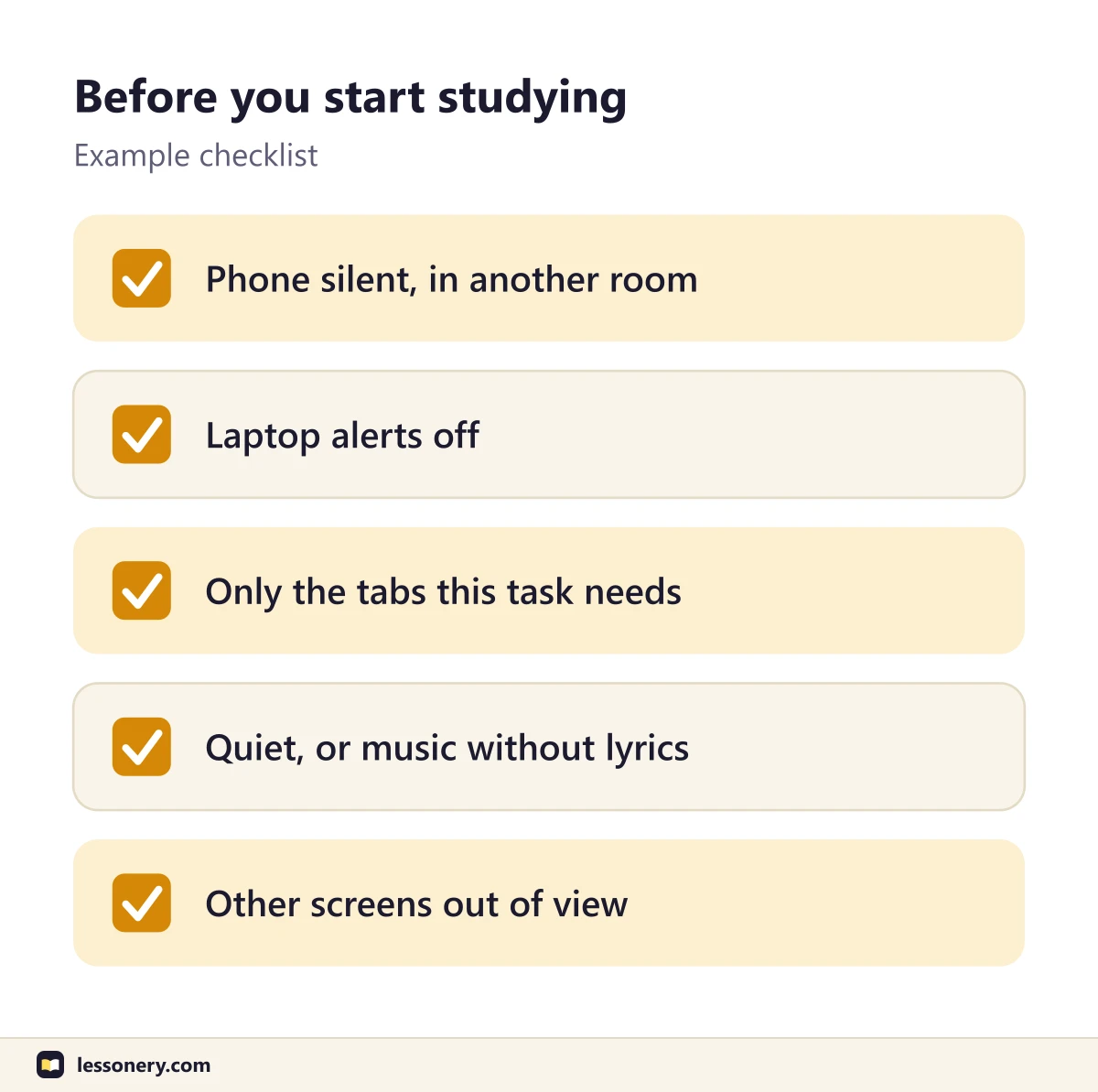
Checking your phone can then become something you do on purpose. UNC suggests using social media as a reward after an intensive study block and timing the break so it doesn't run on. A fixed work-and-break pattern such as the Pomodoro Technique for students gives those checks a set place.
When the distraction isn't in the room
Clearing the desk removes outside interruptions. It doesn't remove the urge to go and look for one. UNC's digital distractions page recommends noticing the moods and thoughts that come just before you reach for a device, and setting fixed times for email and messages.
If you keep putting the work off even in a quiet room, the problem may be closer to procrastination, covered in how to beat procrastination. If phone use feels out of your control, or it is affecting your sleep, mood or studies, a counselor or your school's support service is the right place to raise it.
Frequently asked questions
Should the phone be switched off, or is face down enough?
In Ward's study, whether the phone was on or off, or lying face up or face down, made no difference. What mattered was where it was. The replication by Ruiz Pardo and Minda found no effect of location. Silent and out of reach is the low-cost choice, because it also stops notifications and checking.
Does music distract you while studying?
For reading, the Vasilev meta-analysis found that music has a small negative effect on average, and that music with lyrics distracts more than music without. UNC lists instrumental music and white noise among its options for masking other sounds.
Do website blockers help?
UNC's page describes browser add-ons and programs that block chosen sites for a set period. None of the studies cited here tested them, so this article can't say how well they work. They address the same problem as closing tabs by hand.
Does it matter if I study with other people around?
It can. In the Sana study, simply having a classmate's off-task screen in view went with lower test scores. Other people's conversation is intelligible speech, which the Vasilev meta-analysis found to be among the most distracting sounds for reading.
What is the single most useful step?
No study here ranks the steps against each other. The research on how to not get distracted while studying is clearer for keeping one task on the screen and for avoiding speech or lyrics while you read than for the mere presence of a silent phone. Putting the phone away and closing what you don't need deals with notifications and multitasking in one step.