Active recall and spaced repetition are two halves of one routine. Active recall is what you do in a study session: answer from memory, then check. Spaced repetition is when you do it: again on a later day, after some forgetting has set in.
Researchers call the combination spaced retrieval practice. One version of it, successive relearning, has been tested in real university courses, and its rules are simple enough to run with a stack of index cards.
Quick answer: Test yourself on each item until you get it right once, then come back on later days and do the same again. In a meta-analysis of 29 studies, Latimier et al. (2021) found a strong benefit of spaced over massed retrieval practice (g = 0.74). Rawson and Dunlosky (2011) found that relearning in later sessions had pronounced effects on long-term retention at a relatively small cost in extra practice.
What active recall and spaced repetition each add
Active recall, which researchers call retrieval practice or practice testing, means producing an answer from memory before you look at it. In Roediger and Karpicke (2006), 120 undergraduates restudied one short science passage and, for another, wrote down everything they could remember. One week later, recall was 56% for the tested passage against 42% for the restudied one, although restudying had been ahead on a test five minutes after study. The guide to the active recall method has the details.
Spaced repetition, or distributed practice, means returning to the same material after a gap instead of repeating it back to back. Cepeda and colleagues (2006) pooled 271 comparisons involving more than 14,000 participants and found 47.3% recall after spaced study against 36.7% after massed study, with total study time held equal. How long the gaps should be is the subject of the spaced repetition schedule guide.
The two were already tied together in the research on each. Dunlosky and colleagues (2013), who gave only these two techniques out of ten a "high utility" rating, report that several studies found little or no gain from repeating practice tests back to back, compared with sizable gains when the tests were spaced.
What research on combining them found
Spaced versus massed retrieval practice
Latimier, Peyre and Ramus (2021) ran a meta-analysis of 29 studies of spaced retrieval practice, in which the same retrieval is repeated either with gaps or back to back. Spacing the practice beat massing it, with an effect size of g = 0.74, which the authors call a strong benefit.
The same paper compared expanding schedules, where each gap is longer than the last, with equal gaps. The two did not differ significantly (g = 0.034). The evidence backs spacing your self-tests. It does not back any particular pattern of growing intervals.
Successive relearning in the laboratory
Successive relearning is a fully specified way of combining the two. A guide for educators by Dunlosky, Greve, Badali, Wissman and Rawson (2023) describes it this way. You try to recall an item and check the answer. If you were right, the item is finished for that session. If you were wrong, you study the correct answer and try the item again later in the same session. You continue until every item has been recalled correctly, then return on two or more later days and do the same again.
Rawson and Dunlosky (2011) tested how much of this is enough. Across three experiments, 533 students learned conceptual material through retrieval practice with restudy. Items were practiced until they had been recalled correctly one to four times in a first session, then relearned to one correct recall in one to five later sessions. Retention was measured one to four months after practice.
The benefit of a stricter first-session target was strong before any relearning and shrank as relearning sessions were added. Relearning itself had pronounced effects on long-term retention at a relatively small cost in extra practice trials. The authors' advice to students was three correct recalls in the first session, then three relearning sessions at widely spaced intervals.
Later work from the same group softened the first half of that advice. Vaughn, Dunlosky and Rawson (2016) had participants recall Swahili-English word pairs correctly one to seven times in a first session, then relearn them to one correct recall at one-week intervals over four or five sessions. The advantage of the higher first-session targets did not persist across the relearning sessions. The authors conclude that if relearning is going to happen, extra time spent reaching a higher initial target is not efficient and is better given to the spaced relearning sessions.
Rawson, Vaughn, Walsh and Dunlosky (2018) compared successive relearning with learning in a single session. In two experiments the advantage of relearning was substantial, with effect sizes from d = 1.52 to 4.19.
Successive relearning in real courses
Rawson, Dunlosky and Sciartelli (2013) ran two experiments in what their abstract calls an authentic educational context, and report meaningful improvements in course exam performance and on long-term retention tests.
The details in this paragraph come from the 2023 guide, whose authors include two of the paper's three authors, and not from the paper itself. As the guide describes the study, students in an introductory psychology course used virtual flashcard stacks, typically holding six to eight concepts, in three or more sessions separated by at least one day. The guide reports that in the first experiment successive relearning raised exam performance by over 10% compared with the baseline. By the guide's account, a group that used the same schedule to restudy instead of recall also gained, but by less. The guide adds that on a recall test 24 days after the exam, students recalled over 60% of the concepts they had successively relearned and less than 20% of those they had learned on their own.
Higham, Zengel, Bartlett and Hadwin (2022) controlled time more tightly. In an introductory psychology class, students received three practice sessions, two days apart, after each weekly lecture. Relearning meant answering fill-in-the-blank questions with feedback. Restudying meant rereading the same sentences for the same exposure time. Recall of course material at the end of the semester was better for relearning. According to the 2023 guide, the tests came about 42 and 68 days after the final practice session. On questions that repeated the practiced terms, the guide reports a significant advantage for relearning at both points, smaller at 68 days, and a minimal benefit for transfer questions and for new questions.
Where the evidence stops
- Problem solving. The guide describes experiments by Rawson, Dunlosky and Janes (2020) in which college students learned to solve four kinds of probability problems. One week later, successive relearning showed a significant but small advantage (d = .28), and average performance in the successive relearning group was around 50% or less.
- Age. The guide's authors write that the experimental research on successive relearning has almost exclusively involved adults.
- Very long retention. They also write that research has not yet systematically explored how much relearning is enough for very long-term retention.
These studies measured recall and exam questions on the material that was practiced. None of them promises a grade.
How to combine active recall and spaced repetition, step by step
The steps follow the description in the 2023 guide.
- Turn the material into questions. A card with a question on one side and the answer on the other works. So do sticky notes placed over the definitions in a textbook, the guide's alternative to cards.
- Answer from memory, then check. For long answers, the guide says writing the response down may make it easier to score accurately against the correct answer.
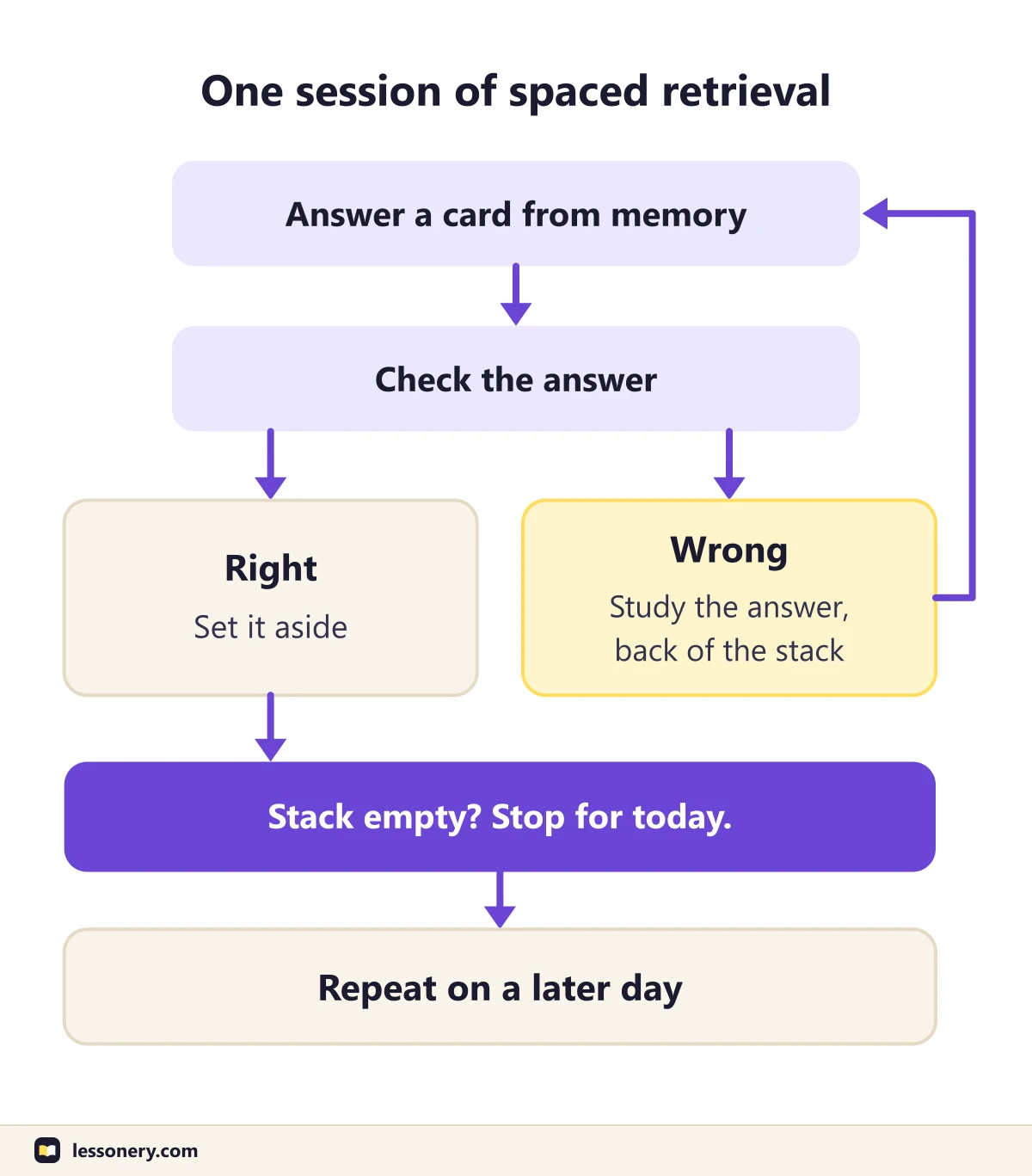
- Sort by result. A card you got right is set aside for today. A card you got wrong goes to the back of the stack once you have studied the answer.
- Continue until the stack is empty. Every card gets answered correctly once in the session.
- Come back on a later day and repeat. The course studies used three or more sessions at least one day apart. The guide's example is three extra sessions separated by two days.
- Set the gap by your deadline. Dunlosky et al. (2013) give a rule of thumb of about 10 to 20% of the time you need to remember the material.
Keep stacks small when the answers are long. The guide suggests 8 to 10 cards for conceptual definitions, and estimates that learning that many to one correct recall may take 30 to 40 minutes the first time, about 15 minutes in the first relearning session and fewer than 5 minutes in the one after.
A worked example: one lecture, four sessions
This plan is an example written for this article, not a schedule from any of the studies. The lecture is on Monday, October 12, 2026 and the exam on Monday, November 9, 2026, which is 28 days later. The stack has eight question cards, and the table follows three of them.
There is one learning session and three relearning sessions, the number Rawson and Dunlosky (2011) arrived at. The sessions are one week apart, the interval used by Vaughn et al. (2016). A week works out to 25% of the 28 days, a little above the 10 to 20% rule of thumb.
| Card | October 12 | October 19 | October 26 | November 2 |
|---|---|---|---|---|
| What two techniques does successive relearning combine? | Right first time | Right first time | Right first time | Right first time |
| What did Latimier et al. (2021) find for spaced versus massed retrieval practice? | Wrong, then right | Wrong, then right | Right first time | Right first time |
| What did Vaughn et al. (2016) find about a higher first-session target? | Wrong twice, then right | Wrong, then right | Wrong, then right | Right first time |
Inside one session, the routine looks like this:
Session 2, Monday, October 19 (example)
Pass 1: 8 cards. 5 right, set aside. 3 wrong: study the answer, back of the stack.
Pass 2: 3 cards. 2 right, set aside. 1 wrong: study the answer, back of the stack.
Pass 3: 1 card. Right. The stack is empty, so the session is over.
Missing a card you knew last week is part of the method. In an experiment by Bahrick (1979) that Dunlosky et al. (2013) describe, the group with the longest gaps had forgotten the most at the start of each session and remembered the most on the final test.
A weekly study schedule is a practical place to hold the four sessions, and a Leitner box is a paper system for deciding which cards come back on which day.
Common mistakes
| Mistake | What the research says | Fix |
|---|---|---|
| Scoring a half-right answer as right | The 2023 guide warns that overconfident scoring leads to dropping items too early, which results in poor retention | Write the answer and compare it with the card point by point |
| Doing every pass in one evening and never returning | Massed retrieval practice did worse than spaced in Latimier et al. (2021) | Put the later sessions in your calendar when you make the cards |
| Drilling each card many times in the first session | In Vaughn et al. (2016) the advantage of a higher first-session target did not persist across relearning sessions | Stop at one correct recall and save the time for the next session |
Frequently asked questions
Is spaced retrieval practice the same as successive relearning?
Successive relearning is one form of it. Spaced retrieval practice is the broad term Latimier et al. (2021) use for retrieval repeated over time. Successive relearning adds a stopping rule: in every session, you practice until each item has been recalled correctly.
How many review sessions does each topic need?
Rawson and Dunlosky (2011) concluded in favor of three relearning sessions after the first. The 2023 guide says the number depends on the time between exams, and suggests that exams four weeks apart leave room for two or perhaps three extra sessions.
Does combining the two work for math problems?
The evidence is thinner there. In the probability experiments by Rawson, Dunlosky and Janes (2020), as the 2023 guide describes them, the advantage of successive relearning was significant but small. The overview of the most effective study techniques covers methods studied with math, such as interleaved practice.