A Cornell method note taking example shows the layout in use, and this page gives three. Each is a complete filled-in page: notes from a lecture, notes on a textbook section and notes from a problem-solving class.
All three are examples made for this article. The content of each page comes from a source that is named and linked, so the facts on it can be checked. For the method itself and the studies behind it, see the guide to the Cornell note-taking system.
Quick answer: A filled-in Cornell page has short notes in the wide right-hand column, a question in the left-hand cue column beside each block of notes, and a summary of the page's main points at the bottom. The questions are written soon after class and then used for self-testing with the notes covered.
How to read each Cornell method note-taking example
Every page has the same three areas. A handout from Cornell University's Learning Strategies Center draws them with their sizes: a cue column 2.5 inches wide, a note-taking column 6 inches wide and a 2-inch summary space at the foot of the page.
The handout fills them at different times: notes during class, questions as soon after class as possible, and the summary after class.
In the tables below, the cue column is on the left, as on paper, and the last row is the summary.
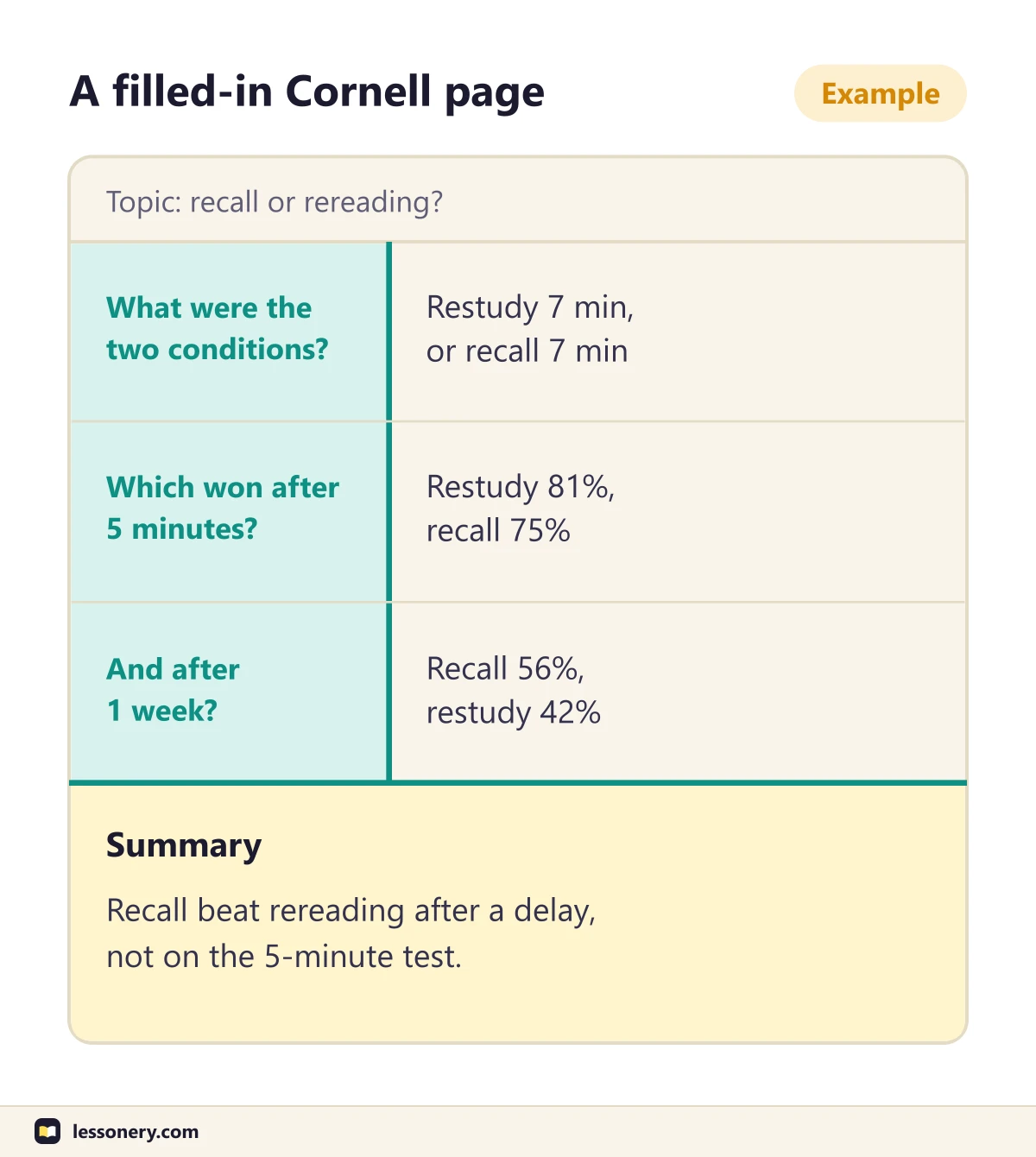
Example 1: notes from a lecture
This page shows notes for a sample psychology lecture on one experiment, the first in Roediger and Karpicke (2006). The article on the active recall method describes that study in full.
| Cue column (written after class) | Notes column (written in class) |
|---|---|
| Who took part? | R&K 2006, exp. 1: 120 undergrads, Washington Univ. in St. Louis |
| What did they read? | 2 short science passages: the sun, sea otters |
| What were the two conditions? | Passage A: restudied for 7 min. Passage B: 7 min writing down all they could recall, no feedback |
| When was the final test? | Recall test after 5 min, 2 days or 1 week |
| Which condition won after 5 minutes? | 5 min: restudy 81% of ideas, recall 75% |
| How does the result change with the delay? | 2 days: recall 68%, restudy 54%. 1 week: recall 56%, restudy 42% |
| How can I apply this to my own revision? | (Not in the notes. Answered from memory at review.) |
| Summary | Students who recalled a passage instead of rereading it remembered more of it 2 days and 1 week later. Rereading was slightly ahead only on the test 5 minutes after study. |
The notes are phrases, which Cornell's handout calls telegraphic sentences. Each cue sits beside the lines that answer it. The last cue is a different kind of question. The handout's fourth step, reflect, suggests asking how you can apply the facts, and that answer has to come from you.
Example 2: notes on a textbook section
The second page is for reading. Its source is the US Geological Survey's Water Science School page on the water cycle, standing in for a section of an earth science textbook.
With a text, the cues can be written first. The page's headings ("Pools store water", "What drives the water cycle?") were turned into questions before reading, and the notes were written afterward. The article on note-taking from a textbook explains that order.
| Cue column (written before reading) | Notes column (written after reading, then checked) |
|---|---|
| What does the water cycle describe? | Where water is on Earth + how it moves |
| What is a pool? Which is the largest? | Pool = place water is stored. Oceans: 96% of all water, saline |
| Where is fresh water stored? | Lakes, reservoirs, rivers, wetlands; ice sheets, glaciers, snowpack; vapor in the atmosphere; soil moisture, permafrost; groundwater in aquifers |
| What is a flux? Name three between air and surface. | Flux = movement between pools. Evaporation, evapotranspiration, precipitation |
| How does water move over and into the ground? | Over: snowmelt, runoff, streamflow. In: infiltration, groundwater recharge |
| What two things drive the cycle, and what does each do? | Sun's energy: evaporates liquid water. Gravity: water flows downhill; rain, snow, hail fall |
| How do people change the cycle? | Redirect rivers, build dams, drain wetlands; draw water for homes, irrigation, industry |
| Summary | Water sits in pools, mostly the oceans, and moves between them as fluxes such as evaporation, precipitation and runoff. The sun's energy and gravity drive the movement, and human use changes where water is stored and how it moves. |
Example 3: notes from a problem-solving class
Some classes in chemistry, physics or math consist largely of worked problems. A handout from the University of Wisconsin-Milwaukee's student success office tells students to adapt the page to problem-based notes, with one column for working the problem and the other for explaining all of the steps.
The page below keeps the working in the notes column, since that is what gets written during class, and adds questions about the steps afterward. The definition is from Purdue University's chemistry help pages, which describe molarity as the number of moles of solute in exactly one liter of a solution. The molar mass of sodium chloride is rounded from the 58.443 listed in the NIST Chemistry WebBook. The problem and its arithmetic were written for this article.
| Cue column (written after class) | Notes column (written in class) |
|---|---|
| What does molarity measure? Liters of what? | Molarity (M) = moles of solute ÷ liters of solution |
| Problem type? | Mass and volume given, molarity wanted: 5.85 g NaCl made up to 250 mL of solution |
| Why convert grams to moles first? | Step 1: 5.85 g ÷ 58.44 g/mol = 0.100 mol |
| Why 0.250 and not 250? | Step 2: 250 mL = 0.250 L |
| Which number goes on top? | Step 3: 0.100 mol ÷ 0.250 L = 0.400 mol/L, written 0.400 M |
| How do I check the answer? | Units come out as mol/L. 0.1 mol in a quarter of a liter is 0.4 mol in a whole liter |
| What if the question gave moles instead of grams? | (Not in the notes: skip step 1.) |
| Summary | To find molarity from a mass, convert grams to moles with the molar mass, convert the volume to liters of solution, then divide moles by liters. |
The first two cues name the idea and the problem type. The next two ask why a step was taken, which a list of steps does not show on its own. The article on Cornell notes in math takes this kind of page further.
What makes the cue questions good
They can be answered from the notes beside them. The University of Cincinnati's Learning Commons says to write questions or keywords next to the related notes soon after class and to quiz yourself with them. Cornell's handout adds that writing the questions clarifies meanings, reveals relationships and strengthens memory.
They work as a test. Dunlosky and colleagues (2013), who reviewed ten learning techniques, rated practice testing as high utility and named the Cornell system as one way for students to test themselves. The review did not test Cornell notes as a format.
Some of them ask why or how. A practice guide written for teachers by the US Institute of Education Sciences, Organizing Instruction and Study to Improve Student Learning (Pashler and colleagues, 2007), recommends asking deep explanatory questions and rates the evidence for that as strong. Its question stems include why, what caused X, what if, and how does X compare to Y. It adds that such questions are usually most useful once the basic facts are in place, which is a reason to mix both kinds on a page.
In the table, the stronger cues are from the three pages and the weak versions are illustrations written for this article.
| Weak cue | Stronger cue | What changed |
|---|---|---|
| Experiment | What were the two conditions? | A keyword became a question with a definite answer |
| Is testing good? | Which condition won after 5 minutes? | The answer is in the notes and can be checked |
| Pools | What is a pool? Which is the largest? | It asks for a definition and a fact |
| Step 2 | Why 0.250 and not 250? | It asks for the reason behind a step |
Keywords are allowed: Cornell's handout speaks of "questions or cue-words". The examples use questions because a question has an answer you can check against the notes. That is reasoning, not a research finding.
What makes the summary good
The summary states the main points of one page. Cornell's handout gives a single instruction: after class, use the space at the bottom of each page to summarize the notes on that page. The Cincinnati page says summaries let you skim the notebook quickly when you need material for papers, quizzes or tests.
The three summaries above share some features, chosen for this article:
- Each is one or two sentences.
- Each states a result or a relationship instead of just naming the topic. "Recall beat rereading after a delay" is a summary. "This lecture was about a memory experiment" is a title.
- The problem page summarizes the method, not the answer.
There is a case for keeping this part short, and it is this article's reading of the research, not a finding. The Dunlosky review rated summarization as low utility: it can be effective for learners who are already skilled at summarizing, but many students need extensive training to do it well. The reviewers also note that in direct comparisons summarizing was less powerful than self-questioning, citing a study by King (1992). In that study 56 underprepared college students were randomly assigned to question themselves, write summaries or review their notes as a way of learning from lectures. The ERIC record reports that the self-questioners did better than the summarizers and significantly better than the note reviewers, and gives no further detail.
Matching the page to the material
A Cornell method note-taking example from one subject does not carry over unchanged to another. The three areas stay where they are, and what goes into them shifts.
| Material | Notes column | Cue column | Summary |
|---|---|---|---|
| Lecture | Main points as phrases, in the order given | Questions written soon after class | The main result or argument |
| Textbook section | Written after reading, then checked against the text | Headings turned into questions before reading | What the section explains |
| Problem class | The problem and every step | Problem type, reasons for steps, how to check | The method in words |
For the lecture itself, the article on taking notes in class covers what to write down and what to leave out.
To use a finished page, cover the notes column, answer each question aloud in your own words, then uncover the notes and check. That is the recite step in Cornell's handout, which also asks for at least ten minutes of review every week.
A problem page needs one more thing. The University of North Carolina's Learning Center describes attempting practice problems from memory as a more potent learning strategy than rereading lecture notes first, so work the covered problem again on blank paper.
Frequently asked questions
How many questions should a Cornell page have?
The handouts cited here give no number. Cal Poly's guide to note-taking systems says to write a cue for every significant bit of information. Each of the three example pages has seven.
Can you make Cornell notes from a textbook?
Yes. The second Cornell method note-taking example above does it with headings turned into cue questions before reading and notes written after reading. The summary is written last, as with lecture notes.
Do Cornell notes work for subjects built on problems?
The Wisconsin-Milwaukee handout adapts the page for math and physics by pairing each worked problem with an explanation of its steps. Example 3 shows one way to lay that out. No study described here compared such pages with other formats.