The plain answer to how to study for a midterm has three parts. Find out what the exam covers and how it asks, spread short self-testing sessions over the one to two weeks before it, and study the marked paper when it comes back. A midterm is an exam held partway through a course; some countries call it a mid-semester or mid-year exam.
Two things separate it from an end-of-term exam. Classes carry on while you prepare, and the result arrives with weeks of the course still to run.
Quick answer: Ask about the format, list the topics and rate each one with your notes closed. Study one chunk a day in short sessions, add brief reviews of earlier chunks, and finish with a timed self-test. When the exam is returned, sort your errors by cause and change how you prepare for the next one.
What makes a midterm different
A midterm can only cover what has been taught so far: a few weeks of lectures, not a whole course. For scale, the sample in the five-day study plan from Cornell University's Learning Strategies Center divides one exam's material into four chunks and uses about 2 hours a day.
The other courses do not pause. The same Cornell page tells students not to neglect their other courses during the five days, and its guidelines for a study schedule say to keep studying for other classes even when an exam is coming up in a different one.
One course survey shows how midterm preparation can go in practice. In an introductory physics course at the University of California, Los Angeles, with 350 students taking part, Samani and Pan (2021) report that most students crammed before the graded midterm exams. What research says about that is covered in how to cram for an exam.
Step 1: Find out the format and what it covers
Start with the exam, not the notes. The Open University's exam format checklist lists the questions to answer: how long the exam is, how many sections it has, how many questions you must answer in each, whether any are compulsory, what types of question appear and whether some carry more marks than others. Its last item is to take any query about the format to your tutor.
For coverage, the University of North Carolina's Learning Center suggests gathering the syllabus, readings, notes and quizzes and listing the topics likely to be tested. You then test yourself on each topic with the materials hidden and rate it 1 (don't know), 2 (sort of know) or 3 (know). Topics rated 1 or 2 get the most time.
The format decides what practice looks like. The University of Guelph Library's guide to studying for exams advises writing practice questions in the same format as the exam and shuffling them, since exam questions may not follow chapter order.
Note: Use only the past papers and practice materials your teacher or institution makes available, and follow your institution's rules on what you may bring into the exam.
Step 2: Plan one to two weeks around your other coursework
University guidance on when to start ranges from five days to two weeks.
| Source | When to start | Daily load | Other courses |
|---|---|---|---|
| Cornell Learning Strategies Center | Five days before the exam | About 2 hours a day, one new chunk plus short reviews | Don't neglect them |
| UNC Learning Center | Several days or weeks ahead | Sessions of 30 or 45 minutes | A short session for each class every day |
| Claremont McKenna College | 10 to 14 days ahead when several tests come close together | 2-hour blocks with 15-minute breaks | Plan when to study for each subject |
The Claremont McKenna figures come from its exam prep handout, and UNC's from its page on studying smarter. UNC's point is that the total time can stay about the same while being divided among classes and days.
The research behind spreading the work is the review of 10 learning techniques by Dunlosky and colleagues (2013), which gave distributed practice, meaning study spread over time, one of only two "high utility" ratings.
On the size of the gaps, Cepeda and colleagues (2008) had more than 1,350 participants learn facts and review them after gaps of up to 3.5 months. For a test 1 week after the review, the best gap was roughly 20 to 40 percent of that week. That works out to 1.4 to 2.8 days, which is this article's arithmetic, and the study used facts, not a course.
In Cornell's sample, days 2 to 4 each pair a new chunk with short reviews of the earlier ones, and day 5 is reviews and a self-test. For the general method, see how to create a study schedule.
Step 3: Spend the sessions testing yourself
A scheduled hour of rereading is still rereading. In the Dunlosky review, practice testing received the other "high utility" rating, and rereading was rated low.
In two experiments by Roediger and Karpicke (2006), students studied prose passages and then either took free-recall tests without feedback or restudied the passage. On a final test after 5 minutes, restudying produced better recall. On final tests after 2 days or 1 week, the students who had been tested remembered substantially more.
Cornell's plan divides the work the same way. "Preparing" a chunk means making something from it, such as a study sheet or a list of predicted questions. "Reviewing" means self-testing, such as working problems without the answer key or outlining an essay answer from memory. The formats are described in how to study effectively for exams and in the guide to the active recall method.
An example 10-day plan for a midterm
This plan is an example made for this article, not a schedule from a source. It assumes a midterm on a Thursday morning (day 11) covering five units. Units 1 to 4 have been taught, and unit 5 is being taught in the first week of the plan.
| Day | New work | Reviews, notes closed | Minutes |
|---|---|---|---|
| 1 (Mon) | Check the format, list the topics, rate units 1–4: 45 | None | 45 |
| 2 (Tue) | Prepare unit 1: 45 | None | 45 |
| 3 (Wed) | Prepare unit 2: 45 | Unit 1: 10 | 55 |
| 4 (Thu) | Prepare unit 3: 45 | Unit 2: 10 | 55 |
| 5 (Fri) | Prepare unit 4: 45 | Unit 3: 10, unit 1: 5 | 60 |
| 6 (Sat) | Prepare unit 5: 60 | Unit 4: 10, unit 2: 5 | 75 |
| 7 (Sun) | Day off | 0 | |
| 8 (Mon) | None | Mixed self-test on units 1–5: 40; correct errors: 20 | 60 |
| 9 (Tue) | None | Timed practice questions in the exam's format: 50; mark them and list weak points: 25 | 75 |
| 10 (Wed) | None | Weak points: 40; quick recall of all five units: 20 | 60 |
| 11 (Thu) | Midterm |
The arithmetic:
- Planning on day 1: 45 minutes.
- Preparing units: 45 + 45 + 45 + 45 + 60 = 240 minutes.
- Short reviews on days 3 to 6: 10 + 10 + 15 + 15 = 50 minutes.
- Self-testing on days 8 to 10: 60 + 75 + 60 = 195 minutes.
- Total: 45 + 240 + 50 + 195 = 530 minutes, or 8 hours 50 minutes.
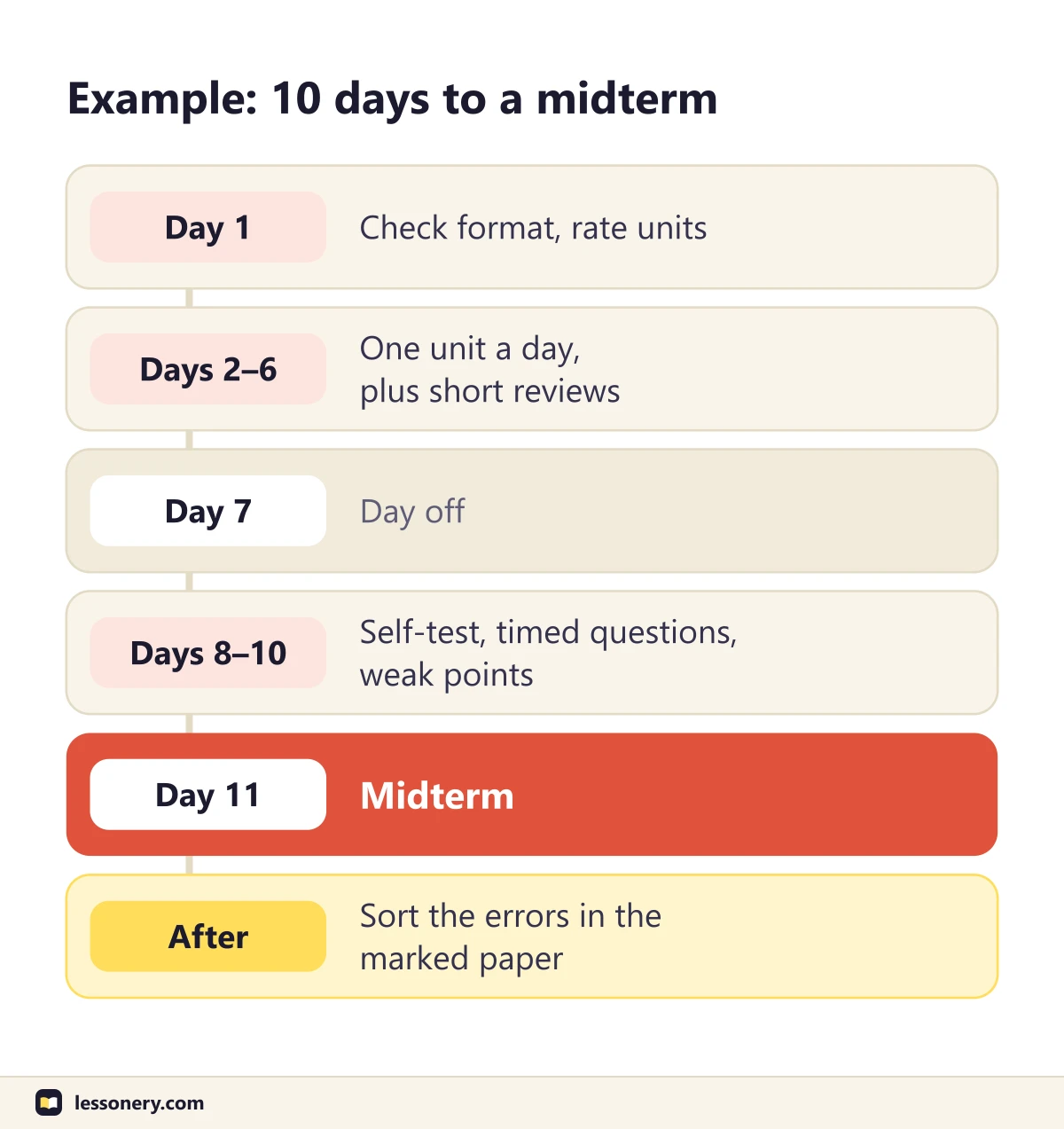
No day goes above 75 minutes, which leaves the rest of each day's study time for other courses. If your term-time routine already has a slot for this course, the plan can sit inside it: see the weekly study schedule article.
After the midterm: use the result
Sort the errors by cause
The University of Guelph Library's guide to analyzing exam errors says to look for patterns in the questions you lost marks on, and to ask your instructor to see the paper if it was not returned. It names five kinds of error.
| Kind of error | What it looks like | What Guelph suggests changing |
|---|---|---|
| Omission | Content missed after falling behind on classes or readings | Get notes for missed classes; use office hours |
| Careless or out of time | Misread questions, calculation slips, skipped questions | Skim the paper first, plan time by marks, leave minutes to check |
| Prioritization | Material skipped because you assumed it wouldn't be tested | Use the course outline; look for topics in both textbook and lectures |
| Application | Trouble applying material to a new situation | Make practice questions central to your preparation |
| Mastery | Content half-remembered, or answers without enough detail | Self-test with practice exams; ask how much detail is expected |
UNC's test analyzer works one question at a time: for each missed item you record the type of question, the reason you missed it and where the material can be found.
What research says about exam wrappers
An exam wrapper is a short reflection form of this kind, handed out by a teacher with the marked exam. Carnegie Mellon University's Eberly Center describes exam wrappers as prompting students to identify their strengths and weaknesses, reflect on whether their preparation was adequate, and characterize their errors to find recurring patterns.
The evidence that completing one raises grades is mixed:
- According to its abstract, a study by Soicher and Gurung (2017) placed 86 students in one course into three groups: exam wrappers, a similar exercise without the instruction on thinking about one's own learning, or neither. The wrappers brought no improvement on any of three exams, on final grades or on a questionnaire measure of metacognition. Scores on that questionnaire rose over the semester in all three groups.
- Hodges and colleagues (2020) used wrappers in five large science and mathematics courses at one US university and report that wrapper use was positively related to course grades in each course, a relation they describe as modest but statistically significant. Wrapper use did not correlate with end-of-term scores on the metacognition questionnaire.
The second study was not an experiment. The authors call it a case study and note that higher-performing students tend to take up the intervention more often. On this article's reading, that leaves open whether the form raised grades or stronger students were the ones filling it in.
Neither study shows that a form changes results by itself. Its use is to point you to a specific change in how you prepare. If your final exam covers the whole course, the marked midterm is also study material, which is covered in how to study for a cumulative final.
Frequently asked questions
How long before a midterm should you start studying?
The guidance cited here ranges from five days (Cornell's plan for one exam) to 10 to 14 days when several tests fall close together (Claremont McKenna's handout). The example above uses 10 days so that every unit can be prepared once and reviewed on later days.
How many hours should you study for a midterm?
None of the sources gives a figure for midterms specifically. Cornell's sample uses about 2 hours a day for five days, and the example in this article comes to 8 hours 50 minutes over 10 days.
What if you have two midterms in the same week?
Cornell says the five-day plan has to be adapted when two or three exams or major assignments fall in one week, and Claremont McKenna's handout advises starting 10 to 14 days ahead. The article on a final exam study schedule works through an example with several exams.
What should you do if the midterm went badly?
Work out why before you study harder in the same way. Sort the lost marks by cause, as in the table above, and take the paper to your teacher's office hours if the pattern isn't clear. UNC's Learning Center invites its students to bring a completed test analysis to an academic coach; ask what your own school offers.