Speed reading techniques are methods that claim to raise your reading rate without costing you understanding: skimming, silencing the voice in your head, pacing with a finger, and apps that flash one word at a time. A research review of them published in 2016 concluded that this is unlikely: when reading gets much faster than normal, comprehension drops.
One of the techniques is still useful when you choose it on purpose, and the review says what helps instead: practice with reading, which works slowly.
Quick answer: A 2016 review by Rayner, Schotter, Masson, Potter and Treiman found a trade-off between speed and accuracy, and no evidence that training lets people dramatically increase their reading rate while keeping excellent comprehension. Skimming gets you through a text faster with moderate comprehension, which is acceptable when the gist is all you need. What the review supports for lasting gains is practice with reading and a larger vocabulary.
What the 2016 review found
The review is Rayner, Schotter, Masson, Potter and Treiman (2016), published in Psychological Science in the Public Interest. The authors first set out what is known about normal reading and then test the claims of speed-reading courses and apps against it.
Their summary has three parts:
- There is a trade-off between speed and accuracy. It is unlikely that readers can double or triple their speed, for example from around 250 to 500–750 words per minute, and still understand a text as well as at normal speed.
- If thorough understanding is not the goal, speed reading or skimming gets a reader through a text faster with moderate comprehension.
- The way to keep comprehension high and still get through text faster is to practice reading and become a more skilled language user, for instance through a larger vocabulary.
The reason they give is that the limit on reading is language, not eyesight. In English, readers take in useful information from about 3 to 4 letter spaces to the left of where they are looking and 14 to 15 to the right. Eye movements take up only about 10% of reading time by the authors' estimate. In one study they cite, the factor that most strongly determined reading speed was the ability to identify words.
How fast is normal?
The review puts college-educated adults who are good readers at about 200 to 400 words per minute. A later meta-analysis by Brysbaert (2019), covering 190 studies and 18,573 participants, estimated the average for adults reading English silently at 238 words per minute for non-fiction and 260 for fiction. Its abstract notes that these estimates are lower than the numbers often cited, and that most adults fall between 175 and 300 for non-fiction and between 200 and 320 for fiction.
The speed reading techniques, one by one
| Technique | What you do | What the 2016 review reports |
|---|---|---|
| Skimming | Read selected parts: headings, openings, summaries | As much as two to four times faster than typical silent reading, with lower comprehension |
| Reducing subvocalization | Try to silence the inner voice | Attempts to suppress inner speech impaired comprehension of harder texts |
| Taking in more per glance | Train peripheral vision to read groups of words | Such training has not produced faster reading with good comprehension |
| Pacing | Move a finger, card or pen to push the eyes forward | No test of a pacer is reported. Rereading, which pacing aims to stop, supports comprehension |
| RSVP apps | Watch words flash one at a time at a set rate | Comprehension similar at normal rates and worse when the rate goes up |
Skimming
Skimming means moving quickly through a text to find a particular piece of information or to get a general idea of its content. Of the speed reading techniques listed here, it is the one the review treats as useful, on one condition: you accept lower comprehension in exchange for speed.
The review calls the study by Just, Masson and Carpenter (1980) the most complete one on the eye movements and comprehension of speed readers. Trained speed readers and people asked to skim both read at around 600 to 700 words per minute, against about 250 for normal readers. The speed readers did better than the skimmers on questions about the gist, though not quite as well as the normal readers. On questions about details, normal readers did relatively well and the two fast groups did not differ. With more technical passages, the speed readers lost their advantage over the skimmers. The review's reading of this is that students of speed-reading courses are essentially being taught to skim.
Duggan and Payne (2009) gave readers only enough time to read half of each text. According to the abstract, skimming the whole text improved memory for its important ideas compared with reading half of it, but did not improve memory for less important details or for inferences. In a second experiment, skimming showed no advantage over reading the first or second half of every paragraph.
Reducing subvocalization
Subvocalization is the inner speech readers often hear in their heads when reading silently. Many of the speed-reading books the authors surveyed recommend eliminating it. The review's evidence points the other way:
- When readers were trained with a feedback tone to reduce activity in their speech muscles, comprehension was unaffected for an easy text and impaired for a harder one (Hardyck and Petrinovich, 1970).
- When readers repeated irrelevant words aloud while reading, comprehension was poorer. Tapping a sequence with their fingers did not have that effect (Daneman and Newson, 1992).
- In a similar study, readers answered questions about single concepts well and did worse on questions that required combining concepts and making inferences (Slowiaczek and Clifton, 1980).
The authors conclude that for complex material, inner speech is not a nuisance to be eliminated, because turning print into sound helps readers understand it.
Pacing
Pacing means moving a guide along or down the page to keep your eyes going forward. It is still taught: a reading-tips handout from Smith College's Jacobson Center suggests a "pacer," such as an index card, a finger or a pen, to break the habits of re-reading and subvocalizing.
The 2016 review reports no experiment on a pacer by itself. What it does report bears on the reason for using one. Skilled readers move back in the text about 10% to 15% of the time, and many of those movements repair a failure to understand. In Schotter, Tran and Rayner (2014), each word was masked once the reader's eyes had passed it, so nothing could be reread. According to the abstract, being unable to go back affected comprehension negatively, and not only for ambiguous sentences.
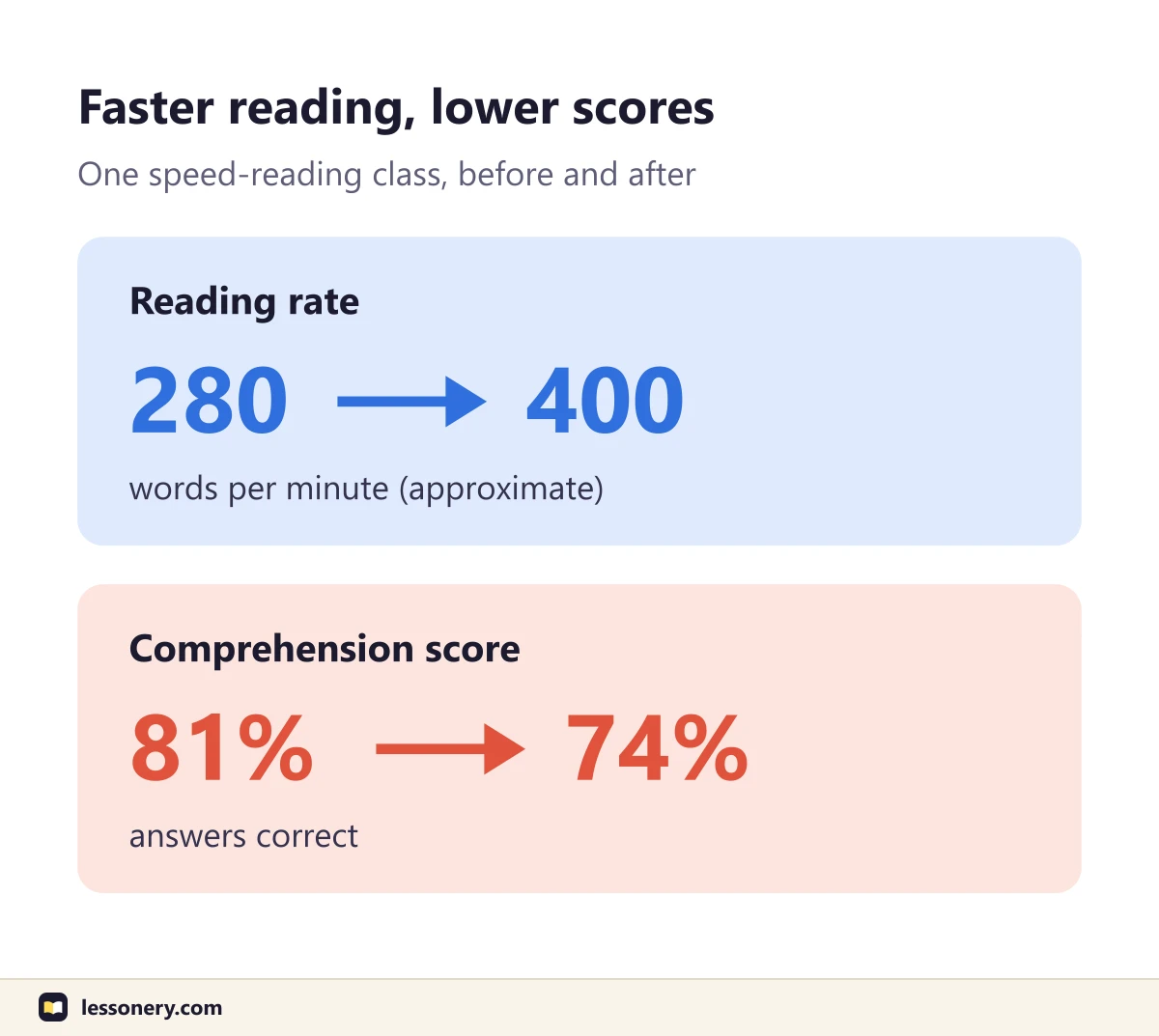
The review also describes a study of adults before and after a speed-reading class (Calef, Pieper and Coffey, 1999). Their rate rose from about 280 to about 400 words per minute, with fewer backward movements, and their comprehension score fell from 81% to 74%. The review does not say which techniques the class taught.
RSVP apps
RSVP stands for rapid serial visual presentation: words appear one at a time in the same spot, at a rate the device sets. The claim is that reading speeds up once the eyes no longer have to move.
The review found that at normal rates, RSVP readers understood paragraphs about as well as people reading a page. Faster streams cost comprehension. In Potter and colleagues (1980), more than 80% of readers still recalled a paragraph's topic word at a rate equal to 600 words per minute, but detailed recall dropped markedly as the rate rose. In Juola and colleagues (1982), performance fell by about 50% when the rate was increased.
The review names one app, Spritz, because it had received the most attention and its developers had made specific claims about the science. The authors knew of one published study that objectively compared comprehension with that kind of display, by Benedetto and colleagues (2015). Readers could pause the stream, and their speed came out close to ordinary reading: 209 words per minute against 200. They did as well on questions that needed inference and worse on questions about what the text literally said.
A later experiment, Acklin and Papesh (2017), presented texts as ordinary static text or by RSVP at 700 and 1,000 words per minute. According to the abstract, static text was associated with better comprehension than either RSVP speed.
Example: matching your reading to the task
The review's practical point is that you don't need to read the same way for every goal. The table below is an example written for this article, not a schedule from any source. It applies that point, and the UNC Learning Center's advice on when to skim, to one evening of reading.
| Task | What you need | Approach |
|---|---|---|
| Textbook chapter that the exam will test in detail | Full understanding | Preview the headings, then read at your normal pace. Go back over hard passages |
| Eight journal articles, to choose three for an essay | The gist of each | Skim: abstract, headings, first and last paragraphs |
| A chapter you read carefully last week | A refresher before class | Skim headings and the summary, then recall the main points from memory |
| A short story for a literature class | The text itself | Read all of it. UNC says skimming is typically less beneficial for novels, poetry and short stories |
What helps you read more efficiently
Decide the purpose, then preview
The UNC Learning Center's page on skimming puts purpose first among the strategies it pairs with skimming: decide what you want from the reading and why. Next comes a preview of headings, illustrations, captions and summaries.
The review gives some backing for attention to headings. It cites a study in which the readers who paid more attention to headings wrote the most accurate summaries. Surveying a chapter first is also the opening step of the SQ3R method of reading.
Skim deliberately when the gist is enough
UNC describes skimming as reading the first and last sentences of paragraphs, the first and last paragraphs of major sections, and chapter introductions and summaries. It warns that flipping through pages half-attentively is not skimming.
The same page says when not to skim: when you have been told a test will cover small details, and when a subject is hard for you and close reading helps you understand it. For those texts, strategies to improve reading comprehension matter more than speed.
Build vocabulary and practice
Practice with reading helps, the review says, but slowly, and it does not cause drastic increases in speed.
The mechanism it describes is familiarity. Readers spend less time on common words than on uncommon ones, and the more often you meet an uncommon word, the more easily you read it. Reading more, and reading varied texts, builds vocabulary and background knowledge, and readers spend less time on words they can predict from context. Deliberate ways to learn new terms are covered in memorization techniques for studying.
Knowledge of the topic matters for the same reason. The review describes effective speed readers as people who already know a great deal about what they are reading and accept the lower comprehension that comes with skimming.
Frequently asked questions
What is the average reading speed?
Brysbaert's 2019 meta-analysis estimates 238 words per minute for adults silently reading English non-fiction and 260 for fiction. It reports lower rates for children, older adults and people reading English as a second language.
Can anyone read 1,000 words per minute with full comprehension?
The review found no evidence that training makes this possible. In one study it describes (Homa, 1983), two graduates of a speed-reading program went through a college textbook at 15,000 words per minute or more and did poorly on a multiple-choice comprehension test.
Do speed reading apps work?
The review concludes that the promise of faster reading by RSVP without loss of understanding and memory is not supported by the research it examined. At normal rates comprehension was similar to ordinary reading, and at higher rates it fell.