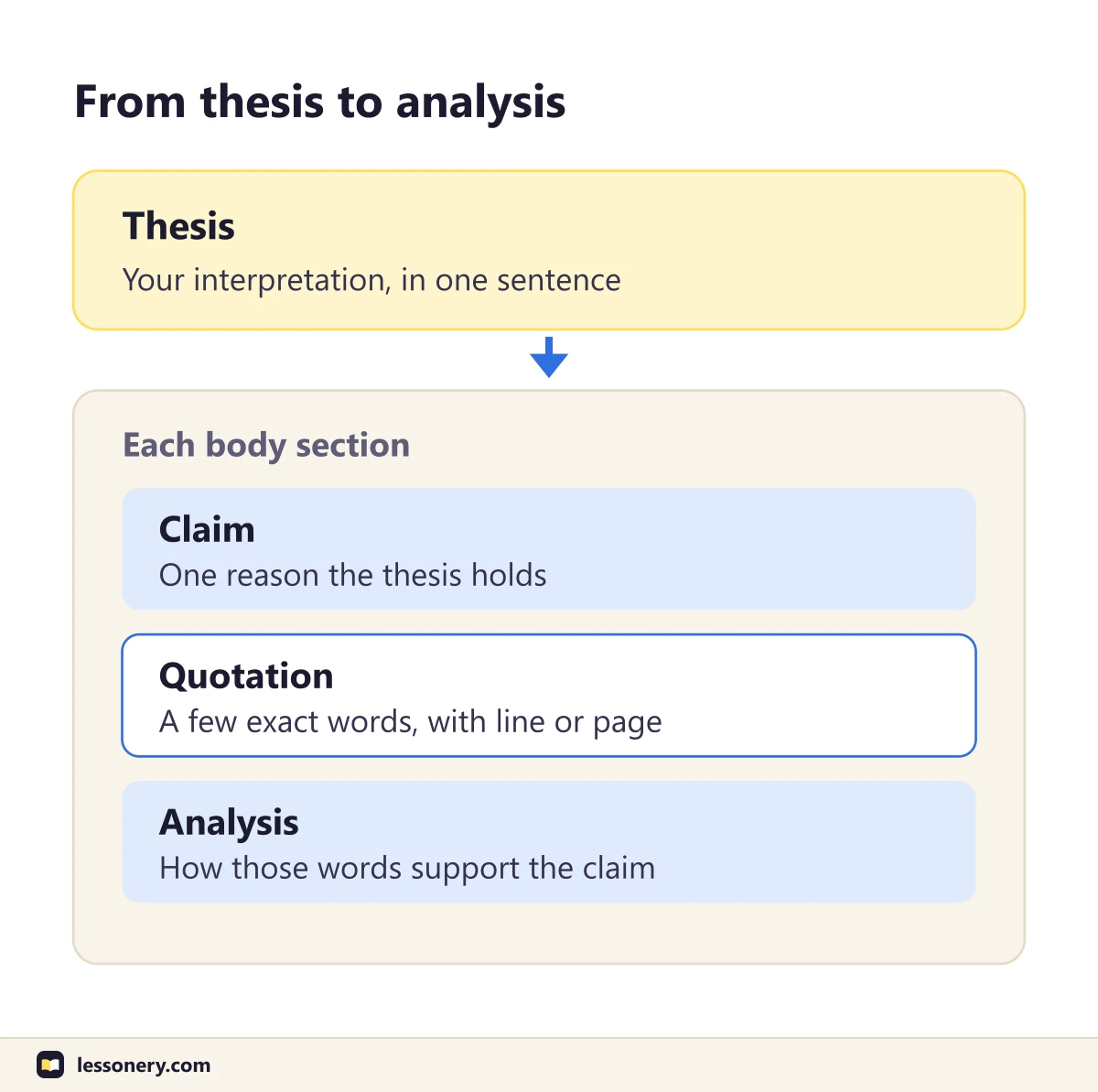
A literary analysis essay outline sets out an argument about a text. At the top is a thesis that interprets the work. Under it sit the claims that support the thesis, and under each claim the quotations that support it and a note on what each quotation shows.
The UNC Writing Center is blunt about that last level: quoting a passage without interpreting it does not demonstrate your reasoning. This page goes from a first question about a text to a finished outline, with an example on a public-domain poem.
Quick answer: Start with a question the text raises, such as a pattern or something that doesn't add up. Collect evidence, then answer the question in a working thesis that someone could disagree with. Group the evidence into claims. Under each claim, list a short quotation with its line or page number and a line of analysis that says how the words support the claim.
What a literary analysis has to do
A literary analysis is an argument, and its thesis has to be debatable. Purdue OWL's page on writing about literature gives a pair of examples. "Shakespeare's Hamlet is a play about a young man who seeks revenge" is a summary and is hardly debatable. Its stronger alternative gives a reason for Hamlet's internal conflict. The page calls that version debatable, even controversial, so the rest of the paper has to show how and why it holds.
The UNC Writing Center's handout on writing about literature sets three tests for a good interpretation:
- It avoids the obvious, meaning a conclusion most readers could reach on their own.
- It supports its main points with strong evidence from the text.
- It uses careful reasoning to explain how that evidence relates to the main points.
Those three tests map onto the outline. The thesis carries the first, the quotations the second, and the analysis lines the third.
What research and teaching guidance say
One small study taught students both to quote and to explain their quotations. Lewis and Ferretti (2011), in Contemporary Educational Psychology, taught six high school students to read literature through two of the lenses that literary scholars use. Three learned to look for one repeated pattern of symbolism and imagery that supports a theme, and three for opposing patterns. All six were then taught to build arguments from those patterns, to back them with direct quotations, and to write "tie-in sentences" that link each quotation to the argument.
According to the abstract, the instruction resulted in higher-quality argumentative essays that gave more textual evidence for the students' interpretations. The same abstract cites earlier research that high school students are generally unable to justify their literary interpretations. With six students, this is evidence that the skill can be taught, not a measure of how much any one outline will help.
A US Institute of Education Sciences practice guide, Teaching Secondary Students to Write Effectively, points the same way. Its recommendation to integrate writing and reading, which it rates as backed by moderate evidence, includes a sample rubric for an interpretive essay. Three of its items are a clear thesis presenting the writer's interpretation, plenty of evidence from the text, and commentary or analysis of the significance of that evidence. The rubric is a classroom example in the guide, not a tested standard.
From a question to a thesis and claims
1. Find a question in the text
The University of Virginia Writing Center's page on literary analysis suggests noting the moments that confused you or made you do a double take, and asking about repetitions, contradictions, irony, tone and imagery.
UNC sorts good starting points into two kinds. A pattern is the recurrence of certain imagery, vocabulary, formal elements or events. A problem is something that doesn't seem to add up, such as a character who acts in a way the text doesn't explain. Marking these as you read is covered in how to annotate a text.
2. Collect the evidence
List everything in the text that bears on your question. UNC's handout says to keep track of page numbers so you can find and cite each passage later, and for a poem the equivalent is the line number. It also advises choosing a topic with plenty of evidence and holding off on firm conclusions until you have looked at it.
3. Write a working thesis
Answer your question in one sentence. UNC's advice is not to spend long on it at this stage, because it will probably change. Virginia's checklist is short: the thesis makes a statement and does not ask a question, it names the topic of the paper, and it takes a stance.
Then test it with UNC's "so what?" question, and make it more specific if the answer is thin.
4. Select evidence and refine the thesis
UNC says these two are best done at the same time. Keep the details that bear most closely on the thesis and the ones you can say the most about. The handout's reasoning is that readers are more impressed by your interpretation of evidence than by a large number of quotations.
5. Group the evidence into claims
Put similar pieces of evidence together. In UNC's method, the idea that ties each cluster together becomes a claim, and every claim has to support the thesis. Then choose an order. UNC's own example runs chronologically, and the handout lists other options, such as ordering by character.
6. Add the analysis
For each quotation, write down what it shows. UNC's instruction is that every time you refer to the text, you explain the significance of that evidence in your own words.
The literary analysis essay outline, level by level
The general format for any essay plan is in writing an essay outline. A literary analysis uses the same levels with a fixed job for each.
| Level | What goes there | Check |
|---|---|---|
| Thesis | Your interpretation of the text, in one sentence | Could a reader disagree with it? (Purdue OWL) |
| Claim (I, II, III) | One reason the thesis holds | Does this section support the thesis? (Virginia) |
| Quotation (A, B) | A few exact words, with line or page number | Is it the detail you can say the most about? (UNC) |
| Analysis (1, 2) | How those words support the claim | Is the significance stated in your own words? (UNC) |
| Conclusion | The strongest evidence drawn together | Does it do more than restate the introduction? (Virginia) |
A filled-in example: "Ozymandias"
The literary analysis essay outline below is an example written for this article. The text is Percy Bysshe Shelley's 14-line poem "Ozymandias," published in 1818, quoted from Thomas Hutchinson's 1914 Oxford edition as reproduced by Project Gutenberg. Numbers in parentheses are line numbers. The thesis is one arguable reading offered as an illustration. It is not the accepted interpretation of the poem, and the poem supports others.
Question: The inscription tells the mighty to "despair" at the
king's works. What in the poem has actually lasted?

Working thesis: In "Ozymandias," the lasting achievement belongs
to the sculptor and not to the king: the king's works are gone,
while the sculptor's reading of him survives in the stone.

I. Introduction
   A. Context: a 14-line poem in which a speaker repeats a
      traveller's account of a ruined statue
   B. Thesis (above)

II. The king's own claim rests on works the poem shows are gone
   A. "Look on my works, ye Mighty, and despair!" (11)
      1. A command that assumes the works can still be seen
   B. "Nothing beside remains." (12)
      1. The next sentence answers the boast in three words
      2. The command now reads against the king's intention

III. What survives is the sculptor's work
   A. "its sculptor well those passions read / Which yet
      survive" (6-7)
      1. "Survive" is said of the passions as the sculptor
         carved them, not of the king or his kingdom
   B. "sneer of cold command" (5)
      1. The surviving portrait is unflattering: the art
         records the man, and does not praise him

IV. The telling keeps the king at a distance
   A. "I met a traveller from an antique land / Who said" (1-2)
      1. The speaker has not seen the statue
      2. The king's words reach the reader third-hand: carved,
         then reported, then repeated

V. Conclusion
   A. "The lone and level sands stretch far away." (14): the
      poem ends on the desert, not on the king
   B. So what: the poem separates power from what outlasts it
Three things to notice. Each Roman numeral in the body is a claim, not a topic such as "imagery." Each quotation is a few words long. And every quotation has at least one line beneath it that says what the words do, which is where the argument is made.
Quoting the text accurately
The UNC handout on quotations gives four guidelines that fit the "quotation" and "analysis" levels of the outline:
- Provide context for each quotation.
- Attribute each quotation to its source.
- Explain the significance of the quotation.
- Provide a citation for the quotation.
On length, its answer is to quote as few words as possible. It reserves block quotations for passages longer than four lines (some sources say five), and only when leaving words out would damage the passage.
Poems add a few conventions. In the UNC handout on poetry explications, the sample analysis marks a line break inside a quotation with a slash and gives line numbers in parentheses. The handout also advises writing in the present tense and referring to "the speaker," since the voice of a poem cannot be assumed to be the poet's own.
Watch out: Copy quotations from the edition you were assigned. Versions of older works can differ: the edition used here records a manuscript copy with different wording in line 9. The citation style is set by your instructor or institution.
If you bring in critics, Purdue OWL's page on literature topics and research says secondary sources are an aid and that your own thoughts should make up most of the essay. Their ideas need citing too, as how to paraphrase without plagiarizing explains.
Where these outlines go wrong
| Problem | What it looks like in the outline | Fix |
|---|---|---|
| Summary in place of argument | Headings follow the plot: "Chapter 1," "The ending" | Make each heading a claim. Purdue OWL's point is that a summary is not debatable |
| An obvious thesis | A statement most readers would accept at once | Narrow it. UNC says the effort to be more specific almost always leads to a thesis that gets the reader's attention |
| Quotations with nothing under them | A list of lines and page numbers | Add the analysis line (UNC, step 9) |
| Too many quotations | Five or six under one claim | Keep the ones you can say the most about (UNC, step 6) |
An outline that passes these checks is ready for the essay rough draft. Essays that set two texts side by side need one more decision, covered in the compare and contrast essay outline example.
Frequently asked questions
How many body paragraphs does a literary analysis need?
None of the sources cited here sets a number. In UNC's method the claims come from how the evidence clusters, so their number depends on the text and your thesis. If your assignment fixes the form, 5 paragraph essay structure explains it.
Is a poetry explication the same as a literary analysis essay?
Not quite. UNC describes an explication as a relatively short analysis of the possible meanings and relationships of a poem's words, images and other small units, and says it needs no formal introductory paragraph. Check which of the two your assignment asks for.
How much of the text should I quote?
As little as will support the point. UNC's quotations handout says your paper should consist mainly of your own words, and its literature handout warns against loading a paper with evidence that is not interpreted.