A compare and contrast essay outline example is easier to read once you know that the body can be arranged in two standard ways. The block structure says everything about the first subject and then everything about the second. The point-by-point structure takes one point of comparison at a time and discusses both subjects under it.
Below, the same material is outlined both ways. The advice on choosing between the two comes from the writing centers of the University of North Carolina at Chapel Hill (UNC) and the University of Toronto.
Quick answer: Settle the basis for comparison, list similarities and differences, and write a thesis that says which of them matter more. Then order the body as a block (all of subject A, then all of subject B) or point by point (A and B together under each point). Toronto's writing advice suggests point by point when the points about A and B are clearly related, and block when they are not, when B builds on A, or when there are three or more subjects.
What the outline has to settle
A comparison outline has two jobs that an ordinary essay outline does not: it fixes what the two subjects are being compared on, and it fixes the order in which the reader meets them.
The first is the basis for comparison. The University of Toronto's page on the comparative essay, written by Vikki Visvis and Jerry Plotnick, explains that the assignment may name it for you (its example is the figure of the gentleman in two novels) or may leave you to find a theme, concern or device that both subjects share.
The second is the structure, the subject of most of this page. The rest works as it does in any essay plan, which writing an essay outline covers step by step.
Toronto's page says that when an assignment says "compare," the assumption is that you will look at both similarities and differences. The UNC Writing Center's handout on comparing and contrasting notes that some topics ask for only one of the two, so read the prompt closely.
What research says about compare and contrast writing
The research found for this article is about how this kind of essay is taught, and none of it tests which structure is better.
Hammann and Stevens (2003), in the Journal of Literacy Research, cite earlier work for the claim that students find compare-contrast writing harder than other expository formats. Students were taught summarization skills, the compare-contrast text structure, or both, and then wrote an essay from two passages. According to the abstract, students taught the text structure scored significantly higher on structure, and lower on content, than the other groups. The authors recommend explicit teaching of the text structure. The abstract does not say how many students took part or how old they were.
MacArthur and Philippakos (2010), in Exceptional Children, taught six adolescents a strategy for planning, writing and evaluating these essays. Three had learning disabilities in writing and three were average writers. According to the abstract, all six made substantial gains in text structure and overall quality, and mean quality scores for individual students rose by between 1.2 and 3.2 points on a 6-point scale. The abstract adds that the gains in quality were maintained for two of the students. With six students, this shows that the strategy can be taught, not how large the benefit usually is.
The US Institute of Education Sciences (IES) practice guide Teaching Secondary Students to Write Effectively, written for teachers of grades 6 to 12, rates its first recommendation, explicitly teaching writing strategies, as backed by strong evidence. Among its sample planning strategies is a Venn diagram for a compare and contrast essay. The strong rating belongs to the recommendation as a whole, not to the diagram.
What follows about choosing a structure is therefore teaching advice from writing centers, not an experimental result.
Before the outline: basis, list, thesis
1. Choose what is worth comparing
Not every similarity belongs in the essay. UNC's handout suggests asking what is relevant to the assignment and the course, what is interesting and informative, and what is central enough that it must be mentioned. Its example: that two novels are printed in the same typeface matters in a class on typesetting and not in a literature class.
2. List similarities and differences
UNC describes two tools. A Venn diagram is a set of overlapping circles, with shared traits in the overlap and differences outside it. A chart lists your criteria down the left side and the items across the top.
Toronto's page is clear that this list is not yet your outline.
3. Weigh them in a thesis
Toronto's advice is to decide whether the similarities on the whole outweigh the differences or the reverse, and to write a thesis that reflects their relative weight. It adds that a more complex thesis will usually include both.
UNC warns against the thesis that only reports that two things are "similar in some ways and different in others." Its test is the question "So what?": the thesis should say why the comparison matters.
The two standard structures
The two sources use different names for the same pair. Toronto calls them the block method and the alternating method. UNC calls them subject-by-subject and point-by-point.
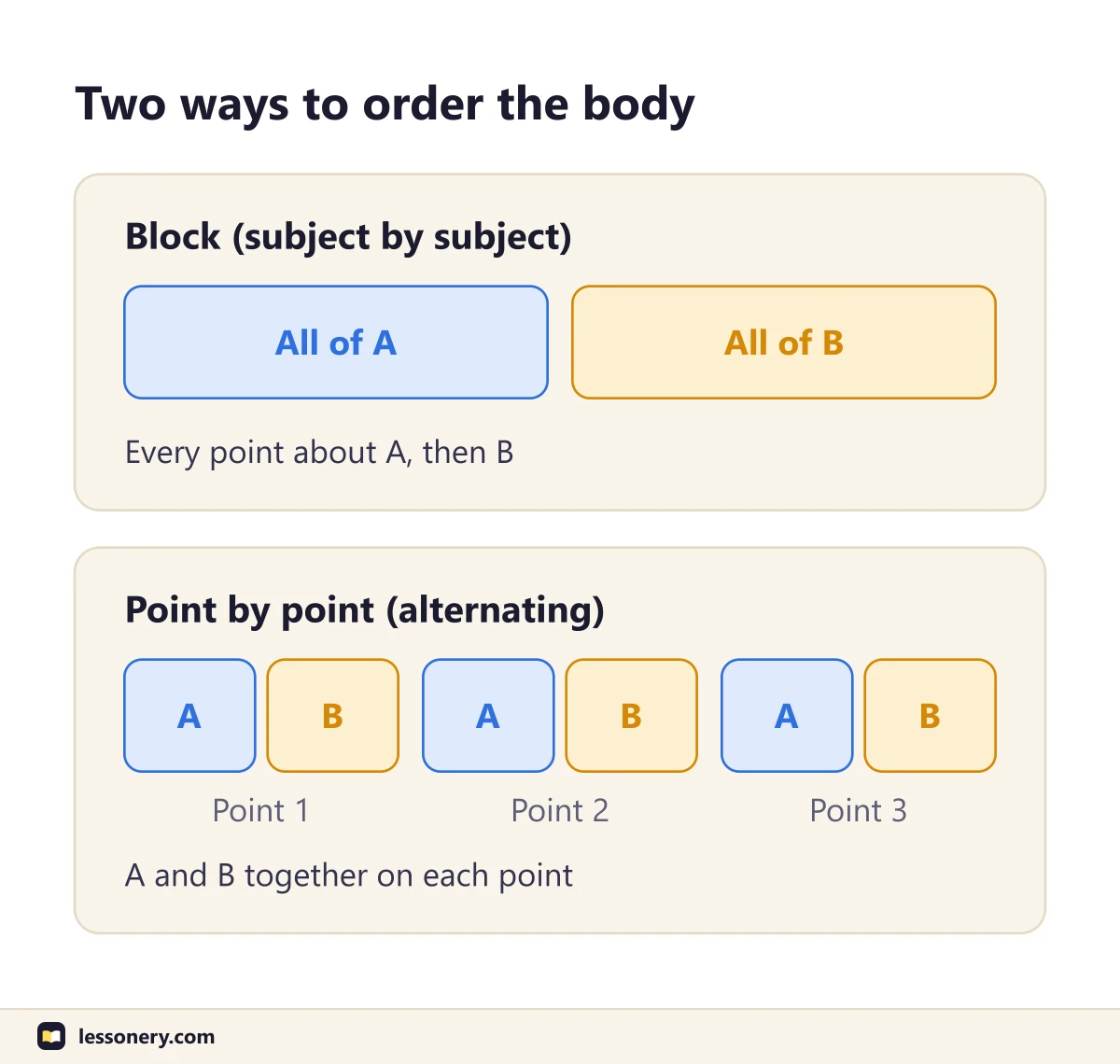
| Block (subject by subject) | Point by point (alternating) | |
|---|---|---|
| Order of the body | All of A, then all of B | Point 1 for A and B, then point 2, and so on |
| Fits when | The points about A and B are not closely related, your ideas about B build on A, or you have three or more subjects (Toronto) | You can identify clearly related points between A and B (Toronto) |
| Main risk | A list of points, or two separate essays under one introduction | Forced pairs of points that have little to do with each other |
Toronto's page says professors often like the alternating method because it generally does a better job of highlighting similarities and differences, and because it tends to produce a more tightly integrated, analytical paper. It also warns that imposing the method on points that are not clearly related will probably be counterproductive.
UNC's caution runs the other way. A subject-by-subject paper can become a list of traits that leaves the reader to work out the comparison, which the handout says is usually not what college instructors want. If you use it, UNC recommends a strongly analytical thesis and at least one body paragraph that ties the points together. It adds one case where the block order is a logical choice: a "lens" comparison, in which one subject is used mainly to understand the other.
Compare and contrast essay outline example: block structure
The compare and contrast essay outline example below was written for this article. Its subjects are two ways of going over a text, rereading and practice testing, and its evidence comes from two sources described elsewhere on this site: the review by Dunlosky and colleagues (2013) and the first experiment in Roediger and Karpicke (2006), in which 120 undergraduates studied short science passages. The thesis is an illustration of an arguable claim, not a research finding.
Question: How do rereading and practice testing compare as ways
to study a text for a test?

Basis for comparison: what each does for recall, and when

Working thesis: Rereading and practice testing both cost little,
but they differ on tests taken days later, so the date of the
test should decide which one gets most of the study time.

I. Introduction
   A. Context: two ways to go over a text you have already read
   B. Thesis (above)

II. Rereading (subject A)
   A. What you do: read the text again
   B. Cost: cheap (Dunlosky et al., 2013)
   C. Recall in Roediger and Karpicke (2006)
      1. Test after 5 minutes: 81% of the passage's ideas
      2. Test after 1 week: 42%
   D. Rating in the 2013 review: low utility

III. Practice testing (subject B)
   A. What you do: unlike rereading, recall the text from memory
   B. Cost: like rereading, little time and little training
   C. Recall in the same experiment
      1. After 5 minutes: 75%, behind rereading
      2. After 1 week: 56%, ahead of rereading
   D. Rating in the 2013 review: high utility

IV. What the two blocks show together
   A. Similarity: both are cheap, and both improve recall
   B. Difference: the order reverses between 5 minutes and 1 week
   C. Limit: one experiment with short science passages

V. Conclusion
   A. Return to the thesis: the timing of the test decides
   B. So what: a test next week favors self-testing
Two features hold the halves together. Section III keeps pointing back to section II ("unlike rereading," "like rereading"), which is Toronto's advice for the second block. Section IV is the paragraph UNC asks for, the one that ties the points together.
The two methods are explained in the active recall method and the most effective study techniques.
The same example in point-by-point structure
This second compare and contrast essay outline example uses the same question, thesis and evidence. Only the order of the body changes.
I. Introduction (as in the block outline)

II. Point 1: what the student does
   A. Rereading: read the text again
   B. Practice testing: recall the text from memory

III. Point 2: what it costs
   A. Rereading: cheap
   B. Practice testing: also little time and little training

IV. Point 3: recall in Roediger and Karpicke (2006)
   A. After 5 minutes: rereading 81%, practice testing 75%
   B. After 1 week: rereading 42%, practice testing 56%

V. Point 4: rating in Dunlosky et al. (2013)
   A. Rereading: low utility
   B. Practice testing: high utility

VI. Conclusion (as in the block outline)
UNC describes two ways to draft from an outline like this. With little to say, one paragraph covers a point for both subjects. With more to say, each subject gets its own paragraph on that point.
The order of the points is deliberate. UNC's handout notes that the last point you make is the one you leave the reader with, and that if the differences matter most, you should end with them. Here the similarity (cost) comes early, and the differences in results and ratings come last.
In a real essay, every figure needs its source. How to paraphrase without plagiarizing covers citing what you take from a study.
Where comparison outlines go wrong
Each problem below is one that UNC or Toronto warns about, and each can be checked in the outline.
| Problem | Fix | Source of the advice |
|---|---|---|
| A thesis that says only "similar in some ways and different in others" | Name the similarities and differences and answer "So what?" | UNC |
| Two unconnected halves | Make the second block refer back to the first: "Unlike A, B…" | Toronto |
| A list of traits with no direct comparison | Add a section that ties the points together | UNC |
| The final point works against your argument | End on the point you want the reader to keep | UNC |
UNC's list of signal words includes like, similarly, unlike, in contrast, however and although. Its sample topic sentences, written about two pizza restaurants, put the cue first: "Compared to Pepper's, Amante is quiet."
Once the outline holds together, the next stage is the essay rough draft.
Frequently asked questions
Is block or point by point better?
Neither source names a winner. Toronto's page says professors often like the alternating (point-by-point) method, and it lists three cases where the block method is particularly useful. UNC says there are no hard and fast rules. If your assignment specifies a structure, use that one.
How many points of comparison do I need?
Toronto's example uses three and says you may include more. The outlines on this page use four.
Does a compare and contrast essay have to be five paragraphs?
Neither writing center ties the essay to a set number of paragraphs, and Toronto lets the subject matter decide the number of points. 5 paragraph essay structure explains when that fixed form fits.