Homework time management comes down to four decisions made before you open a book: how long each task should take, what order to do them in, when you start, and when you pause. This article is written for school students, and for parents helping them.
Studies in several countries link homework with achievement, mostly for older students, but more minutes are not reliably better. How you use the time is the part you control.
Quick answer: List tonight's tasks with an estimate in minutes, put the task that needs most concentration early, begin at the same time each school day, and plan short breaks between tasks. Write down how long each task really took and use that for the next estimate.
What research found about homework time and achievement
United States: stronger link for older students
The starting point is a review by Cooper, Robinson and Patall (2006), who summarized research done in the United States from 1987 to 2003. They found six studies in which homework was deliberately given to some students or classes and not to others. All six showed a positive effect of homework on unit tests, with effect sizes from d = .39 to d = .97. The classes ranged from second grade to high school. The authors point out that none of the six was published, and that their design flaws make it difficult to draw strong conclusions about cause.
A larger group of studies simply correlated time spent on homework with achievement. Here age mattered. For secondary students (US Grades 7 to 12) the average correlation was .20 to .25, depending on the statistical model. For elementary students (kindergarten to Grade 6) it was close to zero: −.04 in one model and .05 in the other. Correlations of this kind cannot establish cause, as the review says of such studies. Its overall reading is that the evidence for a positive influence of homework on achievement was generally consistent, although every study had design flaws.
On how much is enough, the authors found only one newer study, of US twelfth-graders, in which the link was strongest for students reporting 7 to 12 hours of homework a week. From it they suggest the optimum for high school students "might lie between" 1.5 and 2.5 hours. The passage gives no unit, but 7 to 12 hours spread over five school nights works out to about 1.4 to 2.4 hours a night. The suggestion assumes that more homework leads to better achievement and not the other way round, and the authors add that "there is still much guesswork in these estimates." Their conclusion is that the benefits are not linear and that too much homework may reduce its effectiveness.
15-year-olds in the OECD's PISA survey
PISA is the OECD's international assessment of 15-year-olds. In 2012 students also reported their homework time, and an OECD summary, Does Homework Perpetuate Inequities in Education?, gives the results.
| Group of 15-year-olds, PISA 2012 | Reported homework time a week |
|---|---|
| Average across OECD countries | Almost 5 hours |
| Finland and Korea | Less than 3 hours |
| Ireland, Italy, Kazakhstan, Romania, Russian Federation, Singapore | 7 hours or more |
| Shanghai-China | 14 hours |
Students who spent more time on homework tended to score higher in PISA, and so did their schools. But the average homework time in a country tended to be unrelated to how well its school system performed overall. The summary adds that evidence from PISA 2009 suggests that after around four hours a week, extra homework time has a negligible impact on performance.
Spain: time above the class average
Fernández-Alonso and colleagues (2017) analyzed a representative sample of 26,543 Spanish students in Year 8, with a mean age of 14.4. Schools whose students did more homework had higher test results. Within a class the relationship reversed: the model predicted lower results for students who spent more time than their class average. The authors suggest 60 to 70 minutes a day for that school year, and state that their models are correlational, so they show an association only.
Cooper's review offers one reason a student might spend longer and score lower: an earlier study it cites found some evidence that young pupils who were struggling at school took more time over their homework.
An evidence summary from England: quality over quantity
The Education Endowment Foundation, an education charity registered in England, pools 43 studies in its evidence summary on homework. The page does not list the countries the studies come from. It reports a positive average impact that is larger in secondary schools (+5 months of progress) than in primary schools (+3 months), and rates the security of that evidence as low. It also says the quality of the task appears to matter more than the quantity, and that there is some evidence the impact diminishes as the time pupils spend increases.
Managing the time, not just spending it
One study looked at time management itself. Xu (2010) surveyed 1,895 secondary school students in 111 classes. The abstract does not name the country. According to it, students who managed homework time better also reported higher grades and more initiative in arranging where they worked. Both were self-reported, so this is an association.
How much homework time is expected
Guidelines differ, and your school's policy is the one that applies to you.
- A US Department of Education booklet for parents, Helping Your Child with Homework (2005), reports that national parent and teacher organizations suggest 10 to 20 minutes each school day from kindergarten to second grade and 30 to 60 minutes from third to sixth grade. For seventh to ninth grade it says only that students can benefit from more, and that the amount may vary from night to night.
- When Duke University announced the 2006 review, Cooper said its findings were consistent with the "10-minute rule": about 10 minutes per grade level each night, which gives roughly 40 minutes in fourth grade and two hours in the last year of high school.
- In Australia, the New South Wales Department of Education's homework advice for schools sets no minutes. It asks secondary schools to keep workloads manageable across subjects and notes that weekly homework may suit students with extracurricular commitments better than daily tasks.
Homework time management in four steps
1. List the tasks and estimate each one
Write every task for tonight with a number of minutes beside it. For a large assignment, the US Department of Education booklet suggests listing the steps (choose a topic, research, outline, draft, revise) and charting the time you expect each step to take.
Estimates can miss in both directions. Brady, Wolters and Yu (2022) asked 210 undergraduates at a US university to predict the minutes for one study task and report the real time later: 47.1% underestimated, 31.9% overestimated and 21% were exactly right. Those were university students, not school pupils. Either way, a record helps: write down what each task took and estimate from that next time.
2. Decide the order before you begin
None of the sources cited here prescribes a single order. Ohio Wesleyan University's academic skills center describes two workable ones: start with the task you like least and follow it with something more enjoyable, or start with an enjoyable task to build momentum. Its firmer advice is to do the most demanding work when you have the most energy, and to rank tasks by due date and effort.
Applied to an ordinary evening, that reasoning puts a task that is due tomorrow and needs concentration first, and short review tasks last.
3. Fix a start time
A regular time removes the nightly decision. The US Department of Education booklet says a regular homework time helps children finish assignments, that the best schedule is whichever works for the child and family, and that homework should not be left until just before bedtime. If sport or music takes some afternoons, it suggests a flexible version: after school on some days and after dinner on others.
A set time works like an if-then plan ("if it is 5:00 p.m., then I am at the table with the math sheet"). Gollwitzer and Sheeran (2006) pooled 94 independent tests of such plans and found a medium-to-large positive effect on reaching goals (d = .65), across many kinds of goals. If the plan exists and starting is still the hard part, see how to beat procrastination.
4. Plan the breaks
Put breaks between tasks so they have an end. A meta-analysis by Albulescu and colleagues (2022) of breaks of 10 minutes or less pooled 22 samples with 2,335 participants, 11 of them student samples. Breaks produced a small increase in vigor (d = .36) and a small reduction in fatigue (d = .35). The effect on performance was not statistically significant.
Timed work periods are explained in the guide to the Pomodoro Technique for students. The booklet's advice on the room is short: turn off the TV and keep social calls out of homework time. Phones are covered in how to not get distracted while studying.
A filled-in example: one evening of homework
This evening was made up for this article to show homework time management on paper. The subjects, tasks and minutes are an illustration to adapt, not a standard.
| Time | Task | Estimate | Time taken |
|---|---|---|---|
| 5:00–5:30 p.m. | Math: 12 equations, due tomorrow | 30 min | 40 min |
| 5:30–5:35 p.m. | Break | 5 min | |
| 5:35–6:00 p.m. | Science: read 6 pages, answer 4 questions, due tomorrow | 25 min | 20 min |
| 6:00–6:10 p.m. | Break | 10 min | |
| 6:10–6:30 p.m. | History project, due in two weeks: find two sources | 20 min | 20 min |
| 6:30–6:40 p.m. | Vocabulary self-quiz for Friday | 10 min | 10 min |
| Total | 85 min of work, 15 min of breaks | 90 min of work |
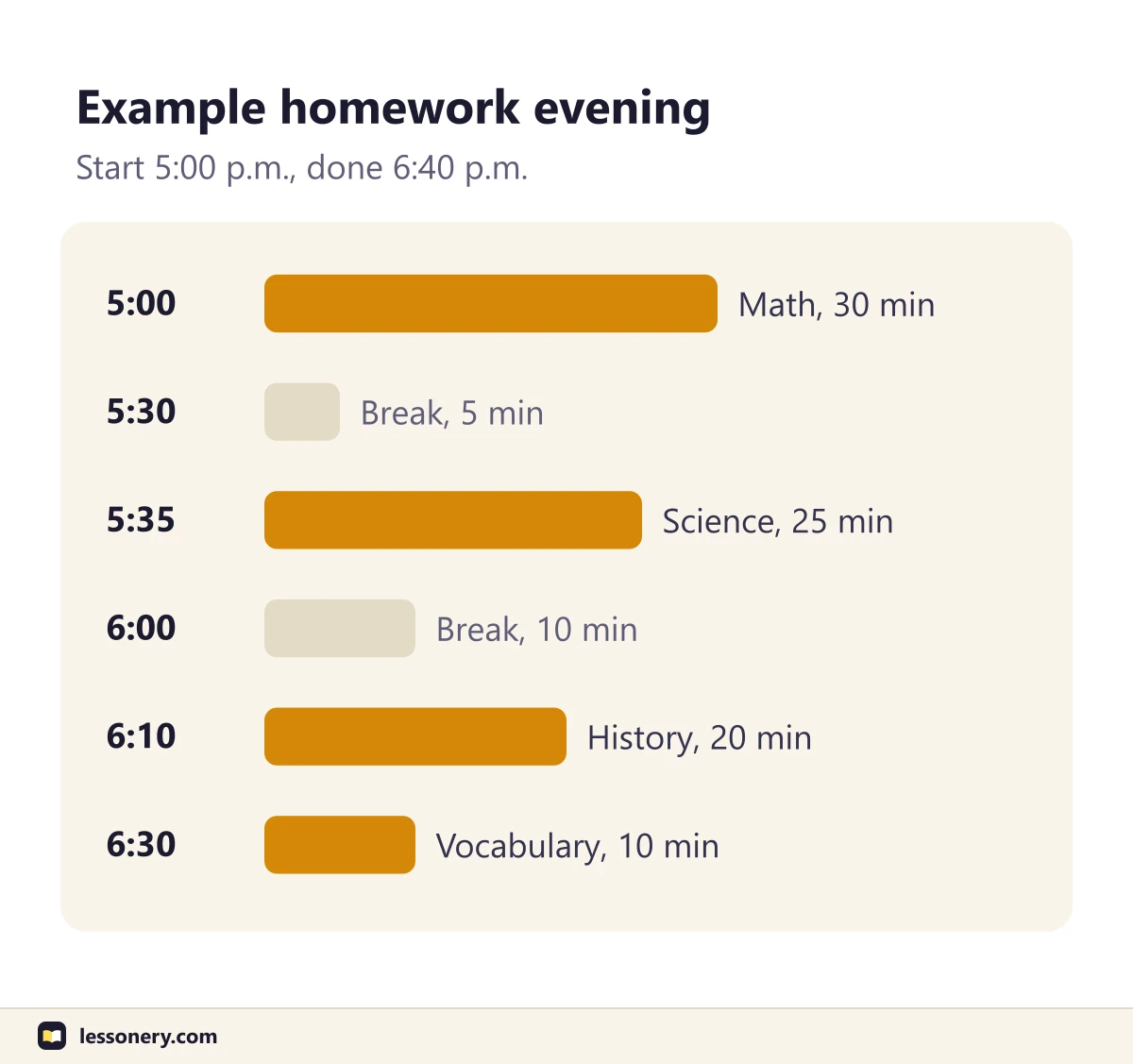
The plan runs 100 minutes, from 5:00 to 6:40 p.m. The hardest task with the nearest deadline is first, and the project gets one small step instead of waiting for its due date. Math overran by 10 minutes and science finished 5 minutes early, so the work took 90 minutes. The next math sheet gets 40 minutes in the plan.
When homework still takes too long
| Problem | What the guidance suggests | Source |
|---|---|---|
| Assignments are too hard, or there is too much | Talk with the teacher | US Department of Education |
| Nothing on some nights, four tasks on another | Raise the uneven load with the teacher | US Department of Education |
| No quiet place at home | Use a library or a school homework club | US Department of Education, EEF |
| Sport or music on some days | Use a flexible schedule | US Department of Education |
| You don't understand the instructions | Ask a classmate or the teacher | US Department of Education |
The OECD summary notes that disadvantaged students may not have a quiet place to study at home, and suggests that schools provide one. Good homework time management also cannot fix a load that is too large. If homework regularly cuts into sleep or causes a lot of stress, talk to a parent, a teacher or a school counselor.
Older students planning a full term can use these time management tips for students, and the task list and timer used here are described with other tool types in time management tools for students.
Frequently asked questions
How much homework time is normal?
It varies widely. In PISA 2012, 15-year-olds across OECD countries reported almost 5 hours a week on average, with less than 3 hours in Finland and Korea and 14 hours in Shanghai-China. Your own school's policy is the relevant guide.
Is more homework time better?
Not reliably. Cooper and colleagues found a positive link for secondary students and almost none for elementary students, and suggested that too much may reduce the benefit. The OECD summary reports a negligible gain beyond about four hours a week, and the Spanish study found lower results for students who spent more time than their class average.
What is the 10-minute rule?
It is a rule of thumb of about 10 minutes of homework per grade level each night. Duke University's announcement of the 2006 review describes it as a common practice among teachers, and Harris Cooper said the review's findings were consistent with it.
How do I stay focused during homework?
Planning decides what you do and when. Staying on the task is a separate skill, covered in the guide on how to stay focused while studying.