The time management tips for students in this article come from university learning centers, and they are plain ones: put every deadline of the term on one calendar, spend a few minutes each week placing tasks into free slots, pick one to three priorities each day, and assume a big task will take longer than you first think.
Studies link time management to somewhat higher grades, better wellbeing and less distress. The link with grades is modest, so the numbers below are given as the researchers reported them.
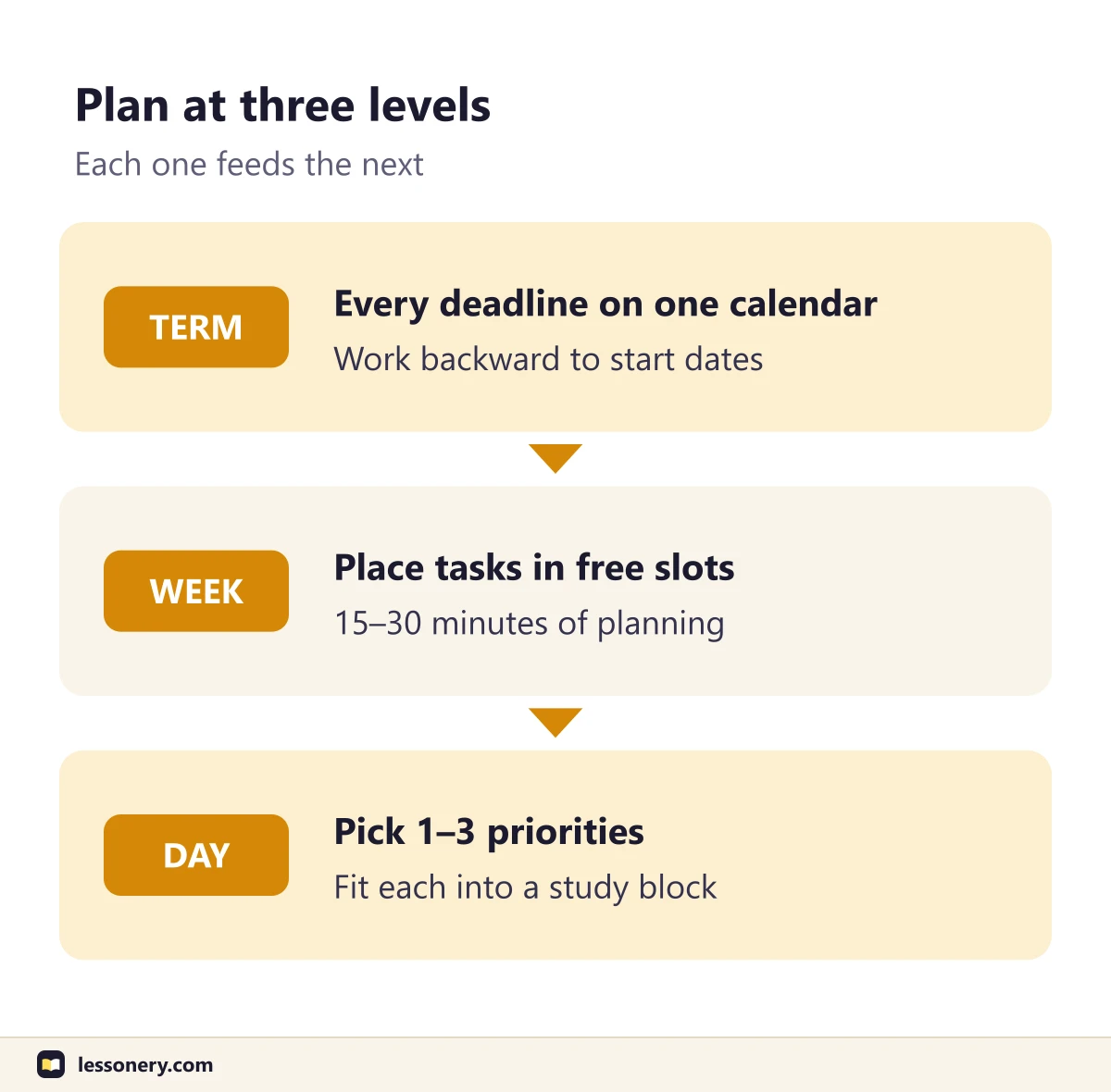
Quick answer: Plan at three levels. Term: enter all exams and due dates on one calendar and work backward to start dates. Week: take 15 to 30 minutes to fit tasks around fixed commitments. Day: choose one to three priorities. A 2021 meta-analysis found time management moderately related to academic achievement (r = .262) and to wellbeing.
What studies of time management and grades found
Two early studies used questionnaires with college students. Macan and colleagues (1990) asked 123 undergraduates to rate their own time management and compared the answers with the students' self-reported academic performance and with measures of stress. The ERIC summary of the paper reports that time management had several dimensions and was meaningfully related to both performance and stress. Performance in that study was the students' own report, not their recorded grades.
Britton and Tesser (1991) used recorded grades. Ninety college students completed a time-management questionnaire in 1983. Four years later, the researchers compared the answers with each student's cumulative grade point average (GPA, the running average of course grades used in the United States). In the words of the ERIC summary, the comparison indicated that time-management practices "may influence achievement", and time management predicted GPA better than scores on the SAT, a US admission test.
The broadest picture comes from Aeon, Faber and Panaccio (2021), a meta-analysis (a study that pools the results of earlier studies) of 158 studies with 53,957 participants. The table shows its results for students. A correlation (r) of 0 means no relationship and 1 a perfect one.
| Outcome | Studies pooled | Correlation with time management (r) |
|---|---|---|
| Academic achievement, all measures | 76 | .262 |
| Grade point average | 57 | .213 |
| Standardized test scores | 7 | .011 (about zero) |
| Less procrastination | 14 | .490 |
| Overall wellbeing | 30 | .313 |
| Overall distress | 58 | −.222 |
Three things follow from that table. Time management goes with better course grades, but not strongly. It showed no relationship with standardized test scores. And its links with wellbeing and with less procrastination were stronger than its link with grades. The authors suggest time management may improve wellbeing more than performance.
Watch out: The authors note that most of these studies measured time management and grades at one point in time. That shows the two go together. It does not show that planning caused the grades.
Time management tips for students at three levels
The time management tips for students below are grouped by level: the term, the week and the day. Each level feeds the next. The structure comes from university learning centers, whose pages are linked in each step.
Term: put every deadline on one calendar
At the start of term, go through each course outline and enter all exams, papers, projects, events and travel on a single calendar. That is the first step in the University of North Carolina Learning Center's guide to calendars. Its second step is to work backward from each due date: for a paper, mark when the research, the draft and the finished first draft need to be done.
UNSW Sydney's academic skills page describes the same thing visually: draw a line back from each due date to its start date, and start earlier than usual when several assessments are due together. Cornell's Learning Strategies Center calls those clusters "crunch" times and suggests using the term calendar to spot them in advance.
Week: place tasks into free slots
Set aside 15 to 30 minutes at a regular time each week to plan, as UNC's guide suggests. In that session:
- Mark fixed commitments such as classes, work, sport and chores.
- For each course, list the week's tasks and estimate the time each needs.
- Place the tasks in the open slots and leave buffer time.
How to turn this into a repeating timetable, with a filled-in example week, is covered in the guide to a weekly study schedule.
Day: pick one to three priorities
Each day, check the week's plan and set one to three priorities, then divide each one into small goals that fit inside a study block. That is the method on the University of Toronto Scarborough's page on creating a daily schedule. A goal such as "write the methods paragraph" fits a block. "Work on report" doesn't tell you when you are done.
Estimate how long tasks will take
People tend to underestimate how long their own projects will take, a bias researchers call the planning fallacy. In the first study of Buehler, Griffin and Ross (1994), 37 psychology students at the University of Waterloo in Canada predicted when they would submit their honors thesis, a final-year research project. On average they predicted 33.9 days and took 55.5. Only 29.7% finished by the date they had predicted.
Asking for a pessimistic guess helped only partly. When the same students predicted their finish date "if everything went as poorly as it possibly could", the average was 48.6 days. The gap to the 55.5 days they took was no longer statistically significant, but fewer than half (48.7%) finished by that date.
What helped, in the paper's fourth study, was memory. Students predicting when they would finish a computer assignment no longer showed the optimistic bias when they were told to recall similar past tasks and connect them with their prediction.
Short tasks look different. Brady, Wolters and Yu (2022) asked 210 undergraduates at a US university to predict the minutes needed for one study task they could finish in a single sitting, then report the real time a week later. 47.1% underestimated, 31.9% overestimated and 21% were exactly right. For a single reading or problem set, the error can go either way.
Three practical moves follow:
- Use your own record. Write down how long tasks took, and base the next estimate on that record. This is a way to apply the finding of Buehler's fourth study.
- Pad the big projects. Cornell's Learning Strategies Center advises estimating realistically and then doubling the figure. That is the center's rule of thumb, not a research result.
- Sort tasks by size. UNSW groups tasks as short (under 1 hour), medium (1 to 2 hours) and long (2 hours or more), and suggests picking a task that fits the time you have.
Decide what comes first
When the list is longer than the day, sort it by urgency and importance. The University of Waterloo's Student Success Office uses a four-box priority matrix. Urgent tasks need attention immediately and have consequences if ignored. Important tasks move you toward your long-term goals.
| Important | Not important | |
|---|---|---|
| Urgent | Do immediately (test tomorrow, assignment due tomorrow) | Reschedule or delegate (phone calls, laundry) |
| Not urgent | Schedule it (study and review time, projects with time to spare, physical activity) | Do it later, in free time (social media, video games) |
The worksheet warns that spending too much time in the urgent-and-important box can cause burnout. Read that way, the box below it is where planning pays off: review time and early project work get scheduled before they turn urgent.
A filled-in example: one report at three levels
This example was written for this article to show how the levels connect. The course, tasks and times are made up. Adapt them to your own timetable.
Term level. A 2,000-word report is due on Friday of week 8. Working backward: edit in week 8, draft in week 7, outline and finish reading in week 6, choose the topic in week 5.
Week level (week 6). Each first estimate is doubled, following Cornell's rule of thumb.
| Task | First estimate | Planned time | Slot |
|---|---|---|---|
| Read two articles and take notes | 1.5 hours | 3 hours | Monday and Tuesday, 2:00–3:30 p.m. |
| Write the outline | 1 hour | 2 hours | Thursday, 10:00 a.m.–12:00 p.m. |
| Statistics problem set (another course) | 1 hour | 2 hours | Wednesday, 2:00–4:00 p.m. |
| Total | 3.5 hours | 7 hours |
Day level (Thursday). Three priorities: write the report outline, review Tuesday's lecture notes for 30 minutes, email the tutor one question about the report.
Afterward. The outline took 1 hour 40 minutes. That goes in the record, and the next outline gets 1 hour 40 minutes as its first estimate.
Where time management tips fall short
No set of time management tips for students leads to a particular grade. In the 2021 meta-analysis, the correlation with GPA was .213, and it was about zero for standardized tests.
A plan also doesn't make you start. If the tasks are on the calendar and still not getting done, the problem may be procrastination, which has its own research and its own steps: see how to beat procrastination.
Some weeks no schedule can fit. UNSW's page tells students not to overcommit and to review paid work, family, sport and volunteer commitments when study time runs out. If your workload stays unmanageable or the stress is getting to you, speak to an academic advisor, a counselor or your school's student support service.
Frequently asked questions
How many hours a week should a student study?
It depends on your institution. Stanford's advising office says one unit of credit means about three hours of work a week, one in class and two outside, so 15 units is about 45 hours. Cornell's Learning Strategies Center suggests 2 to 3 hours outside class for every hour in class. These are two US universities' rules of thumb, so check your own course handbook.
Does time management improve grades?
The studies show an association, not a guarantee. Aeon and colleagues found a moderate correlation with academic achievement (r = .262 across 76 studies), and most of those studies could not show cause and effect. Britton and Tesser's study of 90 students found that a time-management questionnaire predicted cumulative GPA four years later.
What is the planning fallacy?
It is the tendency to underestimate how long your own tasks will take. In Buehler, Griffin and Ross's 1994 study, thesis students predicted 33.9 days on average and took 55.5.
Is a paper planner or a calendar app better?
None of the studies described here compared them. UNC's guide lists a wall calendar, a paper planner and an online calendar as options, and notes that online calendars can repeat events and send reminders. It also advises keeping whichever you use with you. Planning around exams is covered separately in the guide on how to create a study schedule.