The most effective study techniques, according to a detailed research review of ten of them, are practice testing and distributed practice: testing yourself on the material and spreading your study over time. Dunlosky and colleagues (2013) examined ten techniques and gave only those two their top rating.
Rereading and highlighting, which the review says students most often report using, were rated low. Below are all ten ratings and the reasons for each, along with the recommendations of a US practice guide and a later meta-analysis that checked the ratings.
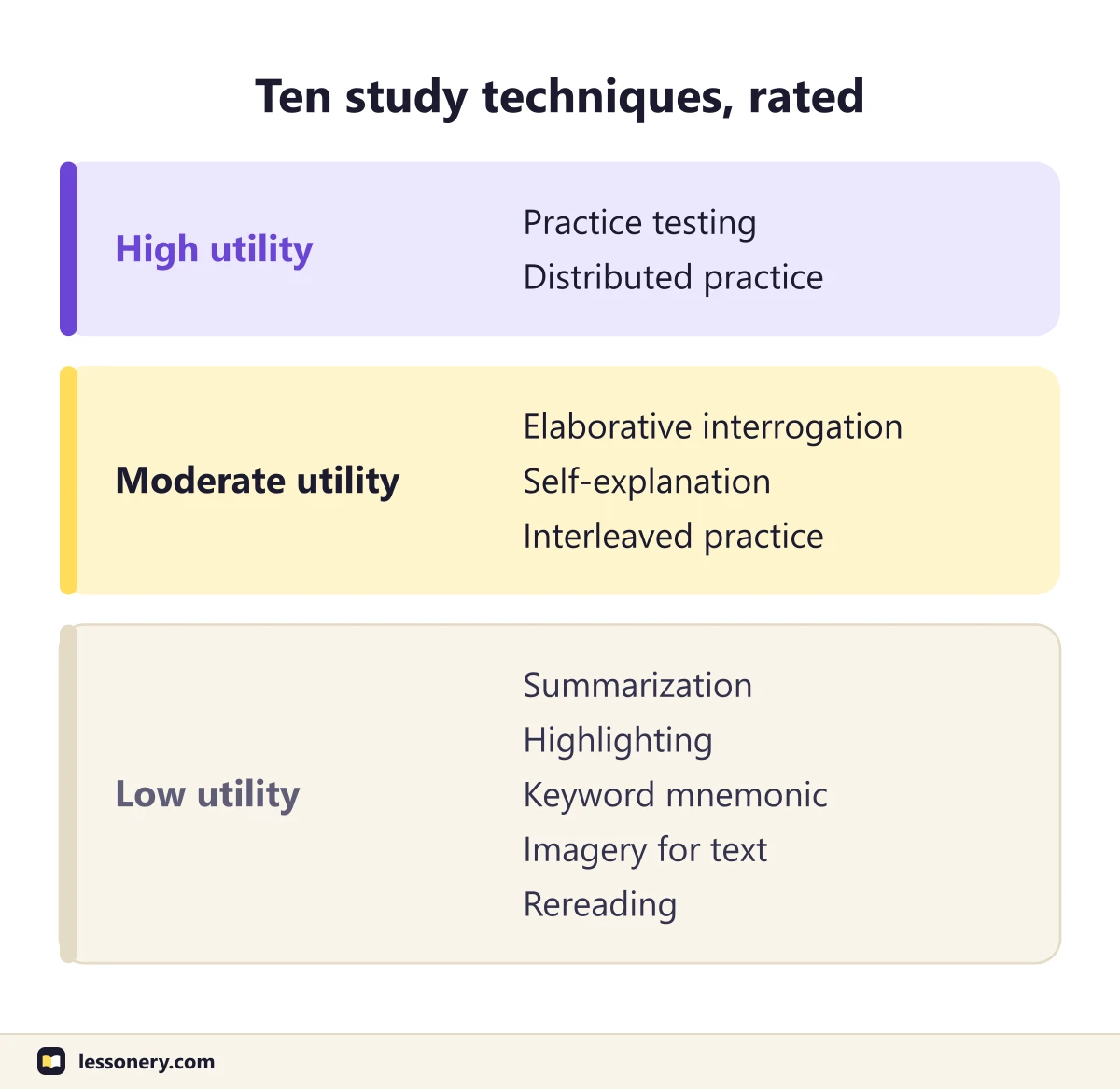
Quick answer: Dunlosky et al. (2013) rated practice testing and distributed practice as high utility; elaborative interrogation, self-explanation and interleaved practice as moderate; and summarization, highlighting, the keyword mnemonic, imagery for text and rereading as low. "Low utility" means limited reach or limited evidence, not that a technique never helps.
Where the ratings come from
The main source is a monograph by Dunlosky, Rawson, Marsh, Nathan and Willingham (2013), published in Psychological Science in the Public Interest. The authors chose ten techniques that students can use on their own, some because early evidence looked promising and some, such as rereading and highlighting, because students rely on them heavily.
Each technique was judged on how far its benefits generalize across four things: learning conditions, student characteristics, materials, and criterion tasks (the kind of test used to measure learning). The authors also weighed evidence from real classrooms and how hard the technique is to put into practice. The result is a rating of high, moderate or low utility.
Utility is about reach. The authors write that a technique could be rated low because its effects are limited to a small subset of materials, or because it showed promise but lacked enough evidence for a higher rating.
The second source is the US Institute of Education Sciences (IES) practice guide Organizing Instruction and Study to Improve Student Learning, written by a panel chaired by Harold Pashler and released in 2007. It makes seven recommendations and grades the evidence behind each as strong, moderate or low. It is addressed to teachers, but several recommendations describe things a student can do alone.
The most effective study techniques: the two rated high
Practice testing
Practice testing means low-stakes or no-stakes testing done as a way of learning: recalling answers from flashcards, working the questions at the end of a chapter, taking practice tests.
Dunlosky and colleagues rated it high because testing effects have been shown across many test formats, kinds of material, learner ages, outcome measures and delays. They add that it takes little time and little training, and that several studies support it in real educational settings.
The IES guide reaches the same place by another route. Its recommendation to use quizzes to re-expose students to material is one of two it grades as having strong evidence. In the full text of the guide, the panel writes that taking a test is almost always a more potent learning device than spending additional time studying the material.
The steps are in the guide to the active recall method.
Distributed practice
Distributed practice is a schedule that spreads study of the same material over time instead of massing it into one block. Dunlosky and colleagues rated it high because it works across students of different ages, with a wide variety of materials, on most standard laboratory measures and over long delays.
They are specific about cramming. Massed study can help on an immediate test, and they call it better than not studying at all in the short term. The distributed-practice effect is often stronger on delayed tests.
The IES guide grades "space learning over time" as moderate evidence. One classroom study it describes involved eighth graders (around age 13 to 14) in a US history class. A review given 16 weeks after the first lesson, compared with a review after 1 week, produced an almost 100 percent increase in performance on a test taken 9 months after the review.
How to set the gaps is covered in the spaced repetition schedule guide.
Moderate utility: three techniques that show promise
Elaborative interrogation means generating an explanation for why a stated fact is true, with prompts such as "Why is this true?" The review found effects across a broad range of factual topics and in learners at least as young as upper elementary age. The authors held back a high rating because the effects were firmly established mainly on memory tests after short delays, may be limited for learners who know little about the topic, and had not been tested enough in classrooms.
Self-explanation means explaining how new information relates to what you already know, or explaining each step as you solve a problem. Effects have been shown across task domains, a wide age range, and measures of memory, comprehension and transfer. The open questions are how long the effects last, how they hold up in classrooms, and the time the technique takes. The Feynman study technique is a related explain-it-yourself routine.
Interleaved practice means mixing different kinds of problems within a session instead of finishing one kind before starting the next. In Rohrer and Taylor (2007), as the review describes it, college students learned to compute the volumes of four kinds of solids. Students who practiced in blocks did better during practice, but on a test one week after the second session, interleaving boosted accuracy by 43%. The rating stayed at moderate because the literature was small and contained enough null effects to raise concern. Classroom evidence has grown since: in a randomized trial by Rohrer, Dedrick, Hartwig and Cheung (2020), 54 seventh-grade mathematics classes (students around age 12 to 13) did interleaved or blocked assignments over 4 months, and on an unannounced test a month later the interleaved group scored 61% against 38%.
The IES guide is more confident about explanation. Its recommendation to ask deep explanatory questions, such as why, how, what-if and how X compares to Y, is the other one graded as strong evidence. The two documents used different criteria, so the grades are not directly comparable.
The guide also covers ground the review did not. It recommends alternating worked examples with problems you solve yourself, combining graphics with verbal descriptions, and connecting abstract and concrete versions of a concept, each graded as moderate evidence. Its advice on checking what you know after a delay is graded low, a level the guide's web page labels "minimal".
Low utility: five techniques and the reasons given
- Summarization. It can work for learners already skilled at summarizing, but many learners would need extensive training, and findings on which tasks it helps were mixed.
- Highlighting and underlining. In most situations studied, highlighting did little to boost performance. In one experiment the review describes (Fowler and Barker, 1974), undergraduates read about 8,000 words of articles and were tested a week later; the highlighting groups did not outperform a group that only read.
- Keyword mnemonic. It helps with material that is easy to picture, but the review found it hard to apply elsewhere and noted it may not produce durable learning. More detail is in the article on memorization techniques for studying.
- Imagery for text. Forming mental images while reading helped mainly with imagery-friendly texts and on memory tests.
- Rereading. It is cheap and does improve recall, mostly in studies with undergraduates. The authors rated it low mainly because it is typically much less effective than the alternatives.
Note: The review does not treat the low-rated techniques as generally harmful. Of highlighting, for example, it says the technique as typically used is not normally detrimental to learning, and that the problem arises when it keeps students from more productive strategies.
All ten ratings in one table
| Technique | What you do | Rating | Main reason given |
|---|---|---|---|
| Practice testing | Test yourself on the material | High | Works across formats, materials, ages and delays |
| Distributed practice | Spread study over time | High | Works across ages and materials, over long delays |
| Elaborative interrogation | Explain why a fact is true | Moderate | Promising, but little evidence on long delays or classrooms |
| Self-explanation | Explain new ideas or your solution steps | Moderate | Broad effects; durability and time cost unclear |
| Interleaved practice | Mix problem types in a session | Moderate | Strong for math skills; small literature with null results |
| Summarization | Write summaries of texts | Low | Needs training; mixed results |
| Highlighting | Mark text while reading | Low | Little benefit in most studies |
| Keyword mnemonic | Link words through images | Low | Limited materials; may not last |
| Imagery for text | Picture what you read | Low | Limited to imagery-friendly texts |
| Rereading | Read the text again | Low | Much less effective than alternatives |
A later check on the ratings, and their limits
Donoghue and Hattie (2021) ran a meta-analysis of the same ten techniques, covering 242 studies and 169,179 participants. They report effect sizes as d, a standard measure of the gap between a technique and its comparison condition. The average across all ten was 0.56.
Distributed practice (0.85) and practice testing (0.74) came out on top, which the authors describe as confirming the main findings of the 2013 review. The lowest, underlining and summarization (both 0.44), still showed what the authors call relatively high effects. Interleaved practice (0.47) fell into the low band the authors used, despite its moderate rating in 2013.
The authors also list limits. About 93% of the outcomes were surface-level or factual, most were measured within a day, and the analysis included no studies published after 2014.
The 2013 review has limits of its own. It covers ten techniques, and the authors say they could not include every promising one. For many techniques it is not known how well they work for students of different ages, abilities and levels of prior knowledge, and few have been evaluated in representative classrooms. The authors suggest reading the individual reviews before deciding, because a low-rated technique may still match a particular goal.
A filled-in example: one chapter, four sessions
This plan is an illustration written for this article. It shows how the higher-rated techniques can be combined, and it is not a schedule taken from either source.
| Day | 30-minute session | Technique used |
|---|---|---|
| Monday | Read the chapter section. Close the book and write down everything you can recall, then check it. | Practice testing |
| Wednesday | Answer the end-of-chapter questions from memory. For each main fact, ask "Why is this true?" | Practice testing, elaborative interrogation |
| Saturday | Work a mixed set of problems from this chapter and earlier ones. | Interleaved and distributed practice |
| Saturday, one week later | Take a short self-made quiz on the whole chapter. | Practice testing, distributed practice |
Neither source ties a plan like this to a particular grade. The ratings describe what helped on average in the studies reviewed.
Frequently asked questions
What is the single most effective study technique?
The 2013 review does not pick one. It gives its high rating to two, practice testing and distributed practice, and the two combine easily because self-tests can be spread over days and weeks. The 2021 meta-analysis found the largest average effects for the same pair.
Is rereading a waste of time?
The review does not go that far. It reports that rereading improves recall, and that the benefit can last across modest delays when the rereading is spaced, but that it is typically much less effective than other techniques. The authors suggest practice testing in its place.
Is highlighting bad for learning?
Dunlosky and colleagues found that highlighting did little to boost performance in most studies and may hurt on tasks that require inferences. They also note it may help when a text is difficult or when students know enough to mark it well.
Do these techniques work for every subject?
Not equally. The interleaving evidence is strongest for mathematics, and the keyword mnemonic applies mainly to vocabulary-like material. Practice testing and distributed practice were rated high because their benefits held across many kinds of material.