If you searched for study strategies for auditory learners, you probably find that hearing a topic explained, or talking it through, suits you better than reading in silence. That preference is real, and nothing below asks you to give it up.
The research adds one correction. Reviews of the evidence have not found adequate support for the idea that matching study methods to a preferred "learning style" makes people learn more. What studies do support is a group of speaking and listening methods that were tested with learners in general, not with people sorted by preference.
Quick answer: A 2008 review found no adequate evidence that teaching people in their preferred style improves learning, and two later experiments point the same way. A 2024 meta-analysis found a small average benefit that its authors judged too small and too infrequent to warrant widespread adoption. Several methods that involve speaking do have research support for learners in general: explain the material aloud, recite it from memory, teach it to someone and discuss it. Use them because studies back them, not because of a label.
What "auditory learner" means, and what studies found
"Learning styles" is the idea that people differ in which mode of instruction or study works best for them. Yale's Poorvu Center for Teaching and Learning describes the usual version: people are categorized by their preferences, and one of the popular models it lists is Neil Fleming's VARK (visual, auditory, reading/writing and kinesthetic).
The 2008 review
Pashler, McDaniel, Rohrer and Bjork (2008) reviewed the evidence in the journal Psychological Science in the Public Interest. Their target was the "meshing hypothesis": the claim that instruction works best when its format matches the learner's preference.
The paper's abstract sets out what a fair test looks like. Learners are grouped by style, each group is split at random between teaching methods, and everyone sits the same final test. The hypothesis is supported only if the method that works best for one style is not the method that works best for another.
The authors report two findings. There was ample evidence that children and adults will state a preference when asked, and that people differ in specific aptitudes. There was virtually no evidence of the pattern the hypothesis needs. Very few studies had used a suitable design, and several of those that did contradicted it.
They concluded that there was "no adequate evidence base to justify incorporating learning-styles assessments into general educational practice." They also stated a limit: many versions of learning styles had never been tested, so it would be an error to say all of them had been tested and had failed.
Later studies
| Study | Who took part | What was done | What was found |
|---|---|---|---|
| Rogowsky, Calhoun and Tallal (2015) | College-educated adults | Preferences were measured; participants were randomly assigned to an audiobook or an e-text of the same nonfiction book and tested immediately and two weeks later | No significant relationship between preference, mode of instruction and comprehension |
| Rogowsky, Calhoun and Tallal (2020) | Fifth graders, ages 10 to 11, at one public school in rural Pennsylvania | Each student read some passages and listened to others | No significant relationship between a visual or auditory preference and comprehension |
| Husmann and O'Loughlin (2018) | 426 undergraduate anatomy students | A study-strategies survey and the VARK questionnaire were compared with course results | Most students did not study in line with their VARK result, and neither VARK scores nor studying "in style" correlated with course outcomes |
| Clinton-Lisell and Litzinger (2024) | A meta-analysis of 21 studies with 1,712 participants | Matched and unmatched instruction were compared | A small average benefit of matching (g = 0.31 in the paper's abstract, 0.32 in its results section), with the required pattern in only 26% of outcome measures |
The 2015 experiment followed the design the 2008 review had asked for, and the 2020 study with schoolchildren repeated it with a younger group. Husmann and O'Loughlin (2018) ran a survey, not an experiment, so it shows associations only.
The picture is not perfectly uniform. Clinton-Lisell and Litzinger (2024) did find a small pooled benefit of matching. (An effect size such as g expresses the gap between two conditions on a standard scale.) They judged it too small and too infrequent to warrant widespread adoption, and pointed to the low quality of the studies behind it.
What this means if you like to learn by listening
None of these studies says your preference is imaginary. What is missing is adequate evidence that studying in the preferred mode produces better results.
Yale's page says reflecting on how you learn can be useful, and it cautions against treating a learning style as a fixed identity, because preferences can shift with the subject and over time. It adds that methods have to fit the material: geometry courses benefit from a visual component, and lab classes from hands-on experience.
Listening itself holds up as a way to take in material. Clinton-Lisell (2022) pooled 46 studies with 4,687 participants that compared reading and listening comprehension, and the average difference was not reliable (g = 0.07). Reading came out ahead when readers could set their own pace (g = 0.13) and on questions that required inferences (g = 0.36). There was no difference for literal comprehension.
A recorded lecture or an audiobook is therefore a reasonable first pass. Where you have to draw inferences, the pooled studies favored reading.
Study strategies for auditory learners that have evidence behind them
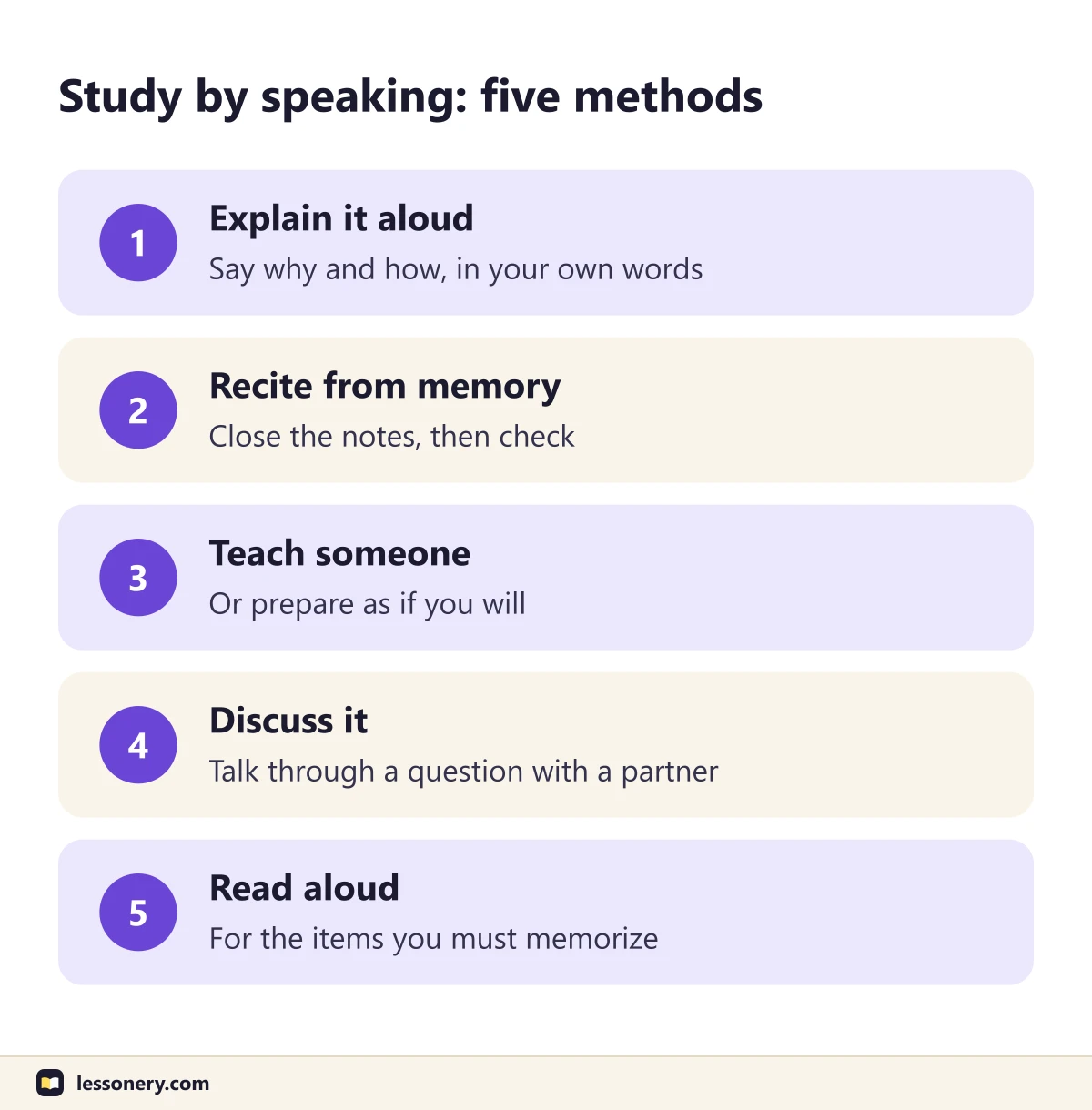
Each method below can be done aloud, and each was tested with learners in general, not with people who called themselves auditory learners. They are study strategies for auditory learners only in that sense.
Explain it aloud
Self-explanation means explaining how new information relates to what you already know, or explaining each step as you solve a problem. Dunlosky and colleagues (2013) rated it as having moderate utility in the review summarized in the most effective study techniques. They held back a higher rating because its durability and its performance in real classrooms were unclear.
A later meta-analysis by Bisra and colleagues (2018) pooled 69 effect sizes from 64 research reports on prompting learners to self-explain, and found an average effect of g = 0.55.
The University of North Carolina's Learning Center gives the practical version in its guide to studying smarter: explain the material in your own words as if you were the teacher. It notes that saying the material aloud shows you where you are confused. The Feynman study technique turns this into a routine.
Recite from memory
Reciting is recall done aloud. McDaniel, Howard and Einstein (2009) tested a read-recite-review routine with college students. With fact-based passages it produced better free recall than rereading or note-taking, both immediately and a week later. With longer engineering passages it matched note-taking on multiple-choice and problem-solving questions in less study time.
The Cornell note-taking system has the same step built in. Cornell's handout says to cover the notes and say the answers aloud in your own words, looking only at the cue column. Why recall beats rereading after a delay is explained in the guide to the active recall method.
Teach it, or prepare as if you will
Nestojko, Bui, Kornell and Bjork (2014) told some undergraduates that they would teach a passage to another student and told others that they would be tested. Nobody actually taught. In the first experiment, with 56 students, those who expected to teach recalled more of the passage's ideas (.17 against .13) and organized their recall better. In a second experiment with 44 students, overall scores did not differ significantly.
Kobayashi (2019) reanalyzed earlier data and found larger average gains for students who prepared and then taught face to face (g = 0.84, from 4 comparisons) than for those who explained on video or in writing (g = 0.48, from 12 comparisons). He describes the evidence as limited and mostly from laboratory settings.
Explaining to an empty room is on weaker ground. Lachner and colleagues (2021) reviewed studies of teaching without an audience that can respond, and note that several recent ones did not replicate the benefit.
Discuss it with someone
Smith and colleagues (2009) studied discussion in an undergraduate genetics course. Students answered a concept question on their own, discussed it with their neighbors and voted again. They then answered a second, similar question on the same concept individually. According to the paper's abstract, the results indicate that peer discussion improved understanding, even when no one in a discussion group had known the correct answer at the start.
That is one course, and the abstract gives no figures.
Read aloud what you need to memorize
Researchers call the memory advantage of saying words aloud over reading them silently the production effect. Forrin and MacLeod (2018) compared four ways of studying written words: reading silently, hearing someone else read, hearing a recording of yourself, and reading aloud. Memory was best after reading aloud, and hearing your own recording fell between reading aloud and hearing someone else. The University of Waterloo's news release about the study gives the number of participants as 95.
For a listener by preference, the detail worth keeping is that hearing another voice did less than speaking. The study tested memory for words, not understanding of course material.
A filled-in example: a 30-minute spoken session
This session is an example made for this article, not a procedure from any of the studies. The material is the section on the 2008 review above.
| Minutes | What you do | Method |
|---|---|---|
| 0 to 8 | Read the section once, or listen to your recording of the class | First pass |
| 8 to 13 | Close the notes and say aloud everything you remember | Reciting |
| 13 to 18 | Open the notes, check what you missed and mark it | Feedback |
| 18 to 25 | Answer two "why" questions aloud | Self-explanation |
| 25 to 30 | Give a study partner the main point in two minutes | Teaching |
First recitation, notes closed:
The 2008 review was about learning styles. The meshing hypothesis says teaching should match your preference. They found that people do have preferences, but almost no studies showed that matching helps. I can't remember what kind of study they said was needed.
Gap found in the check: the design. Learners grouped by style, random assignment to methods, the same test for everyone, and a result in which the best method differs between styles.
Two "why" questions: Why does the test need random assignment? Why is a stated preference not enough to support the hypothesis?
Where spoken study goes wrong
| Problem | What the sources say | What to do |
|---|---|---|
| Explaining with the notes open every time | UNC says starting with notes in hand is fine, with the aim of teaching without them | Close the notes once you have been through the material |
| Skipping the check | Dunlosky and colleagues note that feedback protects against repeating an error made on a practice test | Compare what you said with your notes |
| Avoiding diagrams or reading because of a label | The Institute of Education Sciences practice guide recommends combining graphics with verbal descriptions and grades the evidence as moderate | Use the format the material calls for, then talk it through |
Watch out: Replaying a recording is a second exposure to the material, much like rereading, which Dunlosky and colleagues rated as low utility. No study opened for this article tested replaying recordings, so that comparison is reasoning, not a finding.
Frequently asked questions
Are auditory learners real?
Preferences are. Pashler and colleagues found ample evidence that people state preferences for how information is presented. What they did not find was adequate evidence that teaching to the preference improves learning, and the experiments by Rogowsky and colleagues in 2015 and 2020 did not find it either.
Should you take a learning style quiz?
It can tell you what you like. In Husmann and O'Loughlin's survey of 426 anatomy students, VARK scores were not correlated with course performance, and most students did not study in line with their result anyway.
Is listening to a recorded lecture as good as reading?
On average, the 2022 meta-analysis by Clinton-Lisell found no reliable difference between reading and listening comprehension. Reading had an advantage when readers set their own pace and on inference questions. The author concluded that both audio and written options are needed for accessible instruction.