The Feynman study technique is a way of learning a topic by explaining it in plain language, as if to someone new to it, and going back to your sources wherever the explanation breaks down. It is named after the physicist Richard Feynman.
The four-step routine is a popular method taught by university learning centers, not a protocol tested under that name in the research reviews this article draws on. What has been studied is its ingredients: explaining material to yourself, teaching it to someone else, and recalling it from memory. That research is encouraging in places and mixed in others.
Quick answer: Study one concept, close your notes, explain it simply aloud or on paper, mark where you got stuck, return to the source for those points and explain again. The main review of study techniques cited below does not cover this routine as a package. Research on its parts (self-explanation, explaining to others, recall from memory) reports benefits, with several failed replications for explaining to an imagined audience.
What the Feynman study technique is
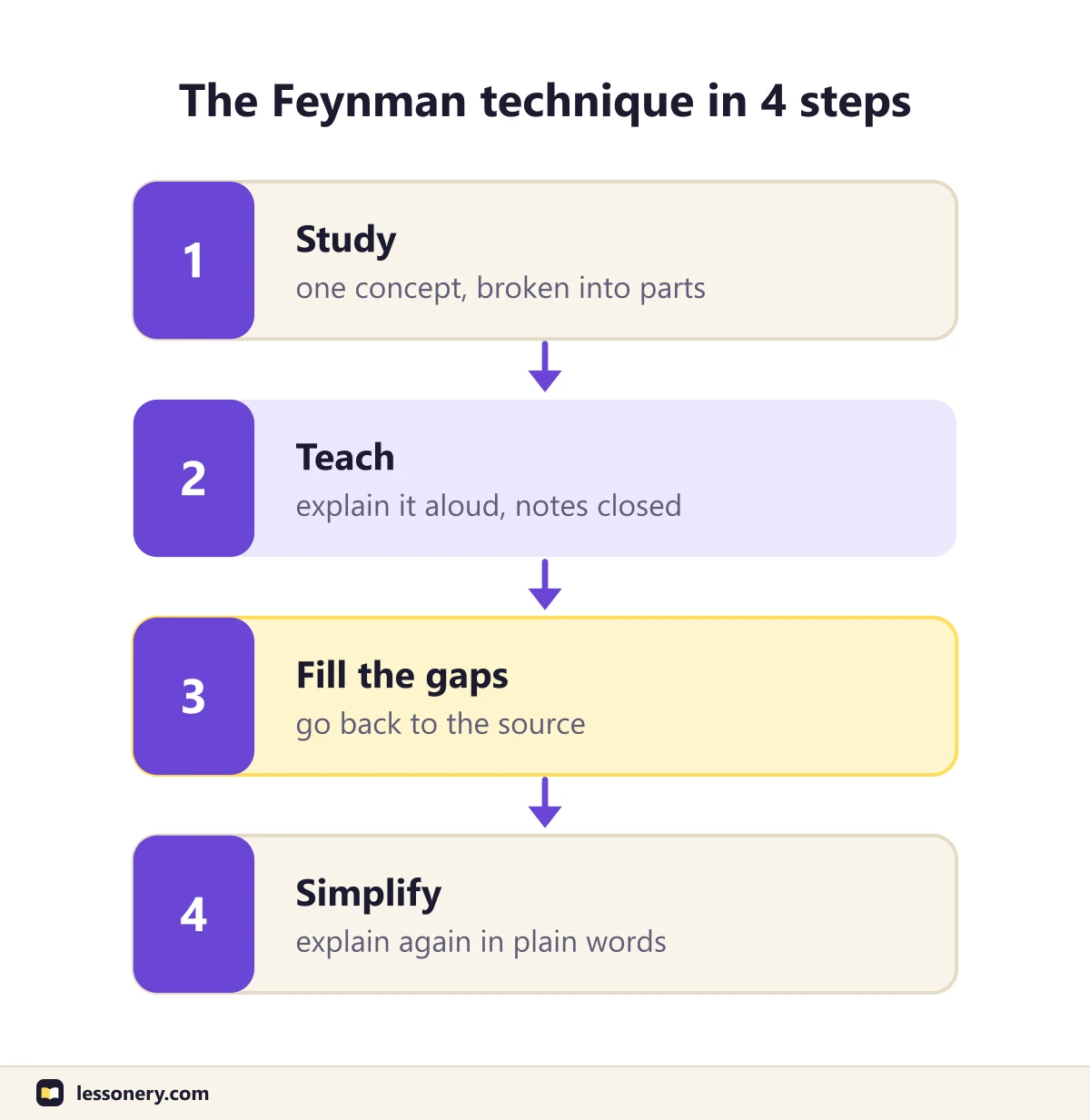
The technique is a short loop of studying, explaining and repairing. Kansas State University's Academic Achievement Center lists four steps:
| Step | What you do |
|---|---|
| 1. Study | Review your material and break the topic into its core components |
| 2. Teach | Explain the topic to a friend, roommate or family member, or talk it through aloud on your own |
| 3. Fill the gaps | Go back over the areas you missed or were unclear about while teaching |
| 4. Simplify | Explain the topic so that someone with no background could follow it; K-State suggests imagining a young child (in its words, a third grader) |
An advising page at the University of Colorado Boulder gives the same four steps and names the source of the label: Richard Feynman, a theoretical physicist who won the Nobel Prize in 1965.
The aim, in K-State's description, is a deeper understanding of the topic.
A popular method, not a tested protocol
A place on a university website and a famous name are not evidence that a method works. The Colorado page, for instance, says Feynman developed the method himself, but it cites neither a text in which he set out these steps nor a study of whether they improve learning.
A major review of study techniques doesn't fill that gap. Dunlosky and colleagues (2013) assessed ten learning techniques, and the Feynman technique is not among them. Self-explanation, its closest relative, is.
Direct tests of the technique do exist, and the one opened for this article shows why they can be hard to interpret. Cheng, Jantharajit and Kanjanakate (2026) compared two existing Grade 6 classes in China, 29 and 27 students, in English lessons. The class taught with analogical learning combined with the Feynman technique scored higher at the end (a mean of 85.00 against 79.96). Because two methods were combined and the classes were not randomly formed, the study can't show what the technique did on its own.
The honest claims about the method are therefore the ones supported for its parts.
What research on its parts found
Explaining to yourself
Self-explanation means explaining some aspect of the material, or of your own reasoning, while you learn. Dunlosky et al. (2013) rate it as having moderate utility. Its effects have been shown across different subjects, a wide age range and several kinds of outcome, including memory, comprehension and transfer to new problems. The authors hold back from a higher rating because it had not been adequately evaluated in real educational settings and its durability over long delays was unclear.
A later meta-analysis, Bisra and colleagues (2018), pooled 69 effect sizes from 64 research reports on prompting learners to self-explain. The average effect was g = .55 in favor of self-explanation. (An effect size such as g expresses the difference between groups on a standard scale; larger means a bigger difference.)
These studies prompted students to explain while studying, which is close to the Feynman routine but not the same thing.
Preparing to teach and teaching
Nestojko, Bui, Kornell and Bjork (2014) told some undergraduates at the University of California, Los Angeles that they would teach a passage to another student, and told others that they would be tested on it. Nobody actually taught. In the first experiment, 56 students had 10 minutes to study a 1,541-word passage. After a 25-minute filler task, those who had expected to teach recalled more of its ideas (.17 against .13) and organized their recall better. In the second experiment, with 44 students and a different passage, overall scores did not differ significantly (.44 against .39).
Kobayashi (2019) reanalyzed meta-analytic data on preparing to teach and teaching. Students who prepared and then taught face to face showed larger average gains over control groups (g = 0.84, from 4 comparisons) than students who prepared and then explained on video or in writing (g = 0.48, from 12 comparisons). He describes the evidence as limited and mostly from laboratory settings.
Explaining to nobody in particular is the shakiest part. Lachner and colleagues (2021) reviewed 25 articles on what they call non-interactive teaching, in which a student explains to a real, remote or imagined audience without any interaction. They note that several recent studies failed to replicate the benefit. Among the conditions they discuss: explaining aloud did better than explaining in writing in some studies, and learners with little prior knowledge of a topic may have too little to explain.
Recalling from memory
Part of the benefit may be plain retrieval. Kobayashi (2022) describes an experiment by Koh, Lee and Lim (2018) in which students studied a text and then did one of four things: made a teaching video from memory, took a free-recall test, read a prepared teaching script aloud on camera, or did an unrelated task. The video and recall groups did about equally well on a later comprehension test (d = 0.10 between them), and both did better than the script group (d = 0.57 and 0.65).
Koh and colleagues concluded that retrieval, not explanation, produced the gain. Kobayashi's review judges the current evidence insufficient to settle that either way.
Finding out what you don't know
Rozenblit and Keil (2002) asked participants, mostly Yale students, to rate how well they understood everyday devices such as zippers, toilets and helicopters on a 7-point scale. After writing a step-by-step explanation of a few of the devices, they rated themselves again, and the ratings dropped. The authors call this the illusion of explanatory depth.
That study measured confidence, not learning. It does support the logic of step 3: trying to explain shows where your understanding is thinner than it felt.
| Part of the technique | Closest research | What was found | Main limit |
|---|---|---|---|
| Explaining to yourself | Dunlosky et al. (2013); Bisra et al. (2018) | Moderate utility; average effect g = .55 | Little evidence from real courses |
| Preparing to teach | Nestojko et al. (2014) | Better recall in one of two experiments | Tests within the hour |
| Explaining to an audience | Kobayashi (2019); Lachner et al. (2021) | Larger gains face to face than on video or in writing | Failed replications without a live audience |
| Working from memory | Koh, Lee and Lim (2018) | Explaining from memory matched free recall | One experiment, disputed |
| Finding gaps | Rozenblit and Keil (2002) | Self-rated understanding fell after explaining | Measured confidence, not learning |
How to do it, step by step
The steps below follow the K-State outline, with a note where the research above suggests a particular way of doing a step.
- Choose one concept and study it. Pick something the size of a single idea or process, not a whole chapter, and break it into its parts.
- Close your notes and explain it in everyday words. Say it aloud, write it, or tell a person. In the Koh experiment, the group that read from a script did worse than the groups that worked from memory. A real listener helps when you can find one: both university pages say a listener can tell you what isn't clear, and the face-to-face gains in Kobayashi's analysis were the largest.
- Mark the gaps. Note every place where you stopped, went vague, or used a term you couldn't define.
- Go back to the source for those points. Reread only the weak spots, and correct anything you got wrong. The routine has no answer key, so this check is the only thing that catches an explanation that sounds smooth and is mistaken.
- Explain again, shorter and simpler. K-State's test is whether someone with no background could follow it.
- Return to it on another day. A spaced repetition schedule covers how to time the repeat.
A filled-in example
This example was written for this article as an illustration. The concept is the testing effect, and the source is the description of Roediger and Karpicke (2006) in the article on the active recall method.
First explanation, notes closed:
The testing effect means that testing yourself makes you remember more than rereading does.
Gaps marked: Remember more when? Is rereading ever better? There is no example and no number, and "testing yourself" is not explained.
Back to the source: the experiment compared rereading a passage with writing down everything remembered from it, and tested students 5 minutes, 2 days or 1 week later.
Second explanation:
In one experiment, students read a short passage. Then they either read it again or put it away and wrote down what they could remember. A week later, the students who had written from memory recalled 56% of the passage and the students who had reread it recalled 42%. Timing is the catch. On a test five minutes after studying, the rereaders were slightly ahead, 81% against 75%. The benefit of testing yourself showed up after a delay.
Where it goes wrong and when it doesn't fit
| Problem | Why it matters | What to do |
|---|---|---|
| Explaining with your notes open | Reading a script aloud did worse than explaining from memory in the Koh experiment | Close everything before you start |
| Skipping the check against the source | Nothing else in the routine corrects a wrong explanation | Compare with your notes, or ask someone who knows the topic |
| Using it on a topic you have barely met | Lachner et al. note that learners with little prior knowledge may have too little to explain | Study the material first |
| Using it for lists, dates or vocabulary | The method targets understanding of a concept | Use self-testing instead; see memorization techniques for studying |
| Using it for everything | Dunlosky et al. report that in Chi et al. (1994), students who explained each sentence of a text spent 125 minutes against 66 for a rereading group | Save it for the concepts you find hardest |
Frequently asked questions
Did Richard Feynman create the Feynman study technique?
The method carries his name, and the University of Colorado Boulder page says he developed it. That page does not point to a text in which Feynman set out the four steps, so this article treats the name as a label for the idea of explaining simply and does not claim the step list is his.
Do I need another person to explain to?
No. K-State says you can talk the topic through aloud by yourself. A listener has advantages, though, and the research on explaining without a live audience is more mixed than the research on face-to-face teaching.
Is the Feynman study technique better than active recall?
That has not been shown. In the Koh, Lee and Lim (2018) experiment, explaining from memory and plain free recall led to similar scores. For where both sit among other rated methods, see the most effective study techniques.
Does it work for math and science problems?
Research on self-explanation covers problem solving as well as reading. The Bisra et al. (2018) meta-analysis included studies in which students explained while solving problems, studying worked problems and studying text.