Mind mapping note taking means recording a lecture or a chapter as a diagram instead of lines of text. The main idea goes in the middle of the page, the main themes branch out from it, and details hang off each branch.
The research on it is mixed. Small experiments with medical students found either a modest advantage in recall or none, while pooled analyses of teaching with maps report benefits. The steps come first below, then the difference between mind maps and concept maps, then the studies.
Quick answer: Turn the page sideways, write the topic in the center, draw a branch for each main theme and smaller branches for details, and label every line with keywords. In two experiments, medical students using mind maps recalled a text about as well as students using their usual notes, and one of the two found a possible advantage a week later.
What mind mapping is as a note-taking method
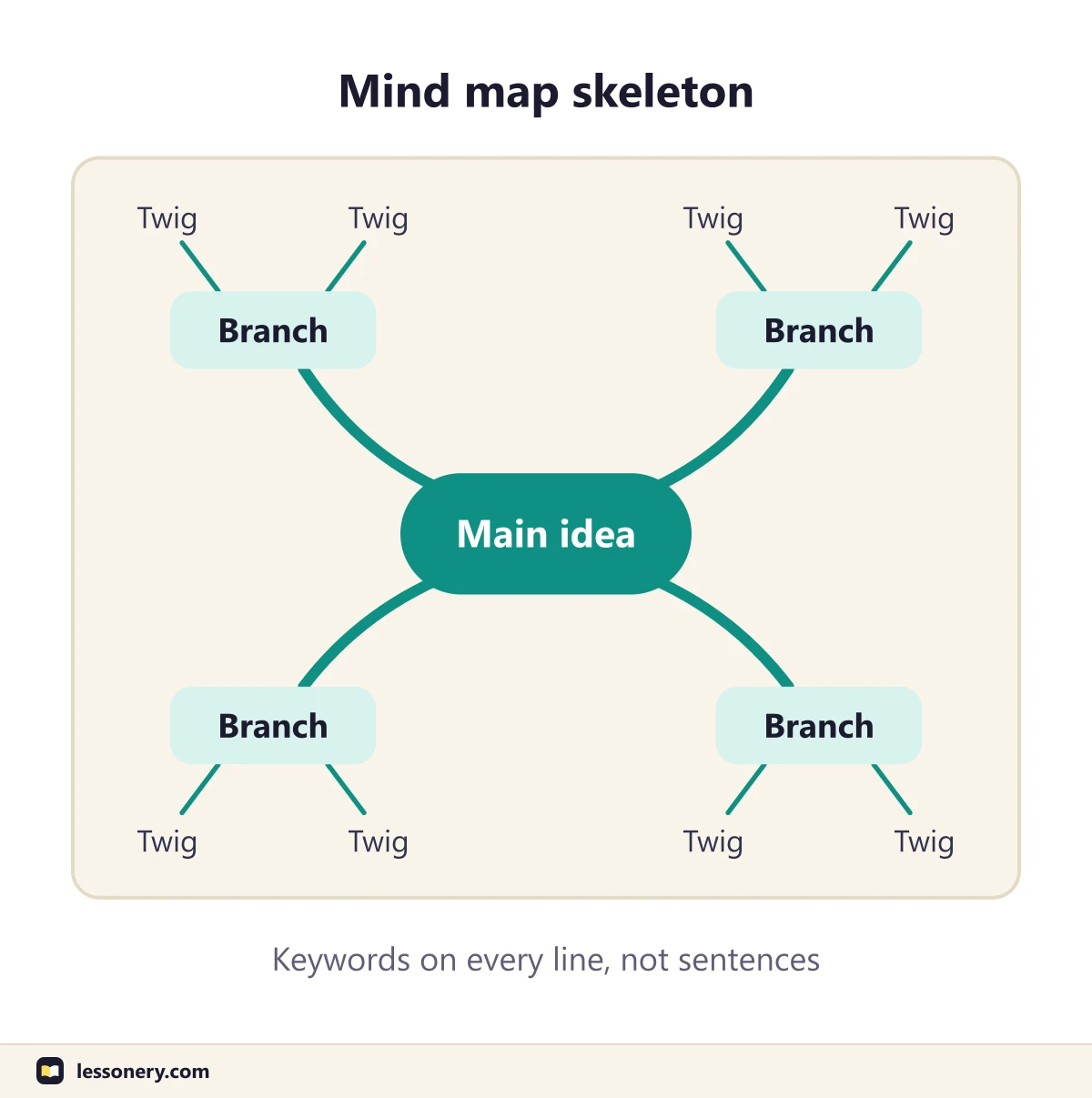
A mind map is a diagram that shows information in a relational way. That is the definition on Clemson University's Academic Success Center handout, which adds that mapping helps you organize lecture and reading notes by connecting the important concepts. The handout names three parts: the main idea in the middle, branches for the major topics, and twigs for the minor details on each branch.
The technique is credited to Tony Buzan. A research paper discussed below, by D'Antoni and colleagues, says Buzan developed it, and a Southampton Solent University library factsheet, hosted among the University of Nottingham's study-skills resources, lists the basic rules that set mind maps apart from other diagrams: a sideways page, a central idea, no more than seven main branches, single words on the branches, and as much color and imagery as possible.
How to build a mind map from a lecture or chapter
The steps below combine the Clemson handout and the Solent factsheet.
- Turn the page sideways. The Solent factsheet starts every map this way.
- Put the main idea in the middle. For a lecture, that is the lecture's topic. For a chapter, it is the chapter title.
- Draw a branch for each major topic. Clemson describes a branch as any major topic or concept that connects to the main idea. The Solent factsheet caps the number at seven.
- Add twigs for details. Each minor detail goes on a smaller line attached to the branch it belongs to.
- Use keywords. Clemson says to stick to keywords, and the Solent factsheet asks for single words. Its reason is that choosing keywords reduces the amount of information you have to process when you take notes or revise from them.
- Mark associations. Clemson suggests arrows or color coding to show how topics on different branches are linked.
- Redraw it later. Clemson suggests drawing the map again after you study, to see how much of it you remember.
From a lecture
Mapping during a live lecture is the harder case. Colorado State University's teaching institute lists the costs: a map runs out of space quickly, can be time-consuming to create during a lecture and needs revising afterward to stay clear. The University of Tennessee at Chattanooga's guide warns that with a map you may miss the change from a major point to its supporting facts.
One way around this is to map after class from the notes you already have. The University of North Carolina's Learning Center suggests that order for concept maps and other graphic organizers: draw the map from memory first to see what you know, then fill the gaps from lecture notes and readings.
From a chapter
A chapter gives you more time and a ready-made structure. Cornell's Learning Strategies Center, writing about concept maps, suggests listing the big ideas first using chapter headings and lecture notes. Those headings are candidates for your branches. See also note-taking from a textbook.
A filled-in example
The table below is an example made for this article. It lays out a mind map of one lecture topic, the Cornell note-taking system, with one row per branch. The content comes from the article on the Cornell note-taking system.
| Branch (from the center "CORNELL NOTES") | Twigs |
|---|---|
| ORIGIN | Pauk; Cornell; How to Study in College |
| LAYOUT | cue column, left; notes column, right; summary, bottom |
| STEPS | record; questions; recite; reflect; review |
| EVIDENCE | few direct studies; review matters; cue column = self-test |
On paper, each row becomes a branch leaving the center in its own color, and each item after it becomes a twig. One association is worth an arrow: "cue column" on the LAYOUT branch connects to "questions" and "recite" on the STEPS branch, because that column is where both steps happen.
Compared with an outline of the same content, the map adds the arrow between branches and loses the order of the five steps unless you number them.
Mind maps and concept maps are different tools
The two names are often used as if they meant the same thing, and they don't. Davies (2011), comparing concept mapping, mind mapping and argument mapping, argues that each has distinct characteristics and that the right one depends on what you want to do with it.
| Mind map | Concept map | |
|---|---|---|
| Credited to | Tony Buzan | Joseph Novak, in 1972 at Cornell University |
| Shape | A central theme in the middle, with categories radiating outward | A hierarchy, with the most general concepts at the top |
| What the lines carry | Keywords naming each branch | Linking words that state how two concepts are related |
| Color and pictures | Part of the method | Absent, as D'Antoni and colleagues describe the format |
| Starting point | A main idea | A focus question the map is built to answer |
The mind map column follows D'Antoni and colleagues (2010) and the Solent factsheet. The concept map column follows Novak and Cañas's paper on the theory underlying concept maps, in which two or more concepts joined by linking words form a proposition, which the authors describe as a meaningful statement.
The distinction matters when you read research. The two largest pooled analyses described below are about concept maps, and a result for one kind of map does not automatically apply to the other.
What studies of mapping found
The studies of mind mapping as a note-taking or study technique described below are small, and their results differ.
Mind maps: small experiments, mixed results
Farrand, Hussain and Hennessy (2002) tested 50 second- and third-year medical students in London on a 600-word text. After a baseline test, the students were randomly assigned either to use their own study technique or to be taught mind mapping and apply it to the text. Recall was tested after an interfering task and again one week later.
Both groups improved on the immediate test. At one week, the improvement was reliable only in the mind map group, whose factual recall was 10% higher after adjusting for baseline scores. The 95% confidence interval ran from −1% to 22%, so it included no difference at all. Motivation was lower in the mind map group. The authors concluded that mind maps are an effective technique for written material, and that motivation should be addressed before they are widely adopted.
D'Antoni and colleagues (2010) ran a larger experiment with 131 first-year students at a US medical school. Students were randomly assigned to standard note-taking or to mind mapping after a 30-minute introduction to the technique. They took notes on a 394-word passage for 25 minutes and answered a 10-question quiz in the same session. The standard note-taking group averaged 7.85 and the mind map group 7.64, a difference that was not statistically significant. Scores on a critical thinking test did not differ either.
A secondary analysis of standardized change scores in that study favored the standard note-takers. The authors' own conclusion was that a brief introduction let beginners perform about as well as standard note-takers, and that longer-term studies are needed. They also describe an earlier study, by Wickramasinghe and colleagues (2007), in which new medical students using mind maps scored 31.3% and those using their own methods 37.6%, again without a significant difference.
Both experiments described in detail here involved medical students reading a short text, with a brief introduction to mapping and tests within a week. Neither followed students through a course.
Teaching with mind maps: a positive pooled result
Shi and colleagues (2023) combined 21 studies that compared instruction built around mind mapping with traditional instruction. Their abstract notes that earlier findings had been inconsistent. Pooled, mind mapping-based instruction had a more positive effect on students' cognitive learning outcomes, with larger effects for students in lower grades and in science, technology, engineering and mathematics subjects.
This is evidence about lessons designed around maps by teachers. It is not a test of one student choosing to take notes as a map.
Concept maps: more evidence, and one direct challenge
The research base for concept maps is larger. Nesbit and Adesope (2006) analyzed 55 studies with 5,818 participants, from Grade 4 to postsecondary level, and found that using concept maps was associated with better knowledge retention. Effects ranged from small to large depending on how the maps were used and what they were compared with. Schroeder and colleagues (2018) pooled 142 effect sizes from 11,814 participants and found a moderate overall benefit (g = 0.58). Creating a map (g = 0.72) helped more than studying one that was already made (g = 0.43).
The challenge comes from Karpicke and Blunt (2011). In their first experiment, 80 undergraduates studied a science text. One group then built a concept map with the text in front of them, and another practiced recalling the text from memory. On a short-answer test one week later, the recall group averaged .67 of the available points and the concept-mapping group .45. Mapping with the text open was not significantly better than spending additional time rereading it. The article on the active recall method describes this study in full.
Note: The Clemson and North Carolina handouts both suggest drawing a map again from memory. That turns the map into a recall exercise, the kind of practice that did better in Karpicke and Blunt's experiment. No study described here tested mind maps used that way.
When mind mapping fits and when it doesn't
The guides place mind mapping for note-taking where relationships matter more than sequence. Colorado State lists subjects in which connecting ideas is the point, such as history, literature, biology, psychology and business, and says a map helps break a large idea into smaller ones. Chattanooga suggests mapping when lecture content is heavy and well organized.
It fits less well when you need detail or order. A branch holds a keyword, not an explanation, and the map in the example above lost the order of the steps. For a lecture that moves from general points to specific ones, the outline method keeps the sequence. The comparison of different note-taking methods sets mapping beside the other formats.
Frequently asked questions
Is mind mapping better than ordinary note-taking?
The experiments described here do not show that. In D'Antoni and colleagues (2010), mind mappers and standard note-takers scored about the same on a quiz straight after studying. Farrand and colleagues (2002) found a possible advantage after one week, but the confidence interval included zero.
What is the difference between a mind map and a concept map?
A mind map radiates from a central idea, with keywords on its branches. A concept map is arranged from general concepts at the top to specific ones below, and its lines carry linking words that state the relationship between two concepts.
Can you draw a mind map on a computer?
Yes. The University of North Carolina's Learning Center describes digital mapping tools that let you search by keyword, switch between views, convert a map to an outline and add photos of handwritten maps. Its handout names a few apps as examples without ranking them.