
A Leitner box is a card file divided into compartments, each reviewed on its own schedule. Every flashcard starts in the first compartment. A card you answer correctly moves forward to a compartment you open less often, and a card you miss moves back to one you open more often.
The method is named after Sebastian Leitner, whose German-language book So lernt man lernen is the source that research papers on the method cite. It applies two well-supported ideas, self-testing and spacing. The box itself has been tested far less than those two ideas have.
Quick answer: Put all new cards in Box 1 and review it every day. Move a card forward one box when you answer it correctly, and back when you miss it. Later boxes are reviewed less often, for example every other day and once a week. A 2013 research review rated self-testing and spaced review as high utility. The box's specific rules and intervals are rules of thumb, and few direct tests of them were found for this article.
What a Leitner box is
A Leitner box is a way of deciding which flashcards to review today. In a paper on review scheduling, Reddy, Labutov, Banerjee and Joachims (2016) call the Leitner system one of the simplest and oldest spaced repetition methods. They describe its aim this way: cards in the lower decks are reviewed more often than cards in the higher ones, so you spend more time on what you have forgotten and less on what you recalled.
Both that paper and Settles and Meeder (2016) cite Leitner's book So lernt man lernen, published by Herder in Freiburg. Settles and Meeder describe the proposal as a spaced repetition method for flashcards in which the gap before a card's next review can grow or shrink depending on how the student did.
Sources date the idea differently. Settles and Meeder give the book's year as 1972, and Reddy and colleagues list it as 1974 while writing that the system was first introduced in 1970. In the journal Language Learning & Technology, Godwin-Jones (2010) writes that Leitner devised his five-step process in the 1940s, using index cards in a "learning box" (Lernkartei in German). The book itself could not be opened for this article, so the descriptions below come from these later sources and from two university study guides.
How the boxes and review intervals work
Two rules run every version of the system.
- Each compartment has its own review interval, and the interval gets longer from one compartment to the next.
- The result of each self-test moves the card. A correct answer sends it forward. A miss does not.
Beyond that, the sources do not agree on the details.
| Source | Compartments | Review intervals | A missed card |
|---|---|---|---|
| Godwin-Jones (2010), describing Leitner's box | 5 | First compartment daily, each later one after a longer lag | Stays where it is |
| Settles and Meeder (2016), "a popular variant" | 5 in their figure | 1, 2, 4, 8 and 16 days | Is demoted to a box with a shorter interval |
| University of York Library | 3 to 5 | Example: daily, every other day, once a week | Goes back to Box 1 |
| Kansas State University handout | 3 stacks | Daily, every other day, then less often | Goes back one stack |
There is no single official schedule here. York presents its frequencies as an example, and the 1, 2, 4, 8, 16-day pattern is one variant. The rule for a missed card ranges from mild (it stays put) to strict (it returns to the start), and the strict rule gives a missed card more reviews before it reaches the last box again.
The sources also differ on what happens at the end. In Godwin-Jones's description, a card remembered in the final compartment leaves the system. The Kansas State handout says to keep going until all cards are in the last stack and then, for continuous learning, to review the cards each week.
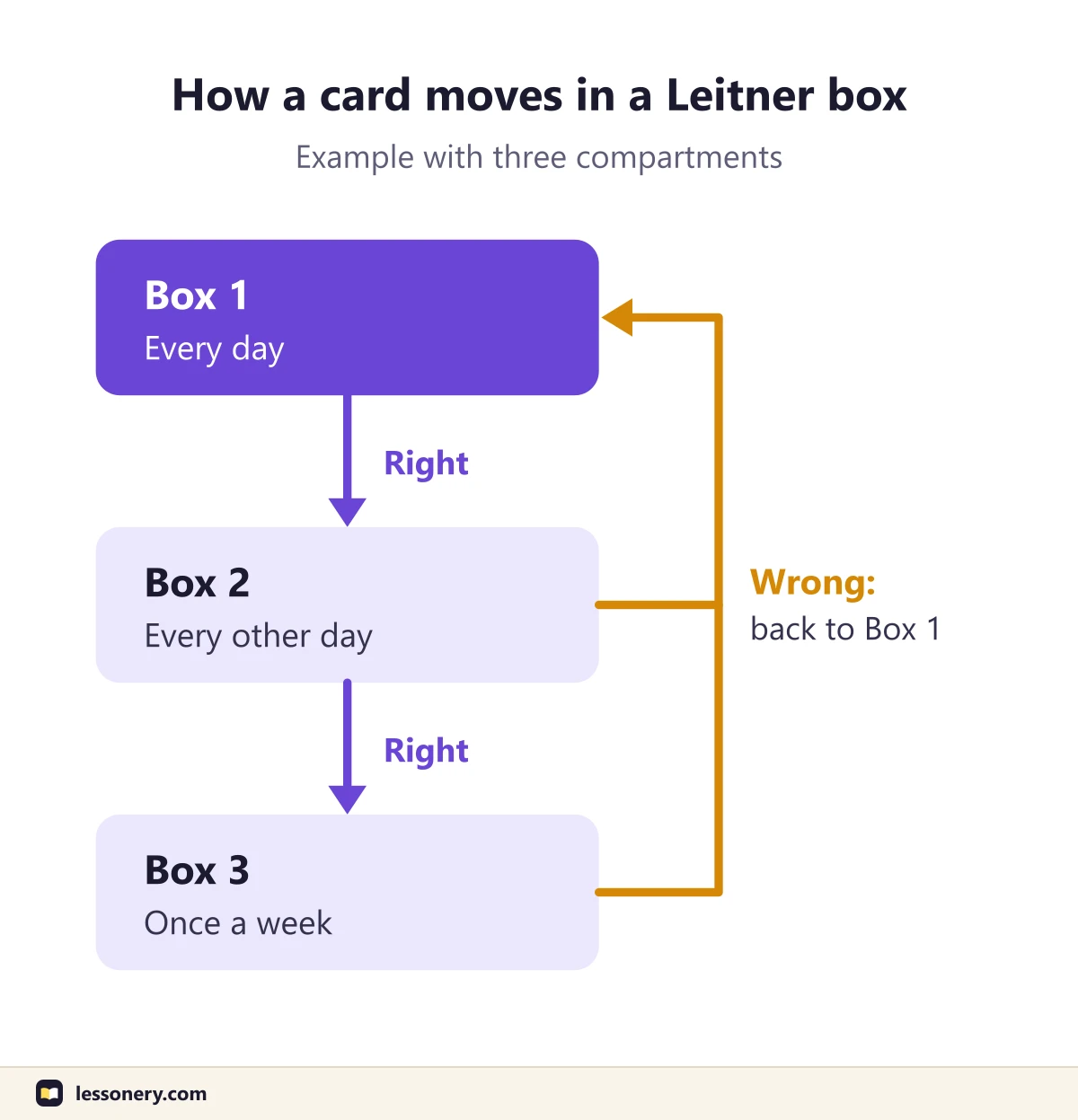
A paper Leitner box, step by step
This setup is an example for this article. It uses York's example frequencies and York's rule for missed cards. Change either to suit your course.
You need index cards and a container with three sections: a card file with dividers, or three envelopes.
- Write the cards. York's guide puts a concept, term or phrase on one side and its explanation on the other.
- Label the sections. Box 1: every day. Box 2: every other day. Box 3: once a week.
- Put every new card in Box 1, as the Kansas State handout does with its first stack.
- Each day, open the boxes that are due. The calendar below shows which.
- Answer each card from memory before you turn it over, aloud or on paper, then check.
- Move the card. Right: forward one box. Wrong: back to Box 1.
- Keep Box 3 going. A card answered correctly in Box 3 stays there for the next weekly review.
- Add new cards to Box 1 as the course moves on.
An example calendar for the first week
The dates are an illustration. The start is Monday, October 12, 2026.
| Day | Date | Boxes to open |
|---|---|---|
| 1 | Monday, October 12 | 1 |
| 2 | Tuesday, October 13 | 1 and 2 |
| 3 | Wednesday, October 14 | 1 |
| 4 | Thursday, October 15 | 1 and 2 |
| 5 | Friday, October 16 | 1 |
| 6 | Saturday, October 17 | 1 and 2 |
| 7 | Sunday, October 18 | 1 and 3 |
How two example cards move
| Day | Card A (easy) | Card B (hard) |
|---|---|---|
| 1 | Box 1: right, moves to Box 2 | Box 1: wrong, stays |
| 2 | Box 2: right, moves to Box 3 | Box 1: right, moves to Box 2 |
| 4 | Not due | Box 2: wrong, back to Box 1 |
| 5 | Not due | Box 1: right, moves to Box 2 |
| 6 | Not due | Box 2: right, moves to Box 3 |
| 7 | Box 3: right, stays | Box 3: right, stays |
In this made-up week, Card A is reviewed three times and Card B six times. That is the design working as intended: the card you keep missing gets the extra practice.
What research says about the Leitner box
The two ingredients are well supported
Each review in a Leitner box is a self-test, and each successful card waits longer before its next one. Both ideas have a large research base.
- Self-testing. In Roediger and Karpicke (2006), students who recalled a passage instead of rereading it remembered more of it two days and one week later, although rereading did slightly better five minutes after study. The guide to the active recall method has the details.
- Spacing. Cepeda and colleagues (2006) pooled 271 comparisons and found 47.3% recall after spaced study against 36.7% after massed study, with total study time held equal.
- Both together. Dunlosky and colleagues (2013) gave practice testing and distributed practice the only two "high utility" ratings among ten techniques. Studies that combine them are described in active recall and spaced repetition.
One feature of the box goes beyond that evidence. Its intervals get longer with each correct answer, but a meta-analysis by Latimier, Peyre and Ramus (2021) found no significant difference between expanding and equal gaps in spaced retrieval practice (g = 0.034). Lengthening intervals are compatible with the research. They have not been shown to beat regular ones.
The box itself has been tested much less
Few direct tests of the Leitner system were found for this article, which was researched in October 2026. That is a statement about what was read here, not the result of a systematic literature search. One small experiment and two computer science papers are the direct evidence described below, and all three involve software, not a paper box.
A short one-session comparison. Wilschut and colleagues (2021) had 21 first-year psychology students in a University of Groningen study, native speakers of Dutch or German, learn Dutch-English or German-English word pairs. Each condition was one 12-minute study session followed by a 3-minute filler task and a test. In one condition a three-box Leitner algorithm chose the order of the words. In another, an adaptive algorithm chose it from the learner's response times. On the test, the probability of a correct answer was 8.3 percentage points higher after the adaptive session.
The limits matter. Everything happened within minutes, so the comparison says nothing about a box used over days or weeks. Every participant did the conditions in the same order, and the authors write that their conclusion should be validated because of the relatively small number of participants. The same authors, citing earlier work, describe the Leitner flashcard system as a relatively effective study strategy.
Data from a language app. Settles and Meeder (2016), in research conducted at the language-learning app Duolingo, report that the app at first used a Leitner variant to manage practice. On two weeks of logs containing 12.9 million practice records, a statistical model they trained predicted learners' recall with at least 45% lower error than the Leitner-based model, although the Leitner model scored highest on one of their ranking measures. A six-week experiment then randomly assigned just under 1 million learners to one model or the other. Its outcome was how often learners returned to the app, not how much they learned. None of this tests what a learner gains from a paper box.
The intervals are heuristics. Reddy and colleagues write that existing schemes for setting how often each Leitner deck is reviewed "are based on heuristics that are not founded on any formal reasoning." Their paper offers a mathematical model in response.
Put together: the Leitner box is a simple way to apply two techniques with strong evidence. The sources found for this article do not establish that its particular intervals or rules are the best ones. Studies that were not found, or that could not be opened and checked, are not described here.
Where a Leitner box goes wrong
| Problem | What the sources say | What to do |
|---|---|---|
| Too many cards | York lists overload from a large volume of cards, and the time needed to make them, among the method's disadvantages | Add new cards in small batches |
| Using it the night before | The Kansas State handout says the system is best for regular, consistent studying, not cramming | Start weeks ahead; for a last-minute plan see how to cram for an exam |
| Turning the card too soon | The benefit in Roediger and Karpicke (2006) came from recalling, not rereading | Say or write the answer first |
The fixes in the third column are this article's suggestions. To choose gaps that match an exam date, see the spaced repetition schedule guide.
Frequently asked questions
How many compartments should a Leitner box have?
The sources vary. Godwin-Jones (2010) describes Leitner's box as having five. The University of York Library suggests three to five, and the Kansas State handout uses three stacks.
Does a wrong card go back one box or all the way to the start?
Both rules are in use. York's guide sends a missed card back to Box 1, the Kansas State handout moves it back one stack, and in Godwin-Jones's description it stays where it is. None of the sources read for this article compares the rules.
Is a paper Leitner box better than a flashcard app?
The studies found for this article do not answer that. The manual for the flashcard program Anki describes the Leitner system as a big step up from a single box of cards but still a rough approach, because it cannot give an exact date for the next review, and Wilschut and colleagues (2021) found an adaptive algorithm ahead of a Leitner algorithm in one short session. Neither is a trial of paper against software over a course.
Does a Leitner box work for language vocabulary?
The comparison by Wilschut and colleagues used English word pairs, and Godwin-Jones (2010) discusses the box as a tool for second-language vocabulary. The research on gaps and vocabulary is covered in spaced repetition for language learning.