If you need to know how to cram for an exam that is one or two days away, the plan is short. Decide what to leave out, test yourself instead of rereading, come back to each topic more than once, and stop in time to sleep.
Be clear about what you are buying. Research comparing massed study (packed into one stretch) with spaced study (spread over days) finds that massed study is worse for lasting memory. It can help on a test taken soon afterwards. Much less of it is still there a week later.
Quick answer: Cramming is an emergency measure, not a method. With a day or two left: get the list of what the exam covers, pick the topics worth the most marks that you half-know, study them by recalling and solving with your notes closed, review each topic a second time later the same day, and stop in time to sleep.
What research says about cramming
Cramming is massed study: most of the work done in one block shortly before the test. Psychologists compare it with distributed (spaced) practice, where the same amount of study is spread over time.
The large reviews
Cepeda and colleagues (2006) reviewed 317 experiments on recalling verbal material such as word lists and word pairs. In 271 comparisons where total study time was equal, average recall on the final test was 47.3% after spaced study and 36.7% after massed study. Only 12 of the 271 comparisons showed no benefit or a disadvantage for spacing.
The authors add a caution of their own. In these experiments "massed" meant repeating an item back-to-back, with under a second between repetitions. A few hours of cramming, in which you return to the same material several times, is not quite the same thing.
Dunlosky and colleagues (2013) reviewed ten learning techniques and rated distributed practice as high utility. They also state the other side: cramming is better than not studying at all in the short term, and massed practice can benefit performance on an immediate test. The advantage of spacing, they write, is often stronger on delayed tests.
A classroom example
Greving and Richter (2019) had seventh-grade students in Germany (average age about 13) read a science text about the bacterial cell twice. Some read it twice in one session. Others read it once and again a week later. In each condition, some students were tested a few minutes after the second reading and the rest a week after it.
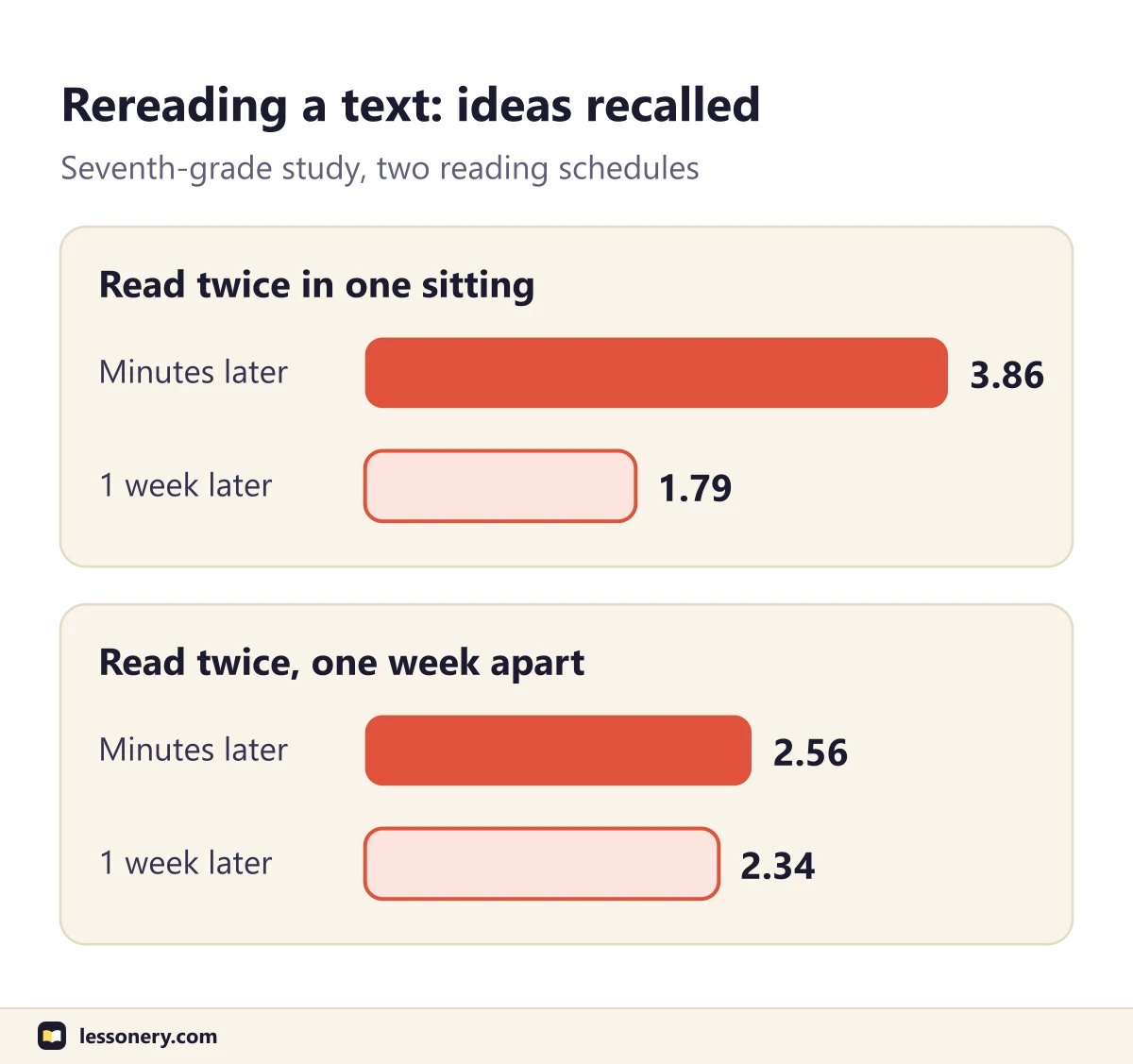
Minutes later, the students who had read twice in one sitting recalled more. A week later, students in that condition recalled 1.79 ideas, which works out to less than half of the earlier figure. In the spaced condition the two test times did not differ significantly, and at one week neither did the two conditions.
That result is less tidy than the usual slogan. Spacing did not beat massing here. It matched it after a week, and the authors describe the spaced group as showing no forgetting between the two tests. The authors note that in an earlier study with undergraduates, Rawson and Kintsch (2005), massed rereading beat a single reading on an immediate test while spaced rereading did not, and two days later spaced rereading was ahead of both.
| When the test came | After massed study | After spaced study | Source |
|---|---|---|---|
| Minutes after the last reading | 3.86 ideas recalled | 2.56 ideas recalled | Greving and Richter (2019) |
| One week after the last reading | 1.79 ideas recalled | 2.34 ideas recalled (difference not significant) | Greving and Richter (2019) |
| All delays pooled, 271 comparisons | 36.7% recalled | 47.3% recalled | Cepeda et al. (2006) |
What this means for you is a matter of reasoning, not a finding. If the only goal is tomorrow's test, cramming may be enough. If the material returns in a later exam or the next course, you will have to learn much of it again.
How to cram for an exam with one or two days left
The steps below put the hours you have where they count. Each one is tied to a source. The order is a suggestion.
1. Find out what the exam covers, then cut
You cannot cover everything, so choose. A University of Waterloo guide to last-minute studying advises skimming your notes, assignments and chapter summaries to set priorities, focusing on manageable material that will earn the most marks, and not getting stuck on highly specific points until the main ideas are covered.
For problem-based subjects such as mathematics and the sciences, the same guide says to spend most of the time practicing problems and to write the main formulas on paper.
2. Test yourself instead of rereading
Close the notes and try to produce the answer. Check, then repeat for what you missed.
Roediger and Karpicke (2006) had students study prose passages and then either restudy them or write down everything they could recall, with no feedback. On a test 5 minutes later, restudying did slightly better (81% against 75% in the first experiment). After 2 days the tested passage was ahead, 68% against 54%, and after 1 week it was 56% against 42%.
An exam tomorrow falls between those delays, so this study does not settle which is better for it. Self-testing has a second use that rereading lacks: it shows you what you don't know. The Institute of Education Sciences practice guide Organizing Instruction and Study to Improve Student Learning recommends using tests and quizzes to identify what still needs study, while rating the evidence for that particular recommendation as low. The guide on the active recall method covers the technique in detail.
3. Return to each topic at least once
Even inside one day, two passes with a gap are a better bet than one long pass. In the Cepeda review, spaced repetition led to better average recall than back-to-back repetition whether the test came less than a minute later or more than a month later.
In practice: study topic A in the morning, move to other topics, and recall topic A again in the afternoon. With two days, review the first day's topics on the second day.
4. Work in short blocks
The Learning Center at the University of North Carolina at Chapel Hill suggests intensive sessions of about 30 to 45 minutes followed by a break, on the grounds that concentration and retention fall in long sessions. The Pomodoro technique for students is one way to structure this.
5. Stop in time to sleep
Waterloo's guide tells last-minute studiers to sleep, eat regular meals and set an alarm.
The research here is general and observational. Okano and colleagues (2019) tracked the sleep of 88 students in an introductory chemistry course at MIT for a semester. Longer, better and more consistent sleep was associated with higher course scores. Sleep on the single night before a test showed no significant link with that test's score, while sleep over the week and month before did.
That study did not test staying up all night, and it cannot show cause. In their introduction the authors summarize controlled sleep-deprivation studies as showing that lack of sleep worsens cognitive performance.
Note: This describes research and is not health advice. If you often can't sleep before exams, or feel unable to cope, speak to a doctor, a counselor or your school's student support service.
An example one-day plan
The plan below was written for this article to illustrate one way to cram for an exam. It assumes the exam is tomorrow morning and today is free. The times are arbitrary. Keep the order and change the hours.
| Time | What you do |
|---|---|
| 9:00–9:30 a.m. | Get the exam outline. List the topics. Sort them: A (likely and weak), B (likely and nearly known), C (leave out). |
| 9:30 a.m.–12:30 p.m. | A topics. Four 40-minute blocks, each followed by a 5-minute break. In each block: read a summary, close it, recall or solve, check. |
| 12:30–1:30 p.m. | Lunch, away from the desk. |
| 1:30–3:45 p.m. | B topics. Three 40-minute blocks with 5-minute breaks. |
| 3:45–4:15 p.m. | Break. |
| 4:15–5:45 p.m. | Second pass on A topics from a blank page. Restudy only what you could not recall. |
| 5:45–7:00 p.m. | Dinner and rest. |
| 7:00–8:00 p.m. | Timed practice questions or part of a past paper. Mark them. |
| 8:00–8:30 p.m. | Write one page of the points you still missed. Pack what you need for the exam. Stop. |
That works out to a little over eight hours of work across the day. The next morning, read the one page once.
With two days, split the same work. Use the first day for sorting and for the A and B topics. Use the second for recall passes and a timed paper. The night between them gives you a real spaced review.
What cramming costs, and what to do afterwards
The cost when you cram for an exam is forgetting. Waterloo's guide calls cramming an emergency technique and warns that it can lead to faster forgetting and more stress.
If the material matters after this exam, plan one review in the following week. A research review by Carpenter and colleagues (2012) notes that people relearn material they once knew and can no longer recall much faster than material they are meeting for the first time.
For the next exam, start earlier with a smaller daily load. Cornell University's Learning Strategies Center lays out a five-day plan of about two hours a day that mixes preparing new material with reviewing earlier material. For the wider picture, see how to study effectively for exams, how to create a study schedule, and how a spaced repetition schedule sets the gaps between reviews.
Frequently asked questions
Does cramming work?
For a test taken soon afterwards, it can. Dunlosky and colleagues write that cramming is better than not studying at all in the short term. What it does poorly is keep the material in memory, which matters if the course builds on it.
Should I stay up all night to study?
The sources used here do not test that directly, and this site does not give health advice. What they do report: the Waterloo guide tells last-minute studiers to sleep, and Okano and colleagues summarize laboratory research as showing that lack of sleep worsens cognitive performance.
What should I study first when I'm out of time?
Start with the main ideas and the material likely to earn the most marks, as the Waterloo guide advises, and leave narrow details for the end. A quick closed-book check of each topic tells you which ones you half-know.
How long can I study in one day?
The research cited here does not set a limit. UNC's Learning Center recommends sessions of 30 to 45 minutes with breaks, and the example plan above spreads its blocks across a day with long pauses for meals.
Is rereading my notes a waste of time when cramming?
Not entirely. In Roediger and Karpicke's study, rereading did slightly better on a test five minutes later. The trouble is that it doesn't show you what you have failed to learn, and with limited hours that information is what you need most.