The Pomodoro Technique for students is a way of studying in timed intervals: 25 minutes on one task, a short break, and a longer break after four intervals. Francesco Cirillo developed it as a university student, timing himself with a kitchen timer shaped like a tomato (pomodoro in Italian).
Research on the technique itself is limited. A few studies have tested Pomodoro-style schedules with university students, and their results are mixed.
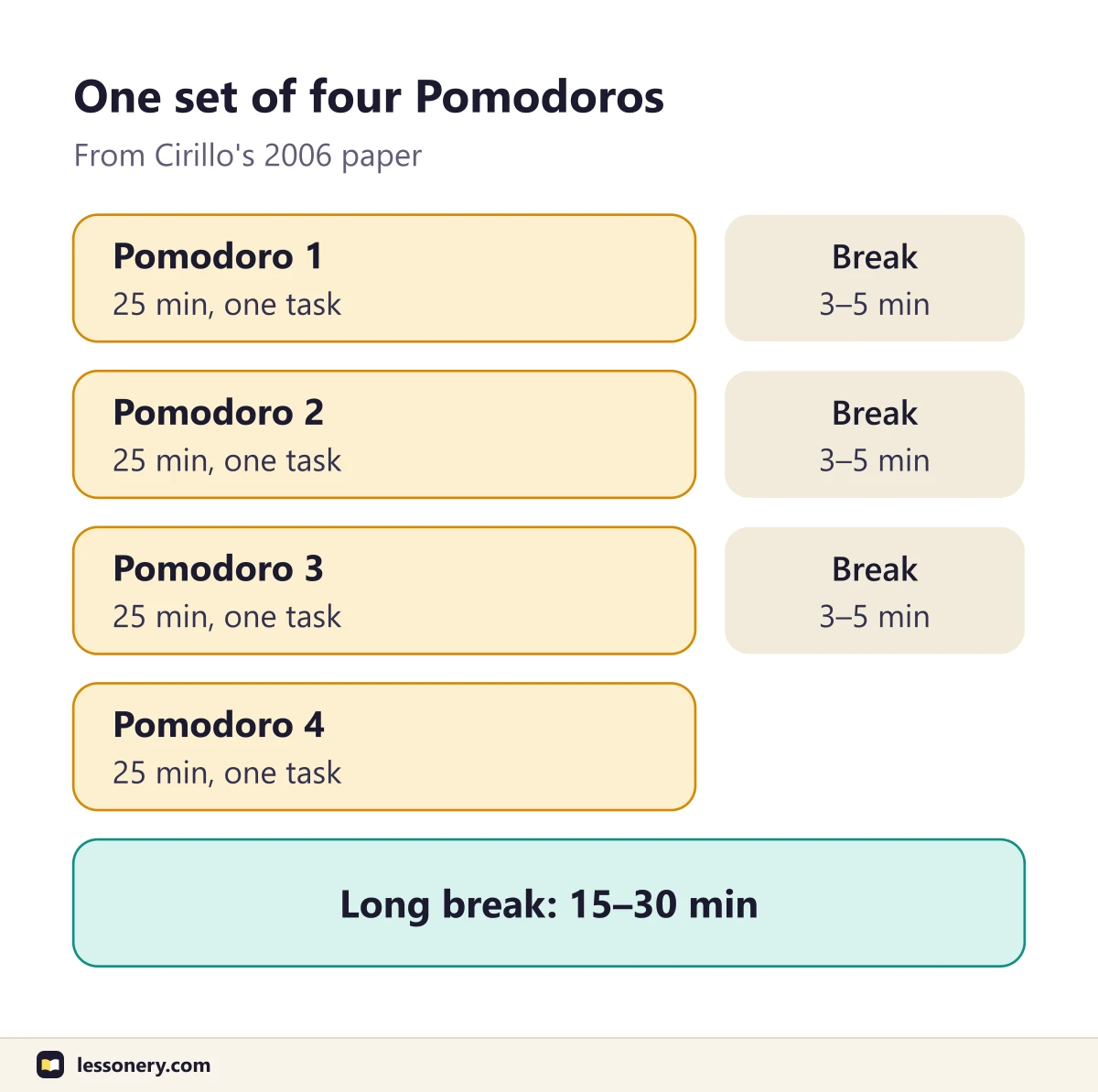
Quick answer: Pick one study task, set a timer for 25 minutes and work only on that task until it rings. Take a 3–5 minute break, and after four intervals take a 15–30 minute break. In two studies with Dutch university students, fixed breaks went with better self-reported concentration in one, and task completion was no different from self-chosen breaks in either.
What the Pomodoro Technique is, in Cirillo's own description
The fullest description is Cirillo's paper The Pomodoro Technique (2006). He writes that as a student he traced the confusion he felt about his studies to frequent distractions and interruptions and to low concentration and motivation, and bet himself that he could really study for 10 minutes. The timer he used to check was shaped like a tomato, which gave the method its name.
The paper presents the technique "as defined in 1992". Cirillo's own website dates the start of his work on it to 1987.
One Pomodoro is the unit of work. In Cirillo's words, "The traditional Pomodoro is 30 minutes long: 25 minutes of work plus a 5-minute break." The equipment is a timer and three sheets of paper: a To Do Today sheet, an Activity Inventory (a running list of activities, added as they come up) and a Records sheet.
| Rule in Cirillo's paper | What it means in a study session |
|---|---|
| A Pomodoro is 25 minutes of work | The timer stays visible and you work on one task until it rings |
| Take a 3–5 minute break after each one | Stop when it rings, even if a few more minutes would finish the task |
| Every four Pomodoros, take a longer break | 15 to 30 minutes away from the work |
| A Pomodoro is indivisible | No half intervals. If you are definitively interrupted, the interval is void and you start a new one |
| If a Pomodoro begins, it has to ring | If you finish early, use the remaining minutes to review or repeat what you did |
| If it takes more than 5–7 Pomodoros, break it down | Split a large assignment into smaller tasks |
| If it takes less than one Pomodoro, add it up | Combine several small tasks into one interval |
The rules are Cirillo's. The wording in the second column is a paraphrase.
The timer is only part of it. Cirillo's site calls the technique "much more than a sequence of 25-minute sessions", and the paper adds planning at the start of each day and recording the results at its close.
Note: Cirillo's paper is a description of his method and of what he observed in people he taught. It is not a controlled study. When he writes that the short break lets the mind assimilate what was learned, that is his explanation, not a tested finding.
How to use the Pomodoro Technique for students, step by step
These steps follow Cirillo's paper. The study tasks used as illustrations are this article's examples.
1. List today's tasks
At the start of the day, write the tasks you want to do on a To Do Today sheet, in order of priority. The entries in Cirillo's sample sheets are tasks with a clear end, so for study that means "problem set 4, questions 1–12" and not "statistics". The University of Toronto Scarborough's guide to staying focused starts the same way, with a list of the tasks you need to complete.
2. Estimate each task in Pomodoros
Cirillo treats estimating as a later skill, to add once the basic routine is familiar. The "break it down" and "add it up" rules in the table above apply here.
3. Set the timer for 25 minutes and start the first task
Work on that task only. Cirillo asks that the time remaining always be visible.
4. Deal with interruptions on paper
Cirillo separates internal interruptions (your own urge to check something or do something else) from external ones (other people).
For an internal interruption, put an apostrophe next to the task, write the new item under "Unplanned & Urgent" or in the Activity Inventory, and carry on until the timer rings. For an external one, say you are busy, agree a later time, and get back to the person as promised.
5. When the timer rings, mark an X and take a short break
Cirillo suggests standing up, walking around the room or having a drink of water. He advises against anything that needs significant mental effort during the break, and against continuing to think about the work.
6. After four Pomodoros, take the longer break
This one lasts 15 to 30 minutes. Cirillo's examples are tidying your desk, getting a coffee or taking a short walk, and again nothing complex.
7. Before you finish for the day, record what happened
Note how many Pomodoros each task took and compare that with your estimate.
What to put inside the 25 minutes
The technique says nothing about how you study during an interval, and that choice matters. A review of ten learning techniques by Dunlosky and colleagues (2013) rated practice testing as high utility and found rereading to be of low utility, according to the Association for Psychological Science's page on the review.
A Pomodoro spent rereading and a Pomodoro spent testing yourself earn the same X on the sheet, but the review rates the two activities very differently. The active recall method article covers ways to fill an interval with self-testing.
A filled-in example: one set of four Pomodoros
The schedule below is an example made for this article. The intervals follow Cirillo's pattern, and the tasks are invented.
| Time | Interval | Task |
|---|---|---|
| 9:00–9:25 a.m. | Pomodoro 1 | Write everything you recall from last week's cell biology lecture, then check your notes |
| 9:25–9:30 a.m. | Break | Stand up, drink water |
| 9:30–9:55 a.m. | Pomodoro 2 | Statistics problem set, questions 1–6 |
| 9:55–10:00 a.m. | Break | Walk around the room |
| 10:00–10:25 a.m. | Pomodoro 3 | Statistics problem set, questions 7–12 |
| 10:25–10:30 a.m. | Break | Stretch |
| 10:30–10:55 a.m. | Pomodoro 4 | Outline the three body paragraphs of the history essay |
| 10:55–11:15 a.m. | Long break | 20 minutes away from the desk |
Four 25-minute intervals come to 100 minutes of work. With three 5-minute breaks between them, the set runs 115 minutes, from 9:00 to 10:55 a.m.
The To Do Today sheet for that morning might look like this, using Cirillo's marks (X for a completed Pomodoro, an apostrophe for an internal interruption):
TO DO TODAY (example)
Recall cell biology lecture         X
Statistics problem set, q. 1–12     X ' X
Outline history essay               X

Unplanned & urgent
Message lab partner about Friday
The apostrophe marks the moment the thought of messaging a lab partner came up. It was written down and left for the long break.
What research found about the Pomodoro Technique and timed breaks
Direct research on the Pomodoro Technique for students is limited. Smits, Wenzel and de Bruin (2025) note that the technique is often recommended online but has "received surprisingly little attention in education research". Two experiments with students at a Dutch university are the closest tests.
Biwer and colleagues (2023) followed 87 bachelor's and master's students at a Dutch university through real study sessions for one day. Students took breaks whenever they chose (35 students), took a 6-minute break after every 24 minutes (25 students) or took a 3-minute break after every 12 minutes (27 students). Those who chose their own breaks had longer study sessions and longer breaks, and reported more fatigue and distractedness and less concentration and motivation. Invested mental effort and task completion did not differ between groups.
Smits, Wenzel and de Bruin (2025) gave 94 psychology students at a Dutch university exactly two hours for study and breaks. One group chose its own breaks, one studied in four 25-minute blocks with 5-minute breaks, and one used "Flowtime" (study as long as you can focus, then take a break whose length depends on how long you worked). Motivation fell faster over the session with Pomodoro breaks than with self-chosen breaks. The paper's abstract also says fatigue rose faster with Pomodoro breaks, but in the full results that comparison was not statistically significant after correction for multiple comparisons (p = 0.074). Average fatigue and motivation did not differ between the groups, and neither did productivity, task completion or flow. Average self-rated task completion was 70.32% with self-chosen breaks, 69.41% with Pomodoro breaks and 67.09% with Flowtime.
Research on short breaks in general is broader. Albulescu and colleagues (2022) pooled 22 samples with 2,335 participants, 11 of them student samples, in a meta-analysis of "micro-breaks" of 10 minutes or less. Breaks produced a small increase in vigor (d = .36) and a small reduction in fatigue (d = .35). The effect on performance (d = .16) was not statistically significant, although longer breaks went with larger performance gains.
A scoping review by Ogut (2025) searched six databases for studies on the technique. Its conclusion favors timed intervals over self-paced breaks, but it did not pool results, reports that most of the included studies were observational or conceptual, and rates the certainty of the evidence as moderate to low.
The two student experiments relied on self-reports, and neither measured how much students learned or remembered. Their findings on fatigue and motivation do not agree: fixed breaks went with less fatigue and more motivation in the first, and with a faster drop in motivation in the second. What they agree on is that students completed about the same share of their tasks with fixed breaks as with breaks they chose.
Where the technique goes wrong, and how to adjust it
Treating 25 minutes as a tested optimum. It isn't one. Cirillo writes that, in the experience of the people he taught, the ideal Pomodoro lasts 20 to 35 minutes and 40 at most. The Toronto Scarborough guide tells students to change the times if the work period feels too long, and offers 15 minutes of work with a 10-minute break as an example.
Expecting very short breaks to restore you after hard work. In the Albulescu meta-analysis, longer breaks gave a bigger performance boost, and the authors conclude that recovering from highly depleting tasks may need breaks longer than 10 minutes.
Using it as a weekly plan. Cirillo's sheets plan a single day. Deciding which subjects get which days is a separate job, covered in the weekly study schedule guide.
Cornell's Learning Strategies Center suggests the method for when you are having trouble getting started. For more on that problem, see how to beat procrastination.
Frequently asked questions
Does the Pomodoro Technique work for studying?
The evidence on the Pomodoro Technique for students is limited and mixed. In Biwer and colleagues (2023), students on fixed break schedules reported more concentration and less fatigue than students who chose their own breaks. In Smits and colleagues (2025), a 25/5 schedule produced no advantage. Task completion did not differ between groups in either study, and neither measured learning.
Can you change the 25 minutes?
Yes. Cirillo himself gives a range of 20 to 35 minutes. No study cited here compared interval lengths against how much students learned.
What should you do if you are interrupted during a Pomodoro?
Note it on paper and carry on. If you have to stop for more than a few seconds, Cirillo's rule is that the interval is void and you start a new one. Phones and notifications are covered in how to not get distracted while studying.
Is the Pomodoro Technique a fix for serious concentration problems?
The studies described here tested it as a way of scheduling breaks with university students, not as a treatment for anything. If trouble concentrating is affecting your studies or daily life, speak to a doctor, a counselor or your school's support service. For general research on attention during study, see how to stay focused while studying.