The SQ3R method of reading is a five-step routine for studying a textbook chapter: Survey, Question, Read, Recite, Review. Francis P. Robinson, a professor of psychology at Ohio State University, set it out in his 1946 book Effective Study.
Two of its steps, reciting from memory and reviewing later, match techniques that a major research review rates highly. Direct tests of the full five-step method are fewer, mostly older, and mixed. The steps, a worked example and both sides of the evidence follow.
Quick answer: SQ3R means Survey the chapter's headings, turn each heading into a Question, Read to answer it, Recite the answer from memory in your own words, and Review your notes at the end. The recite and review steps have the strongest research behind them. Evidence for the whole package is limited and mixed.
Where the SQ3R method of reading comes from
Robinson introduced the routine as the "Survey Q3R Method" in Effective Study, published by Harper & Brothers in 1946. The scanned copyright page gives two dates, 1941 and 1946, and calls the book a revised edition of Diagnostic and Remedial Techniques for Effective Study, which the preface dates to 1941. That earlier year is the one the archive's catalog record shows. The preface presents the part of the book that contains the method as new, and says the book grew out of fifteen years of how-to-study work at Ohio State.
He did not claim the steps were new ideas. The book says the method was put together from earlier experiments on reading and remembering: a quick look at headings and summaries before reading, a question asked before each section, recall straight after reading, and a brief review.
A life history of Robinson by Norman Stahl and Sonya Armstrong (2020) in Reading Psychology describes SQ3R as the strategy he is best known for, and argues that his work on reading and study strategies went well beyond it.
The method is built around headings. Every step after the survey starts from a heading, which is why it suits textbooks and other material divided into titled sections better than novels or unbroken essays.
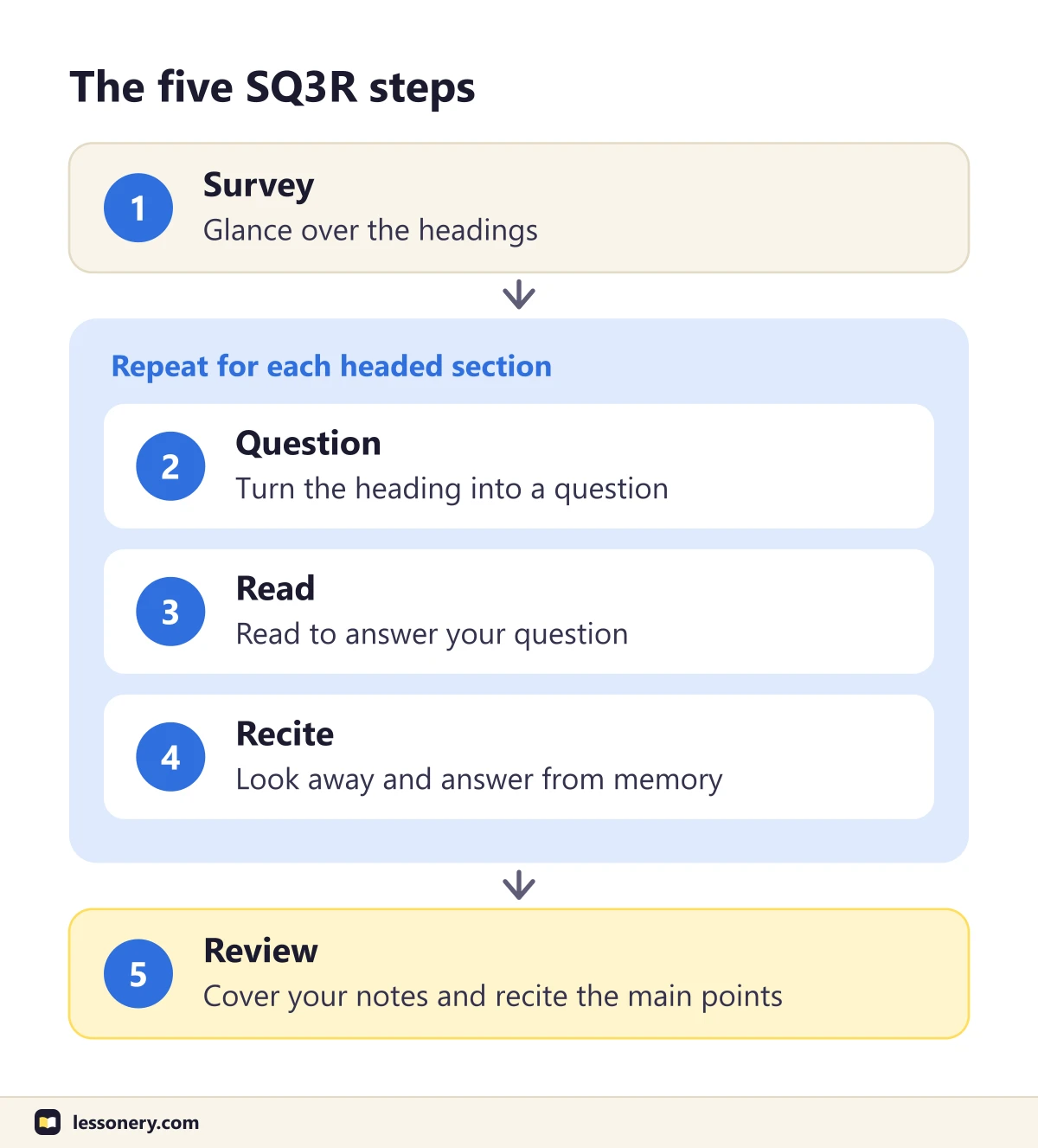
The five steps, as Robinson described them
Robinson's own instructions are short. The table paraphrases them from the 1946 text.
| Step | What you do | Robinson's guidance |
|---|---|---|
| Survey | Glance over the chapter's headings, and the final summary paragraph if there is one | It "should not take more than a minute" and should show the three to six core ideas of the chapter |
| Question | Turn the first heading into a question | It takes a conscious effort, and it gives you something to read for |
| Read | Read to the end of that headed section to answer your question | An active search for the answer, not a passive pass over the lines |
| Recite | Look away from the book and answer the question in your own words, with an example | If you can't, glance over the section again. Then jot down a few cue phrases from memory |
| Review | When the chapter is finished, look over your notes, then cover them and recite the main points | Keep it brief: "probably not more than five minutes" |
After the fourth step, Robinson's instruction is to repeat steps 2, 3 and 4 on each headed section, and to review only when the whole lesson has been read.
His notes are deliberately thin. They are cue words and phrases in outline form, written from memory after reciting and never copied from the page.
University learning centers still teach the sequence. Stanford's Center for Teaching and Learning adds bold and italic text, graphs, diagrams and end-of-chapter questions to the survey, tells you to write your questions down, and reminds you to read for meaning and not only for the answers. It also suggests following the steps in order at first and adapting them once you know the method.
Example: SQ3R on one textbook chapter
The chapter below is made up for illustration. Its facts come from John Dunlosky's article "Strengthening the Student Toolbox" in American Educator, so the sample notes are accurate.
Survey (about one minute). The chapter is called "How Students Study" and has three headings: Rereading, Highlighting and underlining, Practice testing. The summary paragraph says the first two are popular but less useful. That is the core idea to hold on to.
Question, read, recite (once per heading).
| Heading | Question you write | Cue phrases, written from memory after reciting |
|---|---|---|
| Rereading | What does rereading do, and where does it fall short? | Helps later recall. Doesn't always improve understanding. Gains may not last |
| Highlighting and underlining | Why isn't highlighting enough by itself? | No reliable gain over plain reading. Fine as a first step only |
| Practice testing | How does testing yourself help? | Successful recall strengthens memory. A failed attempt shows what to restudy |
Review (about five minutes). Read down the cue phrases once. Then cover the right-hand column and answer all three questions aloud. A question you can't answer sends you back to that one section, not to the whole chapter.
Robinson's five minutes covers the review straight after reading. He adds that later reviews are also worthwhile because of forgetting. The timing of those later reviews, a second pass the next day and another before the test, is this example's suggestion, in line with the research on spaced review described below.
What research says about the full method
Direct evidence for SQ3R as a complete package is limited, and two reviews of it found little support.
- Johns and McNamara (1980) reviewed the research in the Journal of Reading and concluded that "support for SQ3R is based more on opinion than on empirical evidence."
- Graham (1982) reviewed it again in Reading Improvement and concluded that SQ3R "does not appear to be more effective" than traditional study techniques or the methods students use on their own.
- Chastain and Thurber (1989) had students study an introductory psychology textbook. Those who used SQ3R did significantly better on recall and conceptual questions than those who used their own methods.
- McCormick and Cooper (1991) ran three experiments with nine secondary-school students with specific learning disabilities. Even with direct teacher instruction throughout, SQ3R did not produce a strong, reliable effect on literal comprehension.
- Carlston (2011), in Teaching of Psychology, treated completed note packets as the sign that students were applying SQ3R. Students who used the strategies retained more, which showed up as higher exam scores. The paper calls itself a preliminary investigation, and its abstract says earlier research was anecdotal or lacked ecological validity, meaning it did not reflect real course conditions.
These descriptions come from the abstracts in ERIC, the US education research database, and go no further than the abstracts do. Sample sizes are small or not stated there.
Cindy Nebel reached a similar reading in a 2021 article for The Learning Scientists: few people have studied SQ3R and published the results, and the findings are mixed, probably because the method is applied differently from study to study.
Note: "Limited and mixed" is not the same as "shown not to work." It means the five steps as a set have rarely been tested well. The separate steps have been studied far more.
What research says about the separate steps
The steps do not have equal support. Recite and review have the most.
| Step | Closest researched technique | What the evidence says |
|---|---|---|
| Survey | Previewing headings | No modern test of this step by itself was found for this article |
| Question | Prequestions | Helps memory for what the question asked about; mixed results for the rest of a text |
| Read | Reading once | The baseline the other steps are compared with |
| Recite | Retrieval practice | Better recall than rereading or note-taking in two experiments |
| Review | Practice testing, spaced over time | The two techniques rated high utility by Dunlosky et al. (2013) |
Recite
The recite step is retrieval practice: pulling information out of memory instead of looking at it again. McDaniel, Howard and Einstein (2009) tested read-recite-review, the last three steps of SQ3R, in two experiments with college students.
Students who read a passage, recited what they could remember and then read it again were compared with students who reread or took notes. With fact-based passages, the recite group recalled more both immediately and one week later. With longer engineering passages, they beat rereading on multiple-choice and problem-solving questions and matched note-taking, in less study time than note-taking took. For more on this technique, see the active recall method.
Review
A review of ten learning techniques by Dunlosky and colleagues (2013) rated two of them as having high utility: practice testing and distributed practice, which means spreading study over time. It rated rereading as having low utility, mainly because rereading is typically much less effective than other techniques.
That matters for how you review. Robinson's version, covering your notes and reciting, is self-testing. Reading your notes again is rereading. A spaced repetition schedule shows how to spread those reviews out.
Question
The nearest research is on prequestions, which are questions you try to answer before studying. Pan and Carpenter (2023) reviewed it in Educational Psychology Review. Answering questions first reliably improved later memory for the information the questions asked about. For information in a text passage that was not asked about, the review calls the results mixed: several studies found no difference from reading without questions, and a few found a benefit there too.
Those studies used set questions, not headings turned into questions, so they are nearby evidence, not a test of Robinson's step. They fit Stanford's reminder to read the whole section for meaning: a question reliably helps with its own answer, and the rest of the section may get no boost from it.
Where SQ3R goes wrong, and how to fix it
Each mistake below turns a step of the SQ3R method of reading into something weaker than Robinson described.
| Mistake | Fix | Why |
|---|---|---|
| Reciting with the book open | Look away, answer, then check | Robinson's notes are written from memory |
| Copying sentences as notes | Write a few cue phrases in your own words | Copying needs no recall |
| Reading only to find the answer | Read the full section for meaning | The reliable benefit is for what the question asks about (Pan and Carpenter, 2023) |
| Reviewing by rereading notes | Cover the notes and recite | Rereading was rated low; self-testing was rated high |
| Forcing it onto text with no headings | Use read-recite-review alone | The first two steps depend on headings |
The last fix has some backing. For readers who find the full method hard to apply, Nebel suggests dropping the survey and question steps and keeping read-recite-review, which she describes as quick to teach, efficient during study and effective for learning. That is her suggestion, not a tested comparison with the full method.
SQ3R also sits alongside other ways of working with a text. If you prefer to mark the page itself, see how to annotate a text. For reading that still doesn't make sense after a careful pass, see these strategies to improve reading comprehension.
Frequently asked questions
What does SQ3R stand for?
Survey, Question, Read, Recite, Review. The "3R" is the three steps that begin with R. Robinson wrote that he shortened the name to make it easier to remember.
Who created SQ3R?
Francis P. Robinson, a professor of psychology at Ohio State University. It appears as the "Survey Q3R Method" in his 1946 book Effective Study, which revised a book he published in 1941.
Does the SQ3R method of reading work?
Parts of it have good support. Reciting from memory beat rereading in experiments with college students, and practice testing and distributed practice are the two techniques Dunlosky and colleagues rated as high utility. The full five-step method has been tested less often, and two research reviews from the early 1980s found little evidence that it beats other study methods.
How long does SQ3R take?
Robinson gives two figures: the survey should take no more than a minute, and the review at the end probably no more than five. The middle three steps depend on the chapter. In the McDaniel study's second experiment, read-recite-review took less study time than note-taking.
What is the difference between SQ3R and read-recite-review?
Read-recite-review, or 3R, is SQ3R without the survey and question steps. It is the version McDaniel, Howard and Einstein tested in 2009, and it does not depend on a text having headings.